Category: Florida

  • Drought Still a Problem for Florida

    The latest map from the U.S. Drought Monitor shows how dry conditions are in Florida and in parts of southern Alabama and Georgia.

    By Clint Thompson

    Even with much-needed rainfall this week and more expected this weekend, Florida remains in a drought; severe in some cases. The southern portions of the state and along the peninsula will remain drier than normal for the foreseeable future, according to Pam Knox, University of Georgia Cooperative Extension state climatologist, .

    “I’ve been watching the drought in Florida because we’ve had issues along the south border in Georgia. I know things have been worse in Florida. I heard David Zierden (state climatologist for the Florida State University Center for Ocean-Atmospheric Prediction Studies) give a talk about it this week. He thinks it’s probably going to get worse before it gets better,” Knox said. “I have a friend in Miami, and they’ve been setting records for the number of days in the 90s. I don’t see for most of the peninsula of Florida that they’re going to have big relief soon.”

    Much of the central part of the state, including Polk County and Hillsborough County, is classified in a severe drought or ‘D2’ status, according to the U.S. Drought Monitor, The majority of Florida is in ‘D1’ status or classified in a moderate drought.

    “Eventually the rainy season will come, and they’ll get some relief at that point. But in the meantime, it’s going to be pretty hard on producers, especially those who are growing forage or who need fairly moist conditions,” Knox said. “I don’t think there’s going to be short-term relief from the drought in the Florida peninsula.”

    In the northern part of Florida, as far west as Escambia County, across the state to Nassau County, conditions are a little better but still classified as abnormally dry, which is also the case for the southern part of Georgia.

    “It looks like to me the next couple of weeks are going to be fairly wet, not continuously wet, but I think we’re going to get two or three storms that will go through and bring us some rain,” Knox said. “For those areas, I think there will be some relief. But I think farther south in Florida, the front may not get that far and so they may be stuck in the warm and fairly dry air for at least the next couple of weeks until we switch into more of a summertime pattern.”

    The northern parts of Georgia and Alabama remain fairly wet as vegetable producers, especially those in Alabama, try to get their plants in the ground.

    According to the U.S. Drought Monitor, Mobile County and Baldwin County remain in moderate-to-severe drought status along the Gulf Coast.

  • USDA Approves Florida’s State Hemp Program

    commissioner
    Nikki Fried
    Florida Agriculture Commissioner

    Tallahassee, Fla. – Today, the U.S. Department of Agriculture formally approved Florida’s state hemp program, clearing the way for Florida growers to begin cultivating hemp later this month. Agriculture Commissioner Nicole “Nikki” Fried, who will oversee Florida’s state hemp program through the Florida Department of Agriculture and Consumer Services (FDACS), offered the following statement:

    “After months of incorporating feedback from the public, growers, and industry stakeholders, we are thrilled that Florida’s hemp industry officially begins now. I thank the USDA for their swift review and approval of our state hemp program. By working closely with our farmers, processors, retailers, and consumers, Florida’s state hemp program will become a model for the nation, will set a gold standard for this emerging industry, and will create billions in economic opportunity for Florida. As our economy deals with the impacts of COVID-19, this approval will give our agriculture industry a new alternative crop for many years to come.”

    Growing in Florida: With the state hemp program’s rules now filed for adoption and approved by USDA, FDACS will begin accepting applications to grow industrial hemp on April 27, the first day authorized under the state filing timeframe, online at FDACS.gov/Cannabis. More information about growing hemp in Florida may be found here.

    Commissioner Nikki Fried has been a consistent champion of Florida’s emerging hemp industry, appointing in 2019 the state’s first-ever Cannabis Director, hosting five workshops and public hearings across Florida on hemp state rulemaking, and working ahead of USDA to finalize rule development. Earlier this week, FDACS had submitted the state’s hemp program to USDA for review and final approval.

    Florida Department of Agriculture

  • Managing Nematodes in Potatoes

    By Ashley Robinson

    There are a variety of nematodes that damage Florida potatoes. These plant-parasitic nematodes are small, microscopic roundworms that feed on plant tissue, causing severe damage to growers’ crops.

    Pictured are potatoes.

    To combat nematode populations, researchers at the University of Florida Institute of Food and Agricultural Sciences (UF/IFAS) have been testing new nematicide products.

    ONGOING FIELD TRIALS

    Nematicide application is one of the main management strategies available to growers in potato production. Zane Grabau, assistant professor of nematology at UF, is one of the researchers experimenting with new nematicide products at the UF/IFAS Hastings Research Station.

    “Most of our nematode research continues to center on testing new nematicide products.  Growers rely heavily on a few nematicides, so new chemistries are always useful,” Grabau says.

    There are two field trials taking place at the research station, one of which is testing Nimitz, a newer, liquid nematicide that contains the active ingredient fluensulfone. According to Grabau, they have done a lot of work with Nimitz over the past few years.

    “Nimitz is a little bit different as it is a non-fumigant, so it’s put out as a liquid, making it a little bit easier for growers to work with,” Grabau says.

    Over the past three years of working with Nimitz, Grabau’s results showed that the nematicide performed at or near the level of the one most common fumigants, Telone II, for managing sting nematode. It’s one of the most problematic and common nematodes in the area.

    In addition, they’re also experimenting with Majestene, a bionematicide to control nematode populations. Majestene is a certified organic product, formulated of dead bacteria that produce chemicals toxic to nematodes. In terms of application, Majestene is very similar to a chemical nematicide as it is biologically based.

    “Since it’s our first year testing it, we don’t really have any data yet, but we’re hoping to be able to see how it performs. For this year, the way we’re looking at it is as a potential supplement to a fumigation application,” Grabau says.

    ADDITIONAL MANAGEMENT RECOMMENDATIONS

    Although nematicide applications are the most effective way to manage nematodes, there are additional management strategies. Crop rotation of less susceptible crops, cultural and tillage practices, and use of nematode-free seed potatoes are additional strategies for growers to consider on top of nematicide applications.

    “One of the big things we encourage growers to do is to try and practice crop rotation when they can,” Grabau says. “This could either be with cash crops or cover crops. It’s just important that they are considered a poor host for nematodes or not a host at all.”

  • UF Surveys to Identify Impact of Pandemic on Florida’s Agriculture Industry

    By Kirsten Romaguera, kromaguera@ufl.edu

    Florida Strawberry
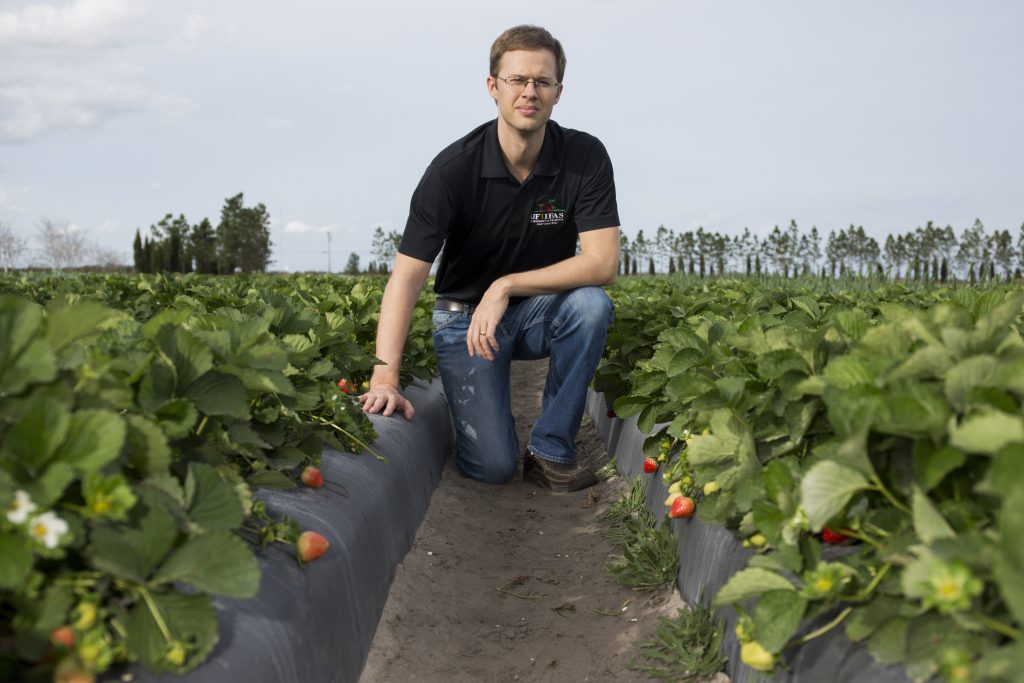
    Vance Whitaker in a strawberry grove at the Gulf Coast Research and Education Center.
    Photo taken on 01-17-17.

    GAINESVILLE, Fla. — With agriculture and marine industries occupying a large portion of Florida’s economy, the University of Florida Institute of Food and Agricultural Sciences (UF/IFAS) wants to better understand how measures to mitigate the spread of COVID-19 are impacting these sectors.

    Starting today, faculty from the UF/IFAS Food and Resource Economics (FRE) department are deploying surveys to UF/IFAS Extension agents and industry professionals to capture this important information.

    “We strongly encourage all businesses in the agriculture and marine sectors to complete the survey,” said Christa Court, director of the Economic Impact Analysis Program, who is leading the effort along with fellow FRE assistant professors John Lai and Andrew Ropicki. “Broad participation from operations throughout the state involved in agricultural production, processing and transportation, as well as marine industries, will result in the most accurate picture of how this crisis is affecting these parts of the state economy.” 

    The Assessment of COVID-19 Impacts on Florida surveys are designed to encompass agricultural production, processing and transportation as well as several marine sectors. The five surveys cover:

    1. Agriculture and aquaculture production, processing and transportation (includes crop production, forestry/timber, nursery and greenhouse operations, agritourism, beekeeping, etc.)
    2. Commercial fishing
    3. Charter/For-hire operations
    4. Seafood wholesale dealers
    5. Marine recreation support businesses

    UF/IFAS faculty are familiar with the challenge of conducting such broad surveys. Similar surveys are typically deployed after weather-related events like hurricanes or winter freezes. In those cases, UF/IFAS Extension agents collect data to report back the situation in their respective areas.

    To capture the wide range of unique and far-reaching impacts caused by COVID-19, faculty have updated the survey instruments, further harmonizing that data collection process.

    The Assessment of COVID-19 Impacts on Florida surveys include background information about the business (operations, revenues, employment, and market channels); current status (open or closed, business changes if open, or reasons for closure if closed); impacts (change in revenues, employment, customer base, products/services offered); willingness to participate in potential follow up or similar surveys related to COVID-19 or other disasters. 

    The first round of surveys is scheduled to close May 15, although Court said there will likely be follow-up surveys conducted as the COVID-19 situation continues to develop.

    The surveys can be accessed at these links:

    Previous analyses for similar event impacts can be found at the Economic Impact Analysis Program website: fred.ifas.ufl.edu/economicimpactanalysis/

  • UF/IFAS Extension Agent Emeritus Defends Florida Farmers

    By Clint Thompson

    Gene McAvoy

    Already a difficult production season for Florida’s fruit and vegetable producers, some are unjustly being criticized for trying to manipulate the market and get government handouts, says Gene McAvoy, UF/IFAS Extension agent emeritus.

    He defended growers and their farming operations amid scrutiny about criticism for not being more gracious with their crop.

    “It is a very complex and tragic situation.  It is easy to make suggestions without a thorough understanding of the matter,” McAvoy said. “What many people fail to realize is that picking, packing, cooling, storing and transporting vegetables costs money, and growers who have already lost millions of dollars are understandably reluctant to throw good money after bad.”

    Many farmers have had to disk their produce in the field because markets have dried up due to the ongoing coronavirus pandemic. McAvoy said the collapse of the food service sector affects 60% to 80% of fresh vegetables produced in Florida.

    “Not only can’t they afford to harvest the crop, they can’t afford to maintain it irrigate, fertilize, and spray for pest and diseases. Without these inputs, crops rapidly deteriorate and become a breeding ground for insects and diseases and threaten the small percentage of nearby crops for which a market remains,” McAvoy said. “Destruction of the crop prevents this from happening and protects the remaining fields.

    McAvoy pointed out that many farmers have donated to local food banks and Meals on Wheels programs. They have been overwhelmed with demand due to a rise in unemployment. Here are a few examples:

    • Over the past few weeks, Wish Farms in Hillsborough County, Florida has donated 220,000 pounds of fresh strawberries — equivalent to 241 pallets/nine semi-trailer loads — to feeding Tampa Bay and the United Food Bank in Plant City, Florida.
    • Growers in Immokalee, Florida donated more than 3 million pounds of vegetables to the Harry Chapin Food Bank of Southwest Florida, “overwhelming their ability to store, transport and distribute the produce,” McAvoy said.
    • Farm Share, a food-distribution non-profit organization, works with more than 2,000 food pantries, churches, schools and other nonprofits throughout Florida. The agency is running at maximum capacity, despite having 25 refrigerated trucks, six warehouses between 10,000 and 35,000 square feet and nearly 50 drop-sites from Jacksonville to Florida City, Florida.
    • Pacific Tomato Growers recently donated 42,000 pounds of tomatoes to Meals on Wheels PLUS of Manatee, helping supply 100 food pantries and agencies,
    • DiMare Farms donated 400,000 pounds of tomatoes to Florida food banks
    • U.S. Sugar provided more than 120,000 servings of fresh, locally-grown green beans to South Florida churches, healthcare providers and food banks. 
    • RC Hatton has been a generous donor of green beans, sweet corn, and other crops to Feeding South Florida

    “Very few people comprehend the quantities of food we are dealing with, this time of year at the peak of harvest. Growers in South Florida collectively ship 50 to 60 million pounds of vegetables across the country,” McAvoy said. “With the closure of hotels, restaurants, schools and cruise ships, sales have declined as much as 80%.”

    Vegetables like tomatoes, cucumbers and squash are highly perishable with a shelf life of only 7 to 10 days under ideal conditions. Heading into the fourth week of this crisis, much of what was in the field is ruined.

    “Farmers work hard to grow this food, putting in a lot of time, money and sweat equity. Nothing breaks their hearts more than to see their efforts go to waste,” McAvoy said. “If people really want to help, they can help in the recovery effort through cash donations to food banks so that they can finance efforts to recover this food before it spoils.”

  • Why Are the Grocery Store Shelves Empty?

    coronavirus
    Courtesy: Sharkshock/Sutterstock.com

    By Gopinath (Gopi) Munisamy for UGA CAES News

    While all industries have been seriously affected by the COVID-19 pandemic, food and agriculture have been among the hardest hit segments of the U.S. economy. The primary reason lies in the composition of household food expenditures.

    The impacts of the pandemic appear to vary by commodity based on two critical issues: perishability and labor use. Perishables like fruits, vegetables and milk are among the hardest hit. Many of these industries also depend on labor for growing and harvesting.

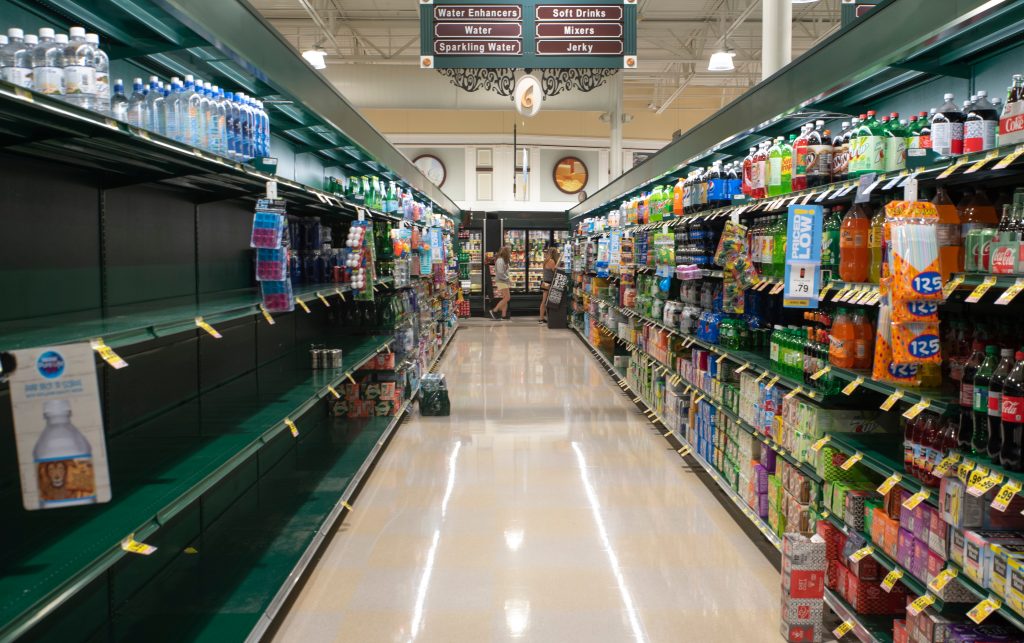
    There is no immediate shortage of food in the U.S., according to the U.S. Department of Agriculture (USDA). However, the current demand for items such as grocery-size products and on-demand delivery is greater than what is in abundant supply – bulk, large-sized products and processed shipments to restaurants that remain open.

    This demand-supply mismatch appears to mimic anecdotal evidence of price spikes and empty store shelves on the consumer side and the collapse of demand and dumping of food on the farm side, with a range of linked effects in the middle.

    Wholesale food demand reduced, supply chain shifts

    Households spent $1.7 trillion on food in 2018, 54% of which was spent on food away from the home at restaurants, bars, sports venues and other establishments, according to the USDA Economic Research Service. A dramatic drop in foot traffic at all types of restaurants began in the second week of March.

    Supermarkets and grocery outlets have also experienced a significant reduction in foot traffic. But delivery and on-demand services have been strained by the sudden surge in demand from people under stay-at-home orders and social distancing guidelines, which includes nearly 90% of the U.S. population.

    With the drastic fall in food demand away from home, multiple forces were unleashed rapidly, causing ripples that stretched farther into every food and agricultural commodity.

    First, the supply chain serving food service industries did not have many buyers. A case in point is cheese, where the major supplier, Wisconsin, found two-thirds of its demand fall to near zero within a week or two.

    Second, social distancing guidelines and shuttered non-essential businesses affected supply chains serving both food services and retail grocers.

    The results include a significant slowdown in the operations of processing and distribution, shortage of workers at farm, processing and distribution (trucking) facilities, and a shortage of cleaning and sanitizing supplies. Compounding these effects are the resources spent in contact tracing and quarantine if and when a worker tested positive for COVID-19.

    Third, is the urgent need to transition products run through food services into those that consumers need at the grocery store. For example, restaurants usually buy diced vegetables, like onions, in 60-pound bags, but consumers at grocery stores usually buy 3- to 5-pound bags of unpeeled onions. Also, large cheese blocks sold to food services, which generally have sizable storage space, cannot be chopped overnight into packs of ounces and pounds to sell at grocery stores.

    (The author is a professor of agricultural and applied economics in the University of Georgia’s College of Agricultural and Environmental Sciences. Chen Zhen, associate professor in the department of agricultural and applied economics, contributed to this story.)

    To read the rest of the story, see UGA CAES Newswire.

  • Facts of the Flow: Lake Okeechobee, 2020 Year-to-Date

    (SFWMD) — Here is the latest update on inflows into Lake Okeechobee for the calendar year to date. This data is provided by SFWMD’s DBHYDRO database.

    lake okeechobee

    There has been no back-pumping into Lake Okeechobee from the Everglades Agricultural Area this year.

    Source: South Florida Water Management District

  • UF/IFAS Extension Veteran: Farmers Give to Food Banks in Time of COVID-19

    University of Florida: A woman shopping for food at a food pantry.

    By: Brad Buck, bradbuck@ufl.edu

    With the COVID-19 shutdowns increasing people’s need for food, some consumers rely on nonprofits for a bite to eat. To help, farmers in Florida and elsewhere are donating excess produce to food banks, said a UF/IFAS expert.

    In fact, some food banks are helping farmers by offsetting some of their costs, thus incentivizing growers to harvest food they can’t sell, said Gene McAvoy, a UF/IFAS Extension agent emeritus.

    “There is no shortage of food, but the majority of vegetables grown in Florida are targeted at the food service industry — hotels, restaurants, schools, cruise ships, etc.,” said McAvoy.

    Food service represents 60% to 80% of normal demand for Florida-grown vegetables. 

    “When this source of customers dried up, growers were faced with a huge oversupply for the remaining retail demand,” said McAvoy. “With no market, it makes little business sense to harvest because that adds expenses like picking, packing and storing, on top of what farmers have already invested in the crop.

    “Growers feel bad when the crops they have worked so hard to grow go to waste, and they’re interested in helping feed hungry Americans,” McAvoy added. “But they also need help to be able to do so.”

    McAvoy, UF/IFAS Extension agent emeritus for Hendry County and a regional vegetable Extension specialist for Southwest Florida, said he has received multiple calls and emails from farmers wishing to donate and from food banks and facilities, who are looking for food.

    He gives several examples of farms that are giving to food banks. Here are four:

    • Over the past few weeks, Wish Farms in Hillsborough County has donated 220,000 pounds of fresh strawberries — equivalent to 241 pallets/nine semi-trailer loads — to Feeding Tampa Bay and the United Food Bank in Plant City.
    • Nearly two weeks ago, growers in Immokalee donated more than 3 million pounds of vegetables to the Harry Chapin Food Bank of Southwest Florida, “overwhelming their ability to store, transport and distribute the produce. They had to call a halt,” said McAvoy.
    • Farm Share, a food-distribution nonprofit, works with more than 2,000 food pantries, churches, schools and other nonprofits throughout Florida. The agency is running at maximum capacity, despite having 25 refrigerated trucks, six warehouses between 10,000 and 35,000 square feet and nearly 50 drop sites from Jacksonville to Florida City.
    • U.S. Sugar provided more than 120,000 servings of fresh, locally grown green beans to South Florida churches, healthcare providers and food banks. 

    “Farmers work hard to grow this food, putting in a lot of time, money and sweat equity, and nothing breaks their hearts more than to see their efforts go to waste,” McAvoy said. “Unfortunately, it costs money to pick, pack and transport produce for which there is currently no market. People can help in the recovery effort by donating to food banks so that they can finance efforts to recover this food before is spoils.”

  • Whiteflies Already a Problem for Florida Farmers

    This file picture shows whiteflies on a squash leaf.

    By Clint Thompson

    Between the coronavirus pandemic and decreased demand for their product, Florida’s vegetable farmers have had their share of challenges this past month. Add whiteflies to the list.

    According to the South Florida Vegetable Pest and Disease Hotline, the Immokalee, Florida area in South Florida has seen hundreds of acres abandoned. This is due to irregular ripening and high incidences of tomato yellow leaf curl virus disease (TLCVD).

    There’s been some reports of 50% to 80% of the disease being seen in several vegetable fields. According to Gene McAvoy, University of Florida/IFAS Regional Vegetable Extension Agent IV Emeritus and President of the National Association of County Agricultural Agents, whiteflies have been problematic in tomatoes, watermelons and other cucurbits.

    “We’ve had a number of growers destroy substantial amount of acreage, even before this whole COVID-19 thing blew up. We’ve had a lot of irregular ripening because of high levels of whiteflies. Most of our growers are using a resistant (tomato) variety so that’s not an issue in the round tomatoes. But especially with the Romas that have no resistance, they’re getting tore up,” McAvoy said.

    According to the South Florida Vegetable Pest and Disease Hotline, farmers have pulled up entire first plantings due to very high incidence of TYLCV.

    The whiteflies’ impact on tomatoes is felt across Central Florida and on the East Coast where pressure is higher in older tomatoes. Whiteflies are also problematic in cucumber and pepper and are increasing in melons.

    High incidences of whiteflies may be attributed to the mild winter. While colder temperatures don’t eliminate whiteflies, they do kill many of their wild hosts and slow population development in cultivated hosts. Warmer temperatures allow for larger whitefly populations to overwinter and become mobile earlier.

    “Down here our strategy is to try to have clean fallow in the summer and not have anything for them. We usually start off pretty low but if we have a warm, mild winter like we’ve had the past couple of years where they start building in the fall, they just continue going this time of year. They basically become unmanageable,” McAvoy said.

  • Pecan Farmers Need to Watch out for Budmoths

    By Clint Thompson

    Budbreak in pecan trees is under way in orchards across the Southeast, and farmers need to be wary of one particular pest – budmoths.

    Budmoths were a nuisance last year on pecan trees and have already showed signs of infesting young trees during the first week in April.

    A bag of shelled pecans in this file photo.

    University of Georgia Cooperative Extension pecan entomologist Angelita Acebes offered tips on her blog on how to identify a budmoth and what management options are available at this point in the growing season.

    Pecan growers can recognize budmoth damage by the webbing around newly-developed leaves and small dark spots on the tips of those leaves.

    During the spring, adult moths start laying eggs and can lay eggs in about six days. Unfortunately, the young larvae will feed on the leaves. Then they spin a web to roll the leaves where they’ll bore into the shoot. Once in the shoot, an insecticide will be ineffective because it can’t reach them.

    Whether to spray your trees at budbreak is a question that can go either way. Spraying at budbreak is an option since there’s a small window to effectively apply an insecticide. If farmers have time to scout, treating when the infestation is first noticed is also an option.

    When considering what insecticide to apply, worm materials are more ideal if you can catch budmoth outbreaks early. If budmoth damage is severe and the initial outbreak was missed, Lorsban is the only option for quick control.

    For more information, see Acebes’ blog.