A national coalition of 64 organizations representing specialty crop producers sent a letter to Congressional leadership this week on safety protocols within the industry during COVID-19. They want Congress to know the steps agricultural employers are taking to protect their workers.
“Farmers and ranchers across the country moved quickly to implement new employee safety protocols early in the crisis,” says National Council of Agricultural Employers President Michael Marsh. “While America was being placed on lockdown, agricultural employers were already at work trying to figure out how to best protect their employees and the public.”
The letter details the collaboration between the agriculture industry, public health experts, and regulatory officials to develop the best safety practices in the field and packing. As future rounds of COVID-19 pandemic legislation is debated, the coalition is asking congressional leaders to acknowledge the widespread employee protection protocols that are already in place, as well as provide additional support to help agricultural employers continue to meet the needs of their employees.
The Western Growers Association, a member of the coalition, is asking Congress to “extend current relief efforts for agriculture, and to include additional funding for personal protective equipment and other measures to offset the costs of maintaining an essential workforce during COVID-19.”
(From the NationalAssociation of Farm Broadcasters)
Photo courtesy of UF/IFAS. Shows a Florida finger lime.
LAKE ALFRED, Fla. — Sweet oranges. Ruby red grapefruit. Sugar Belle mandarins. When one thinks of Florida citrus, these fruits immediately come to mind.
But finger limes?
A University of Florida Institute of Food and Agricultural Sciences researcher believes that finger limes maybe the next food trend that will continue to fortify Florida’s role as a citrus producer for the world.
Manjul Dutt, a research scientist with the UF/IFAS Citrus Research and Education Center, has received funding to explore how finger limes could be grown and marketed by Florida citrus growers.
It is a project that brings both opportunity and the potential to diversify the Florida citrus portfolio.
Finger limes are an oblong, finger-shaped fruit about 4 inches long with red, pink or green-yellow pulp filled with tangy juice. They are a culinary delicacy used as garnishes for sushi, vegetables, salads and pasta. Finger limes grow mostly in Australia, California and Hawaii. Dutt believes Florida’s climate, agricultural expertise and soils are perfect to develop an emerging agricultural enterprise.
“An added benefit is that finger limes have the potential to tolerate Huanglongbing (HLB), use less fertilizer and require less pesticide than other forms of citrus,” said Dutt.
What is HLB?
HLB is the cause of the deadly citrus greening disease that has impacted most groves across Florida.
In the project, scientists will plant several finger lime plots across the state at UF/IFAS and stakeholder facilities to measure how successful the plants are in different conditions. Researchers will also assess the best production methods to grow finger lime under Florida conditions.
UF/IFAS citrus breeders will help with the research. They will evaluate the fruit’s tolerance to HLB, which will include sequencing the finger lime’s DNA to identify disease-resistance genes. This in turn may provide insights to enhance existing research underway to breed a citrus-greening resistant tree.
Researchers will also look at market opportunities for finger limes in Florida and potential for distribution both in institutional and consumer markets. Tasting sessions will evaluate if consumers find the finger limes flavorful, appealing to taste and smell, and whether it looks good on a grocery shelf.
Research History
Dutt has been studying finger limes since 2012 and established a finger lime trial in 2017 with funding support from the Florida Department of Agriculture and Consumer Services’ Specialty Crop Block Grant Program. That pilot study attracted the interests of several citrus and specialty crop growers who are enthusiastic about the project.
“We are excited about the possibility that a new citrus variety might be available to Florida growers,” said Anna Jameson of Brite Leaf Citrus Nursery.
“We envision a steady growth of the market and there has been increased demand for this crop in the last few years,” Dutt said. “The UF/IFAS citrus breeding program has some improved cultivars that are potentially superior to currently available varieties.”
The current 18-month project is funded by the UF/IFAS Support for Emerging Enterprise Development Integration Teams (SEEDIT) program. The program is designed to fund integrated research, Extension and economics faculty team science to alleviate barriers in developing emerging enterprises for the state of Florida.
Given the issues Florida agriculture faces, the time is right for us to take a scientific and systematic approach in developing more options for profitable and sustainable industries in the state. Dutt has also received financial support from the UF/IFAS Plant Breeding Graduate Initiative to fully support a doctoral student who will be researching the HLB tolerance characteristics of the finger limes.
Paul Allen’s point of emphasis has been clear recently: Support the American farmer. He believes the message has been received loud and clear.
“We’re thinking all of the local and national attention we’ve gotten about us destroying our crops has brought the American public to the forefront to supporting the American farmer. I really believe that,” said Allen, president of R.C. Hatton Farms in Belle Glade, Florida and chairman of the Florida Fruit and Vegetable Association. “The American people have heard everything that’s been on the national media all about Mexico. They’ve stopped buying Mexican produce. They’re buying American produce. It’s a big part of it.”
He thinks that is a reason watermelons are in short supply and there could be a major shortage by Memorial Day weekend. It also could be attributed to strong demand for tomatoes with prices improving.
“It’s everything. It’s sweet corn, watermelons; people are buying. It’s not that we’re short. People are buying and supporting us,” Allen said. “There’s a lot of product being moved. And in a lot of cases restaurants are starting to open back up. People are starting to get out. It’s a big part of it.
“Thankfully, it looks like the American people are going to have their say in it. They’ve heard our cry because there’s been a hard run on national media, local media about this whole thing.”
Tough Start to Season
Unfortunately, it was not always this way this season. In a previous interview in early April, Allen said he left about 2 million pounds of green beans in the field and about 5 million pounds of cabbage. All because of the coronavirus pandemic that shut restaurants down and closed off a major supply chain to foodservice industries.
“We had a devastating March and April for all crops. When the country was shut down, it was the worst we’ve ever seen it,” Allen said. “When the pandemic hit, there was a buying frenzy for a week to 10 days. Then everybody went lockdown. When we farm, we plant, cultivate, grow, harvest and ship every day for it to be consumed every day. When (the pandemic) hit us, we were the sacrificial lamb.”
Allen believes more financial aid could still be provided by the federal government.
“The biggest thing right now is the government allocated per crop a cap of $125,000, which is nothing. We’re really working trying to get the USDA to see and understand the massive hit that Florida is taken and raise the direct payment caps,” Allen said. “What is fair is not always equal.
“It costs 10 times to grow vegetable crops what it does regular commodity crops.”
Florida’s peach season has come and gone. David Wheeler, peach farmer in Lake Placid, Florida, said his season started early and finished earlier. From a marketing standpoint, that was as good as he could have hoped for.
Peach season is underway in Georgia and Alabama.
“The marketing window, that was very good this year, yes,” Wheeler said.
Wheeler produces 120 acres of peach trees and had success this year selling retail.
“Walmart was very supportive of the Florida peach program. That really helped us. They took a lot of our volume,” Wheeler said. “They were very good to us.”
In a previous interview, Wheeler confirmed that the high temperatures in March spurred the peaches to ripen earlier than normal. With hot and dry conditions felt throughout the state the past in March and April, peach season closed sooner than normal.
Since Wheeler’s harvesting window closed sooner than normal, he didn’t have to compete against growers in Georgia or Alabama for marketing supremacy. Both states have just now started harvesting their peach crop. Wheeler didn’t have to compete for the market against larger-scale operations. The result was a good year despite a decrease in production.
“I think overall (it went) pretty well. Production was down about 25% but we had a very heavy crop last year so that’s not a big surprise,” Wheeler said. “The fruit quality was outstanding. The best way I have to judge that is when I take peaches to friends; everybody raved about them this year. I know they were a good quality peach. Overall, I would say (it was) a good season, even though production was down and packouts were down.”
Primarily a citrus grower, Wheeler, a peach farmer for nine years, began producing peaches when citrus greening disease became problematic in Florida and has since wiped out a bulk of citrus production in the state. He mainly produces a pair of varieties, UF Best and the UF Sun. Wheeler says he has had the most success producing UF Sun.
Florida’s hot and dry weather this winter and spring has impacted its tropical fruits, according to Jonathan Crane, University of Florida tropical fruit crop specialist. From lychees to avocados and mangos, none were immune to high temperatures over the past few months.
Lychees
Lychee requires exposure to cooler temperatures. If they don’t get much of that, they don’t bloom very well.
“The fact that we’ve had very warm winter; November, December and January, this has affected the natural bloom for lychee. They don’t flower much when that happens, when it’s too warm for too long. The fruit set on that is down, not everywhere, but I’m talking about in South Dade, mostly,” Crane said. “North of us, some of the other counties, Martin, Palm Beach and others, they get more cool weather. So, they’re probably okay, I’m not sure. Certainly, in Dade County, it’s been too warm of a winter to have good fruit set for lychee.”
Avocados and Mangos
As for mangos and avocados, they require a period when they’re not growing or are just dormant.
Avocados
“For some of our avocados, the bloom and fruit set was affected by the very high temperatures; the dry climate, low humidity, lack of rainfall even if you were irrigating. This has affected some of the fruit set on some of the early varieties of avocados,” Crane said. “It is not everywhere and in not all varieties and not in all locations but on some of them. There was some effect on the avocado bloom.
“(For mangos) it looked like we were going to have a good bloom but it’s been sort of spotty. We sort of had two or three smaller blooms. Most of what I see out there didn’t set all that well. Not exactly sure what’s going on with that because usually they set pretty well. This year, the set hasn’t been as good as previous years, and I suspect again it’s because of the warm weather. They do require a period of no growth in order to flower. If we stay warm, then what happens is the flowers are mixed in with leaves and it’s generally not as good.”
High Winds
Mangos
Crane also attributes high winds to a low fruit set.
“Another thing that happens is if it’s very hot and dry, especially if it’s windy … just the banging of the flowers into the leaves and stems knocks the flower buds off and knocks the small fruit off,” Crane said.
Crane said lychees will be harvested beginning in June. Avocados and mangos will begin to be harvested at the end of May.
Figure 1. The pepper weevil is one of the most serious pests of peppers.
By Clint Thompson
Florida produce growers need to be wary of the pepper weevil, which is running rampant in the state’s vegetable fields.
According to the South Florida Vegetable Pest and Disease Hotline, pepper weevils are out of control on the East Coast in Florida vegetable fields. Growers are also seeing damage increasing in eggplant.
Damage is so extreme in remaining peppers that growers are having to terminate many of their plantings.
In addition, South Florida farmers are reporting that the Cuban pepper weevil is a problem.
University of Georgia entomologist David Riley said that 70% of the winter peppers imported into the U.S. are grown in Mexico, where pepper weevils originate. He stresses that even a small percentage of weevil-infested fruit can lead to an infestation.
Thresholds are one adult per 400 terminal buds or 1% of the buds infested. Populations are best observed by visual examination and yellow sticky traps.
Insecticides are commonly applied to the plant foliage at short intervals once budding begins.Chemical suppression is feasible, but insecticides vary in effectiveness. Despite the presence of chemical insecticides some loss is inevitable. Actara, Vydate, diamides and pyrethroids can be used in a program to control the pepper weevil. Consult the University of Florida/Institute of Food and Agricultural Sciences recommendations for currently labeled insecticides for proper control in Florida.
There are a couple of factors for farmers to consider if they hope to disrupt the weevil’s life cycle. Proper sanitation and a crop-free period, if it’s accompanied by the destruction of alternate hosts can be effective. Sanitation involves any practice that eliminates or reduces the amount of pathogen inoculum, pests, or weed seeds that are still present in the field.
Watermelons are already in short supply. There soon could be a watermelon shortage, said Carr Hussey, a watermelon farmer in Florida and Alabama and chairman of the board of the Florida Watermelon Association.
“It’s drying up by the minute. There’s going to be shortage for Memorial Day, I do believe,” Hussey said. “The kicker is, how fast can North Florida come in? Right now, today’s it’s 91 degrees here right now. North Florida can’t be too far behind. A few days like that will bring them ahead a little bit.
“I can tell you this weekend, South Central Florida is going to be done. When I say done, there will be a few loads come. But they’re going to be done with any volume shipping. I think in my mind the bigger part of next week is going to be a shortage. They won’t be out completely, but there will be a shortage. It’ll drive the price up pretty good.”
Hussey farms between 500 and 600 acres in the Southeast under Sweet Mama Produce. His Florida crop is done, though he’s helping other farmers in Lake Placid and Wauchula, Florida. Hussey also has about 300 acres in Cottonwood, Alabama. He expects to be shipping the last week of the May.
Positive Prices for Producers
He said prices are around 20 cents per pound right now but could improve to 22 or 24 cents around Memorial Day weekend. He said the reason Florida is running out of melons is due to three straight weekends of rain events. Heavy rains on mature vines led to a quick harvest season.
“It’s going to be short supply next week, I don’t know what it’s going to be like after that. I don’t know how fast they’ll come on (elsewhere) and with what kind of volume,” Hussey said. “I understand that Georgia’s late. That’s what I’m hearing. There’s going to be a small gap next week and it could be another gap going into the fourth of July if Georgia’s late.”
Another reason there could be a watermelon shortage is due to an extreme low supply in Mexico. They’ve had poor weather conditions in Mexico.
“Their quality’s all shot to pieces right now,” Hussey said.
The watermelon supply chain is currently down. As a result, prices are up. It’s a pleasant surprise for Florida growers who are currently harvesting this year’s crop, according to Gene McAvoy, University of Florida/Institute of Food and Agricultural Sciences Extension agent emeritus.
The watermelon supply line is currently decreased, due in large part to less imports from Mexico.
“(The farmers) were a little bit apprehensive that with all of this COVID-related decline in demand that there might not be a demand for the (watermelon) product. They’ve had poor weather growing conditions in Mexico, so supplies are down from that side,” McAvoy said. “Even here in Florida, we had a really hot and dry March and April which affected pollination. The fruit set is less than what we would consider to be normal.”
Other Florida produce farmers have struggled with selling this spring’s crop amid the coronavirus pandemic. The pandemic has shut down the country since the second week in March. The resulting shutdown led to closures of restaurants across the U.S.
Positive Prices
But as businesses begin to open up and states begin loosening the restrictions on self-quarantining, demand for fresh fruits and vegetables is improving. The same appears to be true for watermelons.
“The supply is down a bit, kind of lining up with demand. Prices are good. They’re getting 20 cents, 19 cents per pound, which is decent for starting out the season. Sometimes it’s a little higher. But things are moving,” McAvoy said.
The bulk of Florida is still harvesting or nearing harvest of watermelons. McAvoy said farmers in the extreme South Florida area, around Immokalee, Florida, are done harvesting this year’s crop. He added that watermelon harvests are continuing in Glades County, Charlotte County, Desoto County and up into Hillsborough.
Georgia and Alabama should start picking in early-to-mid June.
Vegetable farmers are reminded they need to practice proper sanitation once harvest season ends. Doing so will protect against future pests and diseases.
According to the South Florida Vegetable Pest and Disease Hotline, one of the best tactics that growers can do for themselves and their neighbors is to clean up crop residues promptly after harvest. Sanitation involves any practice that eliminates or reduces the amount of pathogen inoculum, pests, or weed seeds that are still present in the field.
One of the biggest problems associated with lack of sanitation is with whiteflies. They overwinter and can survive on multiple hosts. This is especially true for those hosts that are not eliminated thoroughly after harvest. They are already a problem for Georgia vegetable farmers.
If farmers will destroy tomato vines promptly, they will kill off whitefly populations. They’ll also eliminate the transmission of the tomato yellow leaf curl (TYLCV) and other viruses to subsequent crops. It also will eliminate inoculum from late blight and other fungal diseases. This is particularly important in the case of TYLCV and other viruses. Sanitation, a crop-free period, and whitefly/thrips control are the only tools currently available for the management of this disease.
Downy and powdery mildew on melons can spread via wind from older, diseased plants to plants in surrounding fields that are still maturing. If farmers will plow or disk under infected plant debris, this will help cover up the inoculum and speed up the disintegration of plant tissue. It kills the pathogen.
Cull Piles
Cull piles should also not be neglected. Several scouts have reported over the past few years that they have found both insects and diseases such as TYLCV, late blight, whiteflies and others in volunteer plants springing up around cull piles.
Soil tillage can destroy insects and expose them to birds and other predators. It can also speed the breakdown of plant residues that harbor insects and plant pathogens. By either allowing the organic matter in a field to decompose completely before planting the next crop or allowing a fallow period between crops, you can enhance the control of numerous insects and diseases.
Powdery mildew disease is present on older squash in various vegetable fields across South Florida. According to the South Florida Vegetable Pest and Disease Hotline, respondents report that the disease has also started to show up on watermelon crops across the region as well.
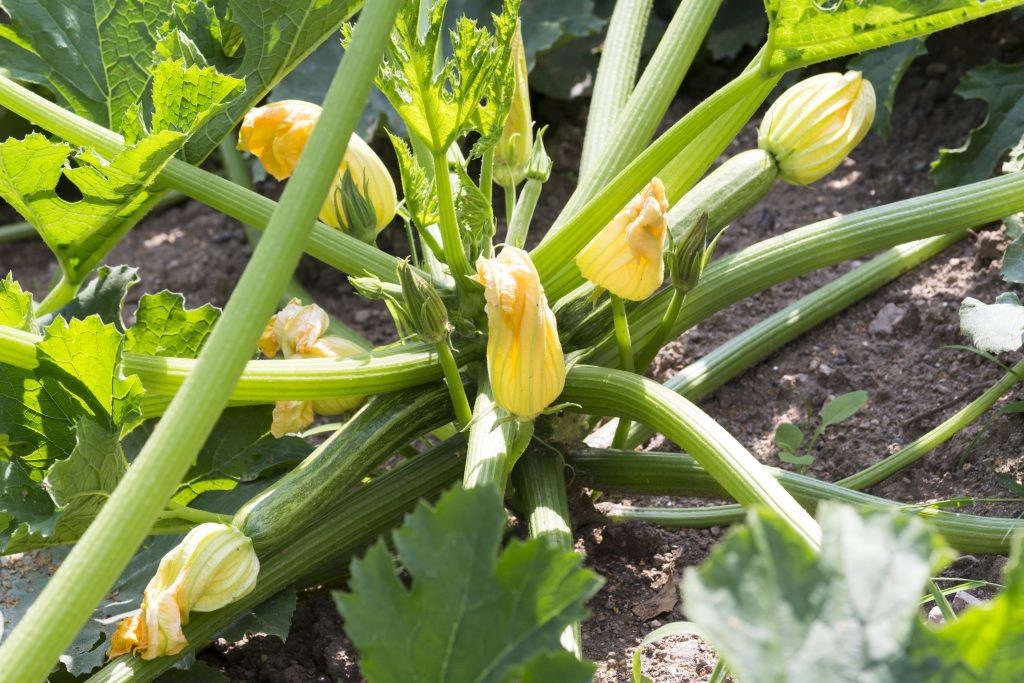
File photo shows squash growing on a plant. Powdery mildew disease is present on some squash plants in South Florida.
It’s also reported that powdery mildew is showing up on squash and cantaloupe in the Manatee Ruskin area.
The disease thrives in high humidity, making the Southeast region a prime target for powdery mildew. Places in Georgia, Florida and Alabama are especially vulnerable the next two weeks. Temperatures in Tifton, Georgia are expected to go back up into the 80s this week and 90s next week. And there’s little to no chance of rainfall. It’s the same forecast for Mobile, Alabama, whose best chance of rain is a 40% chance on Monday, May 18 and Saturday, May 23. Temperatures in Tampa, Florida are going to be in the high 80s the next two weeks.
The disease can develop rapidly under these favorable conditions.
Disease Symptoms
Symptoms on watermelon plants appear as yellow blotches on the oldest leaves first. If the disease is left untreated, the fungus spreads to the entire leaf. These blotches become bronzed and turn dark brown or purplish as the disease progresses during the season. Eventually the leaf dies and has a crisp texture.
Powdery mildew normally appears in the middle of the production season. Preventive treatments can help maximize the crop’s yield potential and prevent plant damage. Growers need to scout fields regularly to know if the disease is a factor in their fields.
There are some vegetables that can tolerate or are resistant to the disease. Most commercial cucumber varieties grown in Florida have acceptable levels of resistance.
Podosphaera xanthii and Erysiphe cichoracerarum, are the two pathogens that cause powdery mildew disease on cucurbits, particularly cucumbers, year-round. P. xanthii is an aggressive pathogen that attacks during warmer months. E. cichiracearum strikes during cool spring and early summer.