Category: Florida

  • New UF/IFAS Economist Comes ‘Home,’ Looks to Help Harness Resources

    By: Brad Buck, bradbuck@ufl.edu

    IMMOKALEE, Fla. — Kim Morgan is coming home, in a manner of speaking.

    Morgan graduated from the University of Florida three times. Mostly recently, she began her position as an associate professor of food and resources economics for the UF/IFAS Southwest Florida Research and Education Center in Immokalee. For now, due to CDC stay-at-home guidelines, Morgan is working for UF/IFAS, albeit from her home in Virginia.

    Morgan comes to the Immokalee center after earning tenure at Virginia Tech as an assistant and recently, associate professor of agricultural and applied economics. Before that, she worked as an assistant professor at Mississippi State.

    Kim Morgan

    Kelly Morgan (no relation), director of the Southwest Florida REC, is pleased to have Kim Morgan as a new faculty member, saying, “She has years of experience in agribusiness and marketing at two respected universities in the Southeast.”

    As the newest member of the SWFREC faculty, Kim Morgan looks forward to investigating issues brought to the attention of scientists at UF/IFAS and partner agencies by agribusiness owners.

    “People drive my research and Extension programs,” Morgan said. “Specialty crops are my primary commodity of interest, and I want to look into how changing consumer preferences along with government regulations and policies may influence grower decisions to adopt new production practices.”

    She also wants to help farmers use marketing techniques to reduce the costs of navigating the food supply chain directly to consumers.

    Not only did Morgan earn degrees from the UF/IFAS animal sciences and food and resource economics departments, she worked as an analyst with the department’s Florida Agricultural Market Research Center. There, she helped find solutions to production, marketing, financial and human risks unique to the agricultural sector.

    Now, she’s helping growers in the fertile agricultural area of Southwest Florida.

    “SWFREC is located in one of the most unique environments in the country — right in the middle of larger-scale agricultural operations led by stewards of the natural resources that make it possible to produce a wide range of commodities while surrounded by an ever-growing population,” Morgan said. “As an economist, I see it as the most exciting place in the world to study how people, companies and policymakers make decisions that impact local customers and retailers, contribute to global food-supply chains and address the intersection of agricultural, environmental, and residential resource uses.”

  • Blueberry Farmer Adjusts During COVID-19, Finds Success

    File photo shows blueberries piled up.

    By Clint Thompson

    COVID-19 struck in the middle of Denton Chapman’s U-pick blueberry season in Osceola County, Florida. Chapman had to pivot his business’ strategy on the fly and move strictly to a pre-pick operation.

    The customers responded favorably.

    “The pandemic started right when we were in the middle of our U-pick so we had to adjust,” said Chapman, with Double C Bar Ranch. “We chose to stop our U-pick. A lot of customers, they wanted to be out here, they wanted to get out. The best part about what we did, we went to a pre-pick operation where we pre-packaged and we did a drive-thru.

    “It took us by surprise how many people wanted to get out and enjoy just getting some fresh air. They stayed in their cars and we did the pre-picking and delivered fruit right to their window. People they loved it.”

    Chapman’s willingness to adjust during a time of uncertainty paid dividends for his business and possibly provided a blueprint for success next growing season.

    “That was memorable for us. The joy of people when they came out, just to get some fresh berries picked that morning delivered right to their window was priceless for us,” Chapman said. “Anyone who’s about to start their U-pick operation, just plan well, plan your flow and your social distancing. People will get out. People want to get out and get to the farm, so you’ll be successful.”

    Tips For U-Pick

    Chapman offers tips to those blueberry producers who want to implement a U-pick element in their farming operation next year.

    Marketing and advertising are key. The power of social media is the easiest, cheapest and quickest form of advertising.

    Focus on the atmosphere of the farm. There needs to be plenty of shade and seating and entertainment for the kids.

    Be willing to sell additional products. While the customers may be there primarily to pick blueberries, they may want to purchase additional products as well. Blueberry jam/jelly, drinks, snacks are easy things to have on sale in your gift shop.

  • Florida Blueberry Farmer: USMCA Not a Good Deal For Vegetable, Specialty Crop Producers

    By Clint Thompson

    One of the most vocal critics of Mexican imports into the U.S. is adamant that the United States-Mexico-Canada Agreement will not help or protect vegetable or specialty crop producers.

    Blueberries are a popular commodity in the U.S. but also as an import from Mexico.

    “No, that’s not a good deal for specialty crops. They didn’t really address our issues at all. That was not a good deal for us,” said Ryan Atwood, blueberry farmer, who lives in Mount Dora, Florida, and is one of the state’s blueberry leaders. He farms 56 acres of blueberries, manages another 350 acres and is part-owner of the largest packing house in the Southeast United States.

    USMCA Background

    According to the USMCA, the agreement, once it enters into force on July 1, will support mutually beneficial trade leading to freer markets, fairer trade and robust economic growth in North America. But critics of the agreement will point to lack of protection for specialty crop farmers who already have to compete against imports of Mexican produce. U.S. Secretary of Agriculture Sonny Perdue even acknowledged concerns by specialty crop growers.

    The idea of fair trade seems more like a fantasy than reality for growers in the Southeast who, not only had to overcome the coronavirus pandemic this year but had to compete against the constant influx of Mexican imports.  

    “They don’t have the regulations we have. They don’t have to abide by the same rules. Their labor is definitely cheaper. They pay somebody $12 per day. I’ve got to pay them $12 an hour to get labor. It’s hard to compete with that. It’s real hard to compete with that,” Atwood said.

    Domestic Supply of Food

    Atwood commented in late April that he was “a fan of having our own domestic supply of food.” Agricultural imports from Mexico may be cheaper, but they’re not American grown. Atwood and Florida vegetable farmer Sam Accursio continue to preach the importance of supporting the American farmer.

    “I think it’s a security issue for our country,” Atwood said in late April. “We’ve got to grow our own food. You saw what happened 10 or 12 years ago when we used to import all that oil and then we got our own domestic supply going again. Other countries are going to be able to control you if they control your food supply.”

    Accursio added, “If you take Florida and California away in the winter, what do you have? You have third-world countries feeding this great nation, and I’m not going to eat it. I’m not going to do it.”

  • Potential Second Wave of Pandemic Could Impact Vegetable, Specialty Crop Producers

    By Clint Thompson

    The coronavirus pandemic struck in mid-March during harvest season for vegetable and specialty crop growers in the Southeast. Many fear a second wave of COVID-19 could strike again in October and November when temperatures start to drop. It is also when many producers have their fall crop in the ground.

    “The specialty crops would be where maybe we might see some shifts in market expectations and whether or not there’s concerns about continued disruptions in the supply chains,” said Adam Rabinowitz, University of Georgia Cooperative Extension agricultural economist.  “The big question mark there is going to be having an alternative supply chain for distribution that’s available if in fact they are reliant on institutional buyers, where if we see another round of restaurants closing and that type of disruption. That was I think the big surprise this first time; how impactful that was, and we really hadn’t seen anything like that in the past.”

    Silver Linings

    One of the silver linings in an otherwise dark time for growers was finding alternative ways to sell their product. Tifton, Georgia farmer Bill Brim thought Inside the Box when he decided to sell boxed produce straight to consumers for several weeks in April, May and June. Customers lined up the roads waiting to buy local and support a farmer who felt the pinch of a lack of a foodservice market.

    Florida vegetable farmer Sam Accursio also thought creatively in a way to provide produce to customers at a cheaper-than-normal rate in late March and early April.

    “One morning I woke up at 3 o’clock in the morning on a Monday after no sales all weekend with coolers full and I said, ‘What are we going to do?’ I talked to my nucleus about this. The upcoming weekend, we put it on social media that the prices we were going to sell produce for. The consumers were excited because they didn’t have money, I had a cooler full of produce that I already picked and packed. The companies that donate produce, they were filling up. We had nowhere to go with this stuff, so we just put a low price. Consumers came and ate it up,” Accursio said. “We worked our tails off; I think it was for about five hours just steady loading cars from 5:30 in the morning on. I think the first day it was 40,000 pounds, the whole trailer load of produce was sold; one box here, seven boxes there.

    “The first day, the line was two hours long. The consumers, what they told me when they finally got up there and I’m apologizing, they said, ‘Listen, we’re all at home. We have nothing better to do.’”

    Same Thing in the Fall

    Accursio said he sold about 60,000 pounds of produce the same way the following weekend. At 50 cents per pound, consumers received a great deal to support a local farmer.

    “I couldn’t let the consumers down because they helped us out of a super jam. We kept on doing it on a smaller basis with the strictly local people coming then. When we had the big sales going on, we had people driving two or three hours to come here. We had shipments, trailer loads going to Key West from here. It was an amazing thing to watch,” said Accursio, who says he will continue this type of marketing in the fall.

    “I never really thought about selling directly to consumers but now we are gearing up for October to continue this.”

    Rabinowitz added, “Having those type of distribution options available can be very significant as not just a fallback strategy but also just as a means to increase sales on a regular basis.”

  • NOFA Deadline for CFAP is Today

    By Clint Thompson

    Today, June 22, is the last day for growers and industry leaders to submit information and data to the USDA Farm Service Agency (FSA) about crops to be considered for inclusion in the Coronavirus Food Assistance Program (CFAP).

    There is a Notice of Funding Availability (NOFA) where stakeholders and producers of other commodities can submit information and data for consideration to be included in the program. These must be submitted by today. This is specifically for data on any commodity not currently eligible for CFAP.

    Not all commodities were covered under CFAP, which provides financial assistance to producers who have suffered a 5%-or-greater price decline or who had losses due to market supply chain disruptions due to COVID-19 and face additional significant market costs.

    CFAP applications will be accepted through Aug. 28. Producers should apply through the FSA at their local USDA Service Center.

    According to Charles Hall, executive director of the Georgia Fruit and Vegetable Association, Georgia farmers are looking to add several commodities to the list covered under CFAP. These include kale, mustard, collards, turnips and specialty lettuce.

  • Red Node Disease in Beans a Potential Problem

    File photo shows green beans.

    By Clint Thompson

    Red Node Disease, aka Tobacco Streak Virus, was discovered in beans in a Florida vegetable field this spring. It’s vectored by thrips and could potentially be a problem for farmers this fall, according to Prissy Fletcher, University of Florida/IFAS Agricultural Extension agent for St. Johns County, Florida.

    “I have been here 14 months and since I have been here, we had never seen this disease. Speaking with some of my predecessors, this has not been an issue that we have seen before. It’s a new situation for us,” Fletcher said. “Even though the virus was first identified in Homestead, Florida in 2014, we weren’t aware of this issue in beans up here. But after doing a literature review and knowing it had been in South Florida, looking back, it was just a matter of time before we found it here. This is definitely a new situation for us locally that we’re going to attack as a team and get a good IPM plan.”

    Thrips Need to be Contained

    Thrips vector the disease and are the key in farmers managing it successfully. They are tiny insects that can feed on various hosts while spreading different diseases. Thrips in peanuts can lead to tomato spotted wilt virus. Onion thrips or western flower thrips are the pests that vector Red Node Disease in beans. But they can also feed on squash, cotton and different weed species.

    “A lot of this is going to boil down to communication, communicating with your neighbors, other folks who are growing crops that can be affected by thrips, which is just about everything. A good IPM program for thrips is going to be pretty crucial,” Fletcher said. “Just the importance of communicating with your neighbors about disease spreading, pest management and working together as a system because if your neighbor has that problem, you’re likely to be impacted by that as well.”

    Fletcher said the impact on beans can be devastating. Symptoms include reddening of the stem, nodes and leaf veins. Infected pods show patterns of necrotic red patches. The spread of the disease can make the pods fall off, shrivel up or not even produce the beans themselves.

    “It could be pretty bad for that farmer if that disease spreads,” Fletcher said. “Prevention is going to be key.”

    Fletcher said farmers will begin planting their fall crop in September and early October.

    “The production of beans in this area is increasing, which is pretty exciting. Seeing more farmers diversifying and taking on more of these alternative crops. It’s pretty cool stuff. Then we find this disease and it’s like, ‘Oh my goodness. Okay, we’ve got to figure this out before next season.’ So prevention, prevention, prevention,” Fletcher said.

  • Facts of the Flow: Lake Okeechobee, 2020 Year-to-Date

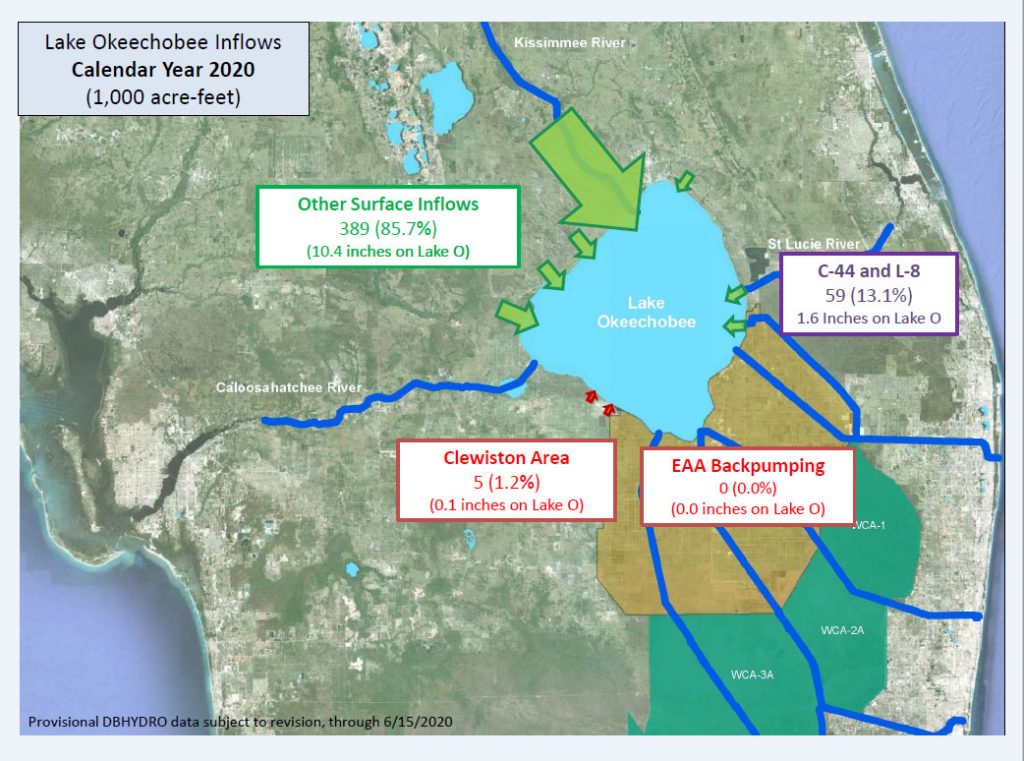
    (SFWMD) — Here is the latest update on inflows into Lake Okeechobee for the calendar year to date. This data is provided by SFWMD’s DBHYDRO database.

    lake okeechobee

    There has been no back-pumping into Lake Okeechobee from the Everglades Agricultural Area this year.

    Source: South Florida Water Management District

  • Start Work Now on Worker Protection for Next Season

    state department
    Worker safety is important for all farms to keep in mind.

    Paul Allen, chairman of the Florida Fruit and Vegetable Association, encourages farmers to prepare now for next growing season with respect to worker safety.

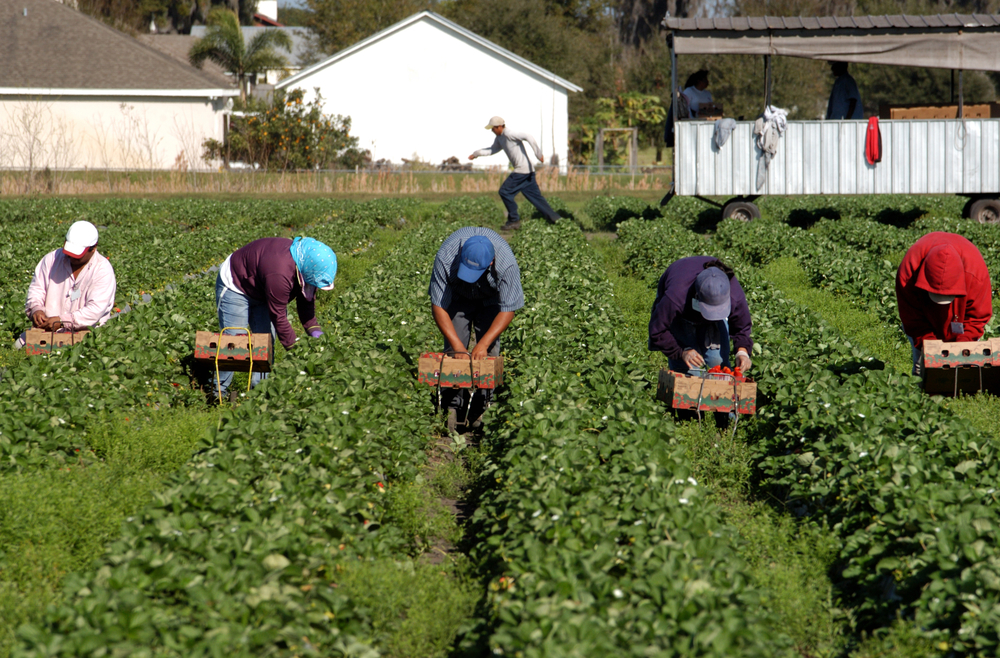
    FFVA strongly urges every grower and farm labor contractor to implement these measures to the utmost of your ability. Download the checklist, review it, print it out and begin working now to designate a workplace coordinator responsible for COVID-19 assessment and control. Growers who work with a farm labor contractor should require that these measures are followed. I plan to make this a priority for my operations and you should, too.

    In addition, your county health departments and emergency management offices are prepared to help with testing, sanitizing supplies and PPE. We’ve included a list of each county’s health department contact information in the packet for your convenience.

    FFVA also is discussing the development of training videos and materials with some industry partners to serve as additional tools and resources. The association continues to be in almost daily contact with state agriculture and public health officials and stands ready to help you in any way it can.

    This is not optional. If we can’t reduce the spread of COVID-19, we may not have a workforce to harvest our crops next season. Our grower/shipper community must be united on the importance of worker safety during COVID-19. If even one employer or farm labor contractor fails to meet his or her responsibility, the entire industry feels the impact.

    Thank you in advance for doing your part.

    Sincerely,

    Paul Allen
    FFVA Chair

  • Pecan Tree Dieback Scary But Normal For Growers

    UGA Extension photo/Shows leaf scorching on a pecan tree.

    By Clint Thompson

    Leaf scorching and dieback on some young pecan trees is common this year with high temperatures, according to Lenny Wells, University of Georgia Cooperative Extension pecan specialist. But Wells assures growers the problem can be corrected.

    “We see that this time of year pretty much every year; young trees where they’re growing so fast that the root system can’t keep up with what the top is trying to produce. This time of year, it turns off hot and soil temperatures warm up some,” Wells said. “Water demand goes up and those young trees with the root system not fully developed yet have a hard time keeping up. They tend to grow out of it. It’s a scary thing for growers to see. But they do tend to grow out of it fine.

    “Anytime you have a tree like that, that’s struggling and you start seeing some shoots dying back and stuff like that, it’s a sign that’s something’s going on in the root system. If you prune back some of that top and bring the top of that tree back more in line with what the root system can support, that usually is a big help to it.”

    Wells cautions growers to maintain consistent soil moisture or apply water every other day. The longer irrigation is applied, the deeper the water runs. This allows the root system to develop deeper through the soil profile. This also prevents the soil from getting too hot. Soil temperatures that exceed 95 degrees F inhibit root growth.

    In the UGA Extension pecan blog, Wells also said that growers will get more vigor and healthy first-year growth if they plant before March.

  • UF Professor Earns Award From UF/IFAS Extension Peers

    Davie Kadyampakeni using a soil moisture meter in a lab. Photo taken 11-28-17.

    By: Ruth Borger, 517-803-7631, rborger@ufl.edu

    LAKE ALFRED, Fla. — Water is essential to Florida farmers. They scrutinize the amount available, its quality and when and how they should use it to grow crops, feed animals and sustain their livelihood.

    University of Florida soil and water sciences assistant professor Davie Kadyampakeni works tirelessly with Florida citrus growers to ensure that they have access to the most current research in water use and soil nutrient management to promote good environmental stewardship and crop production efficiency. 

    Kadyampakeni, working at the UF Institute of Food and Agricultural Sciences Citrus Research and Education Center in Lake Alfred, combines a research portfolio with a UF/IFAS Extension appointment to bring the latest information to growers. His work has been so effective that he is being recognized by his colleagues with the 2020 Outstanding Extension Specialist award.

    Kadyampakeni’s Extension philosophy is to address the immediate and long-term needs of citrus growers (and growers of other horticultural crops such as peach and blueberries) in Florida by establishing himself as a “go-to” researcher with information provided as needed. The majority of Florida citrus is grown in sandy soil, and growers need thoughtful nutrient and water management strategies to be successful. Educational activities to achieve his goals in Extension include talks, publications, phone calls and demonstrations. His Extension program takes a three-pronged approach by focusing on:

    • Irrigation management of citrus for increased production efficiency, and nutrient management for citrus for environmental sustainability and nutrient use efficiency.
    • Best management practices; and
    • Capacity building and Extension talks. These activities include research publications, conference presentations, workshops, field days and individuals’ consultations.

    “Dr. Kadyampakeni deserves this award because of his relentless drive to get information to growers,” said Juanita Popenoe, a UF/IFAS multi-county commercial fruit production agent and the person who nominated him.  “He is focused on promoting optimal irrigation and nutrient application rates for citrus affected with huanglongbing (HLB), something that is absolutely needed.”

    Over his time with UF/IFAS, Kadyampakeni has processed over 5,000 samples and analyzed for pH or nutrient content and reached out to more than 1,200 participants in workshops.

    Nationally, he is the past chair for the American Society of Agronomy (ASA) Sensor-based Water Management Community and organized a symposium on “Optimizing efficiency with sensors for irrigation scheduling and water management” at the ASA Annual Meeting in November 2019. Davie was also the 2019 Leader for the W4128 Multistate Project: Microirrigation: A sustainable technology for crop intensification and improved water productivity, with participants from more than 20 Universities in the US and several USDA scientists. He was chair and moderator of a symposium at the 2019 ASA-CSSA-SSSA meetings. He is current Chair for the Citrus Working Group for the American Society of Horticultural Science (ASHS) and chairs the 2020 panel for selecting the International Horticulturalist of the year. He is also the organizer of the Citrus ASHS Workshop on “Novel Practices for Sustaining Citrus Production in the Era of Citrus Greening (Huanglongbing)” scheduled for August 2020 in Orlando, Florida with invited speakers from across the US at the ASHS annual conference. He is also the 2020 Citrus Section Vice President for the Florida State Horticultural Society.