Category: Florida

  • Florida Farmers Overcome COVID-19 Impacts

    UF photo/More than 70% of Florida’s large farms sell to the service industry which includes theme parks, hotels, restaurants and cruise lines. When COVID-19 brought the tourism industry to a crashing halt this spring, farmers around the state quickly pivoted to sell the bounty of fruit and vegetables that were at peak harvest.
     

    By: Tory Moore, 352-273-3566, torymoore@ufl.edu

    More than 70% of Florida’s large farms sell to the service industry which includes theme parks, hotels, restaurants and cruise lines. When COVID-19 brought the tourism industry to a crashing halt this spring, farmers around the state quickly pivoted to sell the bounty of fruit and vegetables that were at peak harvest.

    In a recently published journal, Catherine Campbell, a UF/IFAS assistant professor and community food systems specialist and Gene McAvoy, a UF/IFAS Emeritus Extension agent specializing in stakeholder relations and vegetable crops, describe the impact COVID-19 had on these farms and how they overcame these impacts with partners around the state.

    Florida farms took losses that are hard to comprehend. One grower plowed under 2 million pounds of green beans and 5 million pounds of cabbage because there was nowhere to send the produce before it spoiled. Another farm dumped 100,000 pounds of tomatoes in one week. There are many more examples of losses like this or larger from around the state.

    “I don’t think people know how large Florida’s agriculture industry is and that COVID-19 hit these growers at the worst possible time,” Campbell said. “It was our peak harvest season, and the market fell out. Florida supplies most of the produce east of the Mississippi River in the spring and it all just stopped. It was bad for everyone, but producers in other parts of the country were at planting time, not harvest time. For our producers, they had already reached the maximum investment on those crops – paid to plant, maintain (spray, irrigate, fertilize, etc.) and in many cases they already harvested crops – then they couldn’t sell them.”

    While the losses were huge, farmers and industry organizations put their heads together to quickly find a home for fresh fruit and vegetables around the state that were on the cusp of waste.

    The University of Florida, industry groups, and state and regional organizations such as the Florida Department of Agriculture and Consumer Services and the Florida Farm Bureau Federation developed a variety of programs and resources to connect Florida growers to buyers.

    “The vegetable industry has always been very volatile with rapid changes in price and demand, even in normal years, in addition to challenges imposed by weather, pests and diseases,” McAvoy said. “In many ways they are used to making changes in how they operate. The growers made rapid course changes and sought alternative markets out of necessity.”

    Retailers around the state committed to purchasing more Florida and U.S.-grown produce, which was large in part to consumer demand generated from public awareness of the issues Florida farms faced.

    Direct-to-consumer sales were another mode farmers utilized. By promoting through partner organizations and social media, farmers marketed their produce directly to their local communities. One packing house in Homestead opened on weekends for consumer sales and sold more than 120,000 pounds of vegetables. While this was still far less produce than what would normally be sold to traditional markets, it helped consumers and growers alike.

    “The losses were heartbreaking,” Campbell said. “This event was a ‘cue to action’ to develop support systems that make it possible for producers to make these kinds of changes in market channels. For some growers, they are just too large to be able to exclusively sell direct-to-consumer, but it can help mitigate events like COVID-19. Their profits were probably not even close to breaking even, but at least it’s a help.”

    Despite substantial losses, producers harvested and transport produce to food banks and other hunger-relief organizations to meet the increased demand from those in the community who recently lost their jobs or were furloughed. One sugar producer donated 42,500 pounds of sugar to a rum distillery to make hand sanitizer for donation to first responders, hospitals, nursing homes and essential food supply employees.

    “We were building the plane while we were flying it,” Campbell said. “These programs can help producers, large and small, find buyers when their traditional supply chain breaks down. The hope is that this strategy will provide a foundation to support food system resilience in the event of future public health emergencies and natural disasters. It can also help move product instead of it going to waste. If we know where there is food and where people need it, we can mobilize it and get it to those in need.”

    For many Florida growers, summer is the off-season, but growers plan to plant for the spring as they normally would each year, McAvoy said.

    “Markets have rebounded nicely since May and acreage will likely be back to normal,” he said. “Many growers plan to continue direct sales to local consumers in addition to their wholesale channels that have reopened. With some markets still down, such as cruise lines, buyers and brokers are looking for ways to continue to diversify their sales.”

    To support Florida farmers year-round, buy seasonal Florida-grown produce at your local retailer and when available, purchase directly from farmers in your area.

  • Coming Soon: White Strawberries From the Wild

    By Seonghee Lee and Vance M. Whitaker

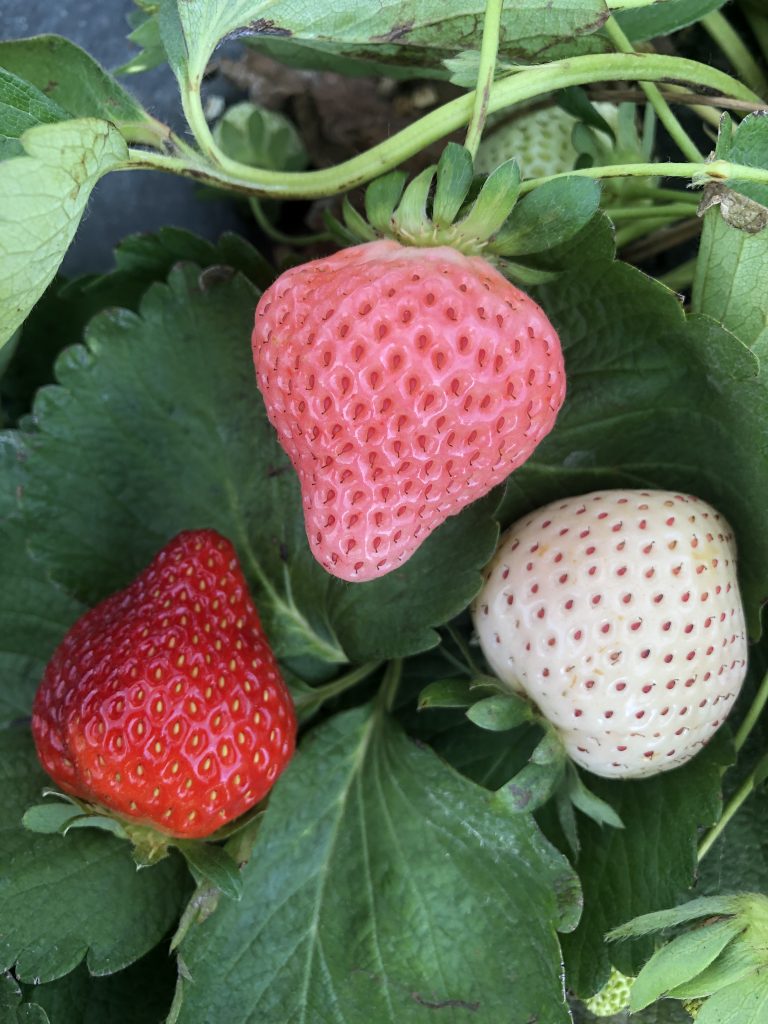
    Figure 1. A new University of Florida strawberry variety is white with a slight pink blush and red seeds when fully ripe. Photo credit: Cristina Carrizosa, UF/IFAS Communications

    The University of Florida will soon commercialize a new strawberry variety. It doesn’t have a name yet, but it is already drawing attention for a very unusual characteristic. When it is ripe and ready to eat, it is white inside and out, with a slight pink blush on the exterior and red seeds. The flavor is very different from a typical strawberry, sweet but with a pineapple-like aroma. White strawberries have been popular for some time in Japan, but this is expected to be the first white strawberry on the market in the United States.

    These unusual strawberries were not made in a lab. White strawberries are actually found in nature. Breeders have harnessed this naturally occurring trait, crossing white strawberries from the wild with modern strawberries to create something different in both appearance and taste.

    WHY IT’S WHITE

    The red color of the typical strawberry comes from pigments called anthocyanins. White strawberries produce much lower amounts of these compounds in their flesh than red strawberries. Recent research has shown that white strawberries of various types all have DNA sequence changes in a single gene called MYB10, which is involved in the synthesis of anthocyanins. These changes keep the gene from carrying out its normal function, essentially halting the chemical process in the fruit that produces red pigments.

    HOW IT WAS DEVELOPED

    In 2012, some strawberry seeds from fruit purchased in Japan were brought to the University of Florida. The seeds were sown, and a few small plants were recovered. The pollen from these plants were crossed with a Florida variety. The seedlings from this cross produced fruit that ranged from white to pink to red.

    Further crosses with Florida varieties were made, ultimately resulting in a strawberry with similar hardiness and fruit characteristics to modern varieties but with white color. Commercial trials have been promising so far. Pickers can tell when the fruit is ripe when a slight pink blush develops on the sun-side of the fruit, and when most of the seeds turn red. By 2022, these new white strawberries should be available in U.S. grocery stores.

    Figure 2. Florida strawberry varieties can be red, pink or white.
    Photo credit: Seonghee Lee
    STRAWBERRY SPECIES

    There are many different species of strawberry throughout the world, and white strawberries are naturally found within several of them.  

    Alpine Strawberry (Fragaria vesca)
    Alpine strawberries are in the species F. vesca, which is an ancient ancestor of the modern strawberry. In Europe, this strawberry is referred to as “fraises des bois” and is prized among food connoisseurs for its aroma. While most members of the species have red fruits about the size of a fingernail, the fruits of some Alpine strawberries are yellow to white in color. More information is available from the University of Florida at edis.ifas.ufl.edu/hs1326 on how to grow Alpine strawberries.

    Beach Strawberry (F. chiloensis)
    The beach strawberry is found in the wild along the Pacific coasts of North and South America. F. chiloensis is one of the most recent ancestors of the modern strawberry. Some of the beach strawberries found in South America are naturally white or pink. The fruit only grow about as large as a thumbnail and are very soft compared to modern strawberries. Some varieties of this species that are crossed between F. chiloensis and the modern strawberry (F. × ananassa) have been called “pineberries.” Some varieties of pineberries are available for home gardeners, but they are not large enough or firm enough to be produced and sold on a large scale.  

    Cultivated Strawberry (F. × ananassa)
    A white beach strawberry from Chile and another wild species from North America called F. virginiana with bright red fruits were collected by explorers and brought to Europe about 300 years ago. There they accidentally hybridized to produce the cultivated strawberry or “modern” strawberry, F. × ananassa, that we know today. Almost all the strawberries currently grown and produced in the United States are F. × ananassa. White cultivated strawberries have been bred for some time in Japan and sold at high prices as novelty items. However, white strawberries have not yet caught on as much in other areas of the world.

    See programs.ifas.ufl.edu/plant-breeding/strawberry for more information on University of Florida strawberry breeding and genetics.

  • Pre-Harvest Sugarcane Burns Necessary and Safe

    Photo via U.S. Sugar, shows pre-harvest cane burn.

    The use of pre-harvest burns is necessary for Florida sugarcane farmers and does not endanger the surrounding communities. That is the message members of the U.S. Sugar company are conveying to alleviate any concerns people or special interest groups may have.

    Pre-harvest burns promote healthy plant regrowth for future crops and improves the quality and efficiency of the harvest. Sugarcane stalks have high moisture content but contain dry leaves on the outside, like corn stalks. The burn removes those leaves from the sugarcane stalk, making it safe for the workers as they can see where they are going in the field.

    Sugarcane is harvested, taken to a railhead, and then transported to the mill by train. Without the burn, much of the leaves and dry material would stay on the sugarcane, which means that the transports carry more leaf-trash. This results in transport inefficiency.

    Also, much of the leaf and dry material is left in the field, creating a “leaf-trash blanket.” In a dry year, this could spark a wildfire. It could also increase rodent and insect pressure, which could damage the subsequent regrowth of the next sugarcane crop.

    Ryan Duffy, director of corporate communications for U.S. Sugar, says specialty interest groups who argue against pre-harvest burns do not present all the facts when making their argument.

    “They have selectively chosen a piece of the research and said you can get the same yield if you don’t burn the cane versus cane that’s burnt. What that misses is that if you leave all of that leaf trash on the field, it will impact the next year’s crop, and there may not be the same yield next year,” Duffy said.

    Burn Permits

    Duffy and Judy Sanchez, senior director for corporate communications and public affairs at U.S. Sugar, reassure Florida residents that all controlled pre-harvest burns are regulated by the Florida Forest Service. Every controlled pre-harvest burn requires an individual burn permit for each field, which will only be issued for that day. The Florida Forest Service grants or denies the permit based upon that day’s weather conditions.

    Certain criteria must be met for a sugarcane grower to be approved for a burn permit. These include wind direction and speed, atmospheric conditions and location relative to sensitive areas like hospitals, schools and highways.

    “For (special interest groups) to say that some communities are protected and some are not, that permit protects everyone every day. Based on wind speed and wind direction and location, that permit will not be given if any of those sensitive areas would be impacted by issuing that permit on that day,” Sanchez said.

    She added that farmers do not apply for permits near schools during the school week.

    University of Florida Study

    According to a research study by the University of Florida in 2013, harvesting without burning can have negative consequences to subsequent sugarcane crops. It found that due to excess vegetation left on the fields with sugarcane that was not burned, young shoots that emerged from green cane harvest fields may suffer frost damage and delayed growth when temperatures are near or below freezing.

    Leftover plant matter can also reduce available soil nitrogen to the crop.

    “When we burn it in the field, our nutrients, like potassium and phosphorus are going to remain in the ash and stay in the field. That’s what we want to put it back in for anyway for the nutritional value of it,” University of Florida Extension agent Stewart Swanson. “We (also) cultivate our fields to keep the weeds out in the row middles. You get that trash layer in there and the equipment just balls it up and bundles it up, so it makes it really hard to cultivate, which is an important weed control practice.”

  • Trialing and Developing Blackberries for Florida

    Blackberries are grown as a commercial crop in North Carolina.

    By Zhanao Deng

    Blackberry has emerged as an alternative crop in Florida. More and more Florida growers are growing or trialing blackberries for commercial production. They have indicated a dire need for suitable blackberry cultivars that can yield well and produce berries of good quality.

    PAST CULTIVARS AND RESEARCH

    In the 1950s, University of Florida (UF) released two blackberry cultivars, Flordagrand and Oklawaha. Both produced high yields of large, attractive berries, but their trailing growth habit and thorny canes made them unsuitable for commercial production.

    The University of Arkansas has maintained an active blackberry breeding program for more than five decades and has released dozens of new cultivars. Essentially all the blackberry cultivars currently grown in Florida and other Southeast states are from this breeding program.

    Some of the popular floricane-fruiting cultivars include Apache, Navaho, Natchez, Osage and Ouachita. They produce berries on second-year canes (floricanes). In 2005, the program released the first primocane-fruiting cultivars that can produce berries on the current-year canes (primocanes) as well as floricanes. Prime-Ark® 45, Prime-Ark® Freedom and Prime-Ark® Traveler have this new type of fruiting habit.

    Flowers are pollinated for blackberry breeding.

    With funding from the Florida Department of Agriculture and Consumer Services Specialty Crop Block Grant program, UF researchers began trialing these cultivars in 2017 in a blackberry orchard at the Gulf Coast Research and Education Center (GCREC). Prior to this, Shinsuke Agehara trialed Navaho, Natchez and Ouachita in wooden boxes and large containers. In his trials, Natchez outperformed Ouachita and Navaho. In the orchard trial, Osage had the highest yield among the five floricane-fruiting cultivars, with an average of 3.9 pounds of berries per plant. Among the three primocane-fruiting cultivars, Prime-Ark® Freedom had the highest yield, producing an average of 6.3 pounds of berries per plant.

    Researchers used in-row spacing of 3 feet and between-row spacing of 10 feet in the trials. With this spacing, 1,452 plants could be grown per acre. The estimated per-acre yield would be 5,663 pounds for Osage and 9,148 pounds for PrimeArk® Freedom. Natchez showed significant variability in berry yield from year to year or site to site.

    CURRENT CULTIVARS

    In recent years, the University of Arkansas blackberry breeding program has released two new floricane-fruiting cultivars, Caddo and Ponca. Based on release documents, both cultivars are high yielding, thornless, erect and produce medium to large fruit. Ponca is the sweetest cultivar released to date and has good shipping and handling traits. Both cultivars have been introduced to Florida, and a new trial is being set at GCREC to test their performance. Stay tuned for trial data in the next two years. 

    In small trials conducted in Arkansas, these cultivars had the potential to produce 10,000 to more than 20,000 pounds of berries an acre. Why do these cultivars yield much less in Florida? Researchers think the primary reason is that chilling requirements were not met in Florida, especially in Central Florida. Very much like blueberries, blackberries need a period of chilling (temperature below 45° F) to break sufficient numbers of buds and develop enough flowers so that growers can have a decent crop.

    The current blackberry cultivars grown in Florida were bred and initially selected in Arkansas, and they need 300 to 900 hours of chilling. On average, Central Florida only has about 100 to 300 hours of chilling. Without enough chilling, blackberry plants break much fewer buds, have much fewer fruiting laterals and flowers, and yield poorly with berries ripening over an extended period.        

    BUILDING A BREEDING PROGRAM

    UF trials and growers’ experiences indicate a strong need for new blackberry cultivars that are better adapted to a low-chill environment. This need prompted UF researchers to breed blackberries. The breeding program received private funding and technical support from Coastal Varieties Management. The GCREC and the UF Institute of Food and Agricultural Sciences (IFAS) Dean for Research Office provided funding to cover expenses associated with facilities.

    In spring 2015, UF researchers made the first batch of crosses to produce blackberry seeds. Newly produced seeds were treated with a strong acid to burn part of the seed coat and then they were kept cold for several months before they were germinated. The seedlings were then grown and selected in Florida. Researchers repeated this process each year since then.

    So far, more than 10,000 blackberry seedlings or young plants have been screened in Florida. Dozens of plants were selected for further trials. Shoot tips have been collected from some of the most promising plants and cultured in test tubes for rapid propagation. The first batch of tissue culture-propagated blackberry young plants from one of the selected lines was sent to growers this past June for trialing.

    Blackberry cultivar trials are underway at the Gulf Coast Research and Education Center in Wimauma, Florida.

    In the meantime, researchers have set up the first replicated trials to test the new line’s berry yield and quality. Effort is being made to expand the blackberry orchard and produce additional liners for more field trials, which is warranted to select the best adapted cultivars for Florida growers.

    As more Florida growers begin growing blackberries, they have more questions needing practical solutions. To better address growers’ needs, a UF/IFAS research and Extension team has been formed. It consists of six specialists from the GCREC and the Horticultural Sciences Department and two Extension faculty from Orange, Marion and Hillsborough counties. Team members are well experienced with berry breeding; variety selection and trials; plant management and manipulation; fertilization; disease, insect pest, nematode and weed identification and control, etc. The team has received great support from Florida growers and some seed funding from the UF/IFAS Support for Emerging Enterprise Development Integration Teams program and the GCREC.

    UF plans to produce the first blackberry production and spray guide by early 2022 and provide growers and Extension agents with more training. The goal of the team and these efforts is to facilitate the development of the Florida blackberry industry and help growers produce profitable crops sustainably.

  • H-2A Process Should Be Smoother Next Season

    The H-2A application process had its challenges this spring in getting the farm workers needed from Mexico to Florida and Georgia. Veronica Nigh, economist with American Farm Bureau, believes the process should continue to improve next season amid the coronavirus pandemic, even if a vaccine is not in place.

    Nigh

    “A good deal of uncertainty was presented both to farmers and to workers early on (this year) because we really didn’t know what we were dealing with and how long it would be. Even though the administration worked hard to get the program to continue to be operable, there were some delays,” Nigh said. “The fact that we now know more about COVID-19 and were able to put procedures in place should make for a significant reduction in that uncertainty.”

    Applications Processed Timely

    According to a previous VSCNews article, H-2A applications during the third quarter, or when COVID-19 first impacted the U.S., were processed in a timely fashion, which happens when an application is resolved 30 days before the needed start date. For the period of April 1 through June 30, 96% of applications were processed in a “timely” manner.

    According to the U.S. Citizenship and Immigration Services, the H-2A program allows U.S. employers who meet specific regulatory requirements to bring foreign nationals to the United States to fill temporary agricultural jobs. Florida is the largest user of the H-2A program during the first three quarters of the year. It listed 28,005 certified positions. Georgia, another user of the program, listed a little more than 23,000 certified positions.

    “Fair Amount of Challenges”

    “There was a fair amount of challenges of actually physically getting some workers to the U.S., figuring out transportation. A lot of folks fly, and a lot of routes were closed down. Certainly, the airlines are learning more about (COVID-19) than they knew six months ago,” Nigh said.

    “Same thing with how do we safely transport a group of people in an enclosed airspace like a van or a bus? What sort of spacing requirements are necessary in order to make that travel safe? Every day, every week we’re learning more about how this actually spreads and how to prevent that. One would expect next year will go even smoother than this year given that we continue to learn more even if we don’t have a vaccine at that point.”

    Nigh said more than 90% of H-2A workers come from Mexico.

  • Deadline is Friday, Sept. 11 to Apply for CFAP

    The deadline is this week for farmers and ranchers to apply for the Coronavirus Food Assistance Program (CFAP). Producers who faced price declines and additional marketing costs due to the coronavirus pandemic and are interested in applying to receive direct payment relief need to do so by Friday, Sept. 11.

    According to VSCNews, more than 160 commodities are eligible for CFAP. These include certain non-specialty crops, livestock, dairy, wool, specialty crops, eggs, aquaculture and nursery crops and cut flowers.

    According to https://www.farmers.gov/cfap, CFAP provides vital financial assistance to producers of agricultural commodities who have suffered a 5%-or-greater price decline or who had losses due to market supply chain disruptions due to COVID-19 and face additional significant market costs. Many of the fruits and vegetables, including tomatoes, watermelons and strawberries are covered under CFAP and were in production, especially in Florida, when the coronavirus struck in mid-March.

    Just a couple of weeks ago, Secretary of Agriculture Sonny Perdue announced additional commodities would be covered under CFAP and the deadline to apply was extended to Sept. 11. It was also announced that producers with approved applications will receive their final payment.

    Customers seeking one-on-one support with the CFAP application process can call 877-508-8364 to speak directly with a USDA employee ready to offer general assistance. This is a recommended first step before a producer engages the team at the Farmer Service Agency (FSA) county office at their local USDA Service Center.

  • USTR Offers Encouraging Action for Blueberry Producers

    One commodity that’s been at the center of unfair trade disputes by producers in Georgia and Florida was at the forefront of the federal agencies’ plan of action issued this week.

    Georgia Agriculture Commissioner Gary Black

    Georgia Ag Commissioner Gary Black was pleased to see the Office of the United States Trade Representative (USTR) requesting the International Trade Commission to initiate a Section 201 global safeguard investigation into the extent to which increased imports of blueberries have caused serious injury to domestic blueberry growers.

    “I was really encouraged by singling out some action on behalf of blueberry. We’ve had some real pressure from Mexico on blueberry. I think the awareness of that is shown through this plan, and I think policing and enforcing and guarding against illegal trade practices, particularly on blueberry, I think is a win for us,” Black said.

    In a prior VSCNews story, Florida blueberry farmer Ryan Atwood believed Mexican imports this year contributed to a price drop for Southeast producers. The market dropped almost overnight, he said.

    “I think it went from about $5.50 a pound, which is a really great price to you couldn’t hardly move the fruit; you would be lucky to sell it at all, like within two days,” said Atwood in late April.

    Section 201

    A Section 201 investigation is part of the Trade Act of 1974. It allows the International Trade Commission to investigate where domestic producers have been harmed by imports. They have to be seriously injured, meaning that level of injury to their marketing opportunities. Typically, it must be completed within 120 days after filing.

    To read the plan, click here.

    Click here to read the full transcript of the virtual hearing held on August 13, 2020.

    Click here to read the full transcript of the virtual hearing held on August 20, 2020.

    To view all submitted comments to the public docket, click here.

  • COVID-19 Safety Trainings: How to Protect Your Farm Labor

    Back by popular demand, additional training dates have been added for COVID-19 safety trainings for farm workers and supervisors.

    The additional dates include Sept. 16,  Sept. 24,  Oct. 7,  Oct. 13 and Oct. 21. The trainings will be held via zoom from 10 a.m. to 12:30 p.m. and will include English and Spanish instruction.

    It is free training on how to protect your workers, supervisors and essential personnel from contracting COVID-19. Training will be based on CDC guidelines. We encourage all your employees who are in direct contact with farm workers to attend. You will receive a copy of resources to help you access further information related to COVID-19 and assist you in obtaining masks and other materials.

    Free Registration

    Pre-registration is required. To register please send an email to Barb Hyman at hymanb@ufl.edu and include:
    • Which date you would like to attend
    • Your company name and address
    • Your email address and phone number
    • Names of those who will be attending, their job title and which language they prefer; English or Spanish. (There will be separate Zoom links for each language.)

    Upon receiving your email, you will be sent the Zoom link. It is suggested that you set up your free Zoom account before the meeting, if you do not have it already. We will include the website in our email.

  • FSGA Applauds USTR Plan for ‘Seasonal and Perishable’ Farmers

    UF photo shows Brilliance variety of strawberries.

    Dover, Fla.- The Florida Strawberry Growers Association (FSGA) is grateful to USTR Ambassador (Robert) Lighthizer, USDA Secretary Sonny Perdue, and Secretary Wilbur Ross at the Commerce Department for keeping their word to find a way to bring meaningful trade relief to Florida strawberry growers who have suffered legitimate injury from subsidized imports from Mexico.

    “This administration has embraced an issue that has historically been ignored. It is abundantly clear that this administration has a desire to find solutions to help level the playing field for the Florida strawberry industry and other seasonal fruits and vegetables,” said FSGA Executive Director, Kenneth Parker.

    FSGA will continue to work with the administration to ensure that timely, effective and durable solutions are in place that will keep Florida strawberry growers viable and competitive. The significant actions outlined in the USTR plan specifically for strawberries include:

    •USTR will pursue senior-level government-to-government discussions with Mexico over the next 90 days to address U.S. industry concerns regarding U.S. imports of Mexican strawberries, bell peppers, and other seasonal and perishable products.

    •USTR will work with domestic producers to commence an investigation by the International Trade Commission to monitor and investigate imports of strawberries and bell peppers, which could enable an expedited Section 201 global safeguard investigation later this year.

    •USDA and the Commerce Department have committed substantial support as well. FSGA appreciates the grower members and the entire Florida congressional delegation for standing shoulder to shoulder in defense of Florida’s agricultural families, and recognizing the importance of the economic impact our growers have on Florida’s economy.

  • Auburn Economist Encouraged by Federal Agencies’ Plan of Action

    One economist in the Southeast is encouraged by the plan to address the threat of increased foreign imports to U.S. producers of seasonal fruits and vegetables.

    Adam Rabinowitz, Auburn University Assistant Professor and Extension economist, believes the hearings held in August for Florida and Georgia producers opened communications and led to a report released by the Office of the U.S. Trade Representative, the Department of Agriculture and the Department of Commerce, that could produce substantial change.

    Adam Rabinowitz

    “It’s really encouraging to see that these hearings were not just a one off if you will, that produced a report and ended up going nowhere and closing communications. That did not happen,” Rabinowitz said. “It actually opened up the doors for continuing communications in the outreach programs, but also it mentions formal channels for stakeholders to actually provide information on where they’re seeing seasonal imports coming into the U.S., including those from Mexico; explicitly listed there, as being hurtful to U.S. production and U.S. producers. Opening that communication, creating those channels certainly has to feel like a win for Southeast fruit and vegetable producers.”

    USTR Press Release

    Rabinowitz

    According to the USTR press release, the public hearings allowed more than 60 witnesses to testify, in addition to more than 300 written submissions.

    The plan’s highlights include, the USTR will request the International Trade Commission to initiate a Section 201 global safeguard investigation into the extent to which increased imports of blueberries have caused serious injury to domestic blueberry growers. The same 201 investigation could be implemented later this year for strawberries and bell peppers.

    Section 201

    “Section 201 is part of the Trade Act of 1974. It really allows the International Trade Commission to look at where domestic producers have been harmed by imports. They have to be seriously injured, meaning that level of injury to their marketing opportunities,” Rabinowitz said. “Typically, it must be completed within 120 days after filing. I don’t know if the initial report here was the day of filing, or if that’s going to follow.

    “I think we can expect within the next 4 to 6 months to see not just the report from the International Trade Commission, but also the president has a limited time after that report comes to actually respond to that and either adopt remedies or make a decision from that. I think within the next 4 to 6 months we should see some activity that occurs, on the blueberry side at least.”

    The plan also states that the USTR will pursue senior-level government-to-government discussions with Mexico over the next 90 days to address U.S. industry concerns regarding U.S. imports of Mexican strawberries, bell peppers and other seasonal and perishable products.

    To read the full report, click here