Weather is one of the most important factors affecting crop growth and production.
The Florida Automated Weather Network (FAWN), a University of Florida-operated service, was created to assist growers in making decisions related primarily to irrigation scheduling and cold protection.
Migliaccio
Currently, the FAWN network operates 42 stations located from Jay to Homestead that record and report every 15 minutes on information like air temperature, wind and rainfall. Some stations are even adding data from newer technologies like soil moisture sensors, with plans to expand these offerings to more locations.
During the recent FAWN virtual showcase, growers, industry members, researchers and Extension gathered to learn about the improvements in FAWN data quality and how users can apply the data.
Kati Migliaccio, a professor at the University of Florida Institute of Food and Agricultural Sciences (UF/IFAS), says FAWN is a great resource for general research applications. Using weather data to complement other observations and having the ability to compare historical averages are just a few ways FAWN is used in research.
“Weather data is very core to what we do at IFAS; its core to natural resources, agriculture and urban systems,” Migliaccio said.
Additionally, data from FAWN is used to make irrigation decisions with SmartIrrigation apps. Growers can use these apps to improve irrigation practices using real-time weather data.
Ryan Atwood of Atwood Family Farms was present at the meeting to provide a personal testimony on how he uses FAWN every day to make decisions at his operation.
“A big part of what I think FAWN’s value to growers is, is the fact that you know you have reliable weather data on a system that’s being maintained regularly,” Atwood said.
Earlier this year, FAWN relaunched its website, making it more efficient for users. FAWN is now accessible through mobile platforms, making it even easier for users to access the same information.
Ashley Robinson, AgNet Media communications intern, wrote this article.
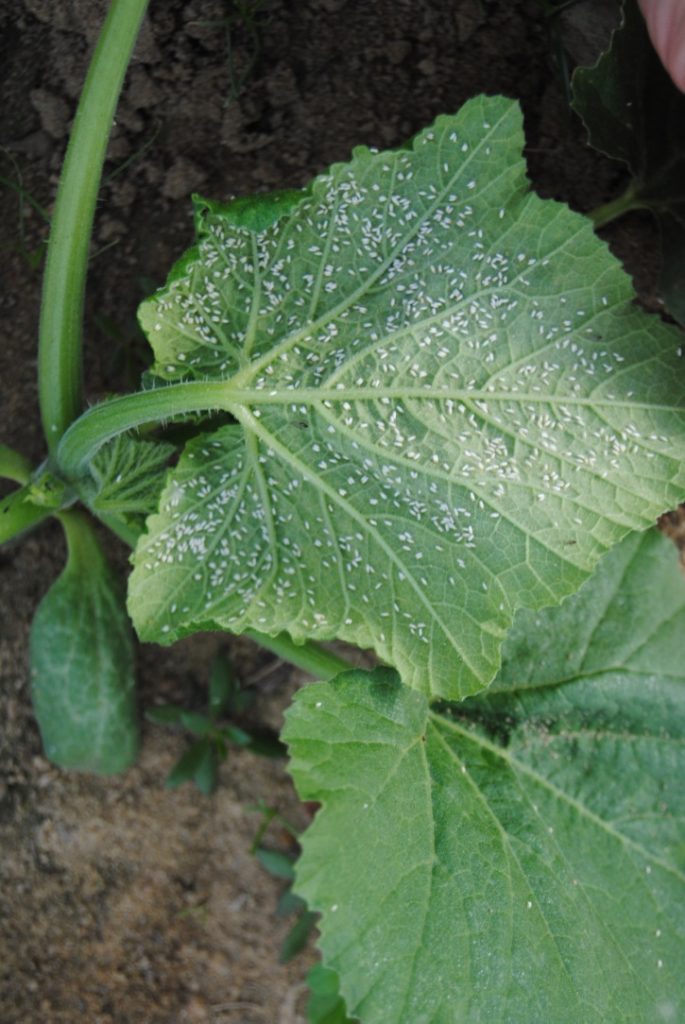
File photo shows whitefly adults feeding on a yellow squash seedling.
According to the South Florida Vegetable Pest and Disease Hotline, whiteflies are flaring up in tomatoes and watermelons in Southwest Florida. In the Central Florida area, growers indicate that whiteflies are present in tomatoes low numbers, although some of the early plantings were hit hard by whiteflies.
Tomato Yellow Leaf Curl Virus pressure remains less than 1% but it is present in nearly every planting.
Growers in Homestead, Florida indicate that whitefly numbers are present in oriental vegetables.
Management of whiteflies later in the season depends on early suppression of whitefly populations. Growers need to be aggressive with systemic materials like Venom, Sivanto Prime and Verimark, early in the season.
Proper scouting remains a viable management tactic for controlling silverleaf whitefly. University of Florida entomologists have established thresholds that have been successful for tomato producers.
For more whitefly management tips, see click here.
Fungicide resistance in strawberries is a major problem, says University of Georgia Cooperative Extension plant pathologist Phil Brannen. He encourages producers to help researchers understand which fungicides are still active and provide protection against diseases like anthracnose and botrytis.
“(Fungicide resistance) has really come to the forefront in the last few years. In the last two or three years, we have seen a lot issues, particularly with anthracnose. Prior to that, we may have had some breakdown but not nearly as much,” Brannen said. “With those fungicides in general across a lot of commodities, (they) are now starting to lose their activity and it just finally happened for us in strawberries. They’ve had issues with that in Florida for now several years also; South Carolina, we all know this happens when you spray that fungicide class; over time, they eventually break down and quit working. We’ve got to get better resistance, and we’re probably seeing more of that in other areas, too; other fungicides, particularly on botrytis.
“When trying to control botrytis, we have quite a few of fungicides that no longer work. I just encourage producers to make sure they test. If they have the opportunity, they can actually send off their pathogens on the strawberries and they can be tested for which fungicides are still active. That’s helpful.”
Yiannis Ampatzidis and his research team combined their collective minds to find the artificial intelligence technology to best help farmers save money and better care for their crops.
Out of that process, they invented a system known as Agroview.
The system utilizes images from drones and satellites and from the ground – along with artificial intelligence — to assess plant stress, count and categorize plants based on their height and canopy area and estimate plant nutrient content. Agroview can reduce data collection and analysis time and cost by up to 90% compared to the manual data collection, Ampatzidis said.
“Florida and U.S. growers can use this novel technology to count plants and predict yield, to detect stressed plant zones earlier and to develop maps for precision and variable-rate fertilizer applications,” said Ampatzidis, a UF/IFAS assistant professor of agricultural and biological engineering. “The maps can optimally apply fertilizers, reduce application cost and reduce environmental impact.”
Agroview captured the eye of UF Innovate | Tech Licensing, which recently recognized the technology as a UF Invention of the Year.
“I am extremely honored to receive this award,” said Ampatzidis, a young scientist who just entered his fourth year at UF/IFAS. “We truly believe that this AI-based technology could help Florida and U.S. producers improve crop productivity and management.”
He thanked his research team at the Southwest Florida Research and Education Center (SWFREC) in Immokalee for helping devise Agroview. He also expressed gratitude to his colleagues from the center and his academic department at the Gainesville campus for their input.
“I would like to thank UF Innovate | Tech Licensing and especially Dr. John Byatt and Dr. Jackson Streeter for their great help to commercialize this invention,” Ampatzidis said.
A spinoff company called “Agriculture Intelligence Inc.,” was created, which provides Agroview’s services to growers.
His bosses are also impressed with the work of Ampatzidis and his team.
“The Agroview product developed by Dr. Ampatzidis’ program provides the key for connecting UAV imagery to grower decisions. This product bridges a gap that existed between research and on-the-ground, everyday use,” said Kati Migliaccio, chair of the UF/IFAS agricultural and biological engineering department. “Dr. Ampatzidis uses AI in his programs to automate processes that have been traditionally been completed in more resource-expense ways. These efforts will allow for greater efficiency and optimization of the agricultural production process, which is necessary to meet future global food needs.”
Ampatzidis’ center director, Kelly Morgan, said SWFREC has a long history of supporting vegetable and citrus production.
“We have typically worked on standard inputs such as fertilizer, water and pesticides,” Morgan said. “Agroview is an example of the new emphasis on precision agriculture by the research center. This program will make growers in Florida much more efficient and result in far less environmental impact. This product of SWFREC should result in lower inputs of fertilizer, water and pesticides.”
The Florida Fruit and Vegetable Association (FFVA) is pleased with the USTR’s decision to implement a Section 201 investigation into blueberries. Mike Joyner, president of FFVA, said the investigation was best for blueberry producers, mainly because of its global approach.
Joyner
“When you watched the testimony of the two hearings, there were a number of blueberry growers. We knew this already but when you look at blueberries and the impacts that they’re seeing, yes Mexico is having an impact on them, but other countries are probably having a bigger impact; Peru, Chile,” Joyner said. “It became very apparent that a Section 201 was probably going to be best for blueberries. The thing about Section 201 is it’s a global approach. It looks at all the countries.”
Hearings
Florida and Georgia blueberry producers were able to state their concerns about imports from other countries and the impact they have had domestic production, especially market prices, during two days of hearings in August. Joyner said the government’s decision to initiate a 201 investigation speaks to the magnitude of how it perceives the concerns brought forth by farmers.
“When the government self-initiates, when they bring it to the International Trade Commission, it sends a signal that this is an important issue. The blueberry growers still have to put on the case. But just the fact that the U.S. Trade Reps Office said we’ve seen enough here that we’re going to self-initiate a 201, it just speaks volumes,” Joyner said. “I do think the 201 is the right trade tool for blueberries.”
Section 201
A Section 201 investigation is part of the Trade Act of 1974. It allows the International Trade Commission to investigate where domestic producers have been harmed by imports. They must be seriously injured, meaning that level of injury to their marketing opportunities. Typically, it must be completed within 120 days after filing.
Although a winter crop, strawberry production in Florida still falls victim to heat stress. With extreme heat during establishment, cool temperatures during the early and mid-harvests, and high temperatures during the late harvest, the crop is subject to dramatic seasonal temperature variations.
Traditionally, the state’s strawberry growers have used black plastic mulch to achieve adequate wintertime soil warming and optimal fruit production. However, black mulch can intensify the negative impacts of high temperatures, leading to greater heat stress, especially when growers advance planting dates (e.g., late September) to improve earliness. Some of the negative effects of heat stress on the plant include greater susceptibility to pests and diseases, nonuniform growth and soft fruit.
On the other hand, reflective mulch films don’t provide enough soil warming during the winter for the plant, so researchers have had to look for a happy medium.
To resolve this issue, researchers at the University of Florida Institute of Food and Agricultural Sciences (UF/IFAS) are looking at the effects of using reflective mulch films; essentially, adding a black center stripe to reflective silver mulch.
Shinsuke Agehara, assistant professor of horticulture at the UF/IFAS Gulf Coast Research and Education Center (GCREC), gave an overview of his research on reflective mulch for strawberry production at the recent Vegetable & Specialty Crop (VSC) Expo.
“The idea is to have the dual benefits of black mulch and reflective mulch,” Agehara says.
According to Agehara, metalized mulch films have the potential to improve early-season fruit development by alleviating heat stress conditions during the establishment period.
Field trials at the UF/IFAS GCREC showed significant early-season yield increases of up to 59% and total season yield increases by up to 30% with reflective mulch films. Other beneficial effects of reflective mulch films include reduced damage from rot, total season yield increases and fruit size increases.
Although there are many benefits to the reflective film, one drawback that Agehara warns growers about is what can happen if your water from your sprinkler irrigation has a high pH.
“Sprinkler irrigation with high pH water, when the pH is greater than 7.5, it can fade aluminum coatings on metalized films,” he says.
If fading of aluminum coatings are an issue, Agehara recommends trying white-on-black mulch, which should perform better than black mulch and nearly as well as metalized mulch.
To view Agehara’s full presentation from VSC Expo, click here.
Colossus has a later blooming time and very large fruit.
By Patricio Munoz and Doug Phillips
The University of Florida (UF) blueberry breeding program has a long history of developing superior southern highbush cultivars for the commercial blueberry industry. Beginning in 1949, the program has produced more than 40 cultivars, all of which exhibit a lower chilling hour requirement and adaptation to the higher temperatures and disease pressure experienced in Florida’s climate.
There are several desirable traits that are the focus of blueberry breeding efforts, including fruit quality (firmness, flavor, size, color, scar size, etc.), plant vigor, disease resistance and machine harvestability (fruit firmness, detachment force, plant architecture, concentrated ripening, etc.).
ADVANCEMENTS ACHIEVED
Blueberry breeding programs have historically used the recurrent phenotypic selection method, which is still used today. Selection of superior candidates is based on the cross-pollination of plants with favorable traits, the progeny of which are grown out and go through a series of successive selection, with favorable plants both advancing to the next stage and being used as parents for the next breeding cycle.
From an initial planting of 20,000 seedlings, each cycle’s population is narrowed to 10 to 15 percent, of which only a few may ultimately be released. With this method, the development of a new cultivar from cross-pollination to release can take between 10 and 12 years.
However, since the original selections from the wild at the beginning of the program until today, significant improvement has been achieved. In 2018 the UF blueberry breeding lab demonstrated by an extensive review of the literature (Cappai et al., 2018) that firmness has been steadily improved, reaching levels that make almost all new cultivars acceptable for machine harvest, and that, in general, southern highbush cultivars are firmer than northern highbush.
More recently, advanced methods including quantitative genetics and molecular information have been introduced, which have the potential to shorten the breeding cycle. These methods include using statistical methods to model molecular markers linked to genes associated with favorable traits. This can be done much earlier in the breeding cycle, instead of waiting until a plant becomes mature to observe whether certain traits will be present.
Optimus is an excellent choice for machine harvesting and exhibits good production in both deciduous and evergreen systems.
In 2019, the UF blueberry breeding lab performed a proof of concept experiment of these methods and demonstrated their feasibility (Oliveira et al., 2019). The focus during 2020 has been on optimizing these methods, which will be reported in studies to be published in the near future.
Other areas of research in the UF breeding program include flavor perception, container production and alternative season production.
FLAVOR PERCEPTION
The UF breeding program recently finished performing studies to demonstrate that consumer “liking” perception can be predicted when using the unique chemical makeup of each new cultivar. The idea is to avoid bias in the selection process associated with the breeder in charge of creating and releasing new cultivars.
In this area, discoveries have been made regarding which chemicals are favorable to the flavor perception and which ones are detrimental. This work started many years ago, and now with more information some of the findings can be validated.
CONTAINER PRODUCTION
Production in containers has become a global trend, primarily to produce high yields on marginal land because these soilless systems do not depend on native soil. The UF breeding program has been performing experiments as a proof of concept of this system for conditions in Florida. Results of second-year experiments show that, while these systems require high investment, they could become an attractive alternative for some Florida growers. The lab is in the process of refining the results to deliver some recommendations to growers.
In addition, the breeding program supports and collaborates in blueberry-related research in pathology, entomology, management and pollination.
RECENTLY RELEASED CULTIVARS
As always, the UF breeding program is closely watching elite selections to release new cultivars. A major focus has been placed on consistency across locations and years, as well as on precociousness (the capacity to produce harvestable fruit the first year after planting).
The most recently released cultivars from the UF program, Colossus and Optimus, have started to gain traction with growers.
Colossus was released in 2019. It has exhibited a later blooming time with a short bloom to ripening period, and has better performance with low doses of hydrogen cyanamide. The fruit is very large to jumbo sized, is very firm, has good color and bloom and a small picking scar. Colossus has performed well in both North Central and Central Florida trial sites. The best fruit is obtained by allowing it to hang on the bush until the preferred sweet and acid balance is achieved. In 2019, the yield in North Central Florida was approximately 12 pounds per bush. Colossus can be machine harvested if needed.
Optimus was released in 2018 as an excellent choice for machine harvesting. It has good timing for the Florida market window, with high yields and natural early leafing. Optimus has firm, medium-sized, high-quality berries. It has performed well in machine-harvesting trials and exhibited good production across Florida in both deciduous and evergreen systems. Optimus yielded 14 pounds of fruit per bush in 2019 in North Central Florida.
Other recent releases, heavily used in the evergreen system, include Arcadia and Avanti, which were released in 2015.
Arcadia has high yield and vigor, very low chilling requirements and disease-tolerant foliage. Several growers have reported good fruit production in the first year after planting. Arcadia has shown susceptibility to bacterial wilt (Ralstonia solanacearum), with severity varying significantly from farm to farm.
Avanti has potential for above-average yields, with early fruit maturity, very low chilling requirements and very sweet fruit. It has shown some susceptibility to mite damage and algal stem blotch, which require good management programs.
The U.S. Department of Agriculture’s National Institute of Food and Agriculture just announced funding for a project comprising an interdisciplinary team from the University of Florida. The three-year project, “Quantifying the nitrogen cycling benefits of different cover crops across different Florida organic vegetable production systems,” received a $496,271 grant as part of USDA-NIFA’s Organic Agriculture Research and Extension Initiative.
Principal investigator Gabriel Maltais-Landry, an assistant professor in the UF/IFAS soil and water sciences department, tells us more about the project and what it hopes to accomplish.
What is the Idea Behind This Project?
One of the key practices used in sustainable agriculture is the use of cover crops that replace bare fallow periods when no crops would typically be grown. The objectives vary: originally meant to reduce soil erosion, cover crops are now also used to control weeds and other pests in addition to providing nutrient cycling benefits, which is my main interest.
Explain More About Nutrient Cycling
Crops depend on essential nutrients to grow; one of these is nitrogen. In organic systems, it can be difficult to supply enough nitrogen to crops in an economically viable way because synthetic fertilizers are prohibited. Oftentimes, legume cover crops can help, as they fix nitrogen from the atmosphere. If we can retain that nitrogen within a system and transfer it to a cash crop, that could reduce the need for inputs, whether that’s fertilizers, amendments, etc., and their associated costs.
Nitrogen can also affect natural ecosystems, as excessive nitrogen can have adverse environmental consequences on our springs and other aquatic systems.
Describe the Study Design
This project is specifically focused on vegetables, which we grow here in Florida in the fall, winter and spring. Our cover crops, then, grow during the hottest and wettest part of the year, which is different from most other U.S. systems when cover crops are grown during cooler months.
We’re going to use three cash crops for this study, which are representative of important vegetable types grown in the state: bok choy is a Brassicaceae or cole crop; cucumber is cucurbit; and bell pepper is a Solanaceae. They also have different nitrogen demands and different growth forms. The plantings will all be done at a certified organic field [at the UF/IFAS Plant Science Research and Education Unit] in Citra.
Sunn hemp, a legume, will be our main cover crop, which is an interesting one because farmers like to use it for its nematicide properties – it reduces nematodes in the soil. Grasses are another common type of cover crop, but grasses don’t break down as quickly as legumes and some are even known to tie up nitrogen during their slow decomposition. So, we’ll be looking at Sunn hemp grown alone or in combination with other cover crops to see if mixtures could extend the duration of nitrogen release during cover crop decomposition. We’ll be looking into how much of that nitrogen actually goes to the next crop.
It’s not just about the nitrogen and cover crops, though. We’ll also compare nutrient management approaches: one that’s based on composted manure because that’s often what farmers rely on primarily, just for the sake of cost; as well as a more integrated approach that uses different fertility sources.
Who is Joining You in This Research and What Are Their Roles?
Chris Wilson (assistant professor of agronomy) will provide expertise in the quantification of nitrogen fixation and nitrogen transfer to subsequent crops. Microbes are an important driver of nitrogen cycling, so Sarah Strauss (assistant professor of soil microbiology at the UF/IFAS Southwest Florida Research and Education Center in Immokalee) is going to look at the microbial communities and how they affect nitrogen cycling. Zane Grabau (assistant professor of nematology) will measure the nematode communities, looking at their ecology beyond plant-parasitic nematodes. Xin Zhao (professor of horticultural sciences) is well-versed in organic systems and will evaluate the quality of the cash crops, including potential trade-offs between increasing yield and increasing the nutritive value of these food crops.
Why is This Research Important?
The overall goal of this project is to optimize the management of cover crops in these organic vegetable systems. We hope to provide fertility to the crop and to the soil, without oversupplying nitrogen, which can become an environmental hazard. We also want to be sure that by optimizing the system for nitrogen, we minimize negative trade-offs with other properties, whether that’s crop quality, nematode pressure or soil health.
Organic food sales topped $50 billion in the United States in 2018. Statistics from the Organic Trade Association tell part of the story of this growing market: Fruits, vegetables and other specialty crops combined to make up 36.3% of total organic sales — up 5.6% from the previous year.
Naturally, farmers want to meet consumer demand. But they may need to use essential oils to battle pests and diseases that often accompany organic crop growth.
That’s why the U.S. Department of Agriculture National Institute of Food and Agriculture awarded a nearly $2 million grant for a project led by Ali Sarkhosh, a UF/IFAS assistant professor of horticultural sciences at the main campus in Gainesville.
Sarkhosh and a team of 14 other scientists from five universities and the USDA Agricultural Research Service (USDA-ARS) will study the degree to which essential oils can help suppress certain pests and pathogens.
Researchers from the University of Florida, Clemson University, the University of Georgia, the University of California-Riverside, the University of Hawaii at Manoa and the USDA-ARS will collaborate on the project.
“Due to long periods of warm temperatures and high humidity that are characteristic of Florida, Hawaii, Southern California, Georgia, South Carolina and other parts of the southeastern United States, diseases are common,” Sarkhosh said. “Therefore, organic production of fruit crops in these regions is difficult because diseases cannot effectively be controlled without synthetic pesticides. This project will evaluate the plant safety and horticultural impact of essential oils (EOs) for disease management and will begin to test plant disease efficacy claims of EO products currently marketed for organic producers.”
Funding for the four-year research program will support scientists with expertise in fruit crop management and physiology, plant pathology, entomology, postharvest biology and organic production.
In the project, scientists will:
Evaluate the plant safety and horticultural impact of essential oils in managing diseases in fruits including blueberries, peaches, mangos and avocados.
Begin to test plant disease efficacy claims of essential oil products marketed for organic producers.
Evaluate organically certified plant essential oils on targeted pathogens such algal stem blotch, anthracnose, brown rot, scabs, gray mold and powdery mildew.
Determine the efficiency of essential oils on fruit shelf life through postharvest testing.
While arthropod pests are not the primary focus of this research, researchers also will test the efficacy of essential oils against insects including scales, thrips and mites.
Included among the 15 scientists who will work on the project nationwide are nine UF/IFAS researchers. They’re based at the UF/IFAS campus in Gainesville and Tropical Research and Education Center (TREC) in Homestead:
Jeffrey Brecht, professor of horticultural sciences.
Philip Harmon, professor of plant pathology.
Danielle Treadwell, associate professor of horticultural sciences.
Jeffrey Williamson, professor of horticultural sciences.
Daniel Carrillo, assistant professor of entomology (TREC).
Jonathan Crane, professor of horticultural sciences (TREC).
Romina Gazis, assistant professor of plant pathology (TREC).
Bruce Schaffer, professor of horticultural sciences (TREC).
Among other duties, Crane will bring data from the research to the tropical fruit industry.
“This research is important because there is little to no science-based information on the efficacy and safety of most essential oils in pest management of fruit crops, including mango and avocado,” Crane said. “Only armed with sound data we can make recommendations to commercial producers on their use and crop safety.”
After they gather their new data, scientists will communicate results of their research to those who grow organic fruit as well as those who grow conventional crops so those producers can rapidly adopt the practices. Scientists will also evaluate the effectiveness of the project through continuous feedback from stakeholders.
“Organic fruit growers in the United States are often hesitant to embrace organic practices due to the shortage of tools for disease management,” Sarkhosh said. “The long-term goal of this project is to provide U.S. organic fruit growers with safe, organically certified compounds for disease management, and consequently improve their confidence in plant-based fungicide, bactericide and insecticide applications.”