Category: Florida

  • A Stressful Living: UF/IFAS Meeting a Need

    The U.S. Department of Agriculture Farm and Ranch Stress Assistance Network Program connects farmers, ranchers and others with agriculture-related jobs to programs designed to combat stress.

    The University of Florida/IFAS is one of more than 50 partners joining the effort in the Southeast.

    Kendra Zamojski, family and consumer sciences regional specialized Extension agent, will lead the UF/IFAS team which encompasses Extension agents, economists, agriculture teachers and communicators.

    National Weather Service graphic shows projected path of Hurricane Eta when it moved across Florida in November.

    “With University of Florida Extension being the land-grant university and arm of the Extension Service, we have agents in every county working, not only with farmers and growers and producers but also with the citizens in the counties. Florida has been pretty heavily impacted by hurricanes recently. We have seen the stress that farmers are under and wanted to be a part of this project to determine what the needs are and figure out strategies to address them and inform the research going forward,” Zamojski said.

    Tragic Statistics

    She noted that according to a 2016 CDC report, the suicide rate among farmers, fishermen and forestry workers was the highest for all occupations. In 2015, a CDC report also showed suicide rates were higher, almost double, in rural regions compared to urban.

    It is especially stressful for Florida producers, who have to deal with hurricanes every year and a COVID-19 pandemic this year that shut down restaurants in March. It took away a huge chunk of Florida’s vegetable and specialty crop business in the process.

    Coronavirus Impact

    “I live here in the Panhandle, so I know the stress from hurricanes that farmers face. Having been through (Hurricane) Michael and the devastation of that, I have definitely seen some of the stress first-hand. But now with the COVID-19 pandemic, there’s definitely stress in how supply chains have changed,” Zamojski said.

    UF/IFAS will also provide a financial planner to assist farmers with economic decisions.

    “So much of it is economics. So on the team we have going forward with this grant, we do have a certified financial planner who will be helping us do some trainings with farmers on economic issues and planning that they can do in such an uncertain environment,” Zamojski said.

    Needs Assessment

    The three-year grant includes plans for a needs assessment; reaching out to the community and understanding what the needs are and tailoring resources to meet those needs. Trainings will be held for farmers and Ag students. A hotline will be established to provide immediate access for support.

    “I think everybody’s feeling the stress of the pandemic right now but definitely our farmers. Not only on a daily basis where they have to deal with pests, disease and the challenges they face with their crops, but also 2020 was a pretty active hurricane season and weather season. There were a lot of impacts to agriculture from that. Throw in a pandemic and that has thrown our supply chains for a loop. I think 2020 has been a pretty stressful year,” Zamojski added.

  • Cautious Optimism: Low Interest Rates Present Opportunities for Farmers

    Interest rates are low and should remain that way for the foreseeable future. Adam Rabinowitz, Assistant Professor and Extension Economist at Auburn University, says vegetable and specialty crop producers may have an opportunity to capitalize.

    Rabinowitz

    “Interest rates are extremely low, and they are forecast to remain low. That is certainly an opportunity to where if there’s interest on any kind of capital equipment or land, in terms of loans that have interest on that; looking at refinancing that is an option, if you can secure a lower rate,” Rabinowitz said.

    “But also, it certainly might be an opportunity, if you have a sound financial position long term, to look at buying some of the equipment that is needed for where you’re going to have a loan that will obviously have a lower interest rate at this point.”

    Interest Rate Background

    The Federal Reserve Bank oversees setting the interest rate, which rises and falls depending on the outlook of the financial market.

    The interest rate is typically high when economic times are good but is low during economic downturns. Such is the case amid the coronavirus pandemic, which led to massive shutdowns and a spike in unemployment when COVID-19 impacted the country in mid-March.

    The interest rate is near zero percent and is expected to remain that way through 2022.

    Proceed with Caution

    But Rabinowitz also cautions farmers to really consider if taking on more debt is the right tactic to take with regards to their farming operations.

    “I would stress, though, it’s important to look at it within the context of the entire operation to make sure the financial position is a sound financial position before taking on that additional debt. We’re still looking at very volatile markets in terms of pricing,” Rabinowitz said.

    “There’s a lot of uncertainty in a lot of other aspects. Taking on more debt is not necessarily the best thing to do either.”

  • Increased Rainfall Not Helpful for South Florida Producers

    The additional rainfall South Florida received earlier this week is not going to help vegetable and specialty crop producers still drying out from a wet November.

    McAvoy

    Gene McAvoy, University of Florida/IFAS Regional Vegetable Extension Agent IV Emeritus, estimated his area in Immokalee, Florida had received almost three inches by the end of Monday.

    “(The rain’s) not going to help, especially on the muck soils, they’re much harder to dry out than the sands. We can pump water off fields that are on mineral soils, and they’ll dry down in a couple of days. That muck is like a sponge so even if you pull the water off, it stays wet,” McAvoy said.

    “We’ve already seen stand loss, and we’re going to continue to see more of that; increased disease in things like lettuce, damping off in beans.”

    Bloom Dropping

    McAvoy said producers are already seeing bloom dropping in peppers and tomatoes, as well as higher incidences of bacterial spot as a result of increased moisture in the soil.

    Weather has been a challenge the last couple of months in South Florida. The region has experienced multiple months of excessive rainfall. McAvoy estimated in mid-November that in the Fort Lauderdale area it had received 26 inches over the previous month.

    Fortunately for Florida growers the upcoming forecast looks dry. According to weather.com, Immokalee is expected to receive little to no rain for the next 10 days, except for Saturday, which is only 35%.

  • In Story of Blueberries and Bees, Scientists Play Matchmaker

    A pollinator on a blueberry plant.

    December 10, 2020

    By: Samantha Murray, grenrosa@ufl.edu, 949-735-1076

    GAINESVILLE, Fla. — Chew on this the next time you eat a blueberry: Every single blueberry is the result of a flower that was pollinated by a bee.

    In other words: no buzz, no berry.

    With that in mind, it’s no wonder blueberry growers bring in hives of honey bees or bumble bees when their blueberry bushes are in flower.

    “We are big believers in pollination on blueberries. We believe pollination helps increase berry size and weight and increases the overall crop yield,” said Ryan Atwood, co-owner of H&A farms, which owns, leases and manages more than 350 acres of blueberries in north and central Florida.

    But pollinating blueberries with bees isn’t an exact science — yet.

    Successful pollination depends on a variety of factors, such as when beehives are introduced or how much buzz a blueberry flower needs to release its pollen.

    Moreover, blueberry growers across the United States report that ineffective pollination is a top concern for their business, as it directly affects the amount and quality of product they can bring to market, said Rachel Mallinger, an assistant professor in the UF/IFAS entomology and nematology department who specializes in pollinators.

    This is why Mallinger and several other researchers from blueberry-growing states have teamed up to develop recommendations and tools to help growers optimize pollination.

    In addition to Mallinger, the research team includes scientists from Michigan State University, Oregon State University and Washington State University. Rufus Issacs, a professor in the department of entomology at Michigan State University, will lead the project, which is funded by a $2 million grant from the National Institute of Food and Agriculture, part of the U.S. Department of Agriculture. 

    “Some years blueberry pollination goes well, other years not so much, so we are looking to help growers take some of the guesswork out of it,” Mallinger said. “Our ultimate goal is to provide a tool we’re calling the pollination planner. The pollination planner will help growers decide how many bees to use and when to bring them in based on their location, climate, size of their farm, and varieties of blueberry they grow.”

    Mallinger and her research team will partner with Florida blueberry growers, including Atwood, to run their field experiments. The Florida blueberry industry is a $60 million-a-year business, and this research on pollination will help support this growing commodity.

    “This research will help us understand the economic benefits of honey bees for pollination and what number of hives are needed to properly pollinate,” Atwood said.

    The multi-state project has several components, Mallinger said.

    “Our contribution in Florida will be to look at our modern southern highbush blueberry varieties and determine their pollination needs and what makes them attractive to bees. Some varieties need to be pollinated with pollen from a different blueberry variety to achieve optimal yields, while others are more self-compatible. Some varieties may hold on to their pollen tightly, others less so. Even the color or size of the flower, or how much nectar it produces, might impact how attractive that flower is to a bee,” she said.

    Identifying those traits is just the first step, Mallinger added.

    “Blueberry breeders are usually trying to develop varieties that have good taste, resistance to pests, things like that. But we don’t think about how likely a blueberry variety is to be pollinated. If we can identify those traits that lead to more pollination, we can inform breeding efforts,” she said.

    Other researchers on the project will develop recommendations for the number of bees — called stocking density — needed to pollinate modern varieties of blueberry. Another component of the project will investigate how weather conditions, such as extreme heat, influences pollination success.

  • Why are Sales of Real Christmas Trees Breaking Records This Year?

    Photo shows Christmas tree farm.

    Sales of real Christmas trees are breaking records this season. Conversations with tree shoppers may reveal why. (Gary Crawford. Tim O’Connor with the National Christmas Tree Association and several intrepid tree hunters)

  • USDA Announces National Watermelon Promotion Board Appointments

    UGA CAES photo/Watermelons being researched on the UGA Tifton Campus. 6–6-17

    The U.S. Department of Agriculture announced the appointment of nine members to serve on the National Watermelon Promotion Board this week. The appointees will serve three-year terms from Jan. 1, 2021, to Dec. 31, 2023. 

    Members newly appointed or reappointed are:

    • District 1 Producer: Kyler Bishop, Punta Gorda, Florida
    • District 1 Producer: Chad Chastain, Punta Gorda, Florida
    • District 1 Handler: Stephen R. Nichols, Lakeland, Florida
    • District 1 Handler: Rob Gibson, Vero Beach, Florida
    • Importer: Matthew N. Tanner, Pompano Beach, Florida
    • Importer: Christopher M. Dyer, Mission, Texas
    • Importer: Christian Murillo, Nogales, Arizona
    • Importer: Jeff Fawcett, Edinburg, Texas
    • Public Member: Craig A. Stokes, San Antonio, Texas

    The National Watermelon Promotion Board now has 30 members composed of 10 producers, 10 handlers, nine importers and one public member. Approximately one-third of the board members are appointed each year. Members can serve up to two consecutive three-year terms.

    More information about the National Watermelon Promotion Board, including a roster of members, is available on the Agricultural Marketing Service (AMS) National Watermelon Promotion Board webpage and on the board’s website at www.watermelon.org.

    Since 1966, Congress has authorized industry-funded research and promotion boards to provide a framework for agricultural industries to pool their resources and combine efforts to develop new markets, strengthen existing markets and conduct important research and promotion activities. AMS provides oversight to 21 boards. The oversight ensures fiscal accountability and program integrity, and is paid for by industry assessments.

  • Wish Farms Expands Florida Strawberry Farm

    Chris Parks, Farm Manager, holds a strawberry.

    Plant City, FL – International grower and year-round marketer of strawberries, blueberries, blackberries and raspberries, Wish Farms, is adding acreage to its Florida strawberry farm operation.

    Founded in 1987, G&D Farms is named as a tribute to the original founders of the company, Gershon and Daniel. Before the land addition, it was already widely considered to be the largest contiguous strawberry farm in the world.

    The purchase adds just more than 800 acres of land, around 600 of which will be designated for farming. The remainder is natural wetlands, which will be left undisturbed for biodiversity and environmental sustainability.

    Farm manager Chris Parks said, “This expansion is very exciting for our team. Not only is the land directly adjacent to our current farm, but we can immediately start farming organically. The ground hasn’t been utilized for many years, so we can bypass the regulated waiting period. It gives us a lot of flexibility with rotation, ensuring that we are good stewards of the land.”

    Wish Farms is farming 55 acres of it this coming season, with a gradual ramp up of usage in each season following.

    While the farm is more than 90% of the popular and successful Sweet Sensation variety, the company is always on the hunt for the next best tasting strawberry. Several rows are dedicated to 100 new variety and seedling trials. Nearly seven acres have been planted with the highly anticipated white strawberry. Wish Farms has branded them Pink-A-Boo Pineberries.

    “I believe there will be strong demand for Pink-A-Boos in the coming years, and this land will allow us to expand that program without having to reduce our red strawberry acreage,” said owner Gary Wishnatzki.

    G&D is also employing some innovative techniques that help reduce its usage of non-organic pesticides. The releasing of predator Persimilis Mites (Phytoseiulus persimilis) started as an organic method to control Two-Spotted Spider Mites (Tetranychus urticae).

    Parks added, “The same effective organic method has worked really well for our non-organic crop. This season we started experimenting with drones that scout and release. If it works, it could be a major boost to our farm’s efficiency.”

    About Wish Farms:

    Feel Good. Eat Berries. Make A Difference.

    It isn’t just a catchy phrase, giving back is engrained in the company culture. Through the Wish Farms Family Foundation, a portion of profits are dedicated to their three pillars of giving: Food Insecurity, Youth Education and Community. With a defined mission, they hope to make the world a better place.

    Founded in 1922, Wish Farms is a fourth-generation, family operated company. As a year-round supplier of strawberries, blueberries, blackberries and raspberries, it grows both conventional and organic varieties. Nationally recognized for innovation, Wish Farms utilizes patented traceability technology to ensure quality and safety by tying consumer feedback to specific information from each day’s harvest. 

    For more information, please visit www.wishfarms.com.

  • UF/IFAS-Developed Blueberry App to Help Growers Battle Diseases, Pests

    UF/IFAS photography

    By: Brad Buck, bradbuck@ufl.edu, 352-875-2641 (cell)

    A new University of Florida app will help the state’s blueberry growers identify and manage disease and insect injuries commonly encountered in Florida before their crop is ruined.

    Collectively, blueberries are a $60 million-per-year crop in Florida.

    Patricio Munoz, the UF/IFAS blueberry breeder and an assistant professor of horticultural sciences, came up with the vision for, and supervised the development of, the UF/IFAS Blueberry Growers Guide phone app, released on Dec. 1.

    “Dr. Munoz saw the need for a field scouting guide for southern highbush blueberries that growers could use on their phones,” said Doug Phillips, statewide blueberry Extension coordinator. “Previously, the only blueberry scouting guide available was a paper guide for northern highbush blueberries, covering diseases and insects typically seen in more northern states.”

    The new UF/IFAS app (type in “UF/IFAS Blueberry Growers Guide”) is available for both iOS and Android operating systems at the Apple Store and the Google Play Store, and it should help farmers who grow blueberries in the Sunshine State.

    Phillips, who works at the UF/IFAS Gulf Coast Research and Education Center in Balm, led this project. He prepared the content and layout for the guide in collaboration with other UF/IFAS scientists: plant pathology Professor Phil Harmon, entomology Professor Oscar Liburd, horticultural sciences Associate Professor Peter Dittmar, and horticultural sciences Professor Jeff Williamson.

    Phillips got help from Jose Delgado, a UF undergraduate who conducted early software development on the app. Delgado earned his bachelor’s degree in engineering in 2019.

    The guide, which will ultimately be divided into multiple modules, is designed to help blueberry growers with various production issues on southern highbush blueberries. Currently, the app serves as a blueberry scouting guide to help farmers scout for diseases, insect pests, nutrient deficiencies and other damage, Phillips said.

    Guide Resources

    Resources in the guide include a diagnostic key, descriptions of symptoms, disease/insect life cycles, recommended management practices, an image gallery and links to UF/IFAS blueberry Extension publications. Users can access this information by using the diagnostic key to help identify symptom or injury causes and the image gallery to compare pictures of symptoms to observed symptoms.

    They also can use a reference listing of diseases, insect injuries, nutrient deficiencies and other symptoms or injuries.

    More functions will be added in the near future, Phillips said. They include a module with detailed information on all UF southern highbush blueberry cultivars.

    “The UF/IFAS Blueberry Growers Guide will help Florida’s growers more easily manage damage from disease, insects, and other causes, and in the future will be a valuable resource for other production issues, including choosing which UF varieties are likely to perform well on their farms,” Phillips said.

  • Avoiding a Shutdown: H-2A Help Essential in Harvesting Crops Next Spring

    Growers take steps to protect farmworkers’ health so they can continue to ensure an abundant, safe food supply is available to U.S. consumers. Image source: The Pajaronian

    The early onset of the coronavirus pandemic spelled doom for certain sectors of the agricultural industry. Restaurants shut down, unemployment rose, and suddenly, fruit and vegetable producers across the Southeast faced a decreased demand for their produce.

    There was also temporary concern among farmers about how suspended travel from foreign countries would impact H-2A workers trying to get in the country to help harvest the crops when they were needed the most.

    Could the country experience a similar shutdown once President-Elect Joe Biden takes office on Jan. 20, especially since COVID-19 cases continue to surge?

    No Shutdown Planned

    According to media reports, Biden has said he wouldn’t put the country through another national shutdown to try to slow the virus’ spread.

    This would be great news for those producers who will rely on H-2A workers to be in place to harvest their crops next spring, according to Allison Crittendon, Director of Congressional Relations at the American Farm Bureau Federation.

    “I think when we had the shutdown back in March, we had no idea what this virus really was or how it spread. It’s crazy to think back in March masks weren’t known as what you had to do. Now we certainly have more information and more clarity about how to go about trying to achieve essential operations like food production as safe as possible,” Crittendon said.

    “I hope that with all of the information we’ve now gathered over the last several months that we could avoid a shutdown. But I wouldn’t be surprised if there were further requirements for employers to adhere to when it comes to mitigating the spread once folks are on the farm and have traveled over here from their home country.

    “Hopefully, since we now have more information about the virus, we won’t have to revert to those early practices of shutting everything off completely when it comes to travel of our essential workers.”

  • U.S. Horticulture Operations Report $13.8 Billion in Sales

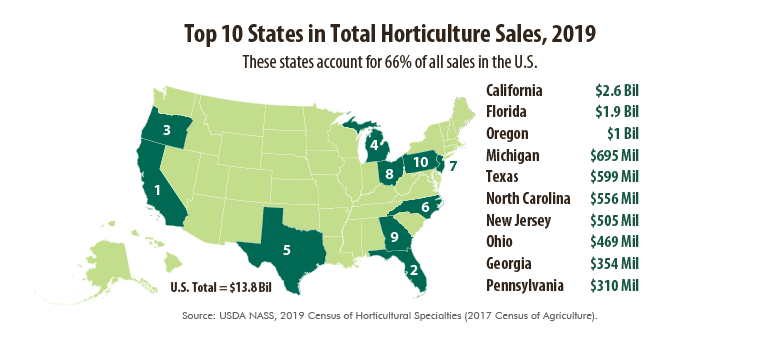
    WASHINGTON, Dec. 8, 2020 – Today, the U.S. Department of Agriculture’s National Agricultural Statistics Service (NASS) released the 2019 Census of Horticultural Specialties report, the only source of detailed production and sales data for floriculture, nursery, and specialty crops for the entire United States.

    The data show that horticulture operations sold a total of $13.8 billion in floriculture, nursery and specialty crops in 2019, down fractionally from the sales in 2014. The number of horticulture operations in the United States decreased 11% during this time to 20,655.

    “First conducted in 1889, the horticulture census provides data on sectors for which there are no other comprehensive data sources,” said NASS Administrator Hubert Hamer. “It is a valuable tool to highlight the contribution horticulture growers bring to our local, state, and national economies as well as changes in the industry over the past five years.”Horticulture Map

    Horticulture production occurred primarily in 10 states, which accounted for 66% of all U.S. horticulture sales in 2019. California ($2.63 billion), Florida ($1.93 billion) and Oregon ($1.02 billion) led the nation in sales.

    The top commodities in U.S. horticulture sales in 2019, and compared to 2014, were:

    • Nursery stock, $4.55 billion, up 7%
    • Annual bedding/garden plants, $2.24 billion, down 13%
    • Sod, sprigs and plugs, $1.27 billion, up 12%
    • Potted flowering plants, $1.2 billion, up 11%
    • Potted herbaceous perennials, $923 million, down 2%
    • Propagative horticultural materials, bareroot, and unfinished plant materials, $720 million, up 4%
    • Food crops under protection, $703 million, down 12%

    Other key findings from the 2019 Census of Horticultural Specialties report include:

    • Family- or individually-owned operations made up the largest number of operations, accounting for 52%, but corporately-owned operations accounted for 75% of sales ($10.3 billion).
    • Total industry expenses were up 6% since 2014, with labor being the largest cost, accounting for 42% of total expenses in 2019.

    The Census of Horticultural Specialties is part of the larger Census of Agriculture program. It provides information on the number and types of establishments engaged in horticultural production, value of sales, varieties of products, production expenses and more. All operations that reported producing and selling $10,000 or more of horticultural crops on the 2017 Census of Agriculture were included in this special study.

    For more information and to access the full report, visit www.nass.usda.gov/AgCensus.