LAKE ALFRED, Fla. — If information is power, Florida citrus growers have a new asset in their fight against citrus greening disease which has been impacting the state’s multi-billion dollar citrus industry.
The University of Florida Institute of Food and Agricultural Sciences statewide citrus program launched a major revision of a website, providing instant access to a portfolio of information valuable to growers.
The citrusresearch.ifas.ufl.edu website underwent a major revision, making it easier to navigate, adding new access to research trials, publications and presentations.
“We know growers are busy and don’t have time to search multiple sites for information,” said Michael Rogers, professor and director of the UF/IFAS Citrus Research and Education Center in Lake Alfred, Florida. “We put the most current research in one website where growers can search for and find what they need to be successful in today’s challenging growing situation.”
The new site includes special features of interest to growers including:
Data from over 20 rootstock trials conducted by the UF/IFAS plant improvement team. Growers can review the data collected from the trials and compare data from sites across the state.
UF/IFAS researchers share their ongoing research priorities in citrus economics, grove management, new varieties, nutrition/water management, psyllid management and root health.
A resources section includes current production and nutrition guides and Extension documents (edis.ifas.ufl.edu) on citrus-related topics from 2016 to the present that are easily linked to from the website and are also presented by researcher for easy searching.
“This website is just one of the ways that the UF/IFAS citrus team is working to support growers with the latest science to best battle citrus greening. We are working to get this information directly to growers as soon as it is available so that they may be able to put it into action as soon as possible,” Rogers said.
Clemson Extension agents provided updates in The South Carolina Grower this week about the status of various crops being produced throughout the state.
Statewide
Dr. Matt Cutulle reports, “It is always good to control goosegrass even if it is past the critical period for competition with the crop. Lack of late-season control made hand-harvesting tomatoes difficult. Also, there will be a huge deposit of goosegrass seeds into the soil seed bank for next year unless the seeds are destroyed after the harvest.”
Coastal
Wilting of hemp is very common and often sporadic throughout fields. Photo from Zack Snipes
Zack Snipes reports, “We experienced a nice hot week of weather in the Lowcountry. Most crops are finishing up with the heat and recent rains. On later season tomato I have seen bacterial leaf spot on the fruit which makes fruit unmarketable. I am seeing this on the second cluster of fruit set and not on the first or third clusters. Hemp seems to be off to the races and looking pretty good so far. There are within every hemp field occasional wilted, stunted and yellowed plants. These plants always have a weak root system and most of the time have girdling and interveinal discoloration. Peppers and eggplants are loving this heat and are producing in high volumes.”
Midlands
Justin Ballew reports, “Last week was hot and mostly dry, though we did have some scattered thunderstorms come through over the weekend. Field prep for fall crops continues. We’ve had some fall tomatoes, peppers, and brassicas transplanted already and more to come this week. Everything is growing pretty fast right now and we’re still picking spring crops. Keep an eye out for spider mites, as they love the hot, dry weather we’ve had lately.”
Sarah Scott reports, “We are still ahead of schedule on peach varieties being harvested. Early August Prince and August Prince are being picked now which is over a week earlier than usual. The fruit quality is still good with slightly smaller than ideal fruit. With the extreme heat and lack of rain in the past week, summer crops like tomatoes and cucumbers are looking rough. Bell peppers are doing well.”
Pee Dee
Bruce McLean reports, “Sweet potatoes are looking good. Establishment seems to be very good for the most part. Long green cucumbers, yellow squash, zucchini, cantaloupe, peas, okra, and sweet corn are harvesting well. Condition is good to very good. Sweet corn will be wrapping up shortly. Blueberries are pretty much finished, with only a few remaining fruit on Powderblue. Fruit condition is fair to good. Muscadines are coming along nicely and appear to have an excellent crop. Fresh muscadines should be beginning harvest soon, with wine/juice grapes still a few weeks from harvest. Be on the lookout for Grape root borer moths. They are starting to emerge. They were being caught in traps placed in vineyards in Marion and Horry counties.”
Tony Melton reports, “Harvested first crop of processing peppers. Continuing to pick and plant pickles. Processing greens are over for the spring crop. Harvesting the first crop of processing and seed peas and planting fall crop. Getting processing tomatoes out of the field as quickly as the plant can take them. Things are drying out, hope we don’t go into drought with the heat.”
Upstate
Kerrie Roach reports, “Spotty rain and high temperatures have left many small growers scrambling for irrigation options throughout the Upstate. Peaches and nectarines are still being harvested. Blueberries are just about finished, and farmers’ market produce is starting to wind down with the heat. Apples should begin next week with early varieties like ‘Ginger Gold’ and ‘Golden Supreme’.”
Andy Rollins reports, “Plenty of early blight, bacterial spot/speck on tomatoes this season, but some of the more troublesome problems have been various tomato virus problems. When diagnosing virus problems it is important to get lab verification because herbicide injury can look very similar when just going by visual symptoms. If you suspect herbicide drift from a neighboring farm. Look for damage to other broadleaf plants in the area in between the suspected source and the damaged plants. Follow the wind direction. You should have more severe damage on the leading edge. Also, herbicide residual from a previous crop like sunflowers can also give you herbicide damage that you did to yourself. Read and follow all pesticide label directions. There are plant back restrictions on some herbicides so be careful. If this is the case the damage should be fairly consistent/uniform throughout the area that was planted in the other crop.
Unlike both of these other situations, virus problems may come from your seed source, the greenhouse where plants were grown or from weeds in the field. Pokeweed is commonly a source, as are many other broadleaf weeds. Thrips, aphids, and whiteflies are all known to vector viruses into plants. Symptoms are what you see below with “shoestring” looking leaves, leaves with distorted veins, and mosaic yellow and green coloration. There are many viruses that infect plants. Each of them can show different symptoms and also they can each look different on other plants as well. It’s even possible for a healthy-looking plant with no symptoms to be infected with several viruses.”
The phaseout of methyl bromide continues to stimulate research into the use of other soil fumigants for controlling soilborne pathogens, nematodes and weeds to an acceptable level for production.
Gary Vallad
Researchers at the University of Florida Institute of Food and Agricultural Sciences (UF/IFAS) are looking at ways to modify the current fumigation system to better reflect the distribution growers once saw with methyl bromide.
“The phaseout from the loss of methyl bromide from where we are now, was not a short one. It’s been going on for decades and I think we’re still in that process,” says Gary Vallad, professor of plant pathology at UF/IFAS. “And of course, this has been kind of a costly process, it’s been a hard process for a number of growers throughout the state and throughout the southeast United States.”
Improving Current Fumigation Systems
In the absence of methyl bromide, tomato diseases have been on the rise, specifically fusarium wilt, caused by Fusarium oxysporum. Since then, growers have been looking to find alternatives to control the disease.
According to Vallad, methyl bromide alternatives are limited in the way they move in the soil.
The biggest weakness that researchers have found with the alternative fumigants is that the fumigant doesn’t reach the soil zones along the edge of the bed and under the tuck of the plastic.
Researchers have developed strategies to improve current fumigation systems using Pic-Clor 60. With the additional of supplemental Pic, researchers saw a 77% decrease in fusarium wilt incidence and yield increase of approximately 21%.
In addition to looking at how to control soilborne pathogens, they also wanted to evaluate strategies to control nematodes.
“In a lot of cases where we run into pest problems, it’s not just one pathogen or nematode. Typically, it’s a mixture of the two,” Vallad says. “So really what we wanted to do is investigate what happens when we put both of these systems together.”
After collecting results from research trials, it was discovered that deep shank Telone applications reduced nematode counts and gall ratings. Also, Pic-Clor 60 or 80 with supplemental Pic and deep shank Telone application was the most effective strategy to reduce fusarium wilt, which actually shocked researchers.
Through further research, they found that Telone is fungicidal to fusarium oxysporum, and by combining both strategies researchers saw yield increases of 25% or more.
UGA photo/Jordan Burbage, of the UGA Soil, Plant and Water Analysis Laboratory in Athens, Georgia, harvests grapes at Trillium Vineyards, part of the collaborative research project being conducted by UGA Extension and Westover Vineyard Consulting.
By Clint Thompson
In his latest UGA Extension Viticulture blog, University of Georgia Extension Fruit Disease Specialist Phil Brannen says grape producers will soon be seeing symptoms of Pierce’s disease in susceptible varieties; typically Vitis vinifera and some hybrids.
Mild winter temperatures have contributed to an increase in Pierce’s disease at higher elevations in Georgia and throughout the Southeast. Symptoms normally start to appear in late July or August. Since symptoms are similar to drought or nutrient stress, it’s essential not to remove plants if they’re not suffering from Pierce’s Disease.
N.C. State hosted an effective workshop about Pierce’s Disease that will be helpful for all farmers.
Brannen stresses it is particularly important that you identify and destroy infected vines to prevent further spread of this disease.
The disease is caused by a bacterium that is transmitted by numerous sharpshooter insects, such as the glassy-winged sharpshooter. It clogs the grape xylem, cutting off nutrient and water flow. Once infected with Pierce’s disease, vines die within one to two years.
Clemson Extension agents provided updates in The South Carolina Grower this week about the status of various crops being produced throughout the state.
Coastal
Spider mites have been reported on beans, tomato and melon in the Coastal Region.
Zack Snipes reports, “It was a warm week with some sprinkled in showers along the coast. All crops are coming in right now with heavy watermelon volume. What’s left of the tomato crop is ripening fast. As far as pests go, I have seen a good amount of bacterial leaf spot in pepper, squash bugs and cucumber beetles in squash, and spider mites on beans, tomato, and melon.”
Midlands
Justin Ballew reports, “We got a little more rain last week and the temperatures were a little warmer than previous weeks. We’re still harvesting tomatoes, sweet corn, peppers, eggplant, peaches, squash, zucchini, beans, etc. Since the environment has been warm and wet, we’re starting to see diseases pick up. Seeing lots of powdery mildew and anthracnose on cucurbits and bacterial spot on tomatoes. Stay on your fungicide programs and rotate modes of action as much as possible. I’ve also been getting some reports of heavy spider mite activity on tomatoes.”
Sarah Scott reports, “We’ve had hot and, for the most part, somewhat dry conditions in the past week. Some areas received an inch of rain, but it was very spotty. Tomatoes, peppers, squash, corn, cucumbers, and melons are all being harvested now. Plums, peaches, and nectarines are also still being picked. The peach crop is about 10 days ahead of schedule.”
Pee Dee
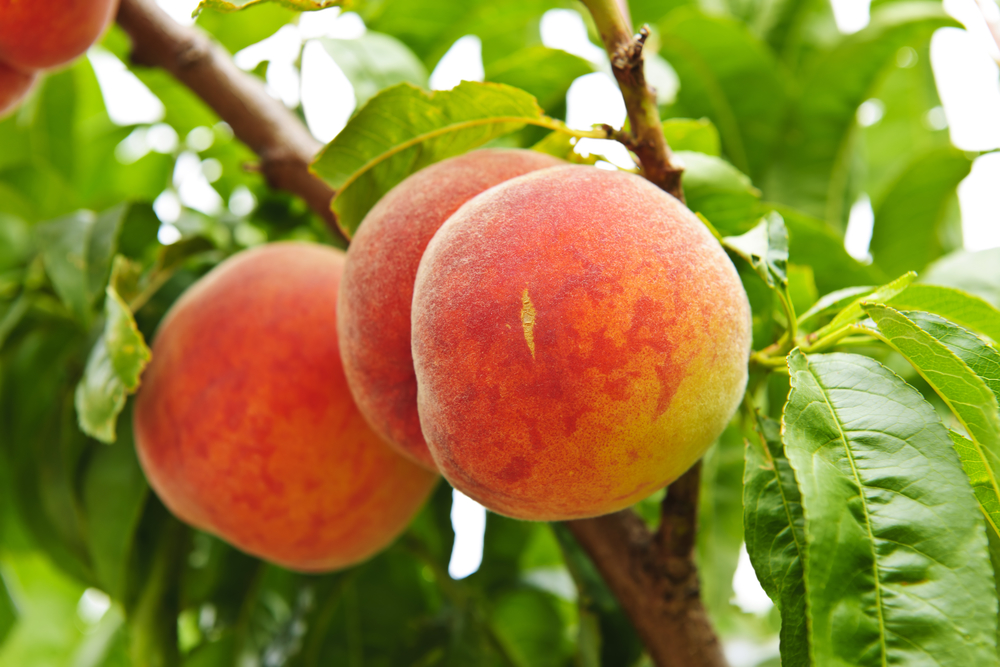
File photo shows ripe peaches ready to pick on tree branches.
Bruce McLean reports, “Vegetable crops are maturing nicely, even though some are exhibiting heat stress from the recent hot weather. Cucurbit Downy Mildew (on cucumbers) has been reported throughout the Pee Dee Region. Powdery Mildew is widespread on zucchini and yellow squash. Sweet corn is looking good, with good volumes being produced. Tomatoes, other than being stressed from the heat and the humidity, look pretty good and are bearing well. Sweet potatoes are still being planted. Muscadines are beginning to size and look to be a very good crop. Blueberries are winding down, with only the latest varieties being harvested now.”
Tony Melton reports, “Processing peppers and tomatoes are beginning to be harvested and they look good. With all the early winds and excessive rain, it was difficult but as my daddy would say ‘we made a silk purse out of a sow’s ear.’ Second and third crop pickles are yielding much better than the weather-beaten first crop. Processing peas will begin harvest this next week, so we badly need some dry weather, but the forecast is not favorable. Also, the amount of cowpea curculio is increasing rapidly, and an intense/timely spray program is needed to prevent what most call “stings (maggots) in the peas.” One grower got slack on his spray program and this week had to discard $6,000 worth of peas. Spray with a pyrethroid at or before the first flower, then every week until flowering is finished. The first spray is the most important because if you wait too late, the curculios are already in the field. Curculios are very hard to kill. When disturbed they ball up inside their protective coat, and your spray is repelled. My program repels them and attempts to keep them out of the field. Also, rotation is very important to keep down the population of curculios surrounding your fields.”
File photo shows a muscadine vineyard. Muscadines are beginning to size in the Pee Dee Region.
Upstate
Kerrie Roach reports, “Upstate peaches are beginning to ripen! While exciting, we have seen some physiological issues with sizing and softening that we attribute back to a late-season cold spell. While the peaches originally appeared to pull through without damage, we are now seeing peaches that are not sizing and those that do size up, only ripen on the very outer portion. It is a waiting game to see how each variety ends the season. In the meantime, market vegetable production is in full swing and the apple crop is looking fabulous.”
Valent U.S.A. is offering a new insecticide that offers fast and long-lasting control of soft-bodied insects of vegetable and citrus crops.
This is the first year that producers will have access to Senstar Insecticide. It provides farmers with two effective modes of action for control of soft-bodied insects, including whiteflies, aphids, thrips and pysillids.
“Southeast vegetable and citrus growers have a new tool this year to protect their crops from damaging insect pests,” said Craig Campbell, regional Valent Field Market Development Specialist. “Senstar has two modes of action, and both have translaminar and systemic activity in the plant. That allows Senstar Insecticide to control all stages of the insect life cycle, providing powerful, long-lasting pest control.
“By controlling all the life cycle stages, including insect eggs, Senstar offers a unique benefit. It breaks down the insect population cycle, resulting in less potential for reinfestation. The growers see a lower pest count and better marketable yields.”
Senstar is very effective at reaching pests on the underside of the leaves, which are hard to reach with a spray. Its translaminar action means it can move up and down the leaves and manage those pests that feed on the underside.
Campbell said two sprays of Senstar are allowed through the season.
Pest Management is Key
Pest management in vegetables and citrus is extremely important for producers. Not only do they feed on the plants and the crops themselves, pests can transmit diseases that can be detrimental to the plant. Thrips can transmit tomato spotted wilt virus in tomatoes. Psyllids vector Huanglongbing (HLB) disease, also known as citrus greening disease.
“Growers know this very well. Virus diseases can take down a vegetable crop. That’s a serious problem every year,” Campbell said.
About Valent U.S.A.
Valent U.S.A. LLC, headquartered in Walnut Creek, Calif., develops and markets products in the United States and Canada that advance sustainable agriculture, protect crops, enhance crop yields, improve food quality, beautify the environment and safeguard public health. Valent products include a well-known line of quality herbicide, insecticide, fungicide and plant growth regulator products for agricultural, seed protection and professional use. Valent is a leader in marketing and sales of both traditional chemical products and biorational products developed by its affiliate, Valent BioSciences LLC. For more information about Valent or our full product line, please call 800-6-VALENT (682-5368) or visit valent.com.
“Mummy berry” disease is easily recognized when the fruit begins to ripen, as infected berries become dry, shrivel and drop prematurely. (UGA Plant Pathology/Bugwood.org)
By Paul Pugliese for CAES News
Blueberries are one of the most popular backyard fruits for Georgia because they are relatively low maintenance compared to other fruit species. However, there is one particular disease issue known as “mummy berry” that can be problematic for blueberry growers.
The disease is easily recognized when the fruit begins to ripen, as infected berries become dry, shrivel and drop prematurely. These infected berries are a pinkish color rather than the normal blue. This is caused by a fungus that can survive over the winter inside the fruit mummies that lay on the ground. Spores within infected berries can remain viable for several years.
Mummy berry can cause crop yield losses as high as 25% to 50% are not unusual if left untreated. Blueberry varieties differ in their susceptibility to the disease. Unfortunately, some of the most popular varieties for Georgia are known to be highly susceptible.
This year has been a terrible year for mummy berry disease due to the unusually cool, wet spring weather. Late freezes also predisposed leaves and flower buds to infection.
Mummy berry actually infects blueberry plants in two stages. The first stage occurs when spores (ascospores) are released from the fruit mummies on the ground. Wind spreads the spores to nearby plants, infecting emerging shoots and leaves. Newly infected leaves, buds, stems and flower clusters suddenly wilt, turn brown and eventually become covered in a powdery mass of spores. Secondary spores (conidia) from these blighted shoots are then carried to open flowers along with pollen. In fact, bees and other pollinators inadvertently spread the spores during pollination. During the second stage, the spores infect developing berries by growing into and colonizing the ovaries of the fruit.
Unfortunately, by the time most people notice the problem — normally close to harvest — it’s too late to do anything to salvage your blueberries for the current season. This is true of most plant disease issues. Once you’ve seen this disease in your blueberry planting, you can anticipate it will return the following year. The good news is that there are effective fungicide options that can be sprayed to prevent this disease early in the growing season. A few properly timed fungicide applications can effectively control this disease.
Sanitation is an important tactic for managing mummy berry disease with backyard blueberry growers, since fungicide options for home gardeners are limited. Burying or mulching the mummies during the winter can help prevent future infections. Rake or use a leaf blower to move mummies into row centers and bury 2” deep by disking the soil between rows or adding 2” of mulch. A bagging mower could be used to collect and remove the mummies. Shallow cultivation between rows before bud break can also kill any exposed fungal fruiting bodies. It is difficult to ensure that all mummies will be buried or removed, so chemical control is also necessary.
Fungicides should be applied soon after bud break when green tip occurs on leaf buds or less than 5% open bloom occurs on the flowers, whichever comes first. Continue sprays until all blooms have fallen. Once the flowers have been pollinated, no further infection can take place.
One control option that provides fair control is a product containing the natural bacterium Bacillus subtilis, sold under the brand name Serenade. This has been shown to reduce mummy berry infection if applied at the shortest labeled intervals during bloom.
Another good fungicide option is Captan 50WP applied every 7 to 10 days through bloom. Be sure to get a standalone fungicide that is not combined with any insecticides. Insecticides should never be applied during bloom as they will harm bees that are necessary for pollination.
For more information about growing blueberries, check out University of Georgia Cooperative Extension Circular 946, “Home Garden Blueberries,” at extension.uga.edu/publications.
File photo shows bacterial spot disease in tomatoes.
By Clint Thompson
Bacterial spot in tomatoes has been observed in various locations in Alabama, according to Ed Sikora, professor and Extension plant pathologist in the Department of Entomology and Plant Pathology at Auburn University.
He believes the excess rainfall and abnormal temperatures contributed to the disease being more problematic this year.
“I think this year with the moisture we’ve had this spring and slightly cooler temperatures, I think it’s more of a problem than normal. In talking with the growers, it appears to be a yearly problem,” Sikora said. “We were in these fields four weeks ago and we had a fairly hard time finding the disease, it would just be in small pockets. Then (last week) when I was out sampling in Mobile (Ala.), it was throughout the field to the top of the upper canopy of the plant. It can move pretty swiftly.”
What is bacterial spot?
According to University of Georgia Cooperative Extension, bacterial spot attacks the stems, petioles, leaves and fruit. Spots are circular and brown and become water-soaked during periods of heavy rains. Symptoms on the fruit itself are tiny raised blisters.
“You can get some defoliation, some blight of the leaves, which I think can have an effect on yield. How much? I do not know. It can get to the fruit, you can get some fruit lesions,” Sikora said. “That can make them unmarketable.”
The disease is spread by rain, workers and tools. The best method for control is to rotate crops and field sites and remove any plant debris and eliminate potential hosts.
“Typically, the disease will often come in on transplants, so it’s very hard to control in the transplant house. Sometimes it can survive on debris in the field,” Sikora said. “Some of these growers are not rotating, they just don’t have the room.”
Resistance Problem
Sikora estimates that between 75% and 80% of populations of the disease pathogen are resistant to copper, which has been the chemical product of choice for growers. It will keep the populations down but does not clean it up entirely. Tomato growers are tolerating the disease instead of controlling it completely.
“They’re seeing the same problems in Florida and I’m sure Georgia and other places. This resistance is not a new phenomenon, but it’s been developing over time. Growers will still be spraying copper and hopefully they can knock down populations a bit,” Sikora said. “Probably our best bet will be developing resistant varieties. The same disease also goes to peppers. But when you start searching peppers, you’ll see that peppers, certain varieties have resistance to this pathogen. If you have a resistant variety, you don’t have to worry about spraying copper. At this point, I don’t recall any bacterial spot resistant tomatoes on the market.”
University of Georgia photo/Shows presence of downy mildew disease.
By Clint Thompson
Grape producers in north Alabama and north Georgia need to be wary of downy mildew disease. It has been confirmed in vonifera grapes in two separate Georgia locations, says Phil Brannen, University of Georgia Cooperative Extension fruit disease specialist.
“My hope is that if folks are spraying well, if they’re actually effective in spraying the vines and keeping fungicides on the vines, hopefully they won’t see this,” Brannen said.
Phil Brannen
He said initial symptoms of downy mildew are “oil” spots on the upper leaf surface with white, fluffy spore formation on the underside of the leaf. The important factor for grape producers to consider is protecting your leaves. As Brannen often preaches to his students at UGA, “plants don’t do well without leaves.”
“What we more often see with downy mildew on grapes and the susceptible varieties is that it will actually infect the leaves and you’ll get so much infection potentially if you don’t get enough fungicide out in a timely fashion, you could actually lose your leaves,” Brannen said. “If you lose your leaves, even though you have grapes that look fine … you cannot mature a grape for wine in that way. You’re going to have a real bad wine that would come from those grapes. You don’t want that to happen.”
First Discovered
Brannen said he first discovered downy mildew in a vineyard in west Georgia. But last week it showed up in his research plots in Watkinsville, Georgia.
“The secondary thing is if you lose enough leaves then you don’t store enough carbohydrates to the root system to survive the winter and you’ll have winter damage.”
Brannen cautions growers who are scouting for downy mildew to not confuse it with powdery mildew symptoms. In his Extension blog, Brannen said, “If you falsely identify downy mildew as powdery mildew, you are likely to start an aggressive spray program for powdery mildew that just allows the downy mildew to only get worse.”
Brannen provides a video on how to properly identify the presence of downy mildew.
He recommends incorporating highly efficacious materials such as Zampro, Revus, Ridomil Gold MZ (note the pre-harvest interval), etc. in spray programs moving forward.
Rain Contributes to Disease
The wet conditions have only fueled downy mildew’s fire in recent weeks.
“We’re getting a tremendous amount of rain in the last week or two. It seems like it rains every couple of days, if not every day. A lot of pop-up thunderstorms. That wets the leaves. The morning dews have been really wet. We tried to spray on Monday, went up to Blairsville (Georgia) to spray and we were just covered up in wetness,” Brannen said.
University of Georgia photo/Shows fruit split in blueberries.
By Clint Thompson
A difficult year for the blueberry industry, which started in Florida amid the coronavirus pandemic, continued in Georgia. Farmers reported fruit splits and yeast rot in their rabbit-eye blueberry crop. The result was a down year where packing houses closed because of the lack of quality fruit coming in.
Excess Rainfall the Culprit?
Jonathan Oliver, University of Georgia small fruits pathologist, said rainfall is the main contributor for fruit splits in blueberries this year, which left them vulnerable to disease infections like yeast rot.
Jonathan Oliver
“They’re likely very related to one another. The fruit splits are an issue that’s commonly seen if we get rain or a lot of irrigation on the fruit itself if the fruit is near ripening. When the fruit is getting close to getting fully ripe, the walls of the fruit, the skin has expanded as far is it can expand. If you get water on the outside of the fruit, the fruit can suck that through the skin. But the skin can’t expand any further. It’ll just pop the berry,” Oliver said. “You’ll start to get splits either near the end of the berry or the whole berry can just split into.
“Once you have fruit that’s starting to split, you can get lots of things in there, including yeast rot. The fungus that causes yeast rot is just naturally present all over the place. It’s not likely an unexpected find to find the fungus but it doesn’t usually cause a major issue on blueberries. But it can if the fruit is wounded in some other way. We think the splits, which were probably caused by the heavy rainfall we had for two to three weeks prior to (growers) starting to harvest some of these rabbit-eye varieties led to the splits which led to the rampant infection with this fungus which causes yeast rot.”
What does yeast rot do?
Oliver said yeast rot can cause fruit to rapidly collapse and take on a wet, slimy appearance. Fruit heavily affected by yeast rot may have a distinct fermented odor.
Water damage on blueberries right before harvest can also occur if overhead irrigation is used, though, most farmers know to abstain from doing this. Oliver said fruit splits happens from time to time but seems to be a much bigger issue this year.
The damage leaves the fruit unmarketable. Several growers had loads rejected because of low quality fruit.
“The fruit having splits, even if they’re just small splits near the end, they’re not going to be quality fruit. They’re not going to hold up very well through the process of harvesting them, packing them, shipping them and getting them to the consumer. Packing houses will usually look for low quality fruit initially, so they make sure they’re not sending low quality fruit on that won’t be purchased,” Oliver said.
Fruit splits appears to also be a problem isolated to Georgia.
“I talked to Phil Harmon, who’s the Extension pathologist there at UF, and he said he’s not seen major problems with yeast rot in Florida before. He was surprised to hear we were having these problems. I don’t believe they had a similar issue there,” Oliver said.