Category: Disease

  • Be on Alert: Gray Mold in Strawberries Can be Devastating

    Alabama Extension photo shows gray mold in strawberries.

    One of the most common diseases of strawberries has already been observed this year in Alabama. Gray mold, also known as Botrytis blight or Botrytis fruit rot, can devastate a crop and cause millions in lost revenue if not managed, according to Alabama Extension.

    No part of the strawberry plant is immune from the disease. Gray mold can affect the leaves, stems, flowers and crowns of the plant. Its wide host range and ability to over-winter in an infested field makes gray mold a challenge to manage.

    The main symptom to look for is fruit rot. A light gray or brownish lesion will develop near the fruit stem. Over time, a grayish, fuzzy mass of spores will spread and cover the entire fruit. Gray mold can also cause post-harvest rot, developing after harvest while still in storage.

    The best management practices include:

    1. Start with healthy transplants. Obtain plants from a reputable nursery.
    2. Use sanitation. Remove dead and infected plant material to reduce the pathogen population.
    3. Allow sufficient spacing between plants. This allows good airflow through the canopy and dries the foliage and fruit quicker.
    4. Avoid over-fertilization. Too much nitrogen can increase fruit rot amid favorable weather conditions.
    5. Early and regular spray. Start fungicide sprays early.
    6. Crop rotation. Rotating strawberries with other crops for two to three years reduces the disease in a field.

    Source: Alabama Extension    

  • UGA Encourages Cleaning of Equipment to Reduce Spread of Neopestalotiopsis

    Neopestalotiopsis spots and pepper-like fruiting structures in spots (photo from Mark Frye; Wayne County Cooperative Extension Service)

    Neopestalotiopsis Fruit Rot is devastating strawberry fields in Georgia and Alabama.

    In an effort to reduce the pathogen’s spread, University of Georgia (UGA) Extension is encouraging strawberry producers to make sure farm equipment is clean before moving from field to field.

    According to the UGA Extension strawberry blog, washing equipment with soap and water after use in a field with the disease, may or may not be sufficient enough to kill the pathogen. But it needs to be done to reduce the spread through the removal of dirt, debris and plant residues left on the equipment.

    Equipment sanitizers can also be considered as well. Cleaning and disinfecting shoes should also be considered. They are also considered a potential means of disseminating the pathogen.

  • Second Source: Strawberry Disease Attributed to Another Nursery

    Dead and dying strawberry plants with Neopestalotiopsis (image from Shane Curry; Appling County Cooperative Extension Service).

    The strawberry disease that has ravaged crops in Florida and Georgia has now been attributed to two nursery sources.

    According to the University of Georgia Extension strawberry blog, a nursery in Canada received plants from a North Carolina nursery, which is the source of the pathogen related to Neopestalotiopsis Fruit Rot. Phil Brannen, University of Georgia Cooperative Extension Fruit Disease Specialist, said the Canadian nursery has been identified as a source of spread through transplants this year and has had difficulty cleaning up its operation.

    “For next year and moving forward, Georgia strawberry producers need to make sure that nursery sources do not have any connection to this pathogen. Once it is in a field, there is no evidence to date that we can get rid of it. It will reside in old residue or weeds in and around the field,” Brannen said in the blog. “The best thing to do is to keep it far away from your strawberry operation.”

    How Bad is it?

    Just how bad can this disease get? Just ask Tifton, Georgia farmer Bill Brim. His entire strawberry operation of 12 acres was wiped out because of Neopestalotiopsis Fruit Rot. Brim was not alone this year. Brannen said the disease devastated multiple strawberry farms in Georgia.

    Thiram and Switch are the only fungicides that have efficacy against this organism, though their activity is not 100%. The pathogen can reside in a field from season to season. It speaks to the importance of growers keeping it out of their fields altogether.

    Growers can remove spotted leaves, starting in the fall, and destroy them outside the field. This should be done when plants are dry to prevent further spread of the disease and infection through these activities.

    Producers need to rotate to another site for production next year if possible. This is if farmers had a problem with the disease this year.

  • Beware: Fungal Foliar Diseases Alive and Well in Alabama

    Figure 1. Anthracnose fruit rot of strawberry © Catherine Eckert / shutterstock.com

    Weather conditions are conducive to certain plant diseases being a problem this year. Joe Kemble, Alabama Extension vegetable specialist, cautions Alabama producers about certain fungal diseases that could become problematic.

    “One of the things that’s important this time of the year is there are a lot of foliar fungal diseases. They cause problems in strawberries, but they also cause problems in vegetable crops,” Kemble said. “I’ve seen quite a bit of scattered anthracnose around the state. It’s a common fungal disease. It also goes to strawberries, different species of the disease. Basically, if the weather conditions are favorable for one, they’re favorable for all the different versions of that disease.”

    While diagnosing the disease is not an issue, managing it can be a problem if you’re an organic producer. They don’t have the same options to control diseases as a conventional grower would.

    “If you’re a conventional grower, there’s herbicides that work quite well to manage these. But if you’re growing organically, you’ve got a bit of a mixed bag in terms of what you need to do. There aren’t any products out there that are curative. It’s really a preventative measure,” Kemble said. “If I’m an organic grower, this time of the year, I think it’s safe to assume that you’re going to have these diseases. It’s a good idea to put on any type of protectant sprays that you’d like to use. If the spray’s not there, you’re not going to get any type of control. It’s very hard after the fact once you see the disease.”

  • Alert: Florida Watermelon Producers Wary of Increased Disease Pressure

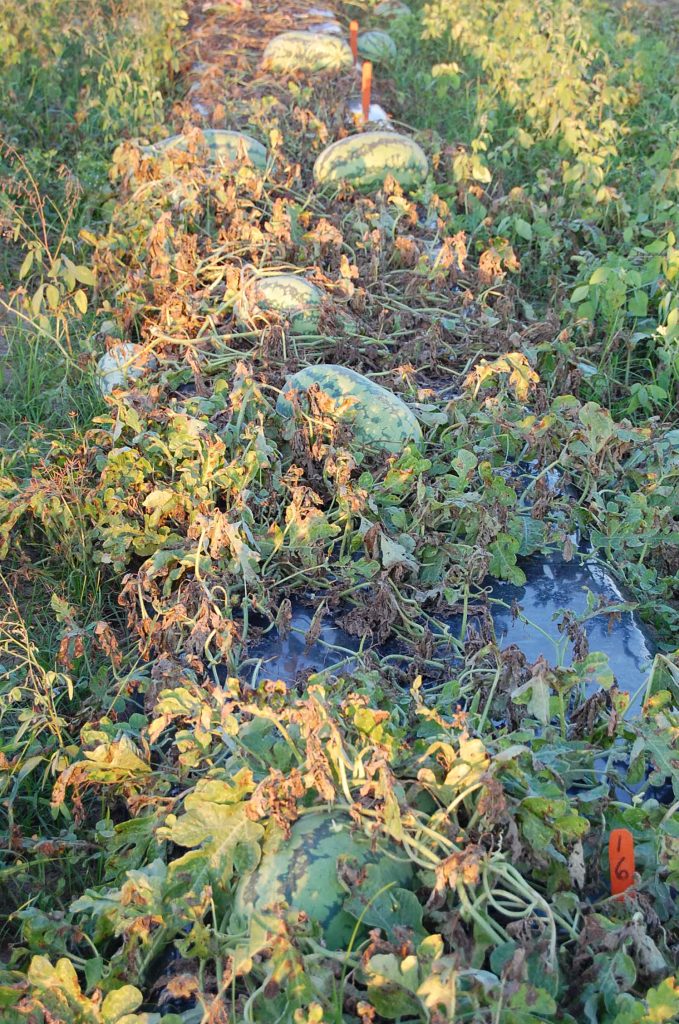
    File photo/Wilting is common in a heavy gummy stem blight outbreak.

    Rainfall over the weekend in north Florida has watermelon producers wary of potential diseases that could potentially occur. Bob Hochmuth, UF/IFAS Regional Specialized Extension agent in Live Oak, Florida, cautions farmers to look for any new symptoms that could occur.

    “Most of our fungicides are in fact preventative. Trying to play catch-up with a preventative fungicide after a disease has gotten started is not the best plan,” Hochmuth said. “There are some systemic fungicides that have good activity once we see the disease start. But for sure, we want to try to stay on a really good, early-season preventative maintenance program. What we try to do as we move into these next few weeks is to keep a close eye on new diseases and then begin to target the fungicide application to the best-case scenario for the diseases that show up.

    “We don’t have a lot of silver bullets to correct a problem once it occurs.”

    Farmers Prefer Dry Conditions

    Florida watermelon producers prefer a dry production season since the crop is vulnerable to various diseases. Farmers utilize drip irrigation to supply ample amount of water. But any extra moisture leaves the crop susceptible to potentially devastating diseases.

    “The drier conditions typically help reduce the disease pressure. The only exception to that is powdery mildew. It can still be a problem, even in dry weather,” Hochmuth said. “But the other diseases, the primary ones being downy mildew, gummy stem blight and bacterial diseases, those are all encouraged by, especially, multi-day rain events.”

    He added that watermelon fields were disease-free heading into the weekend. But chances are that could change this week.

    “There was pretty significant rainfall throughout the watermelon growing region. A little bit on Friday but pretty significant on/off showers over the weekend,” Hochmuth said. “We were clean going into the weekend I feel like. We haven’t really seen anything other than the fusarium wilt, which has nothing to do with rain.

  • Georgia Strawberry Farmer: Disease Wiped Out This Year’s Crop

    Neopestalotiopsis Fruit Rot is not just impacting Florida strawberry producers. It has quickly made its way north. Just ask Georgia strawberry farmer Bill Brim.

    Photo by Natalia Peres/UF: Shows the effect of Neopestalotiopsis Fruit Rot on strawberries.

    “It just wiped (my strawberries) out. As a matter of fact, we sprayed it with roundup (Wednesday),” Brim said.

    Brim’s strawberry production equated to 12 acres.

    “It’s a pile of money, too, the plants; about $60,000 worth of plants,” said Brim, who is in his fifth season growing strawberries at Lewis Taylor Farms, in Tifton, Georgia. “We didn’t have it last year. If we had it, we didn’t know it. It wasn’t noticeable. There might have been a few plants.”

    But that wasn’t the case for this year’s crop.

    Symptoms

    Neopestalotiopsis causes leaf spots on strawberry plants. It develops quickly and produces spores on the leaves. It can cause severe leaf spotting and fruit rot under favorable weather conditions. The disease was first discovered during the 2018-19 season in five farms and was attributed to one nursery source in North Carolina.

    “We’re going to have to change vendors is what I think we’re going to have to do; get them out of California, Canada, somewhere. Can’t grow them in Florida, send them over and plug them out in North Carolina and get a clean plant, don’t look like,” said Brim, who is not the only Georgia strawberry farmer impacted. “It’s not just us, there’s several other growers that have got it, too.”

    Disease instances have increased over the past three seasons. The disease was also discovered in fields that had it the prior season.

    One Florida producer even called it the “Greening of Strawberries.”

  • Resistant Varieties Key Against Anthracnose

    UGA Extension photo/Shows anthracnose disease in pepper.

    It is never too early to start thinking about cucurbit disease management in Alabama. In the case of anthracnose, producers who are planting their crops are best served by utilizing resistant varieties, according to Ed Sikora, professor and Extension plant pathologist in the Department of Entomology and Plant Pathology at Auburn University.

    “I was just looking through the Southeast Handbook for 2021 and we do have a lot of anthracnose-resistant varieties for a number of different crops; for watermelon, cantaloupe and cucumber. That’s the best control practice we have if you have a history of this disease in your field,” Sikora said.

    It’s important to avoid overhead irrigation if you are not using disease-resistant varieties. It just promotes the disease and provides conditions for its development.

    Follow a fungicide spray program when there are warm and wet conditions. These conditions will favor the disease’s development.

    Sikora said anthracnose is probably the most common cucurbit disease every year.

    “Cantaloupe, cucumber and watermelon are all sensitive to it, more susceptible. You’ll see these tan to brown spots on the leaves, fairly small and conspicuous. Often times, you’ll see shallow elongated tan spots on the stems as well,” Sikora said. “On the fruit, you might see sunken areas on the fruit with pink discoloration to them, which is the disease-producing fungal spores.”

  • Devastating Disease: Bacterial Spot a Problem for Some Florida Producers

    UF/IFAS picture shows bacterial spot on tomato.

    According to the South Florida Pest and Disease Hotline, bacterial spot disease is active in tomato and pepper fields on the east coast and around southwest Florida.

    It is present at moderate levels in older hot pepper plants. Bacterial spot disease flares up after rain events and with fog in tomatoes and non-resistant peppers across the southwest region of Florida.

    Reports from the Manatee Ruskin indicate low levels of bacterial spot in susceptible peppers. Farmers and scouts in Homestead, Florida report the disease is present in tomato and susceptible pepper varieties.

    Bacterial spot is a serious threat to tomato and pepper production in Florida. It spreads quickly during warm periods with wind-driven rains. Fruit symptoms lead to reduced marketability.

    Symptoms on tomatoes include distinct spots with or without yellowing. Fruit spots often begin as dark specks with or without a white halo. As spots increase, they become raised and scab-like.

    Click here for additional information on bacterial spot.

  • Florida Producer: It’s the Greening of Strawberries

    Citrus Greening has devastated Florida’s citrus industry. The state’s strawberry producers are concerned about their future with Neopestalotiopsis Fruit Rot disease.

    Photo by Natalia Peres/UF: Shows the effect of Neopestalotiopsis Fruit Rot on strawberries.

    It may still be in its infancy, but Neopestalotiopsis Fruit Rot is taking its toll on the Florida strawberry industry. One Florida producer is concerned about its impact moving forward.

    “I would call it the ‘Greening of strawberries,’” said Matt Parke, farm manager of Parkesdale Farms in Plant City, Florida. “There’s no cure for it, as we know. This is the third season that we know what it is, and we still have more questions than answers.”

    Decreased Volume

    Parke said volume has been way off this year, maybe two-thirds of what last year’s crop produced. It varies from farmer to farmer. While the weather played a role in decreased production, so has Neopestalotiopsis.

    “The whole industry was impacted by it, I think,” Parke said. “Just on one pick, I probably threw 400 flats to the acre on the ground. They were just totally ate up with it.

    “I would say for the next three years, it’s going to take a hit on our industry.”

    Disease Background

    The disease has quickly spiraled out of control in three years. It was first discovered during the 2018-19 season in five farms and was attributed to one nursery source in North Carolina. More than 20 farms experienced the disease during the 2019-20 season, and the disease was attributed to two nursery sources early in the season in North Carolina and Canada.

    It was discovered this year in fields that had it the prior season.

    Neopestalotiopsis causes leaf spots on strawberry plants. It develops quickly and produces spores on the leaves. It can cause severe leaf spotting and fruit rot under favorable weather conditions.

    Unfortunately, it can be hard to detect because of other similar leaf spot diseases that growers must contend with like leaf scorch, leaf blotch and Cercospora leaf spot.

  • Grape Diseases: Mildews a Concern for Producers

    No matter what environmental conditions grape producers face this season, they are likely to encounter either downy mildew or powdery mildew.

    Early powdery mildew on a grape leaf in this UGA photo. Note the white fuzzy patches on the upper side of the leaf (photo courtesy of Brooke Warres; UGA Plant Pathology).

    “Powdery mildew actually does better in a drier environment. That’s why it’s a major problem in places like California. But when we have dry conditions, it can be worse for us. Even in wet conditions, we have it,” said University of Georgia Cooperative Extension Fruit Disease Specialist Phil Brannen.

    “Downy mildew is one that we deal with year in, year out. They don’t even have it in California because it’s too dry out there. With our wet environment, it’s the one we have the most of on a year-in, year-out basis and gives us the most trouble trying to control.”

    Comparing the Two

    While the two diseases sound similar, they are much different.

    Downy mildew is not a fungus, but powdery mildew is caused by a fungal organism.

    Downy mildew attacks all the green parts of the vine, but the leaves are especially susceptible. The disease can cause up to 100% crop loss if unmanaged. Oil spots will develop on the top of the leaves, which can lead to desiccation and defoliation.

    Powdery mildew causes issues on the leaves and fruit. It opens channels into the fruit which allows other organisms to rot the fruit. Signs of white powdery growth will show up on the surface of the fruit and leaves. Any amount of the disease will cause an off-flavor in wine production.

    Potential Resistance

    What is especially concerning for grape growers is the pathogens that cause both diseases are developing resistance to several fungicides in use. According to Brannen, downy mildew Qol resistance is widespread in Georgia vineyards. Resistance development has also been reported in powdery mildew in Qols, DMIS and SDHIs in various parts of the world.

    “The pathogens that cause those diseases are developing resistance to quite a bit of the fungicides we utilize for controlling them. They’re becoming more and more of a challenge to manage from the standpoint of developing a spray program,” Brannen said.