Florida and Georgia remain two of the leading cucumber-producing states in the country. Along with Michigan and North Carolina, they harvest more than 60% of the nation’s fresh market acres, according to USDA Vegetable and Pulses April Outlook.
However, imports continue to challenge the two states for market supremacy, accounting for more than three-fourths of domestic availability, up from less than one-half in 2000.
Imports of fresh cucumbers totaled 2.19 billion pounds in 2020 and are projected to increase in 2021 amid the pandemic. Mexico remains the leading source of imported cucumbers, averaging 80% of the annual volume from 2018-20. Canada provided 16% of import volume during that same timeframe.
Imports accounted for 87% of domestic availability, up from 61% in 2010. From 2015 to 2019, cucumber imports increased by 5% every year.
Greenhouse production accounts for 11% of the domestic cucumber production, up from 10% in 2014 and 3% in 2009. Greenhouse import share, which was 15% during 2010-12, is slowly increasing.
Cucumbers and squash were the source of an investigation by the U.S. International Trade Commission. The hearing centered on the impact that imports are having on the domestic industry.
The sweetpotato whitefly (Bemisia tabaci) is one of the most problematic pests in vegetable production in the world and it is a key pest in squash. Most significant damage caused by this pest is due to the transmission of viral diseases and its ability to rapidly develop resistance to pesticides.
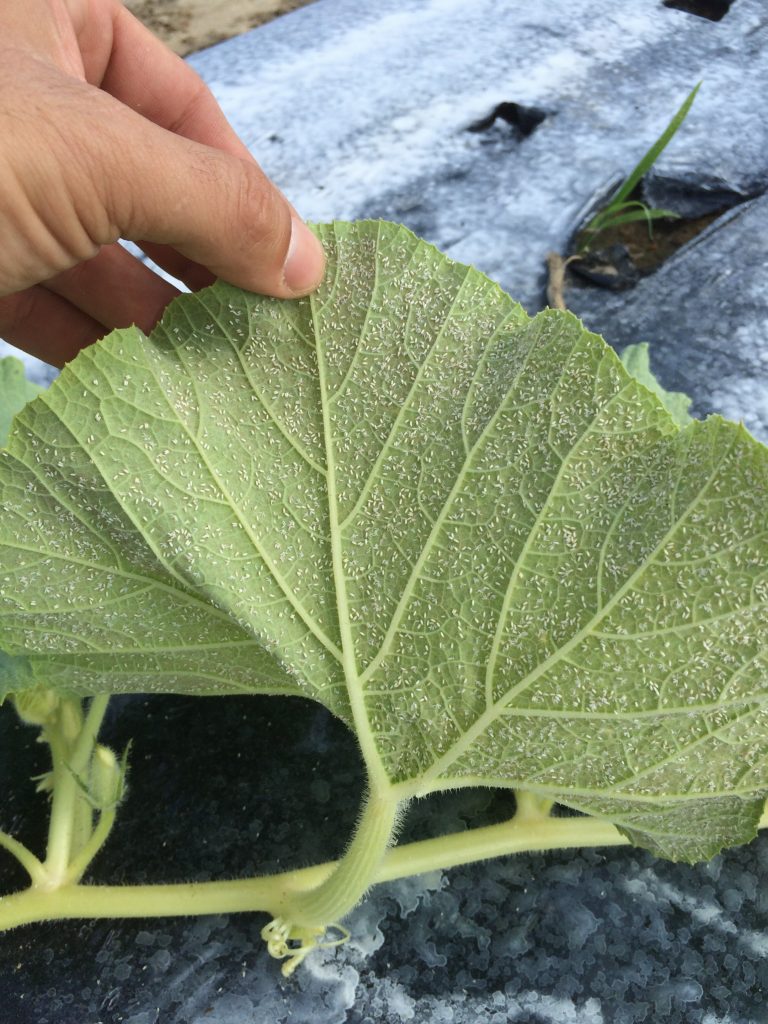
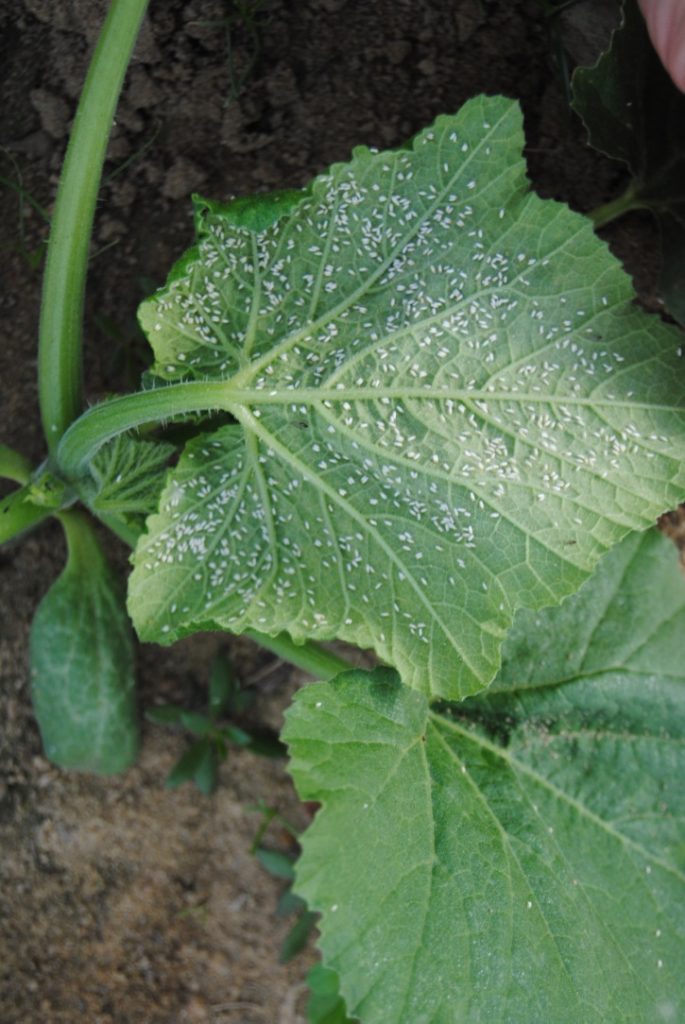
Sweetpotato whiteflies can develop from egg to adult in two to three weeks under optimal environmental conditions (77 to 91°F, 50-70% relative humidity). Adult whiteflies are ~0.03- inch-long, yellow insects with two pairs of iridescent white wings.
Females can live up to 24 days and lay up to 300 eggs. Eggs are oval, pearly white to yellow, and darken as they mature.
Whitefly nymphs disperse briefly within the same leaf and then attach permanently to the leaf while continuously feeding on its contents. Before turning into adults, nymphs are less flattened and have big red eyes.
THE DAMAGE DONE
Sweetpotato whiteflies are usually found living and feeding on the lower side of squash leaves. Nymphs excrete honeydew that accumulates on leaves, flowers and fruit when populations reach high numbers. This results in sooty mold (fungus) development, reduction in photosynthesis and fruit losses.
A) Silvered squash leaves. B) Healthy fruit (top) and fruit with discoloration due to viral infection (bottom)
Feeding of nymphs is also associated with the development of squash silverleaf disorder in pumpkins, winter and summer squash, and some types of butternut squash. Squash silverleaf causes the newly developing leaves to turn silver due to proteins in the nymph’s saliva. Decreased photosynthesis and yield reductions result from high silvering of the squash leaves.
Additionally, sweetpotato whiteflies transmit multiple viral diseases to squash. These include cucurbit leaf crumple virus, cucurbit yellow stunting disorder virus and squash vein yellowing virus. Common symptoms of viral diseases in squash include plant stunting, leaf and fruit malformation, yellowing and discoloration.
In Florida, squash is grown mostly during the fall from mid-September to mid-November. Some growers may also plant squash in the spring from mid-March to mid-April. It is common to have higher whitefly pressure during the fall compared to the spring season. The combination of whitefly-transmitted diseases with high pest infestations can cause up to 50% reduction in marketable yield during the fall compared with the spring season when fewer viral diseases and low whitefly infestation levels are observed.
WHAT TO DO
The management of plant viruses is best achieved when resistant varieties are available. However, there are no squash varieties resistant to whitefly-transmitted viruses yet. Therefore, squash plant viruses are mainly managed by suppressing the vector.
Sweetpotato whitefly populations are usually managed using insecticides that are applied on a weekly basis. However, the development of resistance against these insecticides is always a major concern. Entrust (spinosad) is a low-risk pesticide commonly used in vegetable crops, but it is not effective against whiteflies. Other low-risk pesticides such as M-Pede® (soap concentrate) or Azera® (azadirachtin + pyrethrins) are effective against whitefly populations and can be used together with biological control agents like predatory mites.
A) Adult predatory mite (Amblyseius swirskii) females guarding eggs. B) Larvae (left) and nymph (right) of A. swirskii
The predatory mite Amblyseius swirskii is an effective predator of major pests found in Florida squash including sweetpotato whitefly and thrips. A. swirskii feeds mostly on whitefly eggs and small whitefly nymphs. Data from University of Florida biological control field studies showed that the predatory mites released onto squash leaves can rapidly disperse to other plants and suppressed whitefly populations as early as four weeks after planting. Additionally, squash silvering can be significantly reduced when this predatory mite is released.
Data from field trials also indicate A. swirskii can disperse regardless of the squash cultivar. Moreover, squash cultivars exhibit different levels of sweetpotato whitefly attraction and susceptibility to silvering. Gold Rush is a sturdy squash cultivar that showed fewer silvered leaves compared to high-yielding squash cultivars such as Zephyr and Cash Flow. Additionally, Zephyr and Cash Flow seemed more susceptible to squash silverleaf.
Zephyr squash is very attractive to farmers and consumers due to its green-yellow tone, but it was observed to be highly attractive to whiteflies as well. This is probably due to the light green color of the leaves that make the plants easily detected by whiteflies.
No significant reductions in yield were observed despite high levels of silvering. However, plants were observed to be stunted and deformed when infested with high numbers of whiteflies and in the presence of whitefly-transmitted viruses. Thus, early management of sweetpotato whiteflies is recommended to avoid risking fruit quality.
It is important to combine the use of predatory mites with other practices such as intercropping flowering plants in row middles or at the edges of the squash crop to attract other predators and parasitoids that can complement the release of predatory mites. Additionally, low-risk pesticides can be used to lessen severe whitefly infestations three to five days before the release of the predatory mites. It is best to release the predatory mites early in the morning or late in the afternoon to avoid the hottest hours of the day, during days with low winds and when there is no forecast for rain.
Lorena Lopezis a postdoctoral research associate and Oscar E. Liburdis a professor at the University of Florida in Gainesville.
Not everyone believes there is a problem with Mexican imports and their impact on the domestic industry. In fact, Lance Jungmeyer, president of the Fresh Produce Association of Americas, believes “Mexico cannot be blamed” for many of the issues Southeast farmers are trying to overcome.
“In reality, many of the problems facing the Southeast growers – labor, hurricanes, real estate development, consumer demand – have nothing to do with Mexican imports but everything to do with the growers’ inability or unwillingness to supply that market as demanded,” Jungmeyer said.
Labor
Labor rates play a significant role in comparing the Florida vs. Mexico. It was established during Thursday’s ITC hearing regarding the impact imports have on the Southeast domestic market, that Mexico’s minimum wage is $10 per day. Florida just voted to increase its minimum wage that will increase to $15 per hour over the next few years.
Jungmeyer was also critical of Florida and Georgia’s usage of the H-2A program and believes their lack of available workers has led to quality issues.
“Mexico cannot be blamed for U.S. farmers not having labor, agricultural workers, to work in their fields. Perishable products such as cucumbers and squash are labor intensive crops, particularly for the harvesting and packing. Without adequate labor, Southeast growers are at a severe disadvantage in how they grow and pack. Their products result in a distinct quality disadvantage that U.S. retail customers clearly recognize,” Jungmeyer said.
Industry leaders in Florida and Georgia insist, though, there is not a labor shortage.
Weather Issues
Jungmeyer’s defense of Mexican imports also centered on hurricanes that are an annual threat to Florida production.
“Mexico cannot be blamed for the hurricanes and tropical storms that cause damage to crops. The threat of bad weather is reason alone why many retail customers seek Mexican suppliers to at least backstop the risk of Florida suppliers running into weather-related supply problems. This happens in Georgia as well. The risk of hurricanes is also a significant disincentive for southeast growers to pursue using protected agriculture to grow cucumbers and squash,” Jungmeyer said.
He also mentioned real estate development for a reason that many Florida producers have sold land instead of continuing the family business.
Consumer preference was his final point of defense. Jungmeyer claims consumers just prefer Mexican produce compared to American producers.
“Consumer choices have evolved to favor premium produce items like fancy squashes and cucumbers. This is in a way similar to how consumers choose bell peppers that are grown in protected agriculture because of the variety and color of peppers available and even the perfect appearance of those green protected agriculture peppers. We also have a perfect appearance in Mexican squash and cucumbers,” Jungmeyer said. “The extreme high quality in imported Mexican produce (distributors) sell gives them a significant demand edge in the market.”
UGA Extension photo/Shows anthracnose disease in pepper.
It is never too early to start thinking about cucurbit disease management in Alabama. In the case of anthracnose, producers who are planting their crops are best served by utilizing resistant varieties, according to Ed Sikora, professor and Extension plant pathologist in the Department of Entomology and Plant Pathology at Auburn University.
“I was just looking through the Southeast Handbook for 2021 and we do have a lot of anthracnose-resistant varieties for a number of different crops; for watermelon, cantaloupe and cucumber. That’s the best control practice we have if you have a history of this disease in your field,” Sikora said.
It’s important to avoid overhead irrigation if you are not using disease-resistant varieties. It just promotes the disease and provides conditions for its development.
Follow a fungicide spray program when there are warm and wet conditions. These conditions will favor the disease’s development.
Sikora said anthracnose is probably the most common cucurbit disease every year.
“Cantaloupe, cucumber and watermelon are all sensitive to it, more susceptible. You’ll see these tan to brown spots on the leaves, fairly small and conspicuous. Often times, you’ll see shallow elongated tan spots on the stems as well,” Sikora said. “On the fruit, you might see sunken areas on the fruit with pink discoloration to them, which is the disease-producing fungal spores.”
According to today’s release of the South Florida Pest and Disease Hotline, whitefly numbers are increasing in some older tomato fields across the southwest Florida region. As many as 5 to 10 whiteflies per leaflet have been detected.
Whiteflies are also present in high numbers in cucumbers, squash and eggplant. They are beginning to show up in some young tomato and watermelons as well.
Pressure remains light in the Manatee Ruskin area, though growers are just now planting.
Whitefly infestations are high in some older eggplant and reaching moderate levels in tomato along the East Coast. In Homestead, Florida, whiteflies are increasing in various crops. There are also reports that Tomato Yellow Leaf Curl Virus, a disease caused by whiteflies, is widespread in tomato.
Management of whiteflies later in the season depends on suppression of whitefly populations early in the season. Growers need to be aggressive with the best systemic materials such as Venom, Sivanto Prime and Verimark.
Whiteflies are difficult to control because of their prolific reproductive cycle. A female can lay between 150 and 200 eggs. It only takes those whiteflies two to four weeks to mature into the adult stage and begin reproducing.
File photo shows downy mildew disease on a cucurbit plant.
Fungicide resistance remains a concern for Florida vegetable farmers trying to manage downy mildew disease.
Scientists like Gary Vallad, a Professor of Plant Pathology at the University of Florida/IFAS Gulf Coast Research and Education Center, implore producers not to be too reliant on one specific fungicide. It can lead to resistance issues.
“Orondis is one that is kind of the industry standard. It’s probably the most effective product available. But it also is in that category of being high risk for resistance,” Vallad said.
“What we’re trying to do here is show growers there are a number of other products that are very effective and would be very good to rotate them in with your Orondis program. What we want to do is make sure the industry is not just relying on Orondis that they are utilizing these other tools they have in the toolbox as well.”
Consequences of Misdiagnosis
Vallad also cautions growers about the consequences of misdiagnosing downy mildew.
“The symptoms can vary based on the cucurbit host itself. Symptoms on cucumber are very classic, but if you get some of the other cucurbit species, the symptoms can vary. A great example is there were some watermelon samples that came in the lab where folks thought it was gummy stem blight and it actually was downy mildew,” Vallad added.
“If you’re not careful, you can misdiagnose. The bad thing is, a lot of things we use for gummy stem blight, fungicides for that management, are not going to work very well on downy mildew, and vice versa. Like all diseases, getting a proper diagnosis is very critical to properly managing it.”
Downy Mildew Background
Downy mildew disease can destroy plant foliage and cause the leaves to curl and die. Without healthy leaves and vines, a plant is vulnerable to blisters and sunscald during hot days. The pathogen thrives in wet, humid conditions and needs moisture on the surface of the plant for successful spore germination and further infection.
“It is an extremely aggressive pathogen, especially under the growing conditions in Florida. A big reason why we have so many big issues here in Florida is because of our environmental conditions. Most of our varieties don’t have any type of resistance to it, which means we’re highly reliant on fungicides for management,” Vallad said.
“We’re sub-tropical so we always have warm weather. Our relative humidity is really high. Of course, it’s Florida so we get lots of rainfall as well. These are very ideal conditions for this fungus.”
The disease is favored by a temperature range of between 41 degrees F and 86 degrees F; relative humidity greater than 90%; period of near-saturated relative humidity for sporangia formation, which includes heavy morning dew, foggy mornings and rain. Spores are easily dispersed by wind and rain.
Congressional support of Georgia’s vegetable and specialty crop sector has helped lead to potential investigative action regarding imports of cucumbers and squash.
Letters from both Georgia U.S. Senators; David Perdue and Kelly Loeffler; as well from four Georgia Congressmen; Sanford Bishop (D-GA-02), Austin Scott (R-GA-08), Buddy Carter (R-GA-01) and Rick Allen (R-GA-12), were sent to U.S. Trade Representative (USTR) Robert Lighthizer, asking that the current Section 332 investigation for strawberries and bell peppers be expanded to include cucumbers and squash.
USTR Responds
The USTR requested on Friday investigations from the US International Trade Commission (ITC) into the imports of both commodities and the effect on domestic seasonal markets.
It is much needed action for Georgia’s vegetable growers, says Charles Hall, executive director of the Georgia Fruit and Vegetable Growers Association.
“We prepared a ‘white paper’ based on what was happening this fall. This fall, we saw squash prices and particularly some cucumber prices just drop out the bottom. Mexico products hit and the market and prices went to almost nothing. We prepared a ‘white paper’ for the Congressmen and asked for any help they could provide. Both the House Congressional staff and the Senate staff, they both submitted the letter to Lighthizer asking for support,” Hall said.
“It’s very good from that standpoint that we’ve been able to get them to step in behind that. Those six offices have always been very supportive of our issues and concerned about USMCA as it was coming up for a vote.”
On Friday, December 4, 2020, U.S. Trade Representative Robert Lighthizer issued a letter to the Chairman of the U.S. International Trade Commission (ITC) requesting investigations into the import of cucumbers and squash and the effect on the domestic seasonal markets.
The request is to investigate the monthly price trends, including an analysis and comparison of the prices of domestically produced products and imported products.
In September, a comprehensive plan to support American producers of seasonal and perishable fruits and vegetables was released from the Office of the United States Trade Representative (USTR), the U.S. Department of Agriculture (USDA) and the Department of Commerce (Commerce). The plan was developed after growers provided more than 300 written submissions, and more than 60 witnesses testifying during two days of hearings.
U.S. Senators David Perdue and Kelly Loeffler, along with Congressmen Austin Scott and Buddy Carter, have led the fight for Georgia produce farmers struggling against unfair trade practices with Mexico. In mid-November Perdue, Loeffler, Scott and Carter along with Representatives Rick Allen and Sanford Bishop, requested Lighthizer broaden the Section 332 investigation for strawberries and bell pepper to include the impact on seasonal cucumber and squash imports have on Southeastern markets.
“While our fight against unfair trade practices with Mexico is far from over, this is a great day for Georgia fruit and vegetable growers. We now have investigations underway for blueberries, strawberries and green pepper, and a request from USTR to also investigate squash and cucumbers,” said Charles Hall, Executive Director of the Georgia Fruit and Vegetable Growers Association. “Our growers express sincere appreciation to Senators Perdue and Loeffler and Congressmen Scott, Carter, Allen and Bishop for their efforts to fight for this additional investigation. In addition, we appreciate Ambassador Lighthizer following through on his commitments. He promised to have hearings so Southeastern grower concerns could be heard, with appropriate follow-up based on the testimony presented.”
Hall is encouraged these official investigations will show unfair trade practices in Mexico, and hopefully, a solution determined as soon as possible.
Whiteflies were projected to have a widespread, devastating impact on fall vegetable crops in Georgia. But according to University of Georgia vegetable entomologist Stormy Sparks, that never happened.
“We were setting up for an explosion of whiteflies in the fall and it never really occurred,” Sparks said. “I’m pleasantly surprised it wasn’t a lot worse than it was. In the summer, we were set up to be ugly, ugly.”
Greater Problem This Year
Whiteflies were a greater problem this year due in large part to a mild winter last year. They were widespread and posed a similar risk to the fall vegetable production that Georgia producers experienced in 2017. Thankfully, it never materialized.
“It didn’t get nearly as bad as I thought it was going to get. I think cotton growers deserve a pat on the back. I think they did a much better job of managing it than they have in the past because they expected it,” Sparks said. “I was really expecting virus to wipe out some of the crops and it didn’t happen. I was really pleased with that. I think a lot of it is just the area wide management of whiteflies.”
Impending La Nina
Whitefly management continues to be a crucial component of vegetable production with the expectation of a La Nina weather pattern this winter. A La Nina is expected to bring warmer temperatures and drier conditions throughout the winter and into early spring. This could allow for more overwintering of whiteflies if the colder temperatures do not kill off their host plants.
“We want cold weather to kill the host plants. We don’t ever get cold enough to kill whiteflies. It takes a lot of cold for a long period to kill a whitefly. But what we (want) is to kill the host plants, which all it really takes is a frost for a lot of them,” Sparks said.
“When we get rid of cucurbits, that gets rid of a lot of our major host crops. Then it’s management of whiteflies in those cole crops that is very important during the winter. The generation time really lengthens so you don’t tend to have a lot of buildup, but you can carry them through, the warmer it is and the less we manage them.”
Congressmen Austin Scott, Sanford Bishop, Rick Allen and Buddy Carter continue to fight for Georgia produce farmers and against unfair trade practices with Mexico. In a letter sent to U.S. Trade Representative Robert Lighthizer, the congressmen requested that the current Section 332 investigation for strawberries and bell pepper be broadened to include the impact seasonal cucumber and squash imports has on Southeastern markets.
Scott
“We were pleased to see that USTR has requested a Section 332 for strawberries and bell peppers. However, we believe the inclusion of other commodities, such as cucumbers and squash, in the Section 332 request, would provide some assistance to growers as they continue to struggle with seasonal imports for the upcoming harvest season,” said the congressmen.
“Section 332 investigation request to the International Trade Commission for cucumbers and squash is needed in order to make a meaningful determination as to the impact of these seasonal imports on Southeastern markets,” the congressmen wrote in their letter.
“We are pleased to have the continued support of members of the Georgia House delegation in our efforts to level the playing field for our industry, said Charles Hall, GFVGA Executive Director. “Market data developed by GFVGA clearly outlines the need for a broadened investigation and we applaud their efforts and support of Georgia farmers.”
The Georgia Fruit and Vegetable Growers Association is committed to continue to work with the Georgia congressional delegation and provide them with the data and support to provide relief for Southeastern growers.