Category: Cole Crop

  • Diamondback Moths a Problem for Cole Crop Producers

    University of Georgia CAES photo by David Riley/Shows diamondback moth and its damage.

    Diamondback moths are starting to show up in some vegetable fields across Georgia, says Stormy Sparks, University of Georgia Cooperative Extension vegetable entomologist. Cole crops producers need to be wary of this pest, as it can pose a threat to cabbage, collards, kale and broccoli.

    “Diamondback moth is starting to show up in some areas. We’ve had three or four really bad fields, and they’re really hard to control,” Sparks said. “It’s been scattered. It’s not just one area right now, either.”

    Generations Per Year

    According to UGA Extension, there are multiple generations per year in Georgia. Generation time will slow considerably in the winter months. However, greater moth activity has been observed when temperatures are higher than normal in December and January. That could be the case this winter with an extended La Nina weather pattern expected.  

    “That’s a strange pest. It has the potential to explode or disappear anytime of the year,” Sparks said. “They can be a problem in the middle of the summer and in the middle of the winter or they can just disappear.”

    Insecticide Effectiveness

    Sparks said they have looked at insecticide products like Proclaim and Radiant. He characterized their success as good to fair. Nothing looks great because this is a hard pest to kill.

    “They are the world champion of insecticide resistance,” Sparks said.

    He added that with the Group 28 insectides, resistance looks pretty severe.

    According to UGA Extension, larvae will feed on foliage. Early instars can cause small channels in the leaf surface. Larger larvae can cause perforations in the leaf. Populations above 0.3 larvae per plant need to be controlled. Sparks recommends growers scout weekly to determine if that threshold level has been reached.
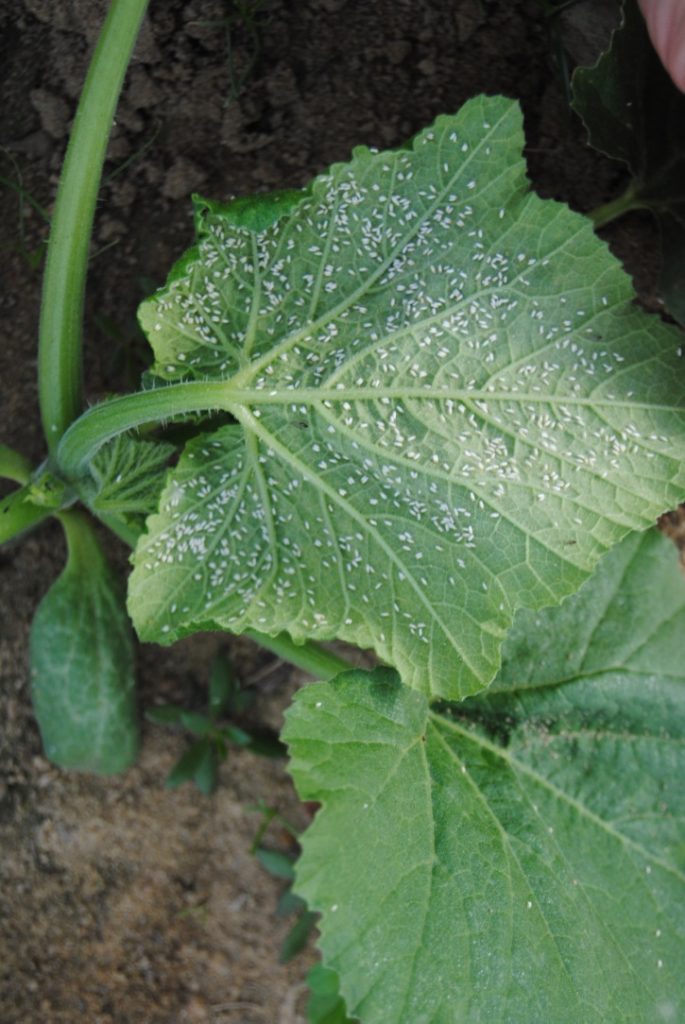
  • UGA Vegetable Entomologist: Potential Explosion of Whiteflies This Fall Never Occurred

    Whitefly adults feed on a yellow squash seedling.

    Whiteflies were projected to have a widespread, devastating impact on fall vegetable crops in Georgia. But according to University of Georgia vegetable entomologist Stormy Sparks, that never happened.

    “We were setting up for an explosion of whiteflies in the fall and it never really occurred,” Sparks said. “I’m pleasantly surprised it wasn’t a lot worse than it was. In the summer, we were set up to be ugly, ugly.”

    Greater Problem This Year

    Whiteflies were a greater problem this year due in large part to a mild winter last year. They were widespread and posed a similar risk to the fall vegetable production that Georgia producers experienced in 2017. Thankfully, it never materialized.

    “It didn’t get nearly as bad as I thought it was going to get. I think cotton growers deserve a pat on the back. I think they did a much better job of managing it than they have in the past because they expected it,” Sparks said. “I was really expecting virus to wipe out some of the crops and it didn’t happen. I was really pleased with that. I think a lot of it is just the area wide management of whiteflies.”

    Impending La Nina

    Whitefly management continues to be a crucial component of vegetable production with the expectation of a La Nina weather pattern this winter. A La Nina is expected to bring warmer temperatures and drier conditions throughout the winter and into early spring. This could allow for more overwintering of whiteflies if the colder temperatures do not kill off their host plants.

    “We want cold weather to kill the host plants. We don’t ever get cold enough to kill whiteflies. It takes a lot of cold for a long period to kill a whitefly. But what we (want) is to kill the host plants, which all it really takes is a frost for a lot of them,” Sparks said.

    “When we get rid of cucurbits, that gets rid of a lot of our major host crops. Then it’s management of whiteflies in those cole crops that is very important during the winter. The generation time really lengthens so you don’t tend to have a lot of buildup, but you can carry them through, the warmer it is and the less we manage them.”

  • Optimizing Nitrogen in Cabbage Production

    File photo shows a field of cabbage.

    By Ashley Robinson

    A shortage of nitrogen is the most common reason for a cabbage crop not reaching its full yield potential. However, applying too much nitrogen may cause more harm than good. It’s important to determine the optimal rate for production.

    Researchers at the University of Georgia (UGA) and the University of Florida are working in collaboration to conduct trials investigating the optimal rates of nitrogen fertilizer to produce cabbage. According to Andre da Silva, UGA Cooperative Extension vegetable specialist, the recommendations for fertility programs in Florida and Georgia were developed in the 1980s.

    “We were really in need of an update,” says da Silva. “Especially since new varieties have been introduced.”

    Research Trials

    According to da Silva, the study has taken place over the last four years and was tested in six different cabbage varieties. 

    “Two years of the project were conducted in Florida’s sandy soils, then we repeated the trials for another two years in Georgia’s loam sandy soil to compare,” da Silva said.

    During the study, researchers looked at the effects of applying a total nitrogen fertilizer rate of 107, 225 and 280 pounds per acre. Current recommendations suggest applying between 150-200 pounds of nitrogen per acre. But after harvest, researchers found that applying 225 pounds of nitrogen per acre produced optimal yields.

    According to da Silva, the results were the same for Florida and Georgia and in all six cabbage varieties. He also mentioned that there was no significant impact on yield between applying 225 pounds of nitrogen per acre and 280 pounds. However, he recommends growers apply 225 pounds per acre to maintain yields and increase profits.

    Although 225 pounds of nitrogen per acre seems to be the magic number, applications may need to be adjusted depending on weather conditions.

    “We found that in rainy years, we experienced a significant loss of nitrogen due to leaching. In this case, growers may need to bump up their fertility program,” da Silva said.

  • CFAP Coverage Dates Exclude Bulk of Specialty Crop Farmers in Alabama, Georgia

    By Clint Thompson

    The United States Department of Agriculture released details of the Coronavirus Food Assistance Program (CFAP) on Tuesday. It will provide up to $16 billion in direct payments to provide relief for farmers and ranchers impacted by COVID-19. It includes relief for livestock, dairy and specialty crops.

    Cabbage producers will be covered under the CFAP program.

    But according to Charles Hall, executive director of the Georgia Fruit and Vegetable Association, the bulk of Georgia and Alabama growers will not be eligible just due to the timing restrictions detailed in the program.

    “This particular package, the problem is the dates of the loss. This package puts January 1 to April 15, which excludes 90% of Georgia’s specialty crop growers. At that point, as of April 14, we’ve had little product on the market at that point. When you’re looking at peaches, blueberries, vegetables, we’re not covered in that,” Hall said. “From January to April, we had broccoli on the market. We had greens, turnip greens, cabbage; some of those cole crops were on the market then and would be eligible to be covered under that. It’s going to help some growers.

    “Georgia blueberries may have been on the market a week or two at that point.”

    CFAP will benefit mostly Florida farmers who have had to overcome produce loss and low market prices  as a result of the pandemic striking the U.S. in mid-March.

    CFAP Background

    According to the USDA press release, CFAP provides financial assistance to producers of agricultural commodities who have suffered a 5%-or-greater price decline due to COVID-19 and face additional significant marketing costs as a result of a drop in demand, excess production, and disruptions to shipping patterns and the orderly marketing of commodities.

    CFAP also includes the USDA’s Farmers to Families Food Box program. It is partnering with regional and local distributors, whose workforces have been significantly impacted by the closure of many restaurants, hotels, and other food service entities, to purchase $3 billion in fresh produce, dairy, and meat and deliver boxes to Americans in need.

    Beginning May 26, the U.S. Department of Agriculture (USDA), through the Farm Service Agency (FSA), will be accepting applications from agricultural producers who have suffered losses.

    For eligible specialty crops, the total payment will be based on the volume of production sold between January 15 and April 15, 2020; the volume of production shipped, but unpaid; and the number of acres for which harvested production did not leave the farm or mature product destroyed or not harvested during that same time period, and which have not and will not be sold. Specialty crops include, but are not limited to, almonds, beans, broccoli, sweet corn, lemons, iceberg lettuce, spinach, squash, strawberries and tomatoes. A full list of eligible crops can be found on farmers.gov/cfap. Additional crops may be deemed eligible at a later date.

    Another Stimulus Package?

    Hall is hopeful that if Congress passes another stimulus package, his growers would be sufficiently covered. It would provide a boost to farmers as the economy tries to recover from the current recession.

    “The bill that passed the House last week would cover Georgia specialty crop growers because it covered the first two quarters of the year. Most of our growers’ harvest will be through the end of June. That will be helpful from that standpoint,” Hall said.

  • Clemson Vegetable Pathologist Cautions Growers About Potential Diseases

    Pictured is downy mildew disease’s impact on vegetables.

    By Clint Thompson

    One Clemson Extension vegetable pathologist has observed downy mildew disease and fusarium oxysporum f. sp. niveneum disease on his research plots and cautions vegetable growers in South Carolina to be on the lookout for both.

    “This is strictly based on observations from my research plots here in Charleston. I have not been out to any commercial fields,” Tony Keinath said.

    Keinath reported downy mildew, a cool-season pathogen, on brassicas and can especially impact kale and collard.

    “For downy mildew on collard, the pathogen prefers to grow in cool temperatures. Once the temperature reaches 85 degrees F, the pathogen basically goes dormant until late fall. And it probably survives in crop debris. It’s dormant, it’s not active at all,” Keinath said.

    South Carolina has experienced cooler temperatures this spring, especially the timeframe between the end of April and first two weeks in May. Downy mildew mainly affects the lower leaves but will sometimes move to the larger leaves in the middle of the plant.

    “Because it causes leaf spots on the leaves and the leaves are what the growers are harvesting … even a small amount of downy mildew means the leaves can not be harvested,” Keinath said.

    Fusarium’s Impact

    Fusarium is also active in cool soil temperatures. It infects roots when the soil temperatures are below 82 degrees F. Unfortunately, if growers observe fusarium damage, there isn’t anything they can do to treat the disease. Fungicides need to be applied during transplanting.

    “If you spray them at this stage it’s too late because all the fungicides do is prevent infection. Once the fungus has gotten into the plant, then the fungicide does not work anymore,” Keinath said. “If they want to use grafted plants because the rootstocks are resistant to fusarium, that’s obviously something that has to be done at transplanting.

    “They should make note of how widespread it is in a given field this year. Then if it’s (bad) enough to cause yield loss, they need to plan to use a control measure the next time they plant watermelons in that same field.”

    There are different control measures available. One could be the watermelon variety and if it’s tolerant to the disease. Growers can also utilize varieties that produce medium to large size fruit. If you plant a variety that was bred to produce small fruit and you plant that in a fusarium-infested field, then a lot of those fruit will not reach marketable size.

    Growers can also utilize hairy vetch as a winter cover. It will provide some suppressive effect on fusarium. Producers can also apply fungicides to the row bed before they lay plastic. Or they can do it through drip irrigation the same day as transplant.

  • Whiteflies Already a Concern for Georgia Farmers

    By Clint Thompson

    University of Georgia Cooperative Extension vegetable entomologist Stormy Sparks said whiteflies are present in Georgia vegetables. This is not good since cotton farmers have begun planting their crop, and whiteflies like to feed on cotton plants as well.

    “There’s some. I don’t know if it’s worse or better or whatever compared to other years. Apurba’s been running those traps and checking some fields and he’s finding whiteflies,” said Sparks, referring to Apurba Barman, a postdoctoral researcher under UGA entomologist Michael Toews.

    “Apparently, they’ve always been here. But yeah, noticeable numbers in April is early, particularly in any fields. Where he’s finding most of them is kale which is not a good sign. That’s one of the crops they overwinter in. This time of year, having numbers is not good in any crop.”

    Why So Early?

    While colder temperatures don’t eliminate whiteflies, they do kill many of their wild hosts. They also slow population development in cultivated hosts. Warmer temperatures this winter allowed for larger whitefly populations to overwinter and become mobile earlier.

    “They’re able to carry through on crops a little easier. It never really gets cold enough here to really kill them, it just slows them down. Hopefully, the crops we have out there in the winter are not as good of hosts as some of our spring, summer or fall crops. You’re always hoping they’ll crash during the winter. But yeah, the mild winter undoubtedly plays a role in them overwintering a little better.”

    Whiteflies cause feeding injury issues in vegetables and transmit two viruses: cucurbit leaf crumple virus and cucurbit yellow stunting disorder virus. Vegetables like squash, zucchini, cucumber, cantaloupe and snap beans are highly susceptible to these viruses. Commercial cultivars that have resistance or tolerance to these pathogens are not available.

    Will They Get Worse?

    The weather patterns over the next couple of months will determine if the whiteflies continue to worsen. How much rain will there be? How heavy are the rains and when will they occur? This is especially important as farmers move from winter crops to spring crops and then to cotton. Freezes in the winter and a tropical storm-type of weather system really impact populations.

    “You never want a tropical storm but a good tropical storm at the right time really knocks them back,” Sparks said.

    Sparks and other specialists continue to preach sanitation with whitefly management. He said farmers have done better in recent years in getting rid of winter vegetables once they’re done harvesting. That needs to continue with the spring crops once they’re done.

    “If you’ve got crops where you know you’ve got them, if you’re done with the crop, get rid of that crop,” Sparks said. “I think overall we’ve been doing a better job with sanitation. That’s something we always need to hammer on and remind them that sanitation is critical.”