Category: Berries

  • USDA, USTR Announce Continued Progress on Implementation of Phase One Agreement

    Contact: USDA Press
    Email: press@oc.usda.gov

    WASHINGTON, May 21, 2020 – The U.S. Department of Agriculture (USDA) and the Office of the U.S. Trade Representative (USTR) today announced additional progress in the implementation of the agriculture-related provisions of the U.S.-China Phase One Economic and Trade Agreement (The Agreement), which entered into force on February 14, 2020. Recent actions described below build upon the actions announced by USDA and USTR on February 25, March 10, and March 24. These are difficult times for both our countries. It is important that we each continue to work to make our agreement a success. Because of this continued progress due to the Agreement:

    • U.S. blueberries and California Hass avocados can now be exported to China. This new market access will provide California avocado growers and blueberry growers from around the United States with new opportunities to market their products to Chinese consumers in the coming years. In 2019, China imported a record volume of fresh fruits and vegetables exceeding $8.6 billion.
    • U.S. barley for processing, along with the forage products Timothy hay, alfalfa hay pellets and cubes, and almond meal pellets and cubes can now be exported to China. In 2019, China imported $1.5 billion of barley used as feed and for malt beverage production, and a record $500 million of forage products.
    • In recent weeks, China updated its lists of U.S. facilities eligible to export beef, pork, poultry, seafood, dairy, and infant formula products to China. China’s lists now include 499 beef, 457 pork, 470 poultry, 397 seafood, and 253 dairy and 9 infant formula facilities. As a result of these actions, more U.S. facilities are eligible to export U.S. food and agricultural products to China than ever before. USDA’s Food Safety and Inspection Service continues to update its export library, which provides additional guidance for U.S. meat and poultry meat exporters, including information related to the scope of products that may be exported to China, China’s labeling requirements, and other guidance.
    • China published on May 15 a new domestic standard for dairy permeate powder for human consumption that will allow imports of this product from the United States in the future. In 2019, China imported nearly $12 billion of dairy products from around the world.

    China continues to implement its tariff exclusion process in an attempt to facilitate imports of U.S. commodities. USDA continues to publish guidance for U.S. exporters seeking to participate in this process (USDA Global Agricultural Information Network). USTR is continuing to process and where appropriate grant exclusions of products from China. USDA also is implementing its obligations under the agreement.

    Perdue

    United States Secretary of Agriculture Sonny Perdue said, “China is a market of tremendous potential for U.S. agriculture and these actions will help U.S. exporters expand their sales there. We look forward to continued cooperative work with China on implementation of Phase One commitments, and immediate increases in U.S. exports of all manner of agricultural products.”

    United States Trade Representative Robert Lighthizer said, “China has worked with the United States to implement measures that will provide greater access for U.S. producers and exporters to China’s growing food and agricultural markets. Under President Trump’s leadership, we fully expect this agreement to be a success.”

  • Keeping Spotted-Wing Drosophila Under Control

    Figure 1. Male and female spotted-wing drosophila

    By Ashfaq Sial

    Since its first detection in 2008, spotted-wing drosophila (SWD) has emerged as a devastating pest of berry and cherry crops throughout the United States.

    IDENTIFICATION AND DEVELOPMENT

    Male SWD have dark spots on the outer margins of their wings. Female SWD have saw-like ovipositors used to cut the skin of ripe or ripening fruit and deposit eggs inside the fruit (Figure 1).

    Figure 2. Spotted-wing drosophila damage progression in blueberry

    Larvae feed inside the berries and develop through three stages within the fruit, causing it to degrade (Figure 2). Larger larvae are visible to the naked eye, and if they are detected in the fruit, distributors may reject contaminated loads of fruit. SWD injury also increases the risk of damage by other pests and fungal infections.

    In regions with mild winter climates (e.g., Georgia, Florida and California), SWD adults can be captured in traps year-round and can infest ripe fruit. Females lay over 300 eggs that develop to adult flies in eight to 10 days during the growing season, completing several generations per year (Figure 3). High populations build up over a short period of time. A wide host range, fast generation time, ability to lay eggs directly into the fruit, and larvae being sheltered from insecticide applications while feeding inside the fruit make this pest a challenge to manage.

    Figure 3. Spotted-wing drosophila life cycle
    CONTROL COMPONENTS

    A multi-regional team of researchers I lead has investigated behavioral, cultural, biological and chemical strategies to effectively control SWD. This team was funded by the U.S. Department of Agriculture National Institute of Food and Agriculture through the Organic Agriculture Research and Extension Initiative (Project # 2015-51300-24154 and 2018-51300-28434). Based on the team’s findings, SWD control programs should consist of three major components: 1) monitoring and identification, 2) preventative tactics such as exclusion, sanitation, frequent harvest intervals, pruning, mulching and resistant varieties and 3) curative tactics such as the judicious use of insecticides.

    While a number of insecticides provide good SWD control in conventional production systems, organic management of SWD is really challenging. However, the research team developed a list of National Organic Program-approved insecticides that can be used to control SWD. Although insecticides are typically needed to maintain fruit quality on commercial farms, organic growers should integrate cultural, physical, behavioral and biological tactics into their SWD management programs as much as possible to help ensure effective control and prevent insecticide resistance development.

    10 TIPS

    Based on research findings, implementation of the following strategies is recommended to effectively control SWD and protect fruit.

    1. Planting regionally appropriate early-ripening varieties and varieties with thicker-skinned fruit can help decrease the chances of SWD infestation.
    2. SWD adults are very sensitive to desiccation (drying out) and do not perform well at high temperatures and low humidity. Heavy pruning of blueberries will allow more light to penetrate through the canopy, which may lower humidity and increase temperature leading to less SWD infestation.
    3. SWD larvae often emerge from fruit to pupate in a suitable protected place, usually under the soil surface. Using black plastic weed mat as mulch on the ground provides an effective barrier that prevents larvae from pupating underneath the soil surface, reducing SWD survival in the field.
    4. Physically excluding SWD from the crop is very effective in preventing SWD infestation. Timely installation of insect netting to high tunnel infrastructure (side walls and ends of tunnels) provides a physical barrier to SWD.
    5. Over-ripe and damaged fruit act as a reservoir for SWD and other pests in the field. Do not leave waste piles of fruit in the open. They should be bagged, burned or frozen. If bagging the fruit, use a clear trash bag and leave it in the sun for at least 48 hours to kill the larvae.
    6. SWD has a broad host range and will infest other non-crop plants, especially those that produce small fruits. A list of plants that can serve as SWD hosts is available at https://bit.ly/2JeVDwd. If these alternate plant hosts are present on the edge of the field, removing them could decrease the onset and severity of the SWD infestation.
    7. Ripe berries serve as a strong attractant for SWD. Frequent harvesting of the ripe fruit will decrease risk of SWD infestation in the fruit.
    8. Once SWD is detected in traps, insecticide applications need to be made to protect fruit from SWD infestation. Conventional management programs rely on the frequent use of pyrethroid, spinosyn, organophosphate, carbamate or diamide insecticides. Of these chemical classes, only the spinosyn insecticide spinosad is approved for use in organic systems. This means that other non-chemical control measures must be implemented to control SWD in organic berries. Among the organic insecticides, Entrust (spinosad) is the most effective but must be rotated with other insecticides to decrease resistance development and meet current label requirements. Products that can be used in a rotation program with Entrust include Pyganic, Grandevo, Venerate and Azera. Agricultural sanitizers such as Jet-Ag and OxiDate 2.0 used in tank-mix or rotation with insecticides also show some promise for use in organic integrated pest management programs.
    9. Spray coverage and timing of applications are critical to achieving good control. Sprayers should be calibrated at least annually, and appropriate spray volumes used to achieve excellent coverage. Initial research suggests that SWD are more active in the field during cooler parts of the day, in the morning and at dusk. Targeting sprays during these times may increase efficacy. When bees are present in the crop, avoid insecticide applications. If control is needed, use insecticides less toxic to bees and do not spray when they are active.
    10. After harvest, cool fruit as soon as possible to maintain quality. Cooling the fruit to 35°F for three days has been shown to kill SWD larvae. If fruit is sold directly to consumers, advise them to keep it in the refrigerator. Freezing the fruit will kill eggs and larvae of SWD.
    SUMMARY POINTS

    In a nutshell, controlling SWD requires a rigorous, persistent and diverse management plan. Using as many control techniques as possible will help to reduce SWD infestation. Continue to evaluate your management program by monitoring SWD populations. Sample ripe and ripening fruit regularly to determine whether your management program is working and respond in a timely manner if needed. Always stay informed of your regional SWD pressure and new management techniques by contacting your local research and Extension personnel and utilizing the resources recommended by them.

  • Clemson Extension Agent: South Carolina Produce Farmers Enjoying Good Spring

    By Clint Thompson

    South Carolina’s produce season is producing sweet results with its farmers. Clemson Extension Commercial Horticulture agent Justin Ballew said fruit and vegetable farmers in the Palmetto State are enjoying a strong spring season so far.

    Strawberry season has been really strong in South Carolina this year.

    “For the most part, we’re having a good spring. We’re in the last month of strawberry season and we’ve had a decent strawberry season for the most part. Demand has been really good this year. Folks are selling everything they pick with no problems at all,” Ballew said. “Other crops, we’ve got stuff growing pretty quickly, growing pretty well. Disease pressure has been low for the most part this year. Insect pressure hasn’t been terrible. We’re doing pretty well as far as growth.”

    And with one exception, growers have experienced little problem with Mother Nature.

    “The only weather-related issues we’ve had recently was from hail damage in … Chesterfield County, that area. They had some pretty tremendous damage to their peach crop up there, some strawberries and other stuff.  There was one large grower up there that was affected pretty badly,” Ballew said. “There were some thunderstorms that came through and dumped a bunch of hail up there.”

    According to the Agricultural Marketing Resource Center, South Carolina is the country’s No. 2 producer of peaches behind California.

  • N.C. State Specialist: Weekend Frost Damages Some Grapes

    By Clint Thompson

    North Carolina State small fruits Extension specialist Mark Hoffmann confirmed that grapes in his state experienced frost damage during last weekend’s cooler temperatures. The state’s strawberries appear to have escaped damage.

    Hoffmann

    “We got lucky for the most part and didn’t see a lot of damage in strawberries. Still a pretty strong strawberry season,” Hoffmann said. “But we had more frost damage in the mountains on grapes. I expect some crop loss this year due to frost damage on grapes.” 

    Freeze warnings and frost advisories were issued for different parts of North Carolina. Heading into the weekend, Hoffmann expected that strawberry growers would implement row covers on their crop. Row covers help reduce radiation in the field and provide adequate frost protection from temperatures in the 30s. Strawberry production is currently in mid-season. If row covers were not used, the low temperatures could have harmed the open blossoms that are still on plants, which lead to late-season fruit. Temperatures could also harm the actual fruits in popcorn stage and other green fruits.

    He also confirmed this was the third frost event for the state’s grape crop. It was especially vulnerable this time since it is late in the season.

    Hoffmann estimates that more than 1 million bottles of wine are produced every year in the state and there are 1,500 acres of grape in state.

  • Challenging Seasons for Georgia Blueberry Producers

    By Clint Thompson

    Between natural disasters, a pandemic and unfair trade practices, Georgia blueberry farmers have taken one blow after another the past four years. For some farmers, a hailstorm on April 23 was the ultimate knockout punch.

    File photo shows blueberries ready for harvest.

    Russ Goodman, co-owner of Cogdell Berry Farm with 600 acres in Clinch and Lanier counties, lost between 60% and 70% of the crop following the storm.

    “In 2017, we had Irma and a late freeze. In our 2018, Hurricane Michael and a later freeze. Then we’ve had the deluge of Mexican blueberries that have hit us. Now, we’ve been hit with this coronavirus and now this storm,” Goodman said.

    Phillip Mixon’s farm in Waycross, Georgia has about 850 acres with approximately 600 that would have been harvested. Its entire farm was devastated by the hail. The storm knocked a bunch of blueberries off, but what was left on the bush was bruised really bad. They were left unmarketable.

    Mixon estimated he lost about 5 million pounds.

    “We’ve faced a lot of challenges that are outside of our control. We do everything that we can as far as being good managers. You have no control over a hurricane or storm how trade issues are negatively impacting Southeastern farmers,” Goodman said. “It’s just a lot of things outside of our control.

    “We were going to have a good crop. We’re no different than the cotton farmers when Hurricane Michael came through when they were going to pay down some debt and get ahead a little bit. Hurricane Michael came through and destroyed it.”

    Unfair Trade Practices?

    While farmers can’t do anything about storms and late freeze events, they can continue to raise awareness unfair trade with Mexico.

    “If there’s not something done about trade in this country, we’ll be importing all of our fruits and vegetables before it’s all over with,” Goodman said. “How do you compete against 80 cents per hour labor? From my understanding, their minimum wage is 81 cents per hour. But they average about $1 an hour.

    “We have automatic labelers that put labels on our clam shells. In Mexico, they can’t even sell labels because they label them all by hand. Labor is so cheap, it’s not even a factor in production.”

    In an interview with VSCNews on April 30, Florida farmer Ryan Atwood confirmed that Mexico exported 5 million pounds of blueberries to the U.S. the prior week. The country is still importing produce amid COVID-19 when American farmers are struggling to find buyers.

    For more information on how COVID-19 has devastated the blueberry market, see:

    http://vscnews.com/covid-19-florida-blueberry-farmers/
  • Be Careful How You Store Certain Fruits, Vegetables

    Peaches are sensitive to cold temperatures.

    By Clint Thompson

    University of Florida post-harvest plant physiologist Jeff Brecht cautions consumers about putting some fruit and vegetables in their refrigerators. Quality commodities like tomatoes, melons, avocados and peaches are chilling sensitive. Consumers need to be wary that too much cooling can affect the quality of certain produce.

    “I hear complaints about all of those where people say, ‘They’re tasteless. They’re not like I remember in the garden when I grew up.  They don’t have flavor.’ What it really is, those are all chilling sensitive, and they’ve been exposed to low temperatures for too long. They stop producing the aroma,” Brecht said. “The aroma is a super important component of flavor. That’s what it really is when you hear people complain about tasteless tomatoes is because they’ve been chilled. It’s a big problem that we have.”

    Clearing Up a Misunderstanding

    Brecht said there is a misunderstanding on the part of consumers about how best to handle different fruits and vegetables when they have them in their possession. Many of the vegetables can be injured by exposure to temperatures that are too low. Sensitivity is especially a concern for immature produce.

    “You can keep them too long in your refrigerator because you’ll actually start to compromise the quality,” Brecht said. “Even though I preach cooling, cooling, lower the temperature to maintain the quality, there’s a whole lot of fruits where you can’t go too far with that. That limits what you can do to keep them in good shape after harvest. You can’t cool them right down to 32 degrees or something like that, which you can do with a strawberry.”

    He also encourages consumers to buy local as much as possible. They’re not only providing much-needed business for producers amid tough financial times, they’re also getting fresher fruit.

    “Consumers are getting even better quality that way because they’re going to pick it up at the farm, take it home and probably eat it within a day or two. I would encourage people to patronize the direct sales farming operation to whatever extent they can,” Brecht said.

  • USDA Report Yields Results for 2019 noncitrus/nuts season

    Georgia’s pecan crop accounts for 29% of the nation’s production.

    By Clint Thompson

    The United States Department of Agriculture National Agricultural Statistics Service released its findings for noncitrus fruits and nuts in the Southern Region for the 2019 crop year. These estimates were based on grower surveys.

    Avocados: Florida’s production of avocados was up 88% from 2018. Its value of production was up 54%. Yields rebounded in 2019. Utilized production for the 2019 crop year was 25,540 tons.

    Blueberries: Georgia led the nation with 21,700 harvested acres in 2019. Utilized production was up 76%, and value of production was up 52% from 2018’s hurricane-damaged crop. Georgia produced 95,900 pounds. Utilized production in Florida was up 16%, while value of production was up 3%. Florida produced 24,200 pounds.

    Peaches: In Georgia, utilized production was up 44% and value of production was up 58% from the crop in 2018. Georgia utilized 33,780 tons of production. South Carolina’s utilized production was up 8%, while value of production was up 20%.

    Pecans: Georgia’s pecan crop accounts for 29% of the nation’s production. It had a 4% increase in utilized production and a 21% increase in value of production in 2019. The lingering impact from Hurricane Michael in 2018 and the dry summer in 2019 impacted the crop. Georgia produced 73,000 pounds.

    Strawberries: Florida’s utilized production was down 18% from last year, while its associated value of production was up 9%.

    For more information, see full USDA report.

  • A Berry Good Deed

    Story is from N.C. State College of Agriculture and Life Sciences News website.

    May 6, 2020  |  Dee Shore

    With unemployment rates hitting record levels in the United States and North Carolina, hunger-relief agencies and nonprofit organizations are encouraging donations. At NC State, Extension Small Fruit Specialist Mark Hoffmann is heeding the call.

    For each of the past three weeks, Hoffmann has harvested between 75 and 100 pounds of strawberries from his experimental plots in Clayton and delivered them to the Inter-Faith Food Shuttle Farm along Tryon Road.

    The need is greater than we have ever seen as an organization.

    Farm Manager Kayla Clark says the donation meets an important and timely need in central North Carolina, contributing to the food shuttle’s efforts to end hunger in Wake, Durham, Johnston, Orange, Chatham, Nash and Edgecombe counties.

    The food shuttle provides not only shelf-stable food but also healthy, fresh produce, and the organization has been “low on produce these days,” Clark says.

    “With the unemployment rate rising so quickly, the need is greater than we have ever seen as an organization,” she says.

    The organization is delivering the strawberries through its Mobile Markets and Grocery Bags for Seniors programs.

    Solving problems for growers and others

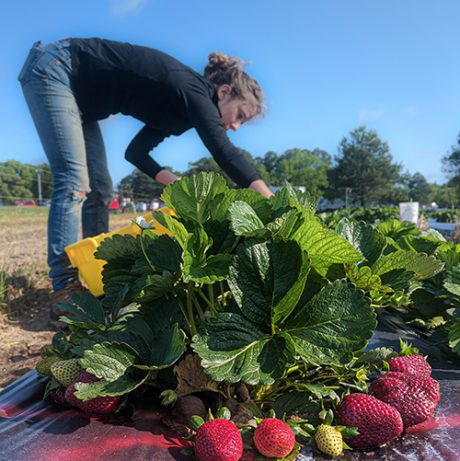
    Woman picking strawberries at a research station
    Technician Emma Volk examines strawberry plants at the Central Crops Research Station in Clayton.

    Hoffmann passes the nonprofit’s farm on his way home from work, where he conducts research and extension education programs aimed at helping growers improve the economic and environmental sustainability of their farms. It occurred to him that donating the berries to the food shuttle would mean that they would benefit not just those growers but also families and individuals hard hit by the economic downturn associated with the COVID-19 pandemic.

    A warm winter set the stage for a strawberry season that’s the best the state has seen in years, Hoffmann says. Production has hit its stride, and the crop has been both beautiful and bountiful.

    In fact, the harvest has been so good that Hoffmann wasn’t sure what he could do with hundreds of pounds of strawberries he’s been harvesting from his research plot at the Central Crops Research Station.

    We have a bumper crop …, and I didn’t want to throw them away.

    Normally, Hoffmann and his associates would distribute the berries to others on campus to acknowledge their support of the university’s small fruits team and their research and Extension work.

    “The strawberries were really good this year, and the season has gone well so we have a bumper crop. It’s a lot of strawberries, and I didn’t want to throw them away and didn’t see any other option,” Hoffmann says.

    “I’m actually eating strawberries every day right now, but they’re way too many strawberries for me to eat by myself,” he adds. “Even if I could distribute them among my students, there’d still be too many left over.”

    Small but important

    Hoffmann expects the crop will amount to 450 to 550 pounds – a small fraction of the 6 million pounds of food that the food shuttle distributes each year to people with low incomes.

    Still, Clark says the donation makes a significant difference – and so does the advice he’s provided the farm on managing and expanding its muscadine grape operation.

    Clark says she’s happy “that our neighbors in need will be able to enjoy the freshest and sweetest strawberries that they possibly could.”

  • Blueberry Farmer Reflects on Lost Crop Following Hailstorm

    By Clint Thompson

    A devastating hailstorm on Thursday, April 23 wiped out production for one of the largest blueberry farming operations in the Southeast, says blueberry farmer Phillip Mixon. The former owner of Mixon Farms, who now serves as manager, reflects on what might have been with this year’s crop.

    Pictured are highbush blueberries.

    “We had the best crop we had since about 2016,” Mixon said. ““We deal with rain. Some of them will split and you have to wait a few days and let them heal up and go back to picking. With hail, it devastates them.”

    Mixon’s farm has about 850 acres. Approximately 600 would have been harvested. The storm knocked a bunch of blueberries off. What was left on the bush was bruised really bad. They aren’t marketable.

    “It wiped ours out. It’s a total loss. It’s not good,” Mixon said. “We had golf ball size hail. It didn’t last but about 30 seconds, but it just totally wiped them out.”

    Mixon estimated he lost about 5 million pounds.

    Challenging Spring

    It’s been a challenging spring for Mixon. First, the blueberry farmer said having enough labor was a problem when the coronavirus pandemic hit. Now, he must find work for his workers. He’s reached out to his farming brethren.

    “You’ve got to guarantee them three-quarters of the contract. You’ve got to pay them whether you’ve got something or not,” Mixon said. “That sucks because I couldn’t help the hailstorm. If not been for that, I’d have plenty of work. It’s a bad deal all the way around.

    “We just start over and hope for the best next year. We started (Wednesday) hedging our blueberries down. We’re just going to have to tend to them and hope for next year and collect what little bit of insurance there is.”

    The only saving grace for Mixon was that this didn’t happen a year or two sooner. He sold the farm to an investment group, who kept him working as manager. Still, it’s a hard pill to swallow to see a year’s production lost.

    “It’s disheartening,” Mixon said. “I still treat it just like it’s mine even if somebody else has got it.”

    For more information about how the blueberry market is faring, see VSCNews story.

  • Florida Blueberry Farmer: I’m a Fan of Having Our Own Domestic Supply of Food

    By Clint Thompson

    Blueberry prices have not improved much, and Mexican imports may be a reason why, says Florida farmer Ryan Atwood.

    Pictured are highbush blueberries.

    “I don’t think (prices have) move the needle much. Part of it is this Mexico deal. Mexico brought another 5 million pounds in last week. Mexico just keeps putting more and more fruit on our window, even Georgia’s window now,” Atwood said. “Normally, they would fall off by this time of year, but they’re going strong still for some reason.”

    Atwood believes being dependent on other countries for food is a dangerous precedent, especially since farmers like himself are more than capable of producing crops.

    “I’m a fan of having our own domestic supply of food. I think it’s a security issue for our country. We’ve got to grow our own food. You saw what happened 10 or 12 years ago when we used to import all that oil and then we got own domestic supply going again. Other countries are going to be able to control you if they control your food supply,” Atwood said. “I just don’t see where it’s in our best interest to allow these foreign competitors into our market when we have a domestic supply of fruit.”

    Industry Leader

    Atwood, who lives in Mount Dora, Florida, is one of the state’s blueberry leaders. He farms 56 acres of blueberries, manages another 350 acres and is part-owner of the largest packing house in the Southeast United States.

    Unfortunately, Atwood’s blueberry crop this year was harvested at an inopportune time. He started picking high volumes of blueberries around March 18 when the coronavirus pandemic shut down the country. The market dropped almost overnight.

    “I think it went from about $5.50 a pound, which is a really great price to you couldn’t hardly move the fruit; you would be lucky to sell it at all, like within two days,” Atwood said.

    Atwood believes prices can improve but various components will have to factor in growers’ favor.

    “I could see Georgia coming off their peak and North Carolina have some early damage, and I think two weeks from now could get interesting. That’s me just guessing,” Atwood said. “If Mexico actually does stop putting fruit over here, at some point they will fall off. If North Carolina’s early crop is not there and Georgia is over its peak, I could see the market tightening up a little bit.

    “I won’t have any fruit in here, but I could see it being good for somebody.”