Category: Alabama

  • Chilling Stat: Peaches Looking Good for Chill Hour Accumulation

    Chill hours remain an integral part of a peach producer’s hope for a successful year. If the current numbers are any indication, Alabama growers could be in line for a productive season.

    During a webinar last week, Edgar Vinson, assistant research professor and Extension specialist in the Department of Horticulture at Auburn University, said there was 737 chill hours or 38 chill portions recorded at the Chilton Regional Research and Extension Center. He was confident that the chill hours will continue to rise heading into February.

    “Over the next several days or weeks we should have enough opportunity for chilling accumulation so that we can have enough chilling to satisfy most of the varieties that we grow,” Vinson said.

    He said 43 degrees Fahrenheit is the optimal temperature for when chill accumulation will occur.

    Chill Management

    There are multiple ways that producers can manage chilling. The first thing is to do your research before planting. Growers need to plant peach varieties that fall in line with the historical chilling accumulation for their areas. Areas in north Alabama are going to receive more chill than south Alabama.

    “You don’t want to plant varieties that have too high a chill requirement or too low. Too high, you threaten not to have enough to sufficiently eliminate dormancy. Too low, then you could break dormancy too early and be subject to late-season frost,” Vinson said.

    While this year’s cooler winter has contributed to more chill accumulation potential, that hasn’t always been the case.

    “In our area, we’re experiencing a lot of warming trends each winter. Winters are becoming increasingly warmer. It’s becoming more and more difficult to accumulate chilling. With these varieties that have a high chill requirement, they’re vulnerable to not having enough chilling,” Vinson said.

    Peaches need chill hours to mature. The required chill hours depend on the peach variety. Contender, a well-known peach variety, has 1,050 chill hour requirements.

  • Quiet Insect Activity: Alabama Producers Still Need to Take Precautions

    Photo courtesy of Ayanava Majumdar

    Insect pressure is currently quiet in Alabama. But infestations could increase dramatically if producers don’t take the proper precautions, says Ayanava Majumdar, Extension Professor in Entomology and Plant Pathology at Auburn University.

    “At this point, things are kind of calm and quiet, except perhaps for people who have greenhouse crops or are trying to start their seedlings or trying to get them. I just want to caution and bring those prevention points again to focus; how to prevent some things,” Majumdar said. “Always get transplants from good sources. If they’re being bought from out of state or a store, check for small insects like aphids. That’s the one that comes to mind that hitchhikes a lot on transplants that are bought outside.

    Armyworms are also an insect to look out for.

    “For the conventional farmers, they have to look at their systemic drench insecticides, make sure they have those. There might be some areas down south where they still have maybe armyworms. Watch out for caterpillars. They may show up if someone’s having a particularly warm winter,” Majumdar said.

  • Whitefly Management: Don’t Get Behind in Spray Program

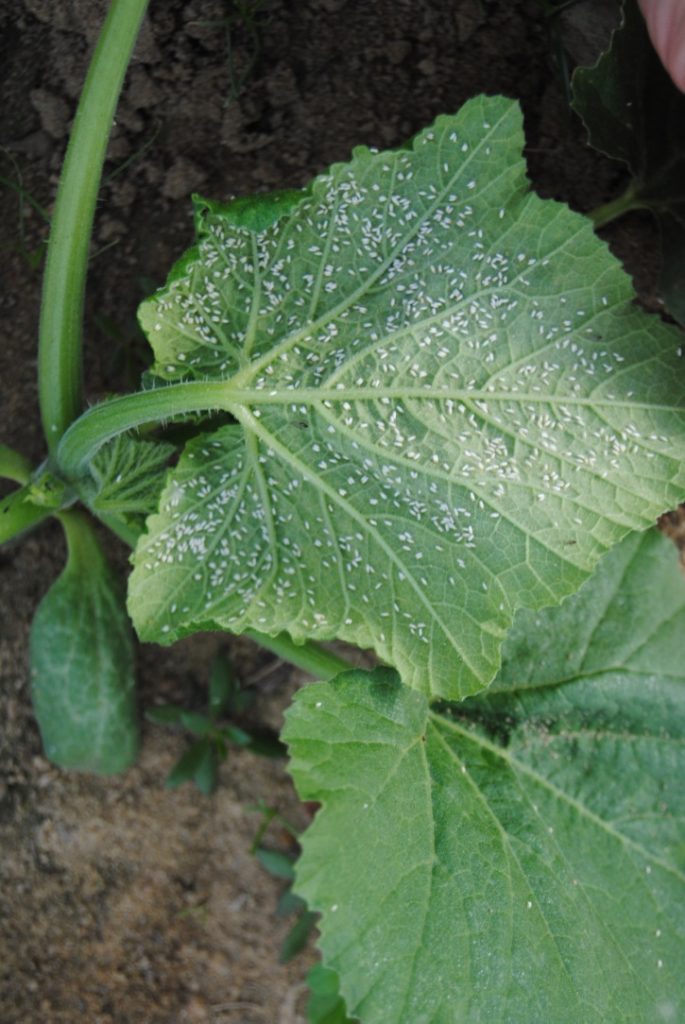
    Whitefly adults feed on a yellow squash seedling.

    Insecticides are available for growers managing whitefly populations. But they need to be applied early in the season when whiteflies are young and immature.

    “Most of the things we use primarily target immatures. That’s where our best control is. We’ve only got a couple of products that are really good on adults,” said Stormy Sparks, University of Georgia Cooperative Extension vegetable entomologist. “Most of them, I can’t say for certain, but most of them probably are most efficacious on very little N-star immatures.”

    Managing whiteflies when they’re young is a producer’s best management strategy considering how quickly they will reproduce.

    Whiteflies can grow by a generation in just two weeks in the heat of the summer when temperatures routinely exceed 90 degrees Fahrenheit. The time for these insects to develop is related to temperature. When temperatures are cooler, development takes longer.

    During hot and muggy conditions, which are common in Georgia and Alabama in July and August, development time for whiteflies decreases.

    “Whiteflies are one of those things you don’t want to get behind on,” Sparks said.

    Southeast producers grow cole crops, like broccoli, kale and cabbage, from September through May. Cucurbits grow in the summer, and cotton grows in the early fall. All of these crops serve as host plants for whiteflies.

    Whiteflies can also transmit cucurbit leaf crumple virus and cucurbit yellow stunting disorder virus. 

  • Greenhouse Lettuce Production Has Risks, Rewards

    Greenhouse lettuce production has its risks and rewards in Alabama. Jeremy Pickens, Alabama Assistant Extension Professor in Horticulture at Auburn University, cautions producers to do their homework before diving headfirst into this potentially rewarding venture.

    “It’s a considerable amount of expense compared to field production. You just really need to know what you’re doing before you commit to it,” Pickens said. “The benefits of growing in a greenhouse are, you can turn out a crop faster. It’s going to be a high-quality crop. In many cases, there’s less pesticide use. But the downside is, it costs more money to grow indoors.”

    Greenhouse Expenses

    It is expensive just to build a greenhouse and operate it year-round. Pickens estimates to build and own a greenhouse can cost producers anywhere from $20,000 to $100,000 depending on how many bells and whistles you want to accessorize the greenhouse with. Labor is a major expense as well. Labor can cost as much as 28 cents per head of lettuce.

    Producers must also consider competition from states out west. California and Arizona account for 95% of all the lettuce produced in the U.S.

    “It is a high-quality product and produced very inexpensively and can get shipped across the country in very little time. It is most often for chefs and be available in a bag, chopped product. It’s already triple rinsed, they don’t have to do anything with it but open the bag and go,” Pickens said. “I don’t think you need to compete head-to-head with those guys because you’re going to lose. They can grow it so much cheaper than we can just because of their great climate and economy of scale.”

    Marketing

    Those Alabama producers who follow through on lettuce production need to market their crop as a premium product if they are to be successful. They are selling local, fresh and flavor.

    “There is a certain size pie, and you’re not going to make the pie any bigger. There’s a chance you could, but you’re trying to get a piece of it by maybe convincing a chef to switch over to your product. There are some opportunities in some of the more urban areas with these CSAs coming along for lettuce to make its way into a box. As far as selling it as a farmer’s market, it’s like anything, it’s got its risks. I don’t want to say there’s not an upside to it, but I wouldn’t go chasing for gold with it,” Pickens said.

  • Marketing Key Issue in Hemp Production

    File photo shows a hemp field.

    Marketing remains one of the top challenges facing Alabama hemp producers. It’s also a topic that Katelyn Kesheimer, Auburn University Assistant Professor and Extension Specialist, hopes to address during a series of informative webinars this spring.

    “A lot of questions are revolving around, ‘What does the market look like?’ ‘How do I market and sell my hemp?’ ‘What variety should I be growing?’” Kesheimer said.

    “I think a lot of it is around the market stability and consumption of the product. Are people still holding on to it? Should they sell it to be turned into crude oil? How do you find a buyer? Should you go into a vertical integration where you’re processing and doing everything on your own. Should I even get into this business because of the market? The biggest questions are around, what does it look like and can I actually make money off this crop?”

    Kesheimer said she is working to schedule multiple webinar sessions designed to educate potential producers about hemp. It will include speakers from across the Southeast, including economists, agronomists, plant pathologists and entomologists.

    Further details of the meetings are still being finalized.

  • Peach Chill Hours Make or Break Growing Season

    File photo shows peaches growing on a tree.

    By Mary Leigh Oliver

    AUBURN UNIVERSITY, Ala. — When picking up a peach from the store, consumers often don’t think about the intricate growth process fruit endures to be store ready. Peach farmers know the importance of nurturing and monitoring the peach growing process. The most important part of a peach’s growth are chill hours. These hours serve as the make or break point for tasty, store quality peaches. 

    Chill Hours

    A chill hour is the exposure the peach or fruit has to chilling temperatures by hour. According to Alabama Extension specialist Edgar Vinson, peaches and other temperate fruits are required to meet a certain number of chill hours. This allows the fruit to break dormancy in the spring when temperatures are warm.

    “It’s like an internal clock that lets the plant know that warm weather in on the way,” Vinson said. “It will soon be time to bloom and produce leaves.”

    Peach Hours

    Peach varieties have different chill hour requirements. Some require as few as 50 chill hours, while others need as many as 1,400 chill hours. However, the number of hours each peach requires is dependent on the specific variety.

    “The early season variety ‘June Gold’ requires 650 chill hours, whereas the ‘Contender’ requires 1,050 chill hours,” Vinson said.

    In the Southeast, chilling measurements begin Oct. 1 and end on Feb. 15 the following year, depending on the region. Chill hours are traditionally measured using the Weinberger model. This model measures chilling at 45 degrees Fahrenheit and below. However, the modified Weinberger measures chilling between 32°F and 45°F. Another model, the Dynamic model, measures chilling in terms of chill portions where the optimum chill occurs at 43°F. As temperatures rise above or fall below 43 degrees, chilling accumulation becomes less efficient according to this model. It also shows that chilling can be lost as a result of exposure to warm temperatures in the winter.

    If peach trees receive an excess number of chill hours, the buds will bloom too early. This will then make the blooms vulnerable to late season frosts.

    Complex issues occur when peaches receive too few chill hours. If chill hours are deficient, it will delay the bloom period causing a protracted harvest season. The marketability of the fruit will substantially diminish with too few chill hours. While there are a few solutions to inadequate chill hours, they cannot have the same effect as the chill hours themselves.

    Solutions to Inadequate Chill Hours

    It is important to first research the amount of chilling your area historically receives if you are growing peaches.

    “It is not advisable to plant a tree that requires 1,050 chill hours when your area historically only receives 650,” Vinson said.

    If there comes a late-season frost and the peaches received too many chill hours, simply delay pruning. Pruning invigorates the trees to help stimulate bud break in the case of low chill accumulation.

    If there are too few hours, some farmers will use rest breaking chemicals to stimulate bud break. The efficiency of these chemicals relies on weather conditions and the degree to which the tree is deficient in chilling.

    “Research is still being conducted to determine optimal methods of applying these chemicals,” Vinson said.

    More Information

    For more information on peach chill hours, visit the Alabama Extension website, www.aces.edu.

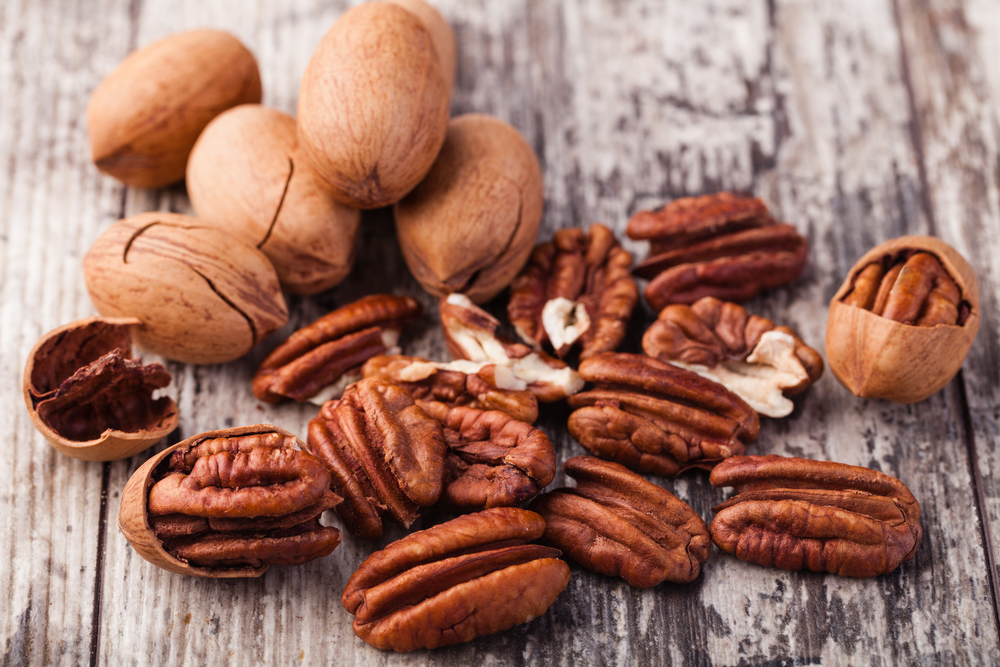
  • Georgia Pecan Producer: Cautiously Optimistic About Future Market Prices

    georgia pecan

    One South Georgia pecan producer is cautiously optimistic farmers will soon experience an increase in market prices. Coming off a season where pecan yields were the best in years and prices were the worst in some time, growers like Randy Hudson are hopeful prices will soon rebound.

    “The old saying about the cure for low prices is low prices. The cure for high prices is high prices. When prices are low, people come in the market and buy a lot of pecans. Supply goes down. Demand goes up because the prices are cheaper. On the other hand, when prices are really high, demand has a tendency to really taper off. Supermarket sales, retail sales begin to go down. As a result of high prices, we typically follow it with low prices. It’s all kind of cyclic in nature any way,” said Hudson, who also works with the American Pecan Council, serves on the Pecan Export Trade Committee and member of the Georgia Pecan Growers Association

    “It’s not a good year for growers, it’s a really good year for processors. I hope next year is a really good year for growers, and it may not be quite as good of a year for processors.”

    The recent surge in interest from other countries has Hudson excited about the future market prices. Price increase is desperately needed considering the amount of Georgia crop that is in storage. Hudson estimates between 25 million and 35 million pounds are currently being stored.

    “We’re already beginning to see in the last several days, we’re seeing some real interest in China, specifically, but around the world in general. Getting China back into this market is going to be a real positive. They’re back into, particularly, the Georgia market. They’re out here now competitively bidding on loads. We’re beginning to see the prices increase,” Hudson said.

    “I’m very cautiously optimistic about the remainder of this market season. I know there’s a lot of growers in Georgia that have a lot of inventory on hand. I think it’s going to bring a little higher price than back during harvest season.”

    High Yields

    According to the latest USDA numbers, Georgia was projected to produce approximately 135 million pounds in 2020. It was amazing production and one growers were looking forward to following Hurricane Michael in 2018. However, prices were devastatingly low which hampered producers’ optimism and forced many to store their crop.

    “It’s the best of times, it’s the worst of times. It was the best of times harvesting because we just had a great harvest season. We had outstanding yields. The quality was superb, probably the best quality we’ve seen in years. The weather was very important because the quality sustained itself all the way through second harvest. That was the best of years,” Hudson said. “The worst of years as a grower, though, when we started having to price this and getting paid for the crop, prices in some cases were half of what they were a year ago.”

    Alabama Production

    It was a devastating year for Alabama producers as well. Not just because of low prices but of two hurricanes that wiped out a substantial amount of this year’s crop. Winds from Hurricanes Sally and Zeta also uprooted many trees, creating countless future losses for the state’s producers.

  • Crop Rotation in SE Vegetable Production

    File photo shows a field of eggplant.

    According to the Southeastern U.S. 2021 Vegetable Crop Handbook, crop rotation is key in preventing the buildup of soil-borne pathogens. Specialists from universities across the Southeast implore producers to consider an effective rotation sequence that consists of crops from different families that are poor or non-hosts of these pathogens.

    The longer the rotation the better the results will be. A 3-to-5-year rotation is recommended.

    However, growers must weigh the practicality of rotating their crops on the availability of land, the markets, what alternate crops that are able to grow in the area, the pathogens and the purpose of the rotation.

    Crop specialists from across the Southeast, including the University of Georgia and Auburn University, collaborated on the Southeastern U.S. 2021 Vegetable Crop Handbook.   

  • Vegetable Weed Management a Complicated Practice for Producers

    Photo submitted by Stanley Culpepper/UGA: Shows a blend of yellow and purple nutsedge.

    Weed management in vegetable crops across the Southeast remains a diverse and complicated practice that all producers need to be reminded of.

    “There are so many components that a vegetable grower has to consider, especially when it comes to weed control. Some production systems you can use tillage. Some you can’t. Some you have plasticulture in a fumigant system. Some that you don’t,” University of Georgia Cooperative Extension weed specialist Stanley Culpepper said.

    “Then when you start thinking about herbicides, we’ve been very fortunate over the last 10 years, getting our growers a lot of cool herbicide tools as a component to their management program, but when you’re a vegetable producer and going to have a crop and be in and out in 60, 80, 90 days, you’ve got to think about herbicide carry-over. I can or I can’t use herbicide ‘A’ because of what it could potentially do to the next crop, which means you’ve got to know what the next crop is going to be. You know vegetable guys as good as I do, a lot of times, they just don’t know.”

    Producers have to implement the right herbicide and do so at the right rate. They have to use the right irrigation program. The tank also has to be perfectly clean.

    “The complexity goes on and on for a vegetable farmer. A lot of decisions have to be made in a 12-month cycle because we could be producing three crops in a lot of our farms,” Culpepper said.

    Weed Problems

    Certain weed species are also problematic at different times of the year. Weeds that are normally a concern for producers in the spring are not the same as those that are plaguing producers right now. Different weeds require different management strategies.

    “Lets start in the spring. In a fumigated plasticulture production system, nutsedge remains the baddest boy that there is. That’s the only weed that can penetrate through the mulch. Nutsedge is still a huge dominant player. In addition to nutsedge, what has really taken its foothold on a lot of my guys has been purslane species and a lot of ours is actually pink purslane; a bunch of different grasses that have always been here and then our amaranth species (not palmer amaranth),” Culpepper said.

    “If you look at this time of year, wild raddish is the baddest boy that there is.”

    Weed Management

    Weed management remains key to successful vegetable production, whether you are talking about now or in the spring. Before plants are ever put in the ground, weed control needs to be a top consideration for producers. Weeds challenge and can overwhelm crops for water, sunlight and nutrients.

    Culpepper said in most situations, the weeds are better competitors than the crop.

    “Before you ever start a conversation, you say, ‘Look, vegetable weed control is really challenging. There can’t be any weed emerge at planting.’ It’s very likely that if we’re going to implement a herbicide program we’ve got to start it before we ever plant,” Culpepper said.

    “In transplanted onion production, obviously, very important to Georgia, we have an excellent herbicide program that will be successful probably 95-plus% of the time, which is really, really good. If you wanted to grow seeded onion production in the state of Georgia, I don’t think you’ll have a chance because you can’t manage the weeds. Or if you do, you’ll spend a tremendous amount of money.

    “There’s the same crop per se grown two different ways; one is very unlikely to be successful and the other is very likely to be successful with regards to weed management.”

    “If you wanted to seed cabbage, because of wild raddish, you’re in trouble. But if you want to transplant cabbage, I have a herbicide you can put out before you transplant, and I’ll take the wild raddish out.

    “There’s two examples, exact same crop, of how you want to process or implement your program will determine how successful you’ll be.”

  • Winter Weather Conditions Challenging for Alabama Vegetable Producers

    A cold and rainy winter has been challenging so far for Alabama vegetable producers. Joe Kemble, Alabama Extension vegetable specialist, cautions growers that though it may be chillier, that does not eliminate certain diseases that can be problematic.

    “I will say on the vegetable side, things are a bit slow. Weather’s been not exactly ideal. The rainfall we’ve been having, I would be concerned about things like Anthracnose, leaf blights; things that cause leaf blights on greens,” Kemble said. “I’d say be diligent and keep an eye out because the weather, unfortunately, yeah it’s cold but the afternoons warming up and still in these 45, 50, 60-degree days, that is warm enough for some of these diseases to keep moving around.

    “The cold weather does not eliminate that problem, unfortunately.”

    Yellowmargined Leaf Beetle

    Farmers also need to be wary of potential insect problems even during cold weather conditions, specifically with the yellowmargined leaf beetle. Unlike some insects that prefer summer, or warm conditions, the yellowmargined leaf beetle likes cooler weather and will impact brassica crops.

    “It’s fairly new to our area the last few years. They’re incredibly hard to kill. If you’re growing cabbage, they can hide very well in the heads,” Kemble said.

    “It’s really hard to get sprays sometimes on them. You’d be harvesting and start finding all of these holes in leaves and things. Unfortunately, the yellow margined leaf beetle is pretty good at what it does in terms of holes and things like that.”