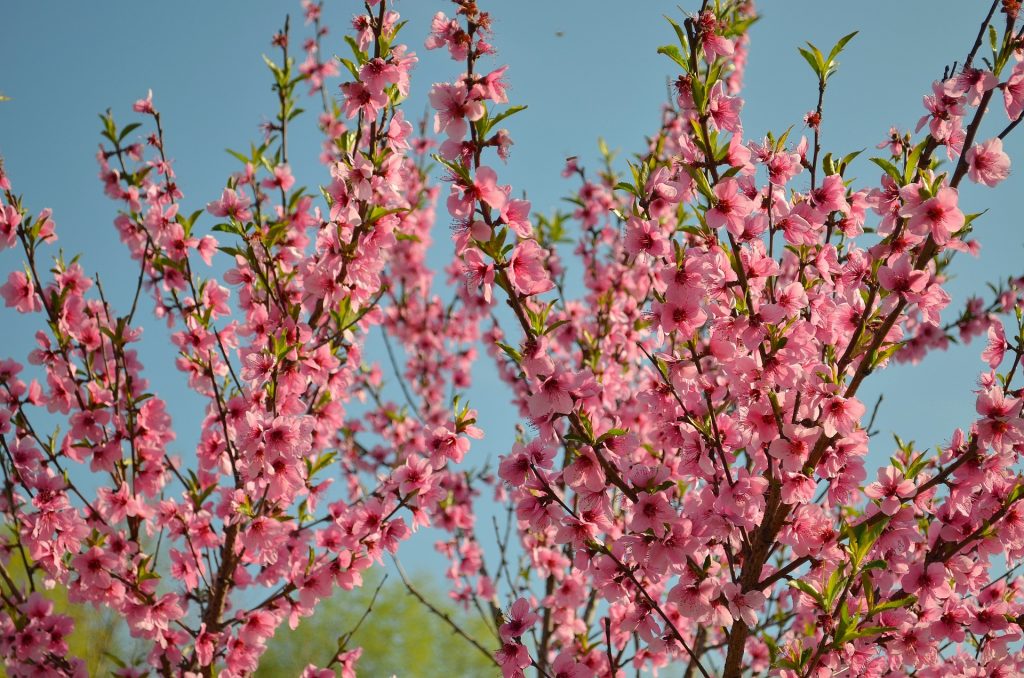
Alabama peaches are progressing but there was some damage from a freeze in February, said Doug Chapman, Alabama Extension agent for Commercial Horticulture in North Alabama.
Peach tree blooming in Georgia.
“We’re in full bloom right now, maybe in central and south Alabama, a little post bloom. I doubt there’s any shucks split just yet in central Alabama,” Chapman said. “The freeze hurt us to some degree. We’re still going to have peaches. Some varieties are just going to be real light crop this year. Interestingly, we got hurt worse in central Alabama than we did in north Alabama.”
Chapman made the comments during the Alabama Extension Commercial Horticulture Facebook Live Q&A event on Friday.
“The damage that we got in February was actually damage to the buds. It was the dormant buds that got hurt worse than the buds that got swollen or maybe had a little pink showing,” Chapman said. “We’ll still have some peaches.”
Peach producers are concerned about late-season freeze events that could impact this year’s peaches. Crops in both Georgia and Alabama received adequate chilling hours this winter to produce a crop.
Increased food consumption at home amid COVID-19 means potentially more sales of fresh fruits and vegetables for Alabama producers, says Wendiam Sawadgo, Alabama Extension economist.
“There was about a 50% increase in consumption at home in (last) March compared to before the pandemic. That sort of tapered off a little bit. But it’s still much higher than it was before,” said Sawadgo during the Alabama Extension Commercial Horticulture Facebook Q&A session on Friday. “What that means for a lot of our fruit and vegetable producers is sales have gone up. Fruit sales have been up 7% compared to before the pandemic. Vegetable sales about 12%.
Restaurants closing amid the onset of the pandemic meant a drastic increase in families eating at home. But as states continue opening up and vaccines are administered around the country, does that mean a return to the pre-COVID days? Not necessarily.
“We have data from a company that’s been tracking what’s going on with grocery sales since last March. Now they have data from the first two months of the year. There’s the thought that maybe we’ll start to come back down to where we were before the pandemic,” Sawadgo said. “We’re still up 5% to 10% from where we were. The question moving forward, are we going to keep having these high sales for the next several months, which is what I think is most likely. I don’t think it’s quite as likely that consumer behavior is going to immediately return to how it was before March of 2020.
“The next few months will be exciting to look at, especially as vaccine rollouts increase and more parts of the country get out more, to see if we can still have sustained vegetable sales.”
Vegetable crops are vulnerable to ant pressure this time of year. Alabama Extension encourages vegetable producers to implement management tactics as they begin planting this year’s crops.
According to Alabama Extension, fire ants can protect aphids and other honeydew producers on vegetables, which makes their effects worse on the plants. Fire ants can also interfere with natural enemies. Ultimately, though, fire ants can damage crops like okra, potatoes, sunflowers and hemp.
Cultural Controls
It is important to control fire ant mounds around or outside the production area to prevent them from moving into the garden. It is also essential to manage excessive plant residue on the soil. This will aid in the detection of foraging ants. It provides ants fewer places to stay out of sight and makes it easier to apply bait insecticides on open ground.
Insecticide Options
The best time to apply baits is from April 15 to Oct. 15. Mound treatments can be done any time of the year on warm, sunny days above 65 degrees Fahrenheit when fire ants are active. Apply products close or on the mound after checking for foraging ants.
Trap cropping is an insect management strategy that saves farmers time and money and protects the ecosystem, specifically beneficial insects, from overuse of pesticides.
UGA CAES/Leaf Footed bug on vine ripe tomatoes Photo by Sharon Dowdy
For example, using sorghum in a field alongside tomatoes protects the tomato crop from leaf-footed bugs. It’s a unique tactic of sacrificing one crop for the safety and protection of the money-making crop, says Ayanava Majumdar, Extension Professor in Entomology and Plant Pathology at Auburn University.
“Just like we make choices every day. For example, if you’re hungry, you make the choice to go to either Cracker Barrel or you want to go to McDonald’s. You know what you’re getting. Just like you make choices, insects make choices on the go,” said Majumdar during a recent webinar. “It’s a very clever way of manipulating their behavior. That’s essentially what you’re doing. We are using their weakness against them.”
Just as some might struggle to resist certain foods, insects struggle to resist certain plants. It is important to plant a trap crop a couple of weeks before the main crop so it can provide a perimeter around an entire field.
What Works in Alabama?
Majumdar said the trap crops evaluated in Alabama include sorghum and sunflower for leaffooted bugs; sunflower, browntop millet and pearl millet for stink bugs; okra, bell peppers and ornamentals for aphids; New England Hubbard squash for squash insects.
Trap cropping also provides alternate benefits that could appeal to some producers.
“I have seen sorghum, because of the height, it actually protects the plants from wind. Wind reduction is a benefit,” he said. “Weed control; if you have a lot of weeds around, you put that sorghum in there, the sorghum takes over. It grows like crazy on a good year.
“Then the beneficial insects. That ecosystem has less pesticides, a lot of beneficial insects are in there, including spiders that you never see in a typical field or garden. It’s incredible to see some of the side benefits from trap crops.”
Not only does it provide expertise from specialists from 12 land-grant universities, including Auburn University, it provides information pertaining to various disciplines. These include entomology, agricultural engineering, vegetable production, soil science, plant pathology, postharvest physiology and weed science.
Four Alabama Extension specialists contributed to this year’s handbook, including: Steve Li, weed scientist; Ayanava Majumdar, entomologist; Ed Sikora, plant pathologist; and Joe Kemble, vegetable specialist.
For more information on the 2021 Southeastern Vegetable Crop Handbook, visit www.aces.edu or access the handbook online here.
Alabama Extension is ensuring hemp producers have all the relevant data throughout the season in hopes they’ll experience a more profitable season in 2021.
The Alabama Extension H.E.M.P. (Hemp Education and Management Program) webinar series is a one-hour webinar held twice monthly. It provides information on various topics pertaining to hemp production. The next meeting will be held Wednesday at 11:30 a.m. Click here to register.
Gail Ellis from the Alabama Department of Agriculture and Industries will provide information on how to submit a grow plan for the upcoming season. Grow plans are due April 30.
“There’s going to be different topics each time, pretty much based on the most questions we get from growers,” said Katelyn Kesheimer, Auburn University Assistant Professor and Extension Specialist. Hemp webinars will be held on the first and third Wednesdays of each month. “The first one we had, there was a risk management extension specialist talking about the USDA Final Rule for hemp. (This) week, Gail is going to talk about the logistics in submitting a grow plan to the Department of Ag.
“Then we will have a grower presenting what’s worked for him to create high CBD plants. We have folks from the U.S. hemp co-op talking about fiber. As we move into May and June, we’ll have someone talk about weed control and then insect control.”
Kesheimer said they are trying to make the webinar meetings regional if possible, so there will be speakers participating from outside of Alabama. Then some are going to be Alabama specific in terms of rules and regulations; how to do the paperwork and how to follow the guidelines and regulations.
Damage from Hurricane Michael in Tift County. By Clint Thompson 10-11-18
Pecan producers still recovering from Hurricane Michael have three weeks to apply for the Quality Loss Adjustment (QLA) Program. The U.S. Department of Agriculture’s decision to extend the deadline from March 5 to April 9 allows farmers extra time to apply for a program that is assisting producers who suffered crop quality losses due to qualifying natural disasters in the 2018 and 2019 crop years.
Crops must meet the following requirements to be eligible for the program:
Suffered a quality loss due to a qualifying disaster event;
Had a 5%-or-greater quality discount due to the qualifying disaster event.
According to a USDA press release, the Farm Service Agency (FSA) began accepting applications on Jan. 6 and has received more than 8,100 applications so far.
Hurricane Michael ravaged the Southeast pecan crop when it moved through the region in October 2018. According to UGA Extension, Georgia pecans suffered $100 million in direct losses to the crop in 2018, $260 million in losses due to lost trees and $200 million in direct losses for future income.
To apply, contact your local USDA Service Center. Additional information is also available at farmers.gov/quality-loss. Producers can also obtain one-on-one support with applications by calling 877-508-8364.
Proper record keeping is a management practice that all farmers need to be utilizing. It can save producers time and money when deciding what to grow for the upcoming season.
It’s important to keep proper records of your crops.
Jessie Boswell, Alabama Regional Extension agent, believes producers will benefit financially if they keep annual records of how productive their crops are. This is especially true for growers who produce multiple crops.
“I do encourage detailed record keeping for any farmer, but especially for a farmer maybe growing several different types of crops. It’s really important to keep track of the revenue and the costs associated with each specific crop because you really want to be able to analyze each individual crop to see which ones you might want to expand and which ones you might want to cut back on,” said Boswell during a Q&A session on the Alabama Extension Commercial Horticulture Facebook page.
“It also can be used to compare the profitability of different practices, like say you have one crop where you use conventional tillage, and you have another crop where you no-till. If you look, you can say, I make a lot more money on this no-till operation. I save a lot of money on labor and machinery. Keeping track of those can help you look back and see which specific crops you’re making money on. Instead of your farm as a whole being profitable or unprofitable, you can look and see which crop is your money maker, your cash cow and which one you might be losing money on.”
The most important decision farmers can make when growing tomatoes in Alabama is variety selection.
Joe Kemble, Alabama Extension vegetable specialist, insists that growers understand what varieties grow well in Alabama before they plant this spring.
“Easily the most important decision you can make is picking which varieties to grow. You can buy local transplants. It’s always great when you can do that. But what I’ve typically found is, often, the selection tends to be pretty narrow,” Kemble said. “There are literally thousands of tomato varieties out there. Many of them are adapted very well to growth in Alabama but unfortunately, some of them are not.
“Sometimes you may be growing varieties and you’ll say to yourself, I really don’t know why these are doing so poorly. The problem is, it may be the fact that it’s just not a very good variety to grow.”
Kemble said it is important to choose variety that will spread your season. Some are better for early in the season. Others are more tolerant of the high summer temperatures and can be grown in mid-to-late season.
“Try to pick varieties that are actually suited to the time of year you wish to grow them,” Kemble said.
Disease resistance is also an important factor to consider. Try to select varieties with resistance to tomato spotted wilt virus, nematodes, fusarium, late blight and early blight. Resistant varieties mean growers don’t have to apply fungicides to control the disease.
Kemble recommends the following tomato varieties: Bella Rosa, Carolina Gold, Crista, Mountain Gem, Mountain Magic, Mountain Merit, Red Bounty, Red Defender, Red Mountain, Rocky Top and Tribute.
This is what peach trees are beginning to look like in the Southeast; blooms everywhere.
Chilling hours is not a concern for Alabama peach producers for the upcoming season. Potential damage from freezing temperatures is, however, something that may impact this year’s crop, according to Elina Coneva, Extension specialist in the Horticulture Department at Auburn University.
“Feb. 15 was an important day for all fruit growers in the state. There were two things that were accomplished on that day. First of all, we have reached, at least in Chilton County, we have reached 1,009 chilling hour accumulation,” Coneva said during a ‘Q&A Friday’ segment on the Alabama Extension Commercial Horticulture Facebook page.
“We thought, ‘Wow, our peaches are going to produce this year.’ We won’t have those concerns like in previous years when we were experiencing insufficiencies in chilling accumulation.
“Good news comes with a caveat (however). On the night of the 15th of February and throughout the 16th, the same county, Chilton County, experienced temperatures of 15 degrees Fahrenheit. There are consequences, especially for our peaches, but for fruit crops to some extent.”
Freeze Impact
Extreme low temperatures have the potential to impact fruit tree production, especially if those trees have already started blooming. However, Alabama producers may have dodged the proverbial bullet with respect to susceptibility of those early varieties.
Coneva said Edgar Vinson, an assistant research professor and Extension specialist in the Department of Horticulture at Auburn University, conducted a survey on 85 cultivars and their status following the freeze event.
Results indicated that the early ripening cultivars that are more advanced and expected to be damaged higher seemed to fare better than cultivars that were completely dormant.
“Our theory is that probably the humidity in those buds that were more advanced at this point of time helped overcome the wind effect that came with that cold. Flower buds on more advanced cultivars were faring better as well as the buds that were distributed on the lower part of the canopy. They did better than the middle and upper part of the trees, which was kind of unusual,” Coneva said.
Peaches need chill hours to mature. The required chill hours depend on the peach variety, but most growers hope to get around 1,000 chill hours before spring.