Like other commodities, the potato industry has been hurt by COVID-19.
The National Potato Council and state grower organizations wrote Ag Secretary Sonny Perdue recently to talk about potatoes that have nowhere to go for processing.
The Hagstrom Report says the council noted more than “1.5 billion pounds of fresh potatoes for processing and potato products are trapped in the supply chain with no likely customers.” Mountains of potatoes were being given away or left to cow feed as surplus crops are piling up despite government efforts to distribute the potatoes as part of food boxes being given to needy families.
The potato industry feels like the USDA’s new Farmers to Families Food Box program, as well as other initiatives, aren’t enough to dent the losses in a sector that depends heavily on foodservice sales.
Kam Quarles (Quarrels), CEO of the National Potato Council, says, “It was clear the people who were doing well in retail could probably take more advantage of this than the impaired side of the business, which is food service.” The NPC sent a letter to USDA saying, “This oversupply has impacted both the 2019 and 2020 crop for U.S. family farms that grow potatoes. Some of these farms will have no ability to sell their 2019 or 2020 crop.”
The industry suggested several enhancements regarding eligibility and payment rate adjustments that will help USDA help the industry.
(From the National Association of Farm Broadcasters)
Blueberry industry leaders were disappointed its farmers were not included in category 1 of the Coronavirus Food Assistance Program. They hope to rectify the situation during the 30-day comment period that the USDA has allowed for feedback.
“Where we landed with the direct payment program, obviously we learned (two weeks ago), it was disappointing because the one category that would really capture the impact on the U.S. grower was category 1,” said Alicia Adler, vice president of the U.S. Highbush Blueberry Council (USHBC) and the North American Blueberry Council (NABC). “Obviously, categories 2 and 3, we were included with direct payment rates in those categories, but it was really category 1 that would capture the impact.”
According to specialty crops in CFAP, producers of specialty crops are eligible for CFAP payments in three categories:
Had crops that suffered a 5%-or-greater price decline between mid-January and mid-April as a result of the COVID-19 pandemic,
Had produce shipped but subsequently spoiled due to loss of marketing channel, and
Had shipments that did not leave the farm or mature crops that remained unharvested.
Comment Period
When the USDA issued CFAP on May 21, it allowed for a comment period. This could lead to amendments being made to the guidelines set forth for blueberry producers. That is what industry leaders are hoping for.
“We submitted comments that still show decline in 2020 was steeper than in 2019 but also capture that daily price data which shows a 60% price decline between mid-March and mid-April. That was directly a result of the COVID crisis and literally the market closure,” Adler said. “We know that they are reviewing comments as they come, and we are anxious to learn if we’ll be included in category one and what the next steps are for that category.”
Adler said the earliest blueberry production is from mid-March to mid-April which showed decline due to the coronavirus pandemic. Florida represents more than 85% of production during that timeframe.
USDA is accepting applications through August 28, 2020. Learn more at farmers.gov/cfap.
Mummy berry disease is caused by the fungus Monilinia vacciniicorymbosi and is an important fungal disease of blueberries.
Posted by Elina Coneva and Ed Sikora (Alabama Extension)
Current wet and cooler than normal conditions are conducive for mummy berry disease in blueberry, according to Alabama Extension. Mummy berry disease is caused by the fungus Monilinia vacciniicorymbosi and is an important fungal disease of blueberries that can cause yield losses of up to 50% when conditions are favorable for disease development.
The pathogen can infect shoots, flowers and fruit. The fungus overwinters in the previous year’s berries that have fallen to the ground. In early spring, a mushroom-like spore cup emerges from the infected berries near the soil surface. Fungal spores are released from these structures when bud swell begins and green tissue is present. Spores are spread via wind and rain. Early detection and control is necessary to reduce the impact of this disease on a crop.
Symptoms and Disease Development
Early season infection of flower buds and stems is promoted by wet conditions and cooler than normal temperatures. The earliest symptoms of mummy berry include drooping of developing leaves and shoots in the spring followed shortly by browning of the upper side of bent shoots, midribs and lateral veins of leaves. The bend in twig tips can resemble a shepherd’s crook. Vegetative shoots, leaves, and infected flowers are killed within four days after discoloration begins.
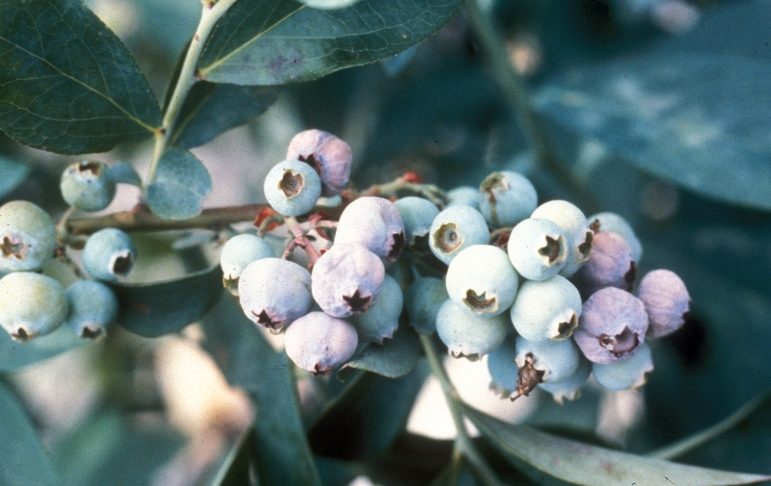
After initial infection, the pathogen produces conidial spores that appear as tan-gray tufts on blighted shoots. Conidia are then dispersed by wind, rain and insect pollinators to healthy flowers. Once the fungus has been introduced to the flower, it will germinate with the pollen and infect the developing fruit. Evidence of blossom infection does not appear until the fruit begins to ripen. As normal berries ripen, the infected berries begin to shrivel and turn a pinkish color. Shriveled berries drop to the ground.
Control Strategies
An integrated pest management program including both cultural and chemical control strategies is needed for best results. For new orchards, select resistant varieties or late blooming cultivars, if available. Also avoid wet sites and/or improve drainage to reduce conditions that favor mummy berry development. Remove wild blueberries or unwanted plants from the vicinity of the orchard to reduce overwintering inoculum.
If mummy berry is detected in an orchard, try to remove or destroy infected fruit at the end of the harvest season. This could include covering mummies with at least 2 inches of soil or mulch. Limit or delay overhead irrigation until petal fall during the growing season. Follow a fungicide spray program that is effective for controlling mummy berry from green tip until petal fall.
University of Georgia Cooperative Extension Ag economist Adam Rabinowitz encourages farmers to submit applications for the Coronavirus Food Assistance Program (CFAP) sooner rather than later.
Adam Rabinowitz
The application process for CFAP started this week. The program provides relief to American farmers and ranchers impacted by the coronavirus pandemic.
When details of CFAP were announced, the first guideline for eligibility requirements was a payment limitation of $250,000 per person or entity for all commodities combined. With so many producers projected to participate in the program that will provide up to $16 billion in direct payments, there is a chance of not having enough funds available.
“The USDA has estimated that there may be insufficient funds. As a result, they’re making payments in two phases. The initial payment is 80% of what the producer will be eligible for. Only if funds are available, (will) the remaining 20% will be paid,” Rabinowitz said. “There is that chance that additional funds will be allocated in the future. That certainly could help but it’s certainly not a guarantee.
“My recommendation is to get it in sooner than later. This way your paperwork is there.”
Specialty Crops Covered
For eligible specialty crops, the total payment will be based on the volume of production sold between January 15 and April 15, 2020; the volume of production shipped, but unpaid; and the number of acres for which harvested production did not leave the farm or mature product destroyed or not harvested during that same time period, and which have not and will not be sold. This has created some concern among farmers in Georgia and Alabama that their crops will not be covered based solely on the dates outlined in the program.
Specialty crops include, but are not limited to, almonds, beans, broccoli, sweet corn, lemons, iceberg lettuce, spinach, squash, strawberries and tomatoes. A full list of eligible crops can be found on farmers.gov/cfap. Additional crops may be deemed eligible at a later date.
Posted by: Joseph Kemble, Edward Sikora, and Gary Gray/Alabama Extension
According to a recent post, over the past several weeks, lower than average temperatures have been common across Alabama. Cucurbit crops (squash, watermelons, cucumbers, cantaloupes, and other small melons) are warm season vegetable crops that can suffer damage when temperatures fall below 60 degrees F. Cold damage is cumulative and can be a challenge to evaluate as cucurbits range in their response to low temperatures. With cold damage, several days at 50 degrees F to 60 degrees F can be just as damaging as a few hours at 40 degrees F.
Damage is generally worse on newly transplanted or poorly established transplants.
Stem Splitting in Squash
Stem splitting in squash.
Stem splitting is a common symptom of cold damage on cucurbit crops and has manifested all around the state, especially in central and north Alabama. The stem of an affected plant splits at or near the soil line. The length of the split can vary but generally only appears on one side of a stem. Stem splitting is not a disease but can lead to infections.
These split areas usually heal over quickly, developing a corky appearance. Unfortunately, windy conditions have been common during this spring as well. Windy conditions combined with stem splitting can cause the plants to snap off or twist at the soil line. In addition to twisting damage, spring winds can pick up sand on lighter soils and cause a sand blasting effect on tender young plants.
Aside from cold temperatures, stem splitting can also be caused in transplants when there is a period of rapid growth resulting from high temperatures, increased irrigation or high fertility.
Growers should carefully evaluate their plants to determine the extent of any cold damage their crop might have suffered. Wilted, snapped, broken, or severely “wind burnt” plants may need to be replaced. Growers should also consider applying protectant fungicides/bactericides to reduce possible infections by opportunistic disease organisms on damaged tissues.
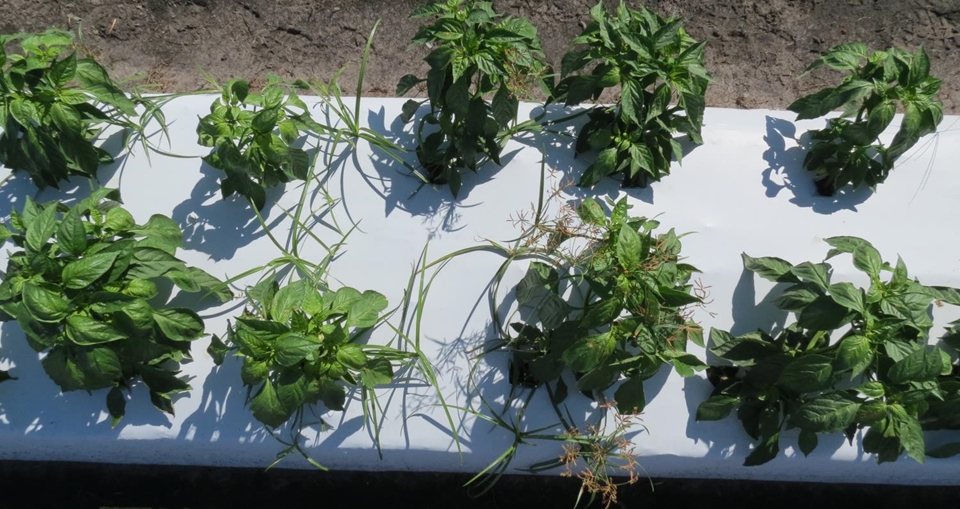
An overhead view of a plasticulture vegetable bed shows nutsedge weeds emerging through the plastic.
By Clint Thompson
University of Georgia Cooperative Extension weed specialist Stanley Culpepper encourages vegetable growers to diversify their management programs against nutsedge. This protects against potential resistance and provides adequate control.
“In general, I would say with our guys, I’m not overly concerned because our fields with our most nutsedge, they get fumigation, they get tillage and they get herbicides,” Culpepper said. “My guys are quite diverse. Will we have resistance one day? Sure, we will, but we are quite diversified in our management approach. We’re not selecting for resistance, say compared to an agronomic guy who goes out and sprays roundup or dicamba three times.”
According to Alabama Cooperative Extension, purple nutsedge and yellow nutsedge are prevalent in most areas where vegetables are grown. Both are perennial weeds that propagate mainly by the production of tubers. While growers maintain control of nutsedge, it comes at a cost, says Culpepper.
“That pest is still the most problematic. Doesn’t necessarily mean we’re not controlling it, but we’re spending a lot of money to control it that we wouldn’t have to spend if it wasn’t so problematic,” Culpepper said. “The one that’s causing us the most money without a doubt in the plasticulture system is nutsedge.”
Why Is It So Problematic?
Farmers who implement plasticulture still struggle with nutsedge because it can penetrate mulch.
“Even if you haven’t poked a hole in the mulch, nutsedge can penetrate it itself. It can damage the mulch and be there before you plant. It can come at any time even if your plant is shading out the plant hole. It’s very unique that way,” Culpepper said. “Is it killing us? Is it hurting our guys? No, I think we’re doing a pretty daggum good job. It’s a repetitive challenge and costing us a lot of money to try to manage.”
Diversification is key since there are very few herbicides that are effective regardless of the vegetable crop being grown. It is not like peanuts where farmers can apply Cadre or cotton where Roundup can be applied. Nutsedge control in vegetables is limited to a couple of products.
“It’s there and probably in every single field but they’re doing a really good job controlling it. It’s not like some disease that jumped on us last week and is going to wipe us out. That’s not it at all,” Culpepper said. “But that’s the one I still say is most challenging for our vegetable growers in plasticulture systems.”
Apurba Barman, a post-doc researcher on the UGA Tifton campus, examines a cotton plant with whiteflies in his lab. By University of Georgia 8-24-18
By Clint Thompson
Whiteflies have already been reported in Georgia vegetables this spring. They are not yet a concern for Alabama producers, however.
Extension Entomologist Ron Smith said as cotton continues to be planted in Alabama, the focus right now is managing grasshoppers and thrips. Their focus will turn to whiteflies in early July.
“I knew they overwintered at some level over there somewhere around Tifton (Georgia). It’s the winter vegetables that are causing them to be able to overwinter over there. We don’t have a lot of vegetables down in the southeastern corner of the state. They have damage and problems at least a month before we do,” Smith said.
University of Georgia Cooperative Extension vegetable entomologist Stormy Sparks said in early May that whiteflies were already present in Georgia vegetables. This is not good since cotton farmers are currently planting their crop in Alabama and Georgia. Whiteflies like to feed on cotton plants as well.
While colder temperatures do not eliminate whiteflies, they do kill many of their wild hosts. They also slow population development in cultivated hosts. Warmer temperatures this winter allowed for larger whitefly populations to overwinter and become mobile earlier.
“We have the potential of having another outbreak like 2017 or 2018 this year because of the mild winter. A lot of things can happen between now and then that can make the problem worse or better. One of the things is planting date, getting our cotton planted on time. Another is how dry it is during the season. Things like that can impact it,” Smith said. “We will really start focusing on what’s happening in Georgia about the first of July.”
Smith said whiteflies’ impact in Alabama is normally felt about a month later than Georgia.
“It is one thing that we’re concerned about because of the mild winter and we will be focused on it a little bit later,” Smith said.
Whiteflies cause feeding injury issues in vegetables and transmit two viruses: cucurbit leaf crumple virus and cucurbit yellow stunting disorder virus. Vegetables like squash, zucchini, cucumber, cantaloupe and snap beans are highly susceptible to these viruses. Commercial cultivars that have resistance or tolerance to these pathogens are not available.
Will They Get Worse?
The weather patterns over the next couple of months will determine if the whiteflies continue to worsen. How much rain will there be? How heavy are the rains and when will they occur? This is especially important as farmers move from winter crops to spring crops and then to cotton. Freezes in the winter and a tropical storm-type of weather system really impact populations.
Sanitation is also key with whitefly management. Farmers need to get rid of spring vegetables once they’re done harvesting.
“If you’ve got crops where you know you’ve got them, if you’re done with the crop, get rid of that crop,” Sparks said. “I think, overall, we’ve been doing a better job with sanitation. That’s something we always need to hammer on and remind them that sanitation is critical.”
AUBURN UNIVERSITY, Ala. — Beginning today, Alabama farmers and ranchers affected by coronavirus will have an opportunity to apply for monetary relief through the Farm Service Agency (FSA). The Coronavirus Food Assistance Program (CFAP) will provide up to $16 billion in direct payments to American agricultural producers who have suffered losses during the COVID-19 pandemic.
The Alabama Cooperative Extension System’s Farm and Agribusiness Management team will be working closely with FSA offices and USDA Service Centers to guide producers through the application process.
Eligibility
Jessica Kelton, the Farm and Agribusiness Management team leader, said the monetary assistance is unique and much needed.
“The COVID-19 pandemic has plunged many of our farmers into more difficult situations,” said Kelton, who is also an agronomic crops regional agent. “So many producers were already struggling after a dry year with an uncertain market. Now, there are a lot of producers with wasted products because of the market declines related to the pandemic.”
The CFAP program specifically targets producers of agricultural products who have suffered a 5% or greater price decline, as well as losses, because of market supply chain disruptions.
Eligible commodities are divided into five groups.
Alabama Extension economist Max Runge said unprecedented was a word used to describe many aspects of the coronavirus pandemic, but the payments to farmers as a result of this virus really are unprecedented.
“In my years as an agricultural economist, we’ve not seen assistance payments as a result of a pandemic,” Runge said. “While we’ve been in uncharted territory for an extended period of time with COVID-19, the farmers in Alabama have continued to operate their farms as usual facing adversity and uncertain markets. I am thankful that the importance of their work is being recognized through these payments.”
Applications
USDA will begin accepting applications today. Producers may submit applications through August 28.
Runge said FSA offices will have an increased volume of applications and phone calls, so patience on the part of the producer will be appreciated. USDA Service Centers will schedule appointments by phone only. USDA will accept applications by email, scan or fax. Extension professionals recommend contacting the local FSA office before sending applications.
Farmers can prepare for appointments by gathering records of recent farm sales and agricultural product inventories. Required application information includes
Ken Kelley, also an Alabama Extension economist, said the financial assistance for producers comes at a time when many livestock and dairy producers find themselves receiving prices well below the 10-year average, even as consumers see higher prices in the grocery stores.
“There were significant supply chain and processing issues earlier in the spring,” Kelley said. “However, the U.S. was and is amid record production of beef, pork and poultry. The issue was not availability of animals, but the logistics of processing and movement.”
While the situation is certainly improving, Kelley said it will be a while before processors catch back up to supply.
“In the meantime, the backlog of supply will continue to hold producer prices at lower levels,” Kelley said. “CFAP will be a welcome assistance as producers work through the effects of COVID-19 on agricultural processors and markets.”
Payment Structure
In order to ensure the availability of funding throughout the application period, producers will receive 80% of the maximum total payment for their operation upon approval of the application. Producers will receive remaining payments as funds are available.
Read more about the Coronavirus Food Assistance Program at www.farmers.gov/cfap. Additional and more detailed information from the USDA is available via their website, www.usda.gov.
Policies and regulations can impact a farmer’s ability to make a living. The 2020 Florida, Georgia and Alabama legislative sessions have officially wrapped up, and the June issue of VSCNews magazine will tell readers how agriculture fared in each state.
Adam Basford, director of state legislative affairs for Florida Farm Bureau, discusses the successes and progress that has been made this legislative session.
Mary Ann Hooks, director of governmental affairs with the University of Florida Institute of Food and Agricultural Sciences (UF/IFAS), gives an update on how the UF/IFAS budget fared this year.
Georgia Lawmakers pressed the pause button on the 2020 legislative session due to COVID-19.
Georgia Agribusiness Council President Will Bentley discusses the Ag bills that were still in play when the session paused.
Furthermore, Ashley Robinson, AgNet Media communications intern, dives deeper into the Alabama session based on an interview with Leigha Cauthen, executive director of the Alabama Agribusiness Council.
Farmworker safety is also highlighted in the June issue. Amy Wolfe, president and CEO of AgSafe, discusses precautions that farm owners and managers should implement to ensure the safety of their farmworkers as the industry navigates through the COVID-19 pandemic. However, Wolfe warns not to trade out one risk for another. On top of additional COVID-19 precautions, growers shouldn’t overlook other tried-and-true general farm safety measures.
Hemp interest is still strong in the Southeast. Clint Thompson, AgNet Media multimedia journalist, looks at the impacts of COVID-19 on the hemp industry. Thompson also addresses the rules and regulations for producing hemp in Florida, Georgia and Alabama.
Lastly, Jaya Joshi, a postdoctoral associate at UF, discusses the future of meeting the demand for meat with plant proteins. According to Joshi, there is rising interest among consumers who want to eat less meat and dairy and more fruits and vegetables without compromising their protein intake. Plant-based protein may be the answer for these individuals.
To receive future issues of VSCNews magazine, visit click here.
Times have changed in the past two months for watermelon farmers in the Southeast. When farmers in Alabama, Florida and Georgia began planting their crop in late winter and early spring, the coronavirus pandemic struck and created a cloud of uncertainty for growers.
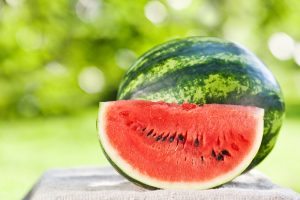
Watermelon prices are good right now for farmers.
What would harvest season look like? Would there be customers to purchase the crop? What kind of market value would there be?
Fast forward two months later; watermelons are in high demand amid fears of a shortage.
“Six weeks ago, a lot of these guys down here, including myself were concerned about, with the pandemic, just getting their money back,” said Greg Leger, a grower and shipper in Florida and Georgia. “Everybody was like, ‘If we can just get our money back.’ Everybody was scared to death because we didn’t know if there was going to be movement and consumption.
“(But) I had a friend tell me he was in a store up in Atlanta and people were social distancing waiting to get to the watermelon bin. Everybody in there was putting a watermelon in their buggy, which is good. It is a value and always has been. That’s promising to me, especially for Georgia and the Southeast for the fourth of July. I just hope that as long as consumption stays up and movement stays good, it should be a good season for us.”
First Signs of Lack of Fruit in Florida
Carr Hussey, a watermelon farmer in Florida and Alabama and chairman of the board of the Florida Watermelon Association, addressed the possibility of a watermelon shortage on May 12. He said the reason Florida is running out of melons is due to three straight weekends of rain events. Heavy rains on mature vines led to a quick harvest season.
South Georgia watermelons are poised to be ready between June 10-15. If there continues to be a shortage of melons, prices should remain strong for farmers in Georgia and Alabama. Currently, they’re around 22 cents per pound.
“Pricing is good. The reason pricing is so strong is that availability is shorter than normal,” Liger said. “I think we’re going to be a week earlier than we’ve been in the past couple of years. Two years ago, we didn’t even start til, we only had like 2 ½ weeks to get the crop off before the holiday. This year I think if things stay like they are now, we’re going to get started around the 15th with decent volume. I hope we do anyway.”