U.S. Hemp growers are disappointed the recent Coronavirus Food Assistance Program commodity expansion does not include hemp. Last week, the Department of Agriculture expanded the commodities covered under the program that provides COVID-19 relief to producers. CFAP includes commodities that USDA can prove saw losses of 5% or more in the first quarter of 2020.
The U.S. Hemp Growers Association (USHGA) says, “We believe our farmers did present evidence of losses to our growers that were 5% or more in the first quarter of 2020.”
Hemp is such a newly legal crop that it does not have the advantage of data gathered by USDA agencies. Currently, the data available to understand the market is gathered privately by several data companies. USHGA believes two datasets showed a 5% pricing decrease and more in hemp and hemp products in the first quarter of 2020.
The statement says, “All hemp farmers are now wondering what kind of treatment they will receive should there be future problems.”
(From the National Association of Farm Broadcasters)
One thing is certain about this year’s pecan crop in Alabama and Georgia – it is loaded. One thing that is not certain is what kind of price those pecans command at the market once they’re harvested this fall.
University of Georgia Cooperative Extension pecan specialist Lenny Wells said there are various factors that will impact prices for farmers this year, starting with China.
“We don’t know what China is going to do, with COVID-19 and with the tariff situation and all the political issues we’ve got between our two countries. There’s a lot of uncertainty there about if they’re going to buy. You hear a lot of different things and don’t know how much of it is accurate,” Wells said. “I think some of the accumulators have told me that they’re starting to get a little interest from China but not like they normally do at this time.”
Domestic Market Concerns
Wells also added that the domestic market will once again be impacted by the influx of pecans from Mexico. Unfortunately, those imports should depress the market price.
“I don’t see that changing anytime soon,” Wells said.
Wells said harvest season should begin no later than mid-September with the Pawnee varieties. Other varieties like Oconee and Caddo will be picked at the end of September and early October.
Wells hopes early pecans will attract a strong price.
“The early good stuff this year is probably going to bring, hopefully, a decent price. It may not be what we want. But that may be some of the better prices we see. Who knows?” Wells said. “But early like this when it is early, it gives an opportunity for the gift packed market to get in there and buy what they need. The prices on the gift packed market are usually decent. But they want top quality stuff. That’s one thing we’re seeing when talking with buyers is you really need to have good quality if you want to even get a halfway decent price. Quality’s going to become more and more in demand.”
Pictured (L to R): Dean Paul Patterson (Auburn University College of Agriculture), Randy Wilson (John Randall Wilson, Architect), David Womack (AFC Board Chairman), Mike Sutterer (Bonnie Plants, Inc.), Mayor Gary Fuller (City of Opelika), David Scott (Scott Land Company), David Canon (Opelika City Council), Eddie Smith (Opelika City Council).
(August 2020) – Bonnie Plants, Inc. (Bonnie) is breaking ground on a new state-of-the-art corporate headquarters building that will bring about 60 jobs to Opelika, Alabama. In addition, Bonnie and Auburn University (AU) have entered into a formal partnership with investments by Bonnie across several key areas of the university – including the Harbert College of Business and the College of Agriculture.
Relocating Bonnie’s headquarters from Union Springs to the Auburn-Opelika area will be used to help enhance associate recruiting and retention efforts as the company continues to grow and expand.
“The decision to relocate to Opelika was made easier by the strong partnership and support we received from city leadership,” said Mike Sutterer, CEO of Bonnie.
The new Bonnie building, which is slated to open late 2021, will be in the Tiger Town Corporate Park in Opelika, Alabama and will include several sustainable features including a 10-foot high indoor living wall that will naturally purify air in the office.
“I am pleased to welcome Bonnie Plants to our community. We are honored that a long-standing company like Bonnie is making an investment in our local economy. This will bring jobs and enhance the quality of life for the residents of Opelika,” said Mayor Gary Fuller.
The move to Opelika will also facilitate Bonnie’s new partnership with Auburn University. This partnership will create additional awareness of Bonnie as a potential employer for Auburn students and alumni with the goal of increasing internships and full-time recruiting.
“Auburn University is nationally recognized with strong, talented faculty, student and alumni networks, and is an ideal partner for Bonnie and its future,” Sutterer said.
Bonnie Plants has made a gift to support two newly endowed scholarships at Auburn that will be given annually, one to a student in the Harbert College of Business studying business analytics and the other in the College of Agriculture for a student majoring in horticulture.
This partnership also includes support for Auburn’s Center for Supply Chain Innovation. Bonnie will participate with several other major companies in a public-private partnership to foster innovation and technology advancements in supply chain – a mission-critical function for Bonnie.
Additionally, this partnership will give Bonnie the opportunity to focus on recruiting interns and full-time positions that will ensure Bonnie can continue to attract the most talented students and alumni to join the Bonnie team. This will include working with the central career center and the career center in the Harbert College of Business.
“We are grateful for this commitment from Bonnie Plants to not only support our students and faculty, but also to partner with our Center for Supply Chain Innovation,” said Annette L. Ranft, dean of the Harbert College of Business. “The supply chain program is ranked among the top in the country, while business analytics is among our fastest growing programs. This investment will increase our ability to remain at the forefront of research and discovery as we prepare students to meet future industry challenges.”
Bonnie will focus on engagement with students and faculty to help solve real-world challenges in areas such as product development, logistics and analytics. This will include guest speakers for the classroom and faculty events. Bonnie will also provide in-kind support for multiple gardens across campus and outreach projects.
Bonnie Plants is the leading brand of live vegetable and herb plants for home gardeners in the United States. Bonnie was founded in 1918 on the principle of providing access for home gardeners to grow fresh food. What started as one small farm in Union Springs, Alabama, has grown to a national brand with 4,000 peak season associates and over 80 greenhouse growing operations, selling plants in all 50 states. Bonnie plants are available at all major retailers along with direct-to-consumer sales through www.bonnieplants.com.
Heat and humidity in the Southeast means hemp producers face challenges this season with regards to pests and diseases.
Matthew Brecht, cannabis grower, hemp expert and plant pathologist with Marrone Bio Innovations, said scouting is essential for growers especially since not much research has been done with this relatively new crop.
“Right now (hemp) should be transitioning to flowers. You should be having some pre-flowers maybe or about to be there. This is a time when you could have anything come in the Southeast. The east coast, Southeast, specifically is hot and humid with lots of rain events or tropical depressions that come through. You have all kinds of bugs and diseases that show up because of the humidity and pressures you have,” Brecht said.
Be on the Lookout for Worms
He noted that the worst pests for hemp are worms, especially corn earworms.
“The insects will get into the newly formed colas (cluster of buds) and basically start chewing on them. They kill the flower or parts of the flower. Once they start doing that, you could lose a good percentage of your crop. Farmers want to think about scouting for these little caterpillars and looking for either the moths or the eggs and try to time some of these applications, products that are for caterpillars during that time,” Brecht said. “Because of high humidity, you also get leaf spot. You could have hemp stem rot. You could have powdery mildew and (bud rot) towards the end.”
Brect emphasized that there wasn’t great research done in hemp prior to 2019. Hemp farming is still in its early stages, especially in Alabama, Florida and Georgia. It’s still very new with not a lot of understanding of the different pests and diseases that can be of impact.
Products are also sporadic from state to state in what growers can utilize, which could mean a challenging growing season for some farmers.
“If you don’t have proper tools to control these pests and diseases, you could potentially lose a good portion of your crop,” Brecht said. “I would say growing hemp on the east coast or the Great Lakes, anywhere that has a more humid or rainy environment during the summer time is much more difficult than it is on the west coast, much more difficult.”
According to the Alabama Extension Commercial Horticulture Facebook page, insect pressure has increased significantly over the past two months. This was reported in 20 locations across Alabama, where moth counts from pheromone traps were collected.
For example, the beet armyworm moth numbers were 823 as of Aug. 15, a 1.2X increase from the 682 reported on July 31. Host plants include corn, cowpea, eggplant, pepper, tomato, cotton, peanut and soybean. The fall armyworm saw a 1.6X increase from 88 to 149 over that same timeframe. It prefers to feed on grasses then move to crops.
The southern armyworm also saw a 1.6X increase from 197 to 307. Moths are active throughout the year in Florida. Larvae have reddish brown head with white line on the body.
The moth most widespread right now is the lesser cornstalk borer. It increased from 4,000 on July 31 to 5,060 on Aug. 15. The squash vine borer, corn earworm, soybean looper and yellow striped armyworm experienced the largest increase of 2X each.
The squash vine borer increased from 152 to 311. It is worse on organic farms. The corn earworm feeds on corn, tomato and cotton.
The cabbage looper increased from 192 on July 31 to 286 on Aug. 15. Its host plants include sweet potatoes, beans, peas, squash, tomato and watermelons.
UGA photo shows a pecan tree suffering through the heat with scorched leaves.
Recent rainfall is a sight for sore eyes for pecan farmers on the verge of harvesting this year’s crop, according to University of Georgia Extension pecan specialist Lenny Wells.
“We’ve had years where August and September we didn’t get a drop of rain. Even with the best irrigation the percent kernel didn’t fill out as good as you would expect,” Wells said. “A little bit of rain goes a long way during this time as far as that goes.”
Weeks of dry conditions and extreme temperatures led to multiple counties in Alabama and Georgia being classified as ‘abnormally dry’ by the US Drought Monitor. This led to tough conditions for pecan trees producing a crop.
“We were seeing a lot of that leaf scorch, especially on the young trees where the roots were getting a little burned from the heat. It’ll be 105 degrees down 5 or 6 inches, and that’ll burn and kill off some of those feeder roots. You get some scorching and that kind of thing,” Wells said. “This (recent rain) will give some relief from that for sure.”
Harvest Season About to Begin
With harvest season just a month or two away – Wells believes the Pawnee varieties will be harvested in mid-September – this is an important time in the production season for the nuts to receive water.
“We’re into the kernel fill stage and that’s such a high energy demand process and especially when they have a heavy crop on them like we see out there this year, it just takes a lot of water to fill those nuts out as the kernel forms,” Wells said. “The crop is probably two weeks ahead of schedule. But a lot of our main varieties are right in the middle of filling those kernels. Some of the early stuff has already got kernels already in place. But the water’s still going to be beneficial to helping them go on and mature properly and open up properly.”
Heat and dry weather conditions make this a peak time for insect pressure. Ayanava Majumdar, an Auburn Extension Professor in Entomology and Plant Pathology, cautions fall vegetable growers about insect pests and to scout regularly.
Pictured is a fall armyworm.
“Insects love the heat because they grow through their life cycle faster because of the extra heat. They grow faster. They mate and reproduce faster plus the plants are stressed. It’s like a perfect storm and it leads to massive crop losses for farmers,” Majumdar said.
Armyworms
There are various insect pests the growers need to be mindful of this time of year. Majumdar is concerned with caterpillars, in particular, the armyworm sisters: beet armyworm, fall armyworm, yellow striped armyworm and southern armyworm.
“These four, often times there’s mixed populations in the field. They can be very difficult to identify when they’re small. As they grow bigger it’s easier to identify. Those armyworms have very distinct patterns and head structures,” Majumdar said. “Those armyworms, along with horned worms, loopers; everything is just exploding right now. This is the peak of insect activity now.; August and then into September, to some extent. We are constantly telling farmers to watch; caterpillars on tomatoes and then you will see sucking insect pests, which cause quality loss like stink bugs, leaf footed bugs.
“Often, it’s hard to tell the yield loss from just the weight of the produce, but they will destroy the appearance or the taste of the produce. There’s a huge quality loss with the sucking insect pests. Those are increasing as well.”
Squash Bugs
He also warns of squash bugs on squash. They feed on the crop and can transmit yellow vine disease. This can shut down plants during harvest and is exacerbated by the current drought-like conditions.
While scouting is important, knowing when to apply insecticides can be just as key to pest management. Majumdar implores farmers to always consider the current weather conditions.
“We can not do calendar-based spraying anymore, at least not in Alabama. We go from drought to extreme wet weather in a week. That has a huge effect on insects,” Majumdar said. “Have some flexibility in the IPM plan. That’s very important to check the weather patterns. I’ve described flash drought versus prolonged drought. There’s different kinds of drought we’re experiencing now. That affects our pest management.”
Sweet Grown Alabama Director Ellie Watson with a representative from Alabama Farm Credit.
MONTGOMERY, Ala.— Sweet Grown Alabama, the state’s agricultural branding program, is pleased to welcome Alabama Farm Credit as a founding member of the non-profit organization.
“Alabama Farm Credit is proud to be a founding member of Sweet Grown Alabama. We believe that the strength of agriculture in our state is dependent on finding every way possible to maximize the value of our farmers’ products,” said Mel Koller, President and CEO of Alabama Farm Credit. “Sweet Grown Alabama provides a new avenue for our growers to connect with customers and increase the strength of their individual brands. At Alabama Farm Credit we believe ‘Together We Grow.’ We know by supporting the Sweet Grown [Alabama] branding together Alabama agriculture will indeed grow.”
Alabama Farm Credit’s financial support will help Sweet Grown Alabama connect Alabama farmers and families. Funds will be utilized to encourage purchasing of locally grown products through traditional and digital marketing. Consumers can search for a variety of locally grown products at SweetGrownAlabama.org.
“We are thrilled to add Alabama Farm Credit to our network of founding members,” said Ellie Watson, Sweet Grown Alabama Director. “This contribution will allow us to educate and connect more consumers to Alabama grown products, and I am grateful that Alabama Farm Credit is committed to support local through our program.”
With this commitment, Alabama Farm Credit becomes the eighth founding member supporter of Sweet Grown Alabama.
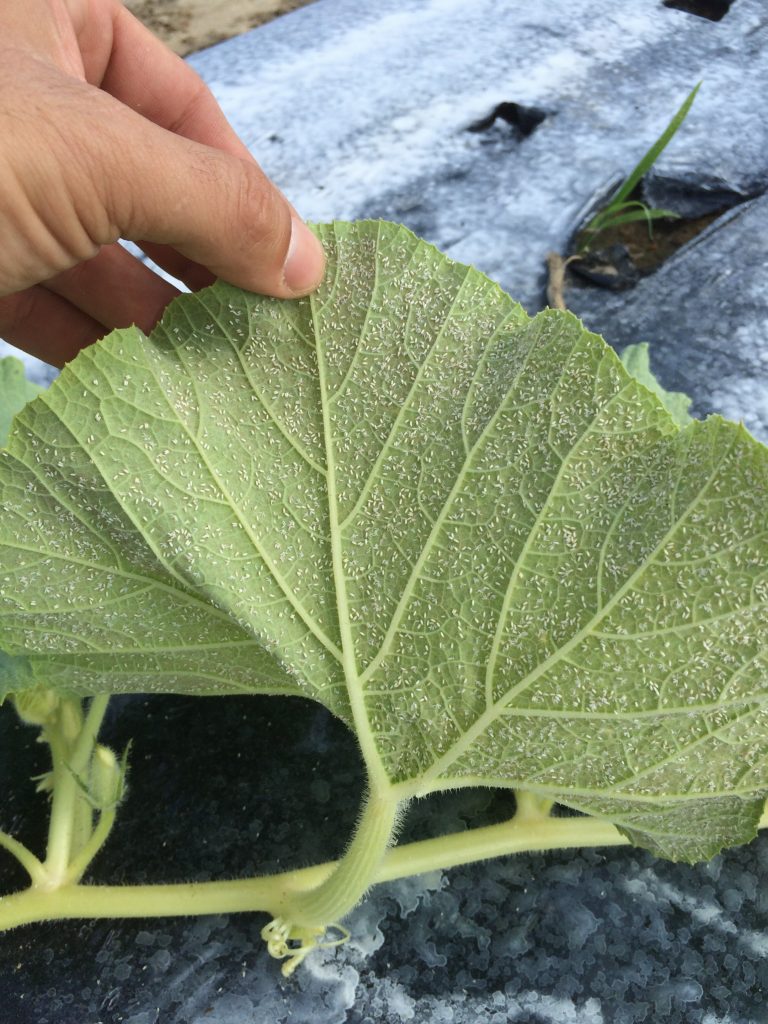
File photo shows how whiteflies infest fall cucurbits.
Unless more rain in the upcoming weeks can knock back populations, whiteflies are a huge concern for fall vegetable growers, according to Stormy Sparks, University of Georgia (UGA) Extension vegetable entomologist.
“Right now, it’s looking pretty bad. It could be devastating. The populations are really high, and we’re just now getting started,” Sparks said. “I’ve got squash where the adult counts are 200-plus per leaf. We’re just starting to see some virus. It’s pretty low, but that can increase rapidly.”
According to the most recent release of the US Drought Monitor, about half of Georgia’s counties are classified as ‘abnormally dry,’ including Tift County where Sparks is based at the UGA Tifton campus.
“They love hot, dry weather. I saw some cotton the other day. I haven’t seen cotton that looked that bad since I was in Rio Grande Valley of Texas,” Sparks said. “Those bad spots are very spotty right now, but if we stay hot and dry, it can get ugly in a hurry. It’s already ugly in some spots.”
Rainfall is needed to, not only help the crops grow, but knock back some of the whitefly populations.
Whiteflies Everywhere
Alabama Extension cotton entomologist Ron Smith said they’re finding whiteflies as far north as Quitman County (Georgia), which is just across from Eufala, Alabama. There’s also some in the Panhandle of Florida and in some fields in the corner of Alabama down in the extreme tip between Georgia and Florida. For more information about whiteflies’ impact in cotton, click here.
Crop Devastation
Whiteflies are especially dangerous since they can also transmit cucurbit leaf crumple virus and cucurbit yellow stunting disorder virus. According to UGA crop loss estimates for fall 2017, these viruses caused between 30% and 50% of crop loss in squash and cucumbers and nearly 80% of crop loss in snap beans. While this year’s whitefly infestation does not rival 2017 yet, the numbers are still bad and a concern for growers in the middle of planting this fall’s crop.
“We can battle the whitefly, it gets real ugly and real expensive but we can battle the whitefly in most crops. It’s those crops where we have virus problems where we don’t have resistance to that are the greatest concern,” Sparks said. “The yellow squash is extremely sensitive. Zucchini is tolerant but not really resistant. Cucumbers, you can produce a crop despite the virus. Tomatoes, we’ve got tomato yellow leaf curl, if you’re not growing a leaf curl resistant variety, you have the potential to losing the crop. But most people now are growing leaf curl resistant varieties in the fall.”
Lack of Cold Winter Temperatures
While colder temperatures do not eliminate whiteflies, they do kill many of their wild hosts. They also slow population development in cultivated hosts. Warmer temperatures this winter allowed for larger whitefly populations to overwinter and become mobile earlier.
(Washington, D.C., Aug. 11, 2020) – U.S. Secretary of Agriculture Sonny Perdue announced today that additional commodities are covered by the Coronavirus Food Assistance Program (CFAP) in response to public comments and data. Additionally, the U.S. Department of Agriculture (USDA) is extending the deadline to apply for the program to Sept. 11, and producers with approved applications will receive their final payment. After reviewing over 1,700 responses, even more farmers and ranchers will have the opportunity for assistance to help keep operations afloat during these tough times.
Perdue
“President Trump is standing with America’s farmers and ranchers to ensure they get through this pandemic and continue to produce enough food and fiber to feed America and the world. That is why he authorized this $16 billion of direct support in the CFAP program, and today we are pleased to add additional commodities eligible to receive much needed assistance,” said Secretary Perdue. “CFAP is just one of the many ways USDA is helping producers weather the impacts of the pandemic. From deferring payments on loans to adding flexibilities to crop insurance and reporting deadlines, USDA has been leveraging many tools to help producers.”
Background
Background: USDA collected comments and supporting data for consideration of additional commodities through June 22, 2020. The following additional commodities are now eligible for CFAP:
Specialty Crops – aloe leaves, bananas, batatas, bok choy, carambola (star fruit), cherimoya, chervil (french parsley), citron, curry leaves, daikon, dates, dill, donqua (winter melon), dragon fruit (red pitaya), endive, escarole, filberts, frisee, horseradish, kohlrabi, kumquats, leeks, mamey sapote, maple sap (for maple syrup), mesculin mix, microgreens, nectarines, parsley, persimmons, plantains, pomegranates, pummelos, pumpkins, rutabagas, shallots, tangelos, turnips/celeriac, turmeric, upland/winter cress, water cress, yautia/malanga, and yuca/cassava.
Non-Specialty Crops and Livestock – liquid eggs, frozen eggs and all sheep. Only lambs and yearlings (sheep less than two years old) were previously eligible.
Aquaculture – catfish, crawfish, largemouth bass and carp sold live as foodfish, hybrid striped bass, red drum, salmon, sturgeon, tilapia, trout, ornamental/tropical fish, and recreational sportfish.
Nursery Crops and Flowers – nursery crops and cut flowers. Other changes to CFAP include: Seven commodities – onions (green), pistachios, peppermint, spearmint, walnuts and watermelons – are now eligible for Coronavirus Aid, Relief, and Economic Stability (CARES) Act funding for sales losses. Originally, these commodities were only eligible for payments on marketing adjustments.
Correcting payment rates for onions (green), pistachios, peppermint, spearmint, walnuts, and watermelons.
Producers Who Have Applied: To ensure availability of funding, producers with approved applications initially received 80% of their payments. The Farm Service Agency (FSA) will automatically issue the remaining 20 percent of the calculated payment to eligible producers. Going forward, producers who apply for CFAP will receive 100% of their total payment, not to exceed the payment limit, when their applications are approved.
Applying for CFAP: Producers, especially those who have not worked with FSA previously, are recommended to call 877-508-8364 to begin the application process. An FSA staff member can help producers start their application during the phone call.
On farmers.gov/cfap, producers can: Download the AD-3114 application form and manually complete the form to submit to their local USDA Service Center by mail, electronically or by hand delivery to their local office or office drop box. Complete the application form using the CFAP Application Generator and Payment Calculator. This Excel workbook allows customers to input information specific to their operation to determine estimated payments and populate the application form, which can be printed, then signed and submitted to their local USDA Service Center. If producers have login credentials known as eAuthentication, they can use the online CFAP Application Portal to certify eligible commodities online, digitally sign applications and submit directly to the local USDA Service Center. All other eligibility forms, such as those related to adjusted gross income and payment information, can be downloaded from farmers.gov/cfap. For existing FSA customers, these documents are likely already on file.
All USDA Service Centers are open for business, including some that are open to visitors to conduct business in person by appointment only. All Service Center visitors wishing to conduct business with FSA, Natural Resources Conservation Service or any other Service Center agency should call ahead and schedule an appointment. Service Centers that are open for appointments will pre-screen visitors based on health concerns or recent travel, and visitors must adhere to social distancing guidelines. Visitors are also required to wear a face covering during their appointment. Our program delivery staff will be in the office, and they will be working with our producers in the office, by phone and using online tools. More information can be found at farmers.gov/coronavirus.