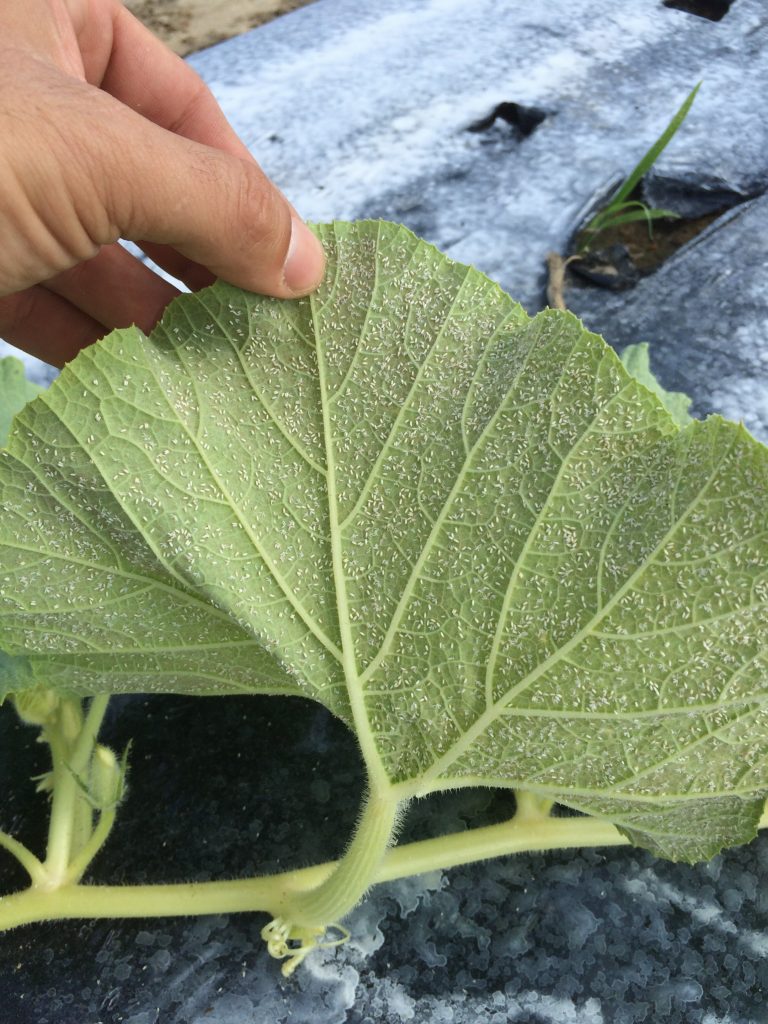
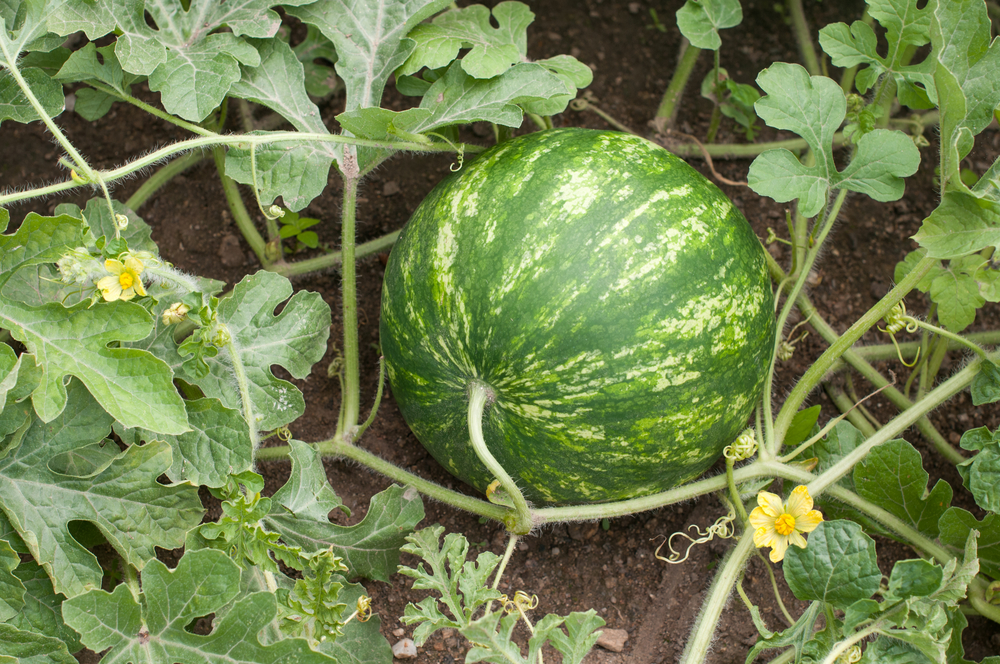
File photo shows how whiteflies can infest fall cucurbits.
University of Georgia Cooperative Extension vegetable entomologist Stormy Sparks is more optimistic about the ongoing whitefly problem that farmers are facing this fall – especially more than what he was feeling two weeks ago. His reason for optimism? Remnants from a hurricane and a drop in temperatures.
Remnants from Hurricane Sally and cooler weather this week should help knock back some of the whitefly populations, which were wreaking havoc on fall vegetable crops.
The rain amounts were extreme in certain places last Thursday when the storm moved across the state. More importantly, the rain was widespread.
“I would anticipate that the weather knocked down the adult populations and this cool weather will greatly delay or reduce the amount that they rebound. That’s what I would think would happen,” Sparks said. “The main thing was (the rain) was everywhere. We got some everywhere. That probably has much more impact than those local heavy rains that we normally get.”
Weather Conditions
According to the UGA Automated Weather Network, Cordele, Georgia received 5.3 inches on Thursday, Sept. 17, while Moultrie, Georgia received 2.36 inches.
Temperatures also dropped from 81 degrees Fahrenheit on Sept. 16 to 67 degrees F on Monday, Sept. 21 in Moultrie.
Whitefly Infestations
Whiteflies have been a problem all year, dating back to early spring. An abnormally mild winter did not kill off many of the wild hosts that whiteflies overwinter on. The result was they became mobile earlier this past spring.
Whiteflies cause feeding injury issues in vegetables and transmit two viruses: cucurbit leaf crumple virus and cucurbit yellow stunting disorder virus. Vegetables like squash, zucchini, cucumber, cantaloupe and snap beans are highly susceptible to these viruses. Commercial cultivars that have resistance or tolerance to these pathogens are not available.
Pictured is a stink bug, an insect that farmers can target with trap cropping.
Ayanava Majumdar, Extension Professor in Entomology and Plant Pathology at Auburn University, touts trap cropping as being effective in controlling unwanted insect pests while also significantly reducing insecticide applications.
“Not all insects will trap crop work. Trap crop works for insects that typically stay in clusters or have a strong border effect. For example, our sucking insect pests like the stink bugs, aphids; they all show a very clumped distribution and have a very high edge effect and then they spread,” Majumdar said. “Those are the insects, especially the migratory insects, that you can arrest; stopping them from going into the main crop.”
Trap crops are sacrificial crops planted around a field that are not meant to be harvested. Producers plant them to draw pests away from the real crop. There is no universal trap crop available. Different insects require different trap crops.
Insects love different kinds of plants. Stink bugs will attack tomatoes, so if farmers provide a distraction like sorghum, they will go to that distraction and stay away from tomatoes.
Majumdar said the trap crops evaluated in Alabama include sorghum and sunflower for leaffooted bugs; sunflower, browntop millet and pearl millet for stink bugs; okra, bell peppers and ornamentals for aphids; New England Hubbard squash for squash insects.
He recommends growers plant a trap crop two weeks ahead of a main crop, for a perimeter trap crop where it envelops an entire field.
Some advantages include farmers can use existing farm equipment; there is minimum new investment (seed); producers can reduce damage to the main crop; and it attracts and conserves beneficial insects.
“The challenge is to become efficient in doing it, not devoting more than 10% or 15% of the total area in trap crop so that you don’t cut back on the land and main crop,” Majumdar said.
Georgia pecan farmers escaped serious damage last week following Hurricane Sally’s trek through the Southeast. Alabama producers were not so lucky, however.
University of Georgia Extension pecan specialist Lenny Wells said Baldwin County, the heart of Alabama’s pecan production, was one of the counties hit hardest by Sally’s Category Two Hurricane status. According to the UGA Extension pecan blog, Wells said he has spoken with growers and pecan specialists in the area. The damage is worse than Hurricane Ivan in 2004.
“From the ones I’ve talked to down there, they’re going through the same thing we went through with Michael (in 2018) and the same thing they’ve been through before with Ivan and so many other storms,” Wells said. “It sounds pretty bad over there. I think it’s worse on one side of the bay than the other. I think the east side of the bay got the worst of it. But it’s pretty bad.”
Growers reported 25% to 75% of their trees down. That area received more than 20 inches of rain with 100 mph winds. Trees were laid on the ground and leaves and nuts were knocked off trees.
Impact on Georgia pecans
While Alabama producers were dealt a double whammy with excessive rainfall and high winds, Georgia’s pecan orchards experienced mainly flooding. There was between 6 to 8 inches of rainfall in some areas, according to the UGA Extension pecan blog.
“There wasn’t a lot of wind damage that I’ve heard about or seen yet,” Wells said.
Wells said this development may delay some growers from getting into orchards where Pawnees were ready for harvest. That is normally the earliest variety that is harvested. The remaining varieties will be ready in a few weeks.
“We’re probably three weeks away, maybe two, but two to three weeks away from really getting started with Elliott and some of the early October varieties that we harvest. Probably by mid-October, I imagine everything will be ready this year,” Wells said. “Crop is a little early.”
Alabama Farmers Federation photo/Hurricane Sally damaged crops and structures along Alabama’s Gulf Coast when it hit Sept. 16. Bitto Farms sustained damage from the hurricane in Baldwin County.
The Alabama Farmers Federation is requesting help from producers hit hard this week by Hurricane Sally. The organization has put together a storm damage survey for growers impacted by the Category 2 hurricane.
In the storm damage survey, it says while it is important to report losses in the survey, it is also important to report damage to your local Farm Service Agency office.
Farmers and homeowners across parts of Florida, Alabama and Georgia felt the wrath of Hurricane-turned-Tropical Storm Sally this week. High winds and massive floods knocked out electricity for residents and impacted farmers’ crops.
Woods
Kristin Woods, Alabama Regional Extension agent, who specializes in commercial horticulture and food safety, reminds growers about the ramifications of floodwaters that come in contact with edible crops.
“The issue with floodwaters is that they’re generally running off from another area. It’s not the same as having a puddle or pool of water on the farm that’s just the contamination that might be from that spot. When the floodwaters are running off from another area, there’s no telling what could be in it,” Woods said. “It could be chemical contamination. It could be microbial contamination if there’s sewage leaking into the floodwaters. It could be just about anything in there.
“The FDA (Food and Drug Administration) says that any crop that is exposed to floodwaters is adulterated; it can’t be sold.”
What are Floodwaters?
According to the Alabama Extension news article, all standing water in a field is considered floodwater. Flooding is considered the flowing or overflowing of a field from open bodies of water outside the producer’s control. Adulterated means to make something poorer in quality by adding another substance, typically of inferior quality.
“Around here, we have quite a few people that just put in their fall gardens. I guess in a way that’s fortunate because you’re talking about replanting and not ruining a crop that has been there for three months,” Woods said. “We have some pumpkins, too. Usually, those are not eaten, so that’s a good thing. If it’s a crop that’s not going to be sold for food, then it’s fine, if it can be salvaged. If it’s under water for too long then the pumpkins won’t be any good, either.”
Excessive Rains Recorded
According to weather.com, more than 24 inches of rain was recorded at Pensacola Naval Air Station in Pensacola, Fla. In Alabama, most of the 238,000 homes and businesses without power were in Mobile and Baldwin counties. According to weather.com, the flooding continued on Thursday in Georgia and moved to the Carolinas and Virginia.
Another week, another challenge for Alabama’s hemp producers.
Kesheimer
The excessive rainfall that some areas in the state experienced because of Hurricane Sally, should impact the hemp crop, according to Katelyn Kesheimer, Auburn University Assistant Professor and Extension Specialist.
“The issue is there’s that 15-day testing window. So, you have to get an Ag inspector to come take a sample of your crop and make sure it’s not hot, not above 0.3% THC,” said Kesheimer. “Then you have within 15 days of that testing, you have to harvest. If you miss it, you have to get tested again after that 15 days; if you miss it. You don’t want to be pulling soaking wet plants out of the field because they have to dry. We’re already struggling this year with diseases primarily in hemp. We’re dealing with issues of corn earworm and stuff but because it’s been so wet and humid, we’re having Ag inspectors go do their inspections and then the growers have a whole host of disease issues.
“It’s probably only going to get worse. It’s not great timing for an already tough year for folks.”
Rude Awakening
Some Alabama hemp producers who were able to plant their seeds by April or May should be ready to begin harvesting their crop. But Kesheimer noted that one issue that farmers have encountered is the cost associated with drying and processing the hemp. The dire reality has even forced some farmers to get rid of their crop.
“It’s going to cost more for some folks to pay for that than they’re going to make (in) a profit. So, they’re just plowing their crop under,” Kesheimer said. “There’s one particular farmer in southern Alabama, it was going to cost him $300,000 to get his plants processed on 15 acres and he was only going to make $90,000. He just plowed it under. That was about a $30,000 investment in terms of seed and inputs.”
Kesheimer said most growers throughout the region didn’t have contracts established before the season – consequently, another problem.
“They’re finding out the harsh reality of cost to process, distance, time and all that stuff. It’s a big learning experience, and if I were a grower, I’d want to get my crop out of the ground as soon as possible, which may be difficult with the rain,” Kesheimer said. “It’s just one more delay that’s going to make an already bad year more tough.”
Watermelon season is winding down in Alabama this week. Just like its southern counterparts, north Alabama producers enjoyed a successful season, according Eric Schavey, Alabama Regional Extension agent in Northeast Alabama
“Overall, watermelons in our area, in Northeast Alabama was good,” said Schavey, who serves Blount County, Cherokee County, Cullman County, DeKalb County, Etowah County, Jackson County, Madison County and Marshall County.
“We got a premium price for them. Up until the last 20 days, 15 days, the watermelons, you were getting a premium. The wholesale side of it went down to $3.25, $3.50, depending on what you had. I’m talking about a good marketable, large watermelon; that 20-pound and even getting up in that 30-pound watermelons.”
Crazy Start
Watermelon producers in North Alabama had to overcome challenges throughout the growing season, starting when seed were put in the ground. Schavey said the northern part of the state experienced a frost on May 26. Normally, seed are in the ground way before that. Growers had to wait, and subsequently, the plants were put in the ground late.
It didn’t impact the fruit’s quality, however.
“As far as quality, everything was really good. We didn’t have a lot of stunted melons or odd-shaped melons. We had real good marketable watermelons this year,” Schavey said.
Production in Alabama
Watermelon production is divided between the southern and northern portions of the state. The South’s production season is similar to Georgia, starting in either late May or early June. Growers in north Alabama are about a month to a month and a half behind, says Schavey.
“We have to wait on those soil temperatures. You’re right on the foothills of the Appalachians when you get into my area. It’s very mountainous up in Etowah, Cherokee, DeKalb and even over in Blount County. You get a lot of terrain change. We can get some cool temperatures,” Schavey said.
He estimated that there are at least 600 to 700 acres of watermelons in his region with most being grown in less than 10-acre plots.
Photo submitted by Edgar Vinson/Alabama Extension: Shows row cover in place on strawberries.
Row Covers in strawberry fields can protect the crop from cold temperatures, fierce winds, devastating frost and persistent wildlife. But it can also potentially increase yields, according Edgar Vinson, assistant research professor and Extension specialist in the Department of Horticulture at Auburn University.
In research conducted this past year at the Wiregrass Research and Extension Center in Headland, Alabama, Vinson tested the effects of row cover applications on late plantings of three strawberry varieties: Albion, Camarosa and Sweet Charlie. Treatments were set for fall applied (Nov. 20-Dec. 20), fall and winter applied (Nov. 20-Dec. 20 and Feb. 11-March. 11) and control (applied for frost protection only).
Research Results
Comparisons were made in marketable yields, total yields and leaf surface areas. In marketable yields, the treatments for fall applied and fall and winter applied row covers were higher than the control treatment for all three varieties. In Sweet Charlie, the control treatment led to a little more than 6,000 pounds per acre. But in the fall treatment for Sweet Charlie, it was nearly 9,000 pounds.
There was nearly 10,000 pounds per acre for Camarosa in the control treatment, but approximately 11,000 in the fall and winter treatment.
“Each time it appeared that the more times that the row cover was applied, the more yield we actually had with the exception of Sweet Charlie,” Vinson said. “Sweet Charlie increased with the fall cover but seemed to fall off with the fall/winter application. I think that’s probably because Sweet Charlie is an early variety. It begins to really sputter around three weeks. It’s a really a great tasting berry, early berry. A lot of people have it in their operations because it’s so early and get on the market early. But you really can’t expect much out of that after three weeks.”
The first weeks of harvest is where growers could potentially see the most benefit. In week one, there was less than 100 pounds per acre for the control treatment of Camarosa but more than 350 in the fall/winter treatment. In the Sweet Charlie variety, there were more than 100 pounds per acre in the control treatment but approximately 225 pounds in the fall/winter treatment.
The yields continued to increase in weeks two and three of harvest for Camarosa and Albion but Sweet Charlie dropped off during the third week.
Cost Effective?
The use of row covers may increase yield but is it cost effective? Vinson compared each cost of the traditional row cover, fall row cover and fall/winter row cover. He estimated expenses based upon how many applications and the man-hours each treatment accounted for. With each treatment, Camarosa was profitable; $14,885.82 in the fall/winter compared to $10,455.41 for traditional. Sweet Charlie was much more profitable in the fall treatment ($9,611.98) compared to the traditional treatment ($2,375.82). Albion was only profitable in the fall-winter treatment ($2,127.12).
Summary Points:
Row covers can effectively improve the growth of strawberries and improve yield.
The effectiveness in row covers on the different varieties depends on the location.
Strawberries receiving row covers in the fall and again in the winter had increased yields over the fall only and non-treated control treatments.
Profits increased when row cover was applied during the fall and in the fall-winter periods.
Row Covers Essential in Winter
While strawberries are a winter crop, they are vulnerable to freezing temperatures, which is the main row covers are applied. Vinson said if temperatures drop to 20 degrees F, this could result in plant injury. However, if the plant is flowering or producing fruit, it can only withstand temperatures as low as 28 degrees F.
“Buds are dormant and as long as that tissue is not quite as susceptible as a plant that’s developing and about to bloom,” Vinson said. “The more the flowers progress, the more they are susceptible to cold damage.”
Strawberries Growing in Popularity
Alabama’s strawberry production is growing in popularity throughout the state. Vinson said in 2012, there were 74 farming operations on 150 acres. While acreage has not increased, the number of operations has increased to 126.
Use of Row Covers on Strawberries
Row covers should be applied ahead of a predicted frost and should be removed after threat of damage has passed, though this does require a lot of workers/bags of weight to keep row covers down. They need to be replaced when the frost threat returns.
Alabama fruit and vegetable growers need to be aware that moths are still active across the state. According to the Alabama Extension Commercial Horticulture Facebook page, the number of fall and yellowstriped armyworms, soybean loopers, corn earworms and vine borers continues to rise.
Pictured is a fall armyworm.
There is a risk of infestations in vegetable crops from caterpillars. Scout and control these early. According to the Alabama Extension Commercial Horticulture Facebook page, moth counts were collected from pheromone traps in 20 locations across the state.
As of Sept. 8, there was 269 fall armyworms moths collected, compared to 149 on Aug. 15. This is a 1.8x increase over two weeks. They are very migratory and move up from Florida where they overwinter. There are 4 to 5 generations per year.
The moth numbers for yellowstriped armyworm were 133, compared to 97 on Aug. 15. They have four generations per year. The larvae have black triangular markings dorsally with white or yellow lines below.
Soybean loopers increased from 139 to 214. Loopers feed on host plants like soybeans, peanuts and other legumes.
Squash vine borers increased from 311 to 466, a 1.5x increase. These are day flying moths and are worse on organic farms.
Corn earworms increased from 139 to 214. They are highly migratory moths with five to six generations per year. Their host plants are corn, tomato and cotton.
Moth species with more than 1.5x activity increase over the previous reporting period are a high risk to crops.
Growing pumpkins is popular in South Alabama, but it comes with its challenges. Neil Kelly, Alabama Regional Extension agent, said disease management is a huge concern for any grower interested in producing pumpkins.
“The pumpkin crop is a difficult crop to grow in my part of the state. I just throw that out to there to everybody that calls about growing pumpkins. Yes we can do it, but I’m going to tell you up front, it’s difficult and it’s not real consistent,” said Kelly, who serves 10 counties in the southeast part of the state, including Barbour County, Bullock County and Coffee County. “With the different mildews and things they can get, diseases are always an issue because we’re growing them during a time of the year when it’s warm and humid. That warm weather and hot weather and humid weather, coupled with the occasional summer shower and moisture, diseases are very difficult to control in pumpkins.”
Downy Mildew
Joe Kemble, Alabama Extension vegetable specialist, said pumpkin farmers need to be wary of downy mildew, which can be devastating on pumpkins. It requires conventional fungicides, but they must be applied before the disease develops. There are not any fungicides that are curative. He said downy mildew has been found in every county in Alabama.
“You’re going to have to spray your pumpkin crop for disease management on a very regular schedule much like we do watermelons and much like we do tomatoes. You’re going to have to stay on top of disease control in the pumpkins if you want to grow good, healthy pumpkin,” Kelly said.
Curing Pumpkins
Curing pumpkins can also be a problem. It is a process that involves elevating storage temperatures to 80 degrees F or 85 degrees F with 75% to 80% relative humidity for approximately 10 days. The curing process heals wounds, helps ripen immature fruit, enhances color and ensures a longer post-harvest life.
“The next problem that we have with pumpkins, if we get past all of the diseases and we produce a good pumpkin and we get past all of the insects…the next big problem we have with pumpkins in my part of the state is them curing out. When the pumpkin starts to ripen and they start to turn that nice bright orange color and they start to cure out, because of our high humidity and our high temperatures that time of year, a lot of times what you’ll see those pumpkins do is just get soft and start to rot instead of cure out like a gourd; like the typical hard-shelled pumpkin you see in the grocery store,” Kelly said.
Kelly said large pumpkin production areas like Arizona and New Mexico have low humidity, which leads to low disease pressure and pumpkins curing out really well.
“I would say the disease issue and curing are two of the biggest problems that we fight in pumpkin production and there’s really not a lot we can do about some of those. We can put out preventative stuff for the diseases and do the best that we can to head off any kind of issue but very few diseases do we have a curative spray for,” Kelly said.