Alabama Department of Agriculture and Industries photo.
MONTGOMERY, Ala.- The Alabama Department of Agriculture and Industries (ADAI) will accept hemp applications from eligible growers and processors/handlers, using a new online application system starting, today, Oct. 13, 2020. Applications are available at agi.alabama.gov/hempapp. The final day to apply for a hemp license is Nov. 30, 2020 by 5:00 pm (CST).
In 2016, the Alabama Legislature passed the Alabama Industrial Hemp Research Program Act, Section 2-8-380 Code of Alabama 1975, tasking ADAI with the development of a licensing and inspection program for the production of industrial hemp. The program launched in 2019, after The Agriculture Improvement Act of 2018 (i.e. Farm Bill) declassified hemp as a schedule I drug and deemed hemp as an agriculture commodity. This legislation defines hemp as all parts of the plant containing less than 0.3% THC, including derivatives, extracts, and cannabinoids.
“As the hemp industry continues to grow in Alabama, critical research data is being collected and evaluated,” said Commissioner of Agriculture and Industries Rick Pate. “This is the department’s third year to administer the hemp program. It has always been our goal to manage the program in a fair and timely manner to benefit Alabama farmers and hemp producers and develop industrial hemp as an alternative crop.”
The 2021 university/college affiliation license application information will be forthcoming before the first week in November 2020.
For more information and updates, please visit agi.alabama.gov/hempapp. ADAI will receive Industrial Hemp applications until 5 pm (CST) on Nov. 30, 2020.
Auburn University Assistant Professor and Extension economist Adam Rabinowitz expects more growers to participate during this current sign-up period for the Coronavirus Food Assistance Program 2.
There’s no reason for growers to wait, go ahead and sign up for the program, which continues through Dec. 11, 2020.
Rabinowitz
“I do expect more participation. I would encourage producers to look at this as a program that’s certainly there to help them through this current period,” Rabinowitz said. “There’s a lot of coverage there in terms of the CFAP 2 program. Anything you can imagine that’s being produced in our region is covered.”
Vegetable and Specialty Crops Impact
It’s especially true for vegetables and specialty crops. More than 230 fruit, vegetable, horticulture and tree nut commodities are eligible for CFAP 2. Visit farmers.gov/cfap/specialty for a full list of eligible commodities and more information on CFAP 2 eligibility and payment details related to these commodities.
“Virtually every specialty crop is included and is based on 2019 sales. As a percentage of those sales depending on what those total gross sales are in 2019 will be what that payment is under the CFAP 2 program,” Rabinowitz said. “There’s very little from a specialty crop standpoint that was excluded; well over 230 fruits and vegetables, nuts, nursery products as well; cut flowers, plants. We’re talking agricultural products that have never received federal assistance in the past are included in this.”
Financial Impact
According to the USDA, an additional $14 billion is made available for agricultural producers. The USDA will use funds being made available from the Commodity Credit Corporation (CCC) Charter Act and CARES Act to support row crops, livestock, specialty crops, dairy, aquaculture and many additional commodities.
“The USDA is confident in the numbers and there’s enough funds there to cover all that. I think historically we know that in some of the specialty crop grower cases, they don’t have these programs, so they often don’t know about them and don’t take advantage of it. I’m not sure if it’s an expectation that a little uptake will take care of it or if USDA has that much confidence in their calculations, but it is pretty substantial,” Rabinowitz said. “There are payment limits that do come into play.”
The most dangerous threat to the peach industry in the Southeast is Oak Root Rot, a soil-borne fungus that can wipe out peach trees, according to Edgar Vinson, Alabama Extension Professor of Horticulture.
Oak Root Rot or Armillaria Root Rot, causes stunted leaves, yellow defoliation, chlorotic leaves, death of branches and, ultimately, death of the tree.
Unfortunately for peach producers, there’s not many management options available to offset the death sentence for peach trees that are planted in a field with this disease.
“As far as we know, once it’s in the soil it’s there probably for good,” Vinson said. “Once the tree starts to succumb to it, there’s no remedy for it. There’s some things to delay it, if you have a tree that’s planted in the soil that has Oak Root Rot. If you’re planting into soil that has Oak Root Rot, there’s really no remedy for it. It will eventually take over the tree and take the tree out.”
One Option
Farmers can implement a root collar excavation. This is a management tactic that producers utilize to remove soil from the crown of the tree to prevent the fungus from growing on the crown. This only delays the inevitable. Eventually the tree will succumb to the disease, but this practice extends the life of the tree so the grower can get more harvests out of it.
The best option would be to plant a resistant root stock. However, one is not broadly available yet.
“Most peaches don’t come from the nursery on their own roots. They’re budded onto a rootstock that’s tolerant to a particular soil condition or diseases. You have a desirable peach variety that’s grafted onto a resistant rootstock. That’s typically how we receive our peaches, apples and a number of other crops,” Vinson said.
Oak Root Rot symptoms usually appear between 5 to 7 years after planting.
“It’s a disease that’s recognized all over the Southeast. We’re currently working on ways to mitigate the damage,” Vinson said.
Fire ant control is essential for Alabama vegetable growers hoping to protect their crop this fall. Alabama Cooperative Extension warns producers that fire ants are known to be pests of numerous vegetable crops, including okra and potatoes.
Ayanava Majumdar, Alabama Extension Professor, said fire ants can especially be harmful to vegetables because they’ll congregate on plants that have a heavy load of aphids. They will tend to protect aphids and other honeydew producers on vegetables. Fire ants can also damage the crops themselves and contaminate the produce.
“I think the issue is they get on plants that get a heavy load of aphids. They follow aphids. If plants have aphids you often have the ants protecting the aphids,” Majumdar said.
Few Management Options
Alabama Cooperative Extension offers producers a few management options. Control fire ant mounds around or outside the vegetable production area to prevent them from moving into the garden or field. Also, manage excessive plant residue on the soil. This will help increase detection of foraging ants, provides ants fewer places to hide and make it easier to scatter bait insecticides on open ground.
The best time to apply broadcast baits is now through Oct. 15. Mound treatments may be done year-round on warm, sunny days above 65 degrees F when the fire ants are active. Majumdar attests that the ants are active now.
“They’re pretty active in my peanut fields. They’re pretty active in and around my vegetable fields and my garden. They’re very active,” Majumdar said.
An abnormally wet September has required Alabama pumpkin farmers to maintain strict fungicide applications, especially following Hurricane Sally’s trek through the state on Sept. 16.
Neil Kelly, Alabama Extension Regional agent in Southeast Alabama, said the lack of consistent sunshine over the last two weeks has created disease concerns for pumpkin growers.
“We haven’t really had a real good break in the weather and things really haven’t dried out very much since Sally came through,” Kelly said. “It’s just been important that they stick to the spray schedule and try to make weekly fungicide applications and stick with it. We’ve carried out extra spraying more so than normal. We kind of back off on some of our fungicide sprays once people start to walk through the fields.
“We had sunny warm weather leading up to this event. We’ve been getting plenty of rain and of course we irrigate. The pumpkin crop was a little bit ahead of normal. They mature out a little quicker and the vines are starting to go downhill, and then we got this wet weather. It was important for people to stick with a fungicide spray program.”
Region of Responsibility
Kelly is responsible for the Southeast part of Alabama including Barbour County, Bullock County, Coffee County, Covington County, Crenshaw County, Dale County, Geneva County, Henry County, Houston County and Pike County. He attests that certain diseases become a factor if pumpkins are growing in fields with increased moisture.
Such diseases include phytophthora, fusarium and downy mildew.
“Plant diseases and certain fruit rots become more of an issue when the pumpkins stay wet for an extended period of time. (Sally) caused some issues but it was more from plant disease issues more so than flooding,” Kelly said.
“Obviously, if the weather does not dry out a little bit, the first of October when everybody gets started with the pumpkin patches and things like that, it’s going to create some issues getting in and out of the field.”
Alabama strawberry producers enjoyed sweet success in 2020. Farmers are hoping for a repeat performance this year as planting season nears. Edgar Vinson, assistant research professor and Extension specialist in the Department of Horticulture at Auburn University, said growers target Oct. 15 date as the latest timeframe they want to have this year’s crop in the ground.
“They can certainly be planted after that date but you’re sacrificing plant size when you do that, and that’s going to affect yield,” Vinson said. “The later you plant, the less time you have to grow them to get them to that optimal size.”
Increased Interest
While strawberry production in Alabama is small compared to high-production states like Florida, it is growing with interest when you consider the number of farming operations there are in the state. In 2012, there was 74 farms on 158 acres. But that number increased 123 farms on 111 acres in 2017.
“It certainly speaks to the growing interest, the growing consumer demand for fresh Alabama grown strawberry,” Vinson said. “Agritourism is a growing industry and strawberry production is certainly a destination for a lot of people who want to be able to harvest strawberries themselves.”
It will certainly continue to grow in popularity if growers find similar success with production and marketing like they did in 2020. Against the backdrop of a global pandemic, strawberry producers capitalized on selling their crop to families who wanted to get their children out of the house.
Alabama grower Bobby Ray Holmes said demand was overwhelming. U-pick strawberry operations provided families an outlet to escape the new norm of social isolation.
“We had a really great year last year. Northern parts of the state, a lot of growers had more yield than they’ve ever had,” Vinson said. “I really think the (’21) outlook is good. You do have to consider the pandemic and where we’ll be.”
Strawberries will normally be ready for small harvest in late March and continue through mid-June.
University of Georgia breeders developed the Orange Bulldog pumpkin.
By Cecilia McGregor and George Boyhan
Cucurbit crops are some of the most widely grown vegetable crops in the Southeast. However, the hot and humid climate is conducive to pest and disease development, which presents a challenge to growers. Cucurbit breeding at the University of Georgia (UGA) is focused on breeding pumpkin, watermelon and squash with excellent fruit quality and enhanced disease resistance.
PUMPKINS
Pumpkins are an important crop in the United States, particularly as decorations during the fall. Unfortunately, pumpkins are difficult to grow in the Southeast because of diseases. There are several diseases (particularly viruses) that affect traditional pumpkins. These diseases are transmitted by aphids in a non-persistent way. This means that as soon as the insect probes the tissue, the virus is transmitted. Control is difficult, because even with 90 to 95 percent insect control, the remaining 5 to 10 percent can effectively infect the crop.
UGA began a breeding program in 1996 with a collection of pumpkin seeds from Brazil. Seed from both elongated and flattened fruit of Cucurbita maxima were obtained and interplanted. Putative hybrids were collected. This began several years of selection for fruit with a round shape, pleasing color and open cavity. These pumpkins have a greater degree of virus resistance compared to traditional pumpkins (C. pepo), so they produce more consistently.
The resulting variety, Orange Bulldog, was released in 2006. Since there was no interest among seed companies, UGA has been handling sales. The primary audience for this variety is pick-your-own and roadside marketers. The vines hold up particularly well into the fall for direct marketers that “reseed” their pumpkin patch with new fruit each day.
Pumpkin research concentrated on developing disease resistance into commercially acceptable pumpkin lines has continued at UGA.
WATERMELON
UGA is also actively breeding for gummy stem blight and fusarium wilt resistance in watermelon. Resistance to gummy stem blight was first described in 1962 when it was discovered in a wild relative of watermelon, Citrullus amarus. This is the same species that was used to breed the fusarium-resistant, non-harvested SP pollinizer cultivars.
Breeding disease resistance into commercial, edible cultivars from this wild germplasm has proven difficult since the wild relative has hard, inedible flesh. This is further complicated by the fact that there are different species of the Stagonosporopsis pathogen that cause gummy stem blight and different races of Fusarium oxysporum var. niveum that cause fusarium wilt. The resistances to these diseases are quantitative, meaning that a single resistance gene does not give field-level resistance to the diseases. All these factors have delayed the development of cultivars resistant to these diseases.
Susceptible (left) and resistant (right) watermelon seedlings infected with gummy stem blight.
The breeding effort at UGA focuses on using modern selection methods to accelerate selection for resistance genes to speed up breeding efforts. Currently, selection is in progress for fusarium race 2 resistance and gummy stem blight resistance.
In addition to these disease-resistance breeding efforts, UGA breeds cultivars specifically for homeowners and farmers’ markets. The focus here is on novel traits like a variety of flesh colors and rind patterns and the egusi seed trait.
Egusi watermelon is very popular as an oilseed crop in many parts of Africa. The seeds are very high in oil (40 to 50 percent) and protein (25 percent) and are eaten as snacks or as a thickener in soups and stews. Egusi seed is large and flat with a unique fleshy outer layer that dries into a very thin seed coat that can easily be shelled. Traditional egusi watermelon has hard inedible flesh, which goes to waste. UGA is breeding egusi watermelon with edible flesh. These plants will produce fruit that pack the health benefits associated with the antioxidants in red- and orange-fleshed watermelon while also being a source of high oil and protein seed.
SUMMER SQUASH
In 2019, UGA started a squash breeding program. This program was launched in response to the severe yield losses experienced by Georgia growers in recent years due to whiteflies and whitefly-transmitted viruses.
The sweetpotato whitefly (Bemisia tabaci) can directly cause yield losses in many different crops due to feeding, but an even bigger cause of yield losses are the viruses it transmits. Sweetpotato whiteflies can transmit more than a hundred different viruses. Cucurbit leaf crumple virus (CuLCrV) and Cucurbit yellow stunting disorder virus (CYSDV) are some of the most important to squash growers.
Commercial squash cultivars have proven to be very susceptible to these viruses, and sources of resistance have not been identified. UGA, in collaboration with the University of Florida, has started large-scale evaluations of squash germplasm from all over the world in search of resistance. Several genotypes with resistance to CuLCrV and CYSDV were identified in 2019 and are now being evaluated further for use in the breeding program.
The UGA cucurbit breeding programs are committed to developing cultivars well adapted to the Southeast, with high disease resistance and exceptional fruit quality for both large- and small-scale growers in the region.
According to the UGA Extension Viticulture Blog, Pam Knox, UGA Extension climatologist, said the nights of Oct. 2-4 could see temperatures in the 30s across the Southern Appalachians and into northern Georgia and Alabama.
She said while most places won’t have temperatures that get down to freezing, areas that are frost pockets and prone to frost could freeze. A second outbreak could also happen the second week of October.
It’s still a ways off, so the predictions are likely to change somewhat in strength and timing, but something to keep an eye on if you have tender plants that could be impacted by the cold air. You can view these probabilistic threats at https://www.cpc.ncep.noaa.gov/products/predictions/threats/threats.php.
Photo courtesy of UGA College of Agricultural & Environmental Sciences.
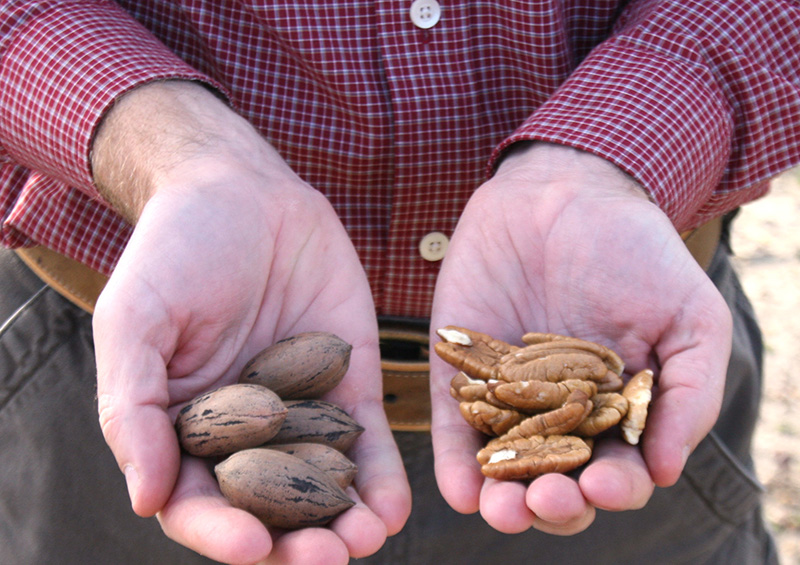
With some certainty, Georgia pecan producers are expecting a bumper crop this year. What remains uncertain is the market price farmers will receive at harvest.
As growers are currently harvesting Pawnees with other varieties expected to be harvested next month, there is still an unpredictability regarding the pecan market, according to Phil Croft, manager of the Hudson Pecan Company.
“Right now, we don’t 100% know this market trend. The only thing we can base it off of is what South Africa on the in-shell market sold into China. Those numbers are somewhere between $4.80 and $4.50 a kilogram, which relates back to $2.05 to $2.25 a pound delivered into China. That’s working it back to the grower level on a premium nut, $1.80, $1.90 a pound for our premium Desirables and qualities of that nature,” Croft said. “If China will come back in this thing and buy strong, I think that may be the bottom of the market, in my opinion. Nobody wants to hear that but at least it’s a starting point, and hopefully, it’s the bottom of it that where we can go up from there.
“I feel like we have an opportunity here for this market to increase pretty quickly if all the ducks line up.”
China
China is the biggest buyer of U.S. pecans. But the relationship between the two countries has been strained recently with the coronavirus pandemic and the trade war that involved tariffs being place on goods by both countries. They established a Phase One Agreement where China would increase its purchases of agricultural products, but it still lags in its pursuit of meeting those purchasing goals.
China’s role as a pecan purchaser cannot be understated.
“They have been some great customers for many years. We hope that will work out. We hope that they will buy Ag products,” Croft said. “We saw a report the other day that the almond market is booming in China and it’s because of lower prices. That’s maybe what it takes to get the market picked back up over there with some cheaper prices initially. Hopefully, it’ll turn around into a positive.”
Cover crops are important tools and have various advantages for farmers transitioning from one season to the next. Eric Schavey, Alabama Regional Extension agent in Northeast Alabama, encourages hemp producers to plant their cover crops now before it’s too late in the season.
Schavey
“If you get into November, you’re a little late. Your cereal rye will do a little better than your clover. That clover likes temperatures between 65 degrees F and 75 degrees F. Your grains are a little more hardy to cold temperatures,” said Schavey, who encourages producers to plant in late September or October. “I’m a big a fan of a cover crop. It just holds in moisture. It’s going to add to your organic moisture. It slows down erosion. To me, a cover crop is there and with our hemp farmers especially, there’s not those weed control options that our row crop farmers have. That’s been some of the challenges that they have is controlling weeds in our in-row in hemp.”
Cover crops planted in the row middles prevent sunlight from penetrating and allowing weed seeds to germinate.
Schavey said such problematic weeds include pigweed and goose grass. He also has certain recommendations when talking about cover crop implementation.
“I like using a cereal rye, not a rye grass but your cereal grains; also, your crimson clover is a good one. With those two, there’s the biomass that you get and their ease of growing there. They’ll grow in a lot of different soil types. That’s what I recommend,” Schavey said.
According to a prior Alabama Extension news article, cover crops are crops grown to benefit the following crop as well as improve the soil. They can protect the soil, feed the soil eco-system, increase soil organic matter and supply nutrients to the following crops.
The right cover crop can improve yields, soil and water conservation and quality and your bottom line.