Author: Clint

  • Storage Options for Watermelons

    Watermelons being researched on the UGA Tifton Campus. By Clint Thompson 6–6-17

    From production to harvest, the battle is not yet over for watermelon farmers. There is the subject of post-harvest care, specifically, with storage options. Joe Kemble, Alabama Extension vegetable specialist, cautions growers that watermelons are not adapted to long-term storage.

    “They will last two to three weeks at most in storage,” Kemble said. “If you’re looking at long-term storage, say I’m harvesting today, tomorrow or the next day and I’m not going to market until Friday, short-term storage at 50 to 60 degrees and around 90% relative humidity is ideal,” Kemble said. “Can you store watermelons and cantaloupes together? Ideally, no. They have two different regimes of temperatures they require to really maintain their quality.”

    If watermelons are stored at low temperatures, they can be subject to chilling injury. This can cause pitting and off-flavors. They can also lose sweetness if they are stored outside in the environment, even in the shade.

    “For you as the seller or grower, you may not see the problem. It’s the end user, the person who gets it at the end and opens it. They’re the ones that’s going to see the problems if they have chilling injury or if they developed off flavors,” Kemble said.

    He also warns producers to never drop, throw or walk on watermelons. It can cause internal bruising and breakdown of the flesh.


  • Decreased Production: Georgia Hemp Acres Expected to Decrease in 2021

    Industrial hemp. Photo taken 06-12-19.

    Georgia’s hemp production is expected to decrease in 2021. Tim Coolong, associate professor in the UGA College of Agricultural and Environmental Sciences, believes there are various factors that will contribute to hemp acreage being down compared to last season.

    “I think a lot of growers are going more towards, kind of, I’ll say smokable flower. It’s more of a boutique product,” Coolong said. “The flower bud that you’re selling has to have a great appearance; has to have a good smell. In order to do those kinds of products, it’s very hard to do large acreage. It’s very labor intensive. You’re going to be more apt to see people just doing a few acres of that type of market.”

    Oversupply Problem

    Then there’s overproduction and the impact last year’s oversupply had on market prices.

    “You can actually produce quite a bit of CBD from one acre of hemp. When you have hundreds or thousands of hemp planted, that actually equates to a lot of CBD isolates. I think like many things, farmers overproduced,” Coolong said. “We’re very good at growing stuff. We’re excellent at growing a lot of high-yielding crops. I do think we overproduced so people want to cut back to let the market catch up.

    “Just like a lot of other veggie crops, if we cut back on acreage a little bit, it’d probably increase the prices.”

    Mike Evans, director of plant industries who oversees the hemp program at the Georgia Department of Agriculture, said there were 144 licenses issued in 2020 with 1,450 acres intended for hemp production and 186 greenhouses.

    As of mid-March, Coolong said there were about 90 growers who had received licenses to grow hemp in 2021.

  • ’22 Crop Insurance Deadline Nears in Florida

    Nursery Value Select Growers Need to Make Insurance Decisions Soon

    Tallahassee, Fla. — The Florida Department of Agriculture and Consumer Services (FDACS) and the U.S. Department of Agriculture’s Risk Management Agency (USDA RMA) remind Florida Nursery Value Select growers that the final date to apply for crop insurance coverage for the 2022 crop year is May 1. Current policyholders who wish to adjust their existing coverage also have until the May 1, 2021 sales closing date to do so.

    Growers applying for the first time may purchase coverage at any time.

    commissioner
    Nikki Fried
    Florida Agriculture Commissioner

    “As Florida’s nursery growers continue to recover from the COVID-19 pandemic, we thank our federal partners for making available resources to protect their livelihoods and help their agricultural businesses thrive,” said Commissioner Nikki Fried. “We encourage our nursery growers to get informed and take advantage of this coverage before the deadline.”

    Federal crop insurance is critical to the farm safety net. It helps producers and owners manage revenue risks and strengthens the rural economy. Coverage is available for Nursery Value Select growers in select Florida counties. Please contact your insurance agent to see if your county is covered.

    More information on nursery crop insurance is available at RMA’s Nursery Policy Web Page.

    Growers are encouraged to visit their crop insurance agent soon to learn specific details for the 2022 crop year. RMA is authorizing additional flexibilities due to coronavirus while continuing to support producers, working through Approved Insurance Providers (AIPs) to deliver services, including processing policies, claims and agreements.

    More information can be found at farmers.gov/coronavirus.

  • Vidalia Onion Field Day is April 8

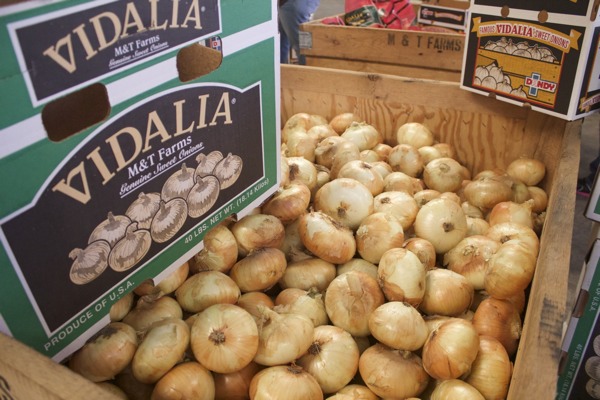
    Photo courtesy of M & T Farms, Lyons, GA, and Vidalia Onions.com

    University of Georgia Cooperative Extension will host the Vidalia Onion Field Day this year on Thursday, April 8, beginning at 10:30 a.m. It will be held outside and conclude at noon.

    There will be a walking tour of the research plots at the Vidalia Onion and Vegetable Research Center in Lyons, Georgia.

    Pre-registration is required to attend. Please pre-register for the event here: https://04vidaliaonionwalkingtour08.eventbrite.com or click on the flyer below.

    Boxed lunches will be provided at the end of the tour.

  • What’s the Impact? Florida’s Food Supply Chain Industries Asked to Respond to COVID Survey

    By: Kirsten Romaguera, 352-294-3313, kromaguera@ufl.edu

    A survey aimed to gauge impact of the coronavirus pandemic on the food supply chain will close on April 11.

    A research team from various institutions, including the University of Florida aims to assess the impact of the pandemic on food and agricultural systems and to develop strategies for coping with future crises. The project is funded by the U.S. Department of Agriculture’s Agriculture and Food Research Initiative (USDA-AFRI).

    The project, titled “Lessons from COVID-19: Positioning Regional Food Supply Chains for Future Pandemics, Natural Disasters and Human-made Crises,” includes multiple components. One of the earliest efforts will capture impacts to food supply chain businesses via surveys. The survey created for Florida industries is scheduled to close on April 11.

    “We’re seeking food supply chain respondents, from producers to retail distributors, and everything in between,” said Christa Court, UF/IFAS assistant professor of food and resource economics and lead investigator of the food supply chain survey component of the project. “So far, the response rate in Florida has been lower than expected, and we ask anyone involved to help us to accurately represent Florida industries in this national survey.”

    The UF/IFAS Economic Impact Analysis program, which Court directs, conducted similar, short-term surveys of Florida businesses last year as impacts evolved along with the pandemic. Information from these efforts can be found on the program’s Disaster Impact Analysis webpage and will continue to be updated.

    The survey for Florida industries can be accessed at tinyurl.com/afri-covid-survey-FL.

    Source: UF/IFAS

  • FFVA President: (Food Security’s) a National Security Issue

    Feb. 11, 2021 could be a date that lives in infamy for Florida’s vegetable and specialty crop growers. At least that’s the way Mike Joyner views the U.S. International Trade Commission’s (USITC) unanimous verdict regarding blueberry imports.

    “As a result of that 5-0 ruling, I would completely agree with you, it was a gut punch for our growers,” said Joyner, president of the Florida Fruit and Vegetable Association (FFVA). The five USITC members voted on the Section 201 investigation into serious injury regarding blueberry imports. It deemed that imports of fresh, chilled or frozen blueberries are not a serious injury to the domestic industry.

    Joyner

    Joyner worries what the ramifications like that ruling can have on other commodities that Mexico exports.

    “One of the biggest concerns we had before the blueberry 201 vote was that if we lose, it’s a green light to unfair imports. We’re seeing that,” Joyner said.

    Imports from countries are overflowing markets with various commodities, including strawberries, blueberries, squash and cucumbers.

    “I worry that as a country, a decision is going to be made, whether it’s intentional or unintentional, that we’re okay to rely on foreign produce during certain times of the year. I personally think that’s a bad public policy. But if it keeps going like it’s going, that’s what’s going to happen,” Joyner said. “These winter months where Florida feeds the U.S., if it keeps going like it’s going, we’re going to be relying on foreign imports to feed the U.S. I just don’t think that’s good public policy.”

    New U.S. Trade Representative

    The fight continues for Florida farmers who are hoping Katherine Tai, the new U.S. Trade Representative, will become a much-needed ally.

    “We’re going to continue to work with Ambassador Tai. I can tell you that the Florida delegation which has just been so solid on this issue. Senators (Marco) Rubio and (Rick) Scott both interviewed her individually as she was being confirmed. She understands this issue, she knows it,” Joyner said. “She made no commitments but we’re hoping Ambassador Katherine Tai will take this issue on and make it a priority.”

    Joyner and Florida farmers will have another chance to voice their concerns during a virtual hearing with the USITC on Thursday, April 8. It will focus on imports of cucumbers and squash on seasonal markets.

    “Our growers like Paul Allen have said so many times, it’s a national security issue. They’ll argue every day it’s a national security issue,” Joyner said. “It is a national security issue; food security, national security.”

  • Georgia Wine and Grape Commission to Hold First Meeting on April 16

    A fully mature cluster of black-skinned muscadine grapes

    The newly formed Georgia Agriculture Commodity Commission for Wine and Grapes will hold its first meeting on Friday, April 16 at 10:30 a.m. at the Atlanta Farmers Market in Forest Park, Georgia. The meeting will be in the Administration Building of the Georgia State Farmers Market (enter from the market side). The address for the meeting is 16 Forest Parkway, Forest Park, 30297.

    The meeting’s purpose is to elect a chair and vice-chair from the commission members appointed earlier this year by the Commodity Commission Ex Officio Committee. The meeting’s agenda will also be to discuss operations and guidelines of a Georgia Agriculture Commodity Commission, as well as the marketing orders and assessments and how to implement them. 

    The Georgia Wine and Grape Commission was created by the Georgia General Assembly in 2020 at the request of Georgia wine and grape producers. 

    Social distancing guidelines and masks are encouraged.

    For more information, please contact:

    Andy Harrison
    Manager, Commodity Commissions
    Georgia Department of Agriculture
    Andy.harrison@agr.georgia.gov
    (404) 710-1196

  • Sweet Finish: Florida Strawberry Growers Ending Season with Strong Crop

    What began as a sour start to Florida’s strawberry season is ending with a sweet finish, says Matt Parke, farm manager of Parkesdale Farms in Plant City, Florida.

    Parke said he wasn’t getting the desired volume before Valentine’s Day. Then it started and hasn’t stopped since.

    “I think it’s going to end up being a bumper deal for us. We started off real slow, and I thought our averages were going to be low,” Parke said. “It could be spotty for a grower, just depends on what varieties you planted and what kind of volume you got. It’d be hard for me to say anybody had a bad deal unless they had a big problem with disease,” Parke said.

    The main disease was Neopestalotiopsis Fruit Rot, which still took its toll on Florida’s strawberry crop. Even Parke had throw away about 400 flats to the acre during one harvest.

    “Regardless of that, I almost matched last year on volume,” Parke said. “I would say this year was a good season as well. For us and the growers I know, everybody’s had a pretty good deal.”

    Even more remarkable than the turnaround in volume was the consistent market prices that growers like Parke capitalized on.

    “Between Mexico, Florida and California, we were picking 1.5 million (flats) a day and still had an $8 to $10 a deal. That’s weird,” Parke said. “Normally when you pick 1.5 in a deal, you’re looking at a $3 to $4 market. I can tell you on the streets, they were $3 to $4. But if you had a good retail business, you were still getting your $8 and $10.

    “Normally, when you think about a market, if you want to hold a market, you don’t want to go for a million flats a day. That’s nationwide. You don’t want to be over a million flats; eight million pounds of fruit a day.”

  • UF Scientist: It’s Really Outside the Box

    A coffee plant in a pot in a greenhouse. The red berries contain coffee beans. Photo by Juan Giuliani.

    University of Florida/IFAS research hopes to yield a new crop for Florida producers.

    Though it is not likely to be ready for farmers for years, coffee is a potential commodity that the state’s growers could utilize one day.

    “It’s really outside the box. Often times we’ll start researching a crop, but growers have already started trying to produce it. This one is likely to be farther off into the future because coffee requires those low temperatures for good quality. It’s going to take a bigger lift to identify varietals that would produce good quality in Florida,” said Diane Rowland, chair of the agronomy department and UF/IFAS’ research lead on the project. “It may even become a controlled condition production where maybe we’re in greenhouses or we’re in hoop houses. There’s so many questions on the table. That’s what makes this one particular challenging.”

    One pleasant surprise in this project that is still in its infancy is how quickly the plant flowers.

    “We brought it into the greenhouse and started to see that it flower, and it produced very, very quickly. That was a surprise. Normally it would take a couple of years in the field for it to become established and to start to produce,” Rowland said. “Almost immediately we saw flowering and some production of berries. That led to the option of exploring, would it be economically feasible under controlled agricultural conditions? That’s one of the questions we’re going to start to explore.”

    Unique Plant

    Coffee is a unique plant in that it needs temperatures that are low enough but not too low. If it is hit with a frost, it will die. The research team is growing Arabica coffee. It is the most commonly grown variety around the world and the most valuable one on the market.

    UF/IFAS is also utilizing artificial intelligence (AI) in its research. Researchers are using minirhizotrons, or clear plastic tubes with tiny cameras inside. These devices are placed underground to record images of the plants’ roots.

    “The roots are essential for water and nutrient uptake. The more we understand about where the roots are in the soil, that helps us determine part of the health of the plant itself. The way this camera is set up, we can go back and look at the same place on the roots over time. Normally you would have to dig up, collect soil cores or whatever, to get the roots out,” Rowland said. “This is non-destructive, so we can go back to the same root and see if it’s still alive.”

    Another Potential Crop?

    One of the main reasons for pursuing a research project like this is it could provide Florida producers another tool in the cropping toolbox. With a climate conducive to various crops, growers like to have options to choose from when deciding what to plant every year.

    “I think it’s part of the benefit and part of the detriment of living in Florida. We’ve got these great growing conditions which makes a lot of crops possible. But we also have a lot of issues we have to deal with, from invasive species to diseases to insects. We’ve got climate change. We’ve got changing rainfall patterns, storms, all of those things,” Rowland said. “It makes it important for us to have a diversified agricultural system, too. It’s more sustainable, certainly more economically sustainable for a producer. I think our goal in IFAS is to make sure we provide as many as those opportunities that we can.”

  • Voices Heard: Georgia Farmers Discuss Issues with Senator Warnock

    Photo by Clint Thompson/Shows farmer Dick Minor talking with U.S. Congressman Sanford Bishop and Senator Raphael Warnock.

    The two issues Southeast vegetable and specialty crop producers want and need assistance with the most are labor and imports. Georgia farmers and industry leaders made sure Senator Raphael Warnock heard their concerns on Wednesday.

    The U.S. Senator visited South Georgia as part of a farm tour that stopped at Minor Brothers Farm in Leslie, Georgia. Along with Congressman Sanford Bishop, Warnock heard from producers about the impact that imports from Mexico are having on various commodities, including cucumbers and squash. Both crops are the focus of separate U.S. International Trade Commission Section 332 investigations that will be heard on April 8.

    “The message is we still have issues we’ve got to deal with,” Georgia farmer Dick Minor said. “As they say, if you’re not at the table, you might be on the menu. We are constantly trying to get in front of our leaders and express what our issues. Today we’re going to talk mostly about labor and trade. Those are the two biggest issues in specialty crops.”

    Labor Reform

    The House has already passed the Farm Workforce Modernization Act, which offers reform to the current H-2A program. The bill has been sent to the Senate.

    “Obviously, the H2A bill they have in front of Congress. We need to tweak those a little bit to help us,” Minor said. “The trade issues we’ve got with cucumbers and squash in front of the ITC that we’re going to try to get some help with Mexican imports that are coming in much cheaper than our products and affecting our markets. Those are the two main things we want to talk to him about today.”

    Georgia farmer Bill Brim and Charles Hall, executive director of the Georgia Fruit and Vegetable Growers Association also spoke.

    Warnock expressed a desire to learn more about the No. 1 industry in Georgia.

    “I chose to be here to focus on agriculture. I hope that signals to you how important this issue is to me,” Warnock said. “I’m here to hear from you. You can’t represent folks without talking to them.”