Applications to grow hemp in Alabama this year are “slowly but surely” moving forward, says Katelyn Kesheimer, Auburn University Assistant Professor and Extension Specialist.
Katelyn Kesheimer
“I got approved for a couple and I’m still waiting on a couple more to get some plants in the ground. It’s a little bit later than I would have liked. We are making progress,” Kesheimer said. “Slowly but surely. I hope to have all of my approvals for my research done and approved by the end of the month so I can have plants in the ground within two weeks at the latest.”
Green Plants By July 31
Kesheimer said farmers need to have green hemp plants up and out of the ground by July 31. She estimates that if growers plant their seed by the second or third week in July, they should be fine as far as the plant emerging by the end of the month.
“If you’re planting from seed, which a lot of people are, then you have to have them up and emerged by July 31. My guess would be if it got held up further, they might make some exceptions for people who were approved really late,” Kesheimer said. “But if you were approved in May and you don’t have seed or green plants by the end of July, they’re probably not going to cut you any slack.”
According to the Alabama Department of Agriculture and Industries (ADAI), if you are a first-time outdoor grower and do not have green plants up and growing by that date, ADAI will need to know why and what immediate plans you have to grow as this delayed planting will affect your crop in 2020.
All growers will also be required to respond to an emailed status report request as to growing activities by Aug. 1.
According to The South Carolina Grower, Clemson Extension agents provided updates on the status of fruits and vegetables throughout the state.
Coastal
Rob Last reports, “In our area, crops are generally looking good with watermelons and cantaloupes coming to harvest. From a pest perspective, we are finding some early pickleworm and melon worm damage occurring. In addition, cucumber beetles and squash bugs remain active. Cucurbit downy mildew is being found in the area, and as such protectant fungicide applications remain viable options. If in doubt scout.”
Zack Snipes reports, “Last week was full of heavy rain and heat. It finally feels like June. Crops are either going one of two ways right now: they either look great or they are succumbing to disease. Tomatoes are picking great and I’ve seen some really nice watermelons finish up this week. Peppers are loving this heat but I have seen an uptick in bacterial leaf spot (BLS) in the crop. Keep up with spray programs (copper and Manzate) for BLS in pepper. Tomatoes are also starting to look rough with all the heat and rain.
Midlands
Justin Ballew reports, “We finally got some widespread rain mid-week and it has rained in places most days since. Some areas received enough rain to cause temporary flooding in lower-lying fields. Remember, according to produce safety guidelines, any produce that was flooded may not be harvested. We should expect diseases to worsen in the coming weeks. Powdery mildew in cucurbits and bacterial spot in tomatoes has certainly increased in the past week.
Pee Dee
Tony Melton reports, “Raining almost every day some storms causing downed trees. Root rot bad applying a lot of potassium phosphide. A few strawberry growers still picking around rains. Pickle cucumbers continue being harvested and replanted in the same land. Many get three and sometimes 4 crops on the same land. Downy mildew bad but Ranman and Orondis are doing a good job of control.
With millions of American workers staying home to aid public health efforts to stop the spread of coronavirus (COVID-19), the security of America’s food supply is more important than ever before. It’s crucial that growers are taking the appropriate measures to ensure food safety during the COVID-19 pandemic.
The Centers for Disease Control and Prevention (CDC), the U.S. Department of Agriculture and the U.S. Food and Drug Administration do not consider COVID-19 to be a foodborne illness. In addition, there is no evidence of food or food packaging being associated with the transmission of the disease.
GOOD HYGIENE Experts at the University of Florida Institute of Food and Agricultural Sciences (UF/IFAS) advise produce growers, harvesters, packers and coolers to continue to follow the good hygiene practices they already have in place as part of their food safety programs when handling produce. This includes hand washing and cleaning and sanitizing surfaces often that may contact food or hands.
Many growers are already participating in voluntary audits to verify that their fruits and vegetables are produced, packed, handled and stored as safely as possible to minimize risks of microbial food safety hazards.
FARMWORKER SAFETY
Mark Lander, administrator of the Florida Department of Health in Marion County, says that agricultural workers are essential to a stable and steady food supply.
UF/IFAS held a food safety webinar last week, where Lander shared some information about farmworker safety.
“The conversation starts locally,” Lander says. “We want to educate our growers, educate the community and our workforce as they come into Marion County, or in any county, on how to take care of yourself and your surrounding workforce.” Identifying local healthcare resources and providing labor with those resources before their arrival can also be helpful, he says.
If a COVID-19 case is identified at your facility, Lander suggests calling your local Health Department. At that point, the Health Department will conduct interviews and identify close contacts to the infected person. The Health Department will also make testing and monitoring recommendations to reduce possible spread at the site, as well work with the labor force to identify if the group is leaving the area. If so, they will discuss precautions for their next destination.
To ensure farmworker safety and minimize the spread of the virus, growers should implement the following precautions:
Promote healthy hygiene practices
Implement worksite health screenings
Post signs on how to stop the spread of COVID-19 in appropriate languages for all staff to comprehend
Avoid use of sharing items that are not easily cleaned, sanitized or disinfected
Ensure that ventilation systems operate properly and increase circulation of outdoor air
Discourage on-site communal gathering
Modify commuting practices
For more information regarding food safety and COVID-19, here are some resources:
University of Georgia pic/Watermelons on display at a farm on the UGA Tifton campus. 6-14-19
By Clint Thompson
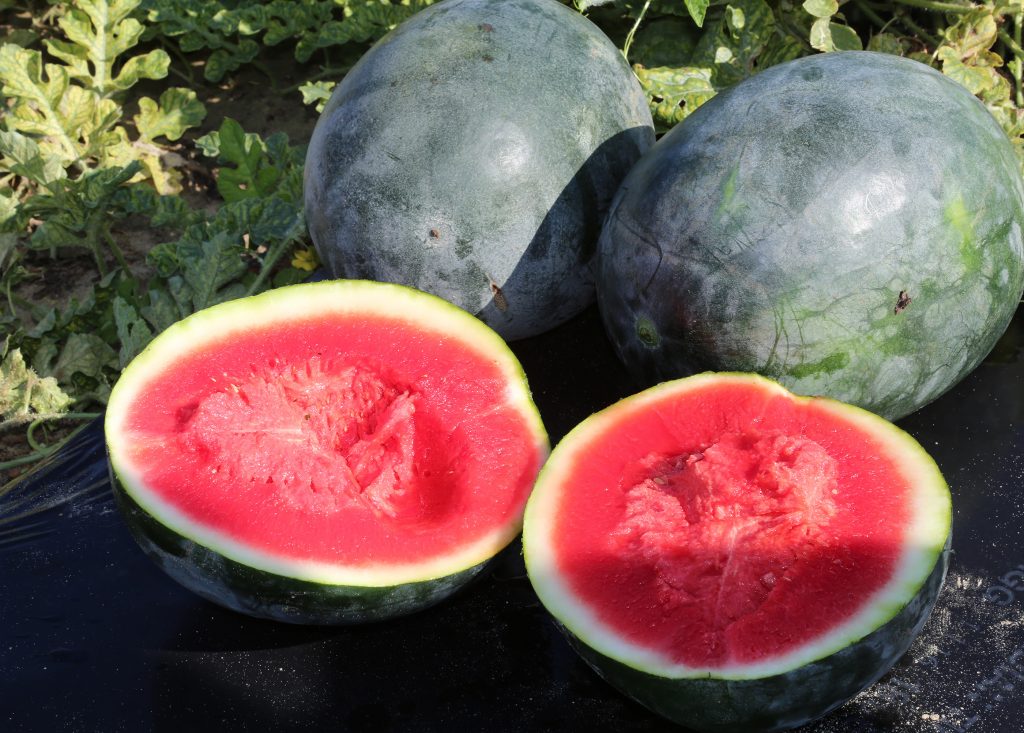
Watermelon prices remain high for farmers in the Southeast. Unfortunately, there’s not enough crop ready for producers to take advantage, according to Bill Brim, co-owner of Lewis Taylor Farms in Tifton, Georgia.
“Prices are still good. They’re around $155 to $160 a bin. There’s not many melons out there that’s ready right now. It’s unfortunate,” said Brim, who estimates individual watermelons are selling for an average of 24 cents per pound.
He also believes the rainy weather has played a role in watermelons not maturing as quickly as they would in previous years.
“Maybe too much water right now and they’re just not ripening as fast. We’ve got all of these showers in the afternoon, probably part due to that,” said Brim, who had to pause harvesting his own watermelon crop over the weekend. “We had some stuff that was planted later, too than what we would normally plant; because the plants weren’t ready or the fields weren’t ready. It could be anything. Fumigants hadn’t been out of the soil long enough.
“It’s quite a bit of difference from last year. Last year we were probably through by the (July) 4th. We won’t be through for three weeks after the 4th (this year),” Brim said.
This is typically a busy week for producers leading up to the July 4th Holiday on Saturday. Demand is normally very high this week.
Drop in Georgia Acreage
According to Samantha Kilgore, executive director of the Georgia Watermelon Association, acreage is projected to decrease this year to 19,000 acres. It would mark a significant drop from previous years’ harvests. According to the National Agricultural Statistics Service, from 2016-2018, Georgia averaged a harvest of just more than 23,000 acres.
Wet Planting Weather
According to Andre da Silva, University of Georgia Cooperative Extension vegetable specialist, wet weather in February and early March could have delayed farmers’ planting window. If growers had to wait to plant their crop, it could have also impacted when their crop would be ready for harvest.
He said that watermelon planting season in Georgia starts as early as March 1, but the bulk of farmers start March 15 and continue to the end of April. The watermelon market in Georgia begins in early June and usually concludes a week after July 4.
Wednesday, July 1 marks a new era for North American Trade.
The United States-Mexico-Canada Agreement (USMCA) will enter into force July 1. But according to economists and industry leaders, the agreement still does not provide much protection for vegetable and specialty crop producers.
Florida Fruit and Vegetable Association President Mike Joyner:
“When Congress passed USMCA, we unfortunately did not get the provisions we were hoping for in USMCA. The Florida delegation, to the person, hung together. Because they hung together, we were able to get a commitment from Ambassador (Robert) Lighthizer to come up with a plan as to how we’re going to address this issue,” Joyner said. “We felt like that was a strong commitment. It’s in writing. We trust Ambassador Lighthizer. Right now, all indications are USMCA will go into effect July 1.
“If you go back and look at the letter, the commitment that the delegation was able to get, that within 60 days of entry into force, Ambassador Lighthizer has to have a plan. We’ll present some information to the U.S. Trade Representative’s Office that they need to consider. It’s data that clearly shows what’s happening with Mexican produce. We’re hoping that over the next two or three months, we can work with Ambassador Lighthizer and his team and come up with something that will help solve this issue.”
University of Georgia Extension Ag Economist Adam Rabinowitz:
“The concern with the USMCA, in terms of specialty crops, is that there are a lot of lower priced crops, low cost labor in Mexico that are coming into the U.S. and competing with southeast fruits and vegetables. There was hope that there would be some restrictions or some assistance that would help with the ability to compete with those Mexican imports. But there was nothing within that. As a result, it’s looking like there’s going to be a challenge in terms of being able to compete on price with the southeast fruits and vegetables with the imports from Mexico.”
Charles Hall, executive director of the Georgia Fruit and Vegetable Association:
“It’s insulting to the specialty crop growers who are suffering with COVID-19. It’s taken away markets. Then on top of that, we’ve got Mexican products coming in on top of us to drive the prices even further down.”
According to the USMCA press release, the agreement marks the beginning of a historic new chapter for North American trade by supporting more balanced, reciprocal trade, leading to freer markets, fairer trade, and robust economic growth in North America. However, Southeast farmers still will compete against imports of Mexican produce.
The July issue of VSCNews magazine focuses on a variety of topics, including machine harvesting of blueberries, strawberry pests and diseases and technology for vegetable production.
Blueberry growers and packers are adopting the latest innovations and technology to reduce harvesting costs and put less reliance on contract laborers. Fumiomi Takeda, a research horticulturalist with the United States Department of Agriculture (USDA) Agricultural Research Service Appalachian Fruit Research Station in Kearneysville, West Virginia and Steven Sargent, professor and Extension postharvest specialist at the University of Florida Institute of Food and Agricultural Sciences (UF/IFAS), discuss the results from a study with USDA and several land-grant institutions, comparing different harvesting methods of blueberries.
Takeda returns for another article, this time joined by Wojciech Janisiewicz, a research plant pathologist at the USDA Agricultural Research Service Appalachian Fruit Research Station in Kearneysville, West Virginia. They take a look at how USDA researchers are successfully using Ultraviolet light to control pests and diseases in strawberry production.
Vegetable growers face a variety of challenges. However, new advancements in technology may help growers address these production issues. Yiannis Ampatzidis, an assistant professor at UF, presents growers with examples of state-of-the-art technologies that may be useful in vegetable production today or in the near future.
Tomato and Pepper Spotlight
The crop spotlight returns in July, this time with a focus on peppers and tomatoes.
Xavier Martini, an assistant professor, and Joe Funderburk, a professor, both at the UF/IFAS North Florida Research and Education Center in Quincy, Florida, provide tomato growers with thrip management strategies.
Anthracnose is a serious disease that occurs across pepper-growing regions worldwide. Pam Roberts, a professor at the UF/IFAS Southwest Florida Research and Education Center (SWFREC) in Immokalee, Florida shares management measures with growers.
In the tomato and pepper spotlight, Gene McAvoy, associate director for stakeholder relations at the UF/IFAS SWFREC, shares some tips and tricks with growers on how to select varieties with profit potential.
VSC Expo Set For Aug. 12-13
Finally, readers will get a preview of the upcoming Citrus Expo and Vegetable & Specialty Crop Expo.
The annual event will take place Aug. 12-13 at the Lee Civic Center in North Fort Myers, Florida. Growers can register here and automatically be entered for a chance to win a John Deere gun safe courtesy of Everglades Equipment Group. To learn more about the Citrus Expo and Vegetable & Specialty Crop Expo, including host hotel information, visit http://citrusexpo.net/. To receive future issues of VSCNews magazine, visit click here.
The Florida Fruit and Vegetable Association is accepting applications for Class 10 of its Emerging Leader Development Program (ELDP). The deadline for submission is Sept. 1. The program, which launched in 2011, develops leaders to be strong advocates for Florida agriculture.
Since then nearly 100 participants have graduated from the program. Sessions and production trips provide a wealth of information on the many issues facing the industry. The year-long program includes seminars provided by FFVA staff members and other experts, meetings with legislators and state officials in Tallahassee, Florida and visits to specialty crop production areas in Florida and California. Ultimately, ELDP graduates can get involved to strengthen the future of specialty crop agriculture.
File photo shows bacterial spot disease in tomatoes.
By Clint Thompson
Bacterial spot in tomatoes has been observed in various locations in Alabama, according to Ed Sikora, professor and Extension plant pathologist in the Department of Entomology and Plant Pathology at Auburn University.
He believes the excess rainfall and abnormal temperatures contributed to the disease being more problematic this year.
“I think this year with the moisture we’ve had this spring and slightly cooler temperatures, I think it’s more of a problem than normal. In talking with the growers, it appears to be a yearly problem,” Sikora said. “We were in these fields four weeks ago and we had a fairly hard time finding the disease, it would just be in small pockets. Then (last week) when I was out sampling in Mobile (Ala.), it was throughout the field to the top of the upper canopy of the plant. It can move pretty swiftly.”
What is bacterial spot?
According to University of Georgia Cooperative Extension, bacterial spot attacks the stems, petioles, leaves and fruit. Spots are circular and brown and become water-soaked during periods of heavy rains. Symptoms on the fruit itself are tiny raised blisters.
“You can get some defoliation, some blight of the leaves, which I think can have an effect on yield. How much? I do not know. It can get to the fruit, you can get some fruit lesions,” Sikora said. “That can make them unmarketable.”
The disease is spread by rain, workers and tools. The best method for control is to rotate crops and field sites and remove any plant debris and eliminate potential hosts.
“Typically, the disease will often come in on transplants, so it’s very hard to control in the transplant house. Sometimes it can survive on debris in the field,” Sikora said. “Some of these growers are not rotating, they just don’t have the room.”
Resistance Problem
Sikora estimates that between 75% and 80% of populations of the disease pathogen are resistant to copper, which has been the chemical product of choice for growers. It will keep the populations down but does not clean it up entirely. Tomato growers are tolerating the disease instead of controlling it completely.
“They’re seeing the same problems in Florida and I’m sure Georgia and other places. This resistance is not a new phenomenon, but it’s been developing over time. Growers will still be spraying copper and hopefully they can knock down populations a bit,” Sikora said. “Probably our best bet will be developing resistant varieties. The same disease also goes to peppers. But when you start searching peppers, you’ll see that peppers, certain varieties have resistance to this pathogen. If you have a resistant variety, you don’t have to worry about spraying copper. At this point, I don’t recall any bacterial spot resistant tomatoes on the market.”
University of Georgia researchers are working on natural solutions to weed problems in row crops as government regulations of chemical herbicides grow stricter.
Test plots at the the J. Phil Campbell Research Farm located near Watkinsville, Georgia, show (from left) cereal rye, no cover crop, living white clover mulch and crimson clover approximately three weeks after cotton planting. Areas in red indicate where Palmer amaranth seed was planted and will be monitored for suppression and reproduction over the next several years.
Earlier in June, the U.S. Ninth Circuit Court of Appeals pulled registrations for the use of all dicamba products for row-crop production. The herbicide, which has been around since the late 1960s, became more widely used with the introduction of chemical-resistant cotton and soybean varieties in 2016 that were cultivated in response to growing weed resistance. The herbicide has been at the center of increased controversy over its utilization in field crops due to inadvertent drift onto sensitive crops.
With the increasing loss of effective chemistries, either due to weed resistance or through legislation, growers need more tools to choose from when tackling economically threatening weeds, especially as farmers continue to face increasingly erratic environmental conditions and other challenges.
Nick Basinger
“Anything we can do to help create more consistency should help growers do their job better,” said Nick Basinger, assistant professor of weed science in the Department of Crop and Soil Sciences at UGA’s College of Agricultural and Environmental Sciences.
Basinger is leading a research group that is examining the potential use of cover crops as part of an integrated weed management program in a number of commercial agricultural systems in Georgia. One of the benefits of cover crops is their ability to suppress weeds, such as Palmer amaranth (Amaranthus palmeri), during fallow periods between cash crops by preventing weed seeds from germinating.
“The goal of our work is to look at ways to manage crop and non-crop areas and try to take advantage of all the tools in the toolbox. Assessing what tools we have for each system, what tools we can potentially develop, then where the strengths and weaknesses are for those tools and what the ‘breaking points’ are so that we can develop comprehensive management practices,” explained Basinger. “This allows us to develop production systems to optimize weed management and gives growers the most advantage.”
Cover crops are widely used throughout the Midwest U.S. in a number of production systems, so much of UGA’s research is being adapted from those systems to fit climate and soil demands in the Southeast. While cover crops have already been successfully used by some growers in parts of Georgia, the implementation is slow among farmers, as the body of research for growing cover crops in this region is still relatively limited.
Basinger and his team have eight to 10 projects underway in the Piedmont region of Georgia, with some of the work happening at the Southeast Georgia Research and Education Center in Midville. Multistate projects studying winter cover crops and summer cover crops will help researchers provide better recommendations for growers during those fallow periods between cash crops.
Winter cover crops are usually planted in the fall after a cash crop has been harvested and will remain in the ground throughout the winter months. A summer cover crop is a quickly established cover crop that’s seeded between summer and winter cash crops to keep the soil covered and accumulating nitrogen.
Summer cover crops can be used successfully in vegetable production because of the quick turnaround time before the next cash crop needs to go in the ground. Sorghum-sudangrass hybrids and sunn hemp, a warm-season annual legume, are quick to establish and rapidly put on biomass, making them great candidates for summer cover crops in Georgia.
“Once projects are well established in the Piedmont, we will look to partner with growers in south Georgia,” said Basinger.
This is the Basinger team’s first year working with cover crops in cotton production in the Piedmont. Because cotton is harvested later in the season, the team is looking at the potential for using cover crops that perform well early in the season within the cotton system.
“This research is actually partially funded by Cotton Incorporated. They are interested in looking at integrated weed management, which is very exciting,” said Basinger.
Winter cover crops used in the project are crimson clover and Wrens Abruzzi rye. Basinger is also adapting and evaluating a living mulch system in cotton using white clover, a spinoff project from UGA crop and soil sciences Professor Nick Hill’s previous work in corn production.
David Weisberger, a doctoral candidate working with Basinger, is focusing on this research at the J. Phil Campbell Research Farm located near Watkinsville, Georgia. Research plots were sown with a known number of Palmer amaranth seeds in the selected cover crop species plots, and treated, bare-ground rows are used as control plots for comparison. Research will evaluate whether cover crops can suppress weeds over time by quantifying weed suppression, emergence counts, growth rates and fecundity.
“The control plots are consistently full of weeds, whereas the cover crop plots are performing well because they limit the amount of light that weed seeds receive and reduce soil temperatures that are essential for Palmer amaranth germination,” said Basinger.
Thus far, the team has observed the best results from the living mulch and cereal rye, but they are examining other important trade-offs that growers need to be aware of, such as water use requirements, shading issues and the potential for cover crops to compete for resources.
“Originally, our research started as a weed focus, but we quickly realized this has more facets that need assessment, so we’ve adapted this research to provide a multidisciplinary approach,” Basinger said.
In addition to looking at cover crops’ potential to suppress weeds in cotton, UGA crop and soil sciences researchers Nandita Gaur and Matthew Levi are studying hydrology and infiltration rates and soil health parameters including organic matter, nitrogen, phosphorus and pore space. Weisberger and UGA entomologist Bill Snyder are also looking at this project from an insect pest management approach.
“This is just one tool in the toolbox — it’s not a cure-all — but we hope to demonstrate that, over time, cover crops have the potential to increase yields, minimize weed seed banks, improve soil health, reduce erosion and limit the amount of costly chemical inputs farmers need to apply for a successful harvest,” explained Basinger. “The beauty of this research is we assume all the risk and work out the problems first, then we are able to disseminate that information to growers so they can make the best decisions for their specific operations.”
To learn more about what’s going on with Basinger’s research and stay up to date on what’s going on in the world of UGA weed science, follow him and his team on Instagram and Twitter (@ugaweeds). For more information on the Department of Crop and Soil Sciences, visit cropsoil.uga.edu.
University of Georgia photo/Shows presence of downy mildew disease.
By Clint Thompson
Grape producers in north Alabama and north Georgia need to be wary of downy mildew disease. It has been confirmed in vonifera grapes in two separate Georgia locations, says Phil Brannen, University of Georgia Cooperative Extension fruit disease specialist.
“My hope is that if folks are spraying well, if they’re actually effective in spraying the vines and keeping fungicides on the vines, hopefully they won’t see this,” Brannen said.
Phil Brannen
He said initial symptoms of downy mildew are “oil” spots on the upper leaf surface with white, fluffy spore formation on the underside of the leaf. The important factor for grape producers to consider is protecting your leaves. As Brannen often preaches to his students at UGA, “plants don’t do well without leaves.”
“What we more often see with downy mildew on grapes and the susceptible varieties is that it will actually infect the leaves and you’ll get so much infection potentially if you don’t get enough fungicide out in a timely fashion, you could actually lose your leaves,” Brannen said. “If you lose your leaves, even though you have grapes that look fine … you cannot mature a grape for wine in that way. You’re going to have a real bad wine that would come from those grapes. You don’t want that to happen.”
First Discovered
Brannen said he first discovered downy mildew in a vineyard in west Georgia. But last week it showed up in his research plots in Watkinsville, Georgia.
“The secondary thing is if you lose enough leaves then you don’t store enough carbohydrates to the root system to survive the winter and you’ll have winter damage.”
Brannen cautions growers who are scouting for downy mildew to not confuse it with powdery mildew symptoms. In his Extension blog, Brannen said, “If you falsely identify downy mildew as powdery mildew, you are likely to start an aggressive spray program for powdery mildew that just allows the downy mildew to only get worse.”
Brannen provides a video on how to properly identify the presence of downy mildew.
He recommends incorporating highly efficacious materials such as Zampro, Revus, Ridomil Gold MZ (note the pre-harvest interval), etc. in spray programs moving forward.
Rain Contributes to Disease
The wet conditions have only fueled downy mildew’s fire in recent weeks.
“We’re getting a tremendous amount of rain in the last week or two. It seems like it rains every couple of days, if not every day. A lot of pop-up thunderstorms. That wets the leaves. The morning dews have been really wet. We tried to spray on Monday, went up to Blairsville (Georgia) to spray and we were just covered up in wetness,” Brannen said.