Author: Clint

  • Bonnie Plants, Inc. Relocates Headquarters to Opelika, Alabama, Makes Gift to Auburn

    Pictured (L to R): Dean Paul Patterson (Auburn University College of Agriculture), Randy Wilson (John Randall Wilson, Architect), David Womack (AFC Board Chairman), Mike Sutterer (Bonnie Plants, Inc.), Mayor Gary Fuller (City of Opelika), David Scott (Scott Land Company), David Canon (Opelika City Council), Eddie Smith (Opelika City Council).

    (August 2020) – Bonnie Plants, Inc. (Bonnie) is breaking ground on a new state-of-the-art corporate headquarters building that will bring about 60 jobs to Opelika, Alabama. In addition, Bonnie and Auburn University (AU) have entered into a formal partnership with investments by Bonnie across several key areas of the university – including the Harbert College of Business and the College of Agriculture.

    Relocating Bonnie’s headquarters from Union Springs to the Auburn-Opelika area will be used to help enhance associate recruiting and retention efforts as the company continues to grow and expand.

    “The decision to relocate to Opelika was made easier by the strong partnership and support we received from city leadership,” said Mike Sutterer, CEO of Bonnie.

    The new Bonnie building, which is slated to open late 2021, will be in the Tiger Town Corporate Park in Opelika, Alabama and will include several sustainable features including a 10-foot high indoor living wall that will naturally purify air in the office.

    “I am pleased to welcome Bonnie Plants to our community. We are honored that a long-standing company like Bonnie is making an investment in our local economy. This will bring jobs and enhance the quality of life for the residents of Opelika,” said Mayor Gary Fuller.

    The move to Opelika will also facilitate Bonnie’s new partnership with Auburn University. This partnership will create additional awareness of Bonnie as a potential employer for Auburn students and alumni with the goal of increasing internships and full-time recruiting.

    “Auburn University is nationally recognized with strong, talented faculty, student and alumni networks, and is an ideal partner for Bonnie and its future,” Sutterer said.

    Bonnie Plants has made a gift to support two newly endowed scholarships at Auburn that will be given annually, one to a student in the Harbert College of Business studying business analytics and the other in the College of Agriculture for a student majoring in horticulture.

    This partnership also includes support for Auburn’s Center for Supply Chain Innovation. Bonnie will participate with several other major companies in a public-private partnership to foster innovation and technology advancements in supply chain – a mission-critical function for Bonnie.

    Additionally, this partnership will give Bonnie the opportunity to focus on recruiting interns and full-time positions that will ensure Bonnie can continue to attract the most talented students and alumni to join the Bonnie team. This will include working with the central career center and the career center in the Harbert College of Business.

    “We are grateful for this commitment from Bonnie Plants to not only support our students and faculty, but also to partner with our Center for Supply Chain Innovation,” said Annette L. Ranft, dean of the Harbert College of Business. “The supply chain program is ranked among the top in the country, while business analytics is among our fastest growing programs. This investment will increase our ability to remain at the forefront of research and discovery as we prepare students to meet future industry challenges.”

    Bonnie will focus on engagement with students and faculty to help solve real-world challenges in areas such as product development, logistics and analytics. This will include guest speakers for the classroom and faculty events. Bonnie will also provide in-kind support for multiple gardens across campus and outreach projects.

    Bonnie Plants is the leading brand of live vegetable and herb plants for home gardeners in the United States. Bonnie was founded in 1918 on the principle of providing access for home gardeners to grow fresh food. What started as one small farm in Union Springs, Alabama, has grown to a national brand with 4,000 peak season associates and over 80 greenhouse growing operations, selling plants in all 50 states. Bonnie plants are available at all major retailers along with direct-to-consumer sales through www.bonnieplants.com.

  • Research Center in Live Oak, Florida Enrolls in BMPs

    By: Kelly Aue, Suwannee River Partnership Outreach Coordinator, 386-219-4257, kaue@ufl.edu

    LIVE OAK, Fla. — As the main research center serving farmers in the Suwannee River Valley, the mission of the UF/IFAS North Florida Research and Education Center – Suwannee Valley (UF/IFAS NFREC-SV) is to protect the area’s natural resources while helping farms succeed. In support of this goal, the center researches agricultural best management practices (BMPs), primarily focusing on nutrient and water management.

    Bob Hochmuth

    “Over the past six years, the center has become much more modernized from a technology standpoint,” said Bob Hochmuth, assistant center director and UF/IFAS Extension regional specialized agent for vegetable crops. “We are in the middle of the implementation phase on adopting technology that we can test to be utilized on farms.”

    “Through the commitment of Jack Payne, the former UF/IFAS senior vice president, to rebuild our center, along with the deans of Extension and Research, we were able to equip this center to be able to handle a variety of research projects,” Hochmuth continued. “In addition, we’ve been supported by the Suwannee River Water Management District (SRWMD), Florida Department of Agricultural and Consumer Services (FDACS) Office of Agricultural Water Policy, and Florida Department of Environmental Protection (FDEP). They have funded many contracts and grants that are the driving force behind the research, funding and implementation of BMPs.”

    “Research is an important part of developing and making sure BMPs work,” said Glenn Horvath, environmental consultant for FDACS. “For example, the center did some important research on soil moisture sensors and shared with farmers how this tool could be important in their efforts to reduce their loss of nitrogen and improve irrigation of their crops. Today, farmers tell me they don’t want to farm without them. The center’s efforts in research were really important to the widespread adoption of that BMP.”

    Beginning in February 2015, the center enrolled in the FDACS BMP program using the guidance of the 2008 Vegetable and Agronomic Crops (VAC) BMP manual. In March 2020, Hochmuth met with Horvath to re-enroll under the updated 2015 VAC BMP manual which updated BMPs, including BMPs on hay and silage production.

    To enroll in the BMP program, a farmer meets with a FDACS representative to identify all applicable BMPs on the BMP checklist. The farmer then signs a “Notice of Intent to Implement BMPs” (NOI), which indicates the farmer’s commitment to properly implement and maintain the applicable BMPs, and submits it to FDACS along with the checklist.

    “To sign something called a ‘Notice of Intent’ is in line with my strategical thinking on what we are trying to do here,” Hochmuth said of his center. “Number one, I want to make this place important to the community; and number two, I want to be a good steward to the natural resources of the property I’m responsible for. Those two align with a Notice of Intent because that is our collective intent here at this farm.”

    The center is located within the proposed Suwannee River Basin Management Action Plan (BMAP). The Suwannee BMAP requires stakeholders in the watershed to reduce nitrogen inputs, and agriculture is a focus of the effort. BMP manuals, such as the VAC BMP manual, are adopted by rule by FDACS. The law requires farmers located in a BMAP to either implement FDACS-adopted BMPs or monitor their water quality as prescribed by FDEP.

    While going through BMP enrollment process, Hochmuth was able to look at the NFREC-SV farm holistically to assess the applicability of all BMP categories – nutrient management, irrigation management and water resource management.

    “Overall, we did super well, but there are things such as the importance vegetative buffers around our lake and drainage ditches that I’m more cognizant about from the NOI visit,” Hochmuth said. “It was an opportunity to learn about things that are not immediately on your mind. We did talk a lot about nitrogen management, but it gives an opportunity to identify areas where we can improve strategies.”

    Overall, Hochmuth’s goal is to share with the community the research that is happening at UF/IFAS NFREC-SV and the importance of implementing BMPs: “I want to get people on the back 40 to be able to show them the things that we are doing here.”

  • Florida Strawberry Industry Members Speak out About Unfair Trade with Mexico

    florida
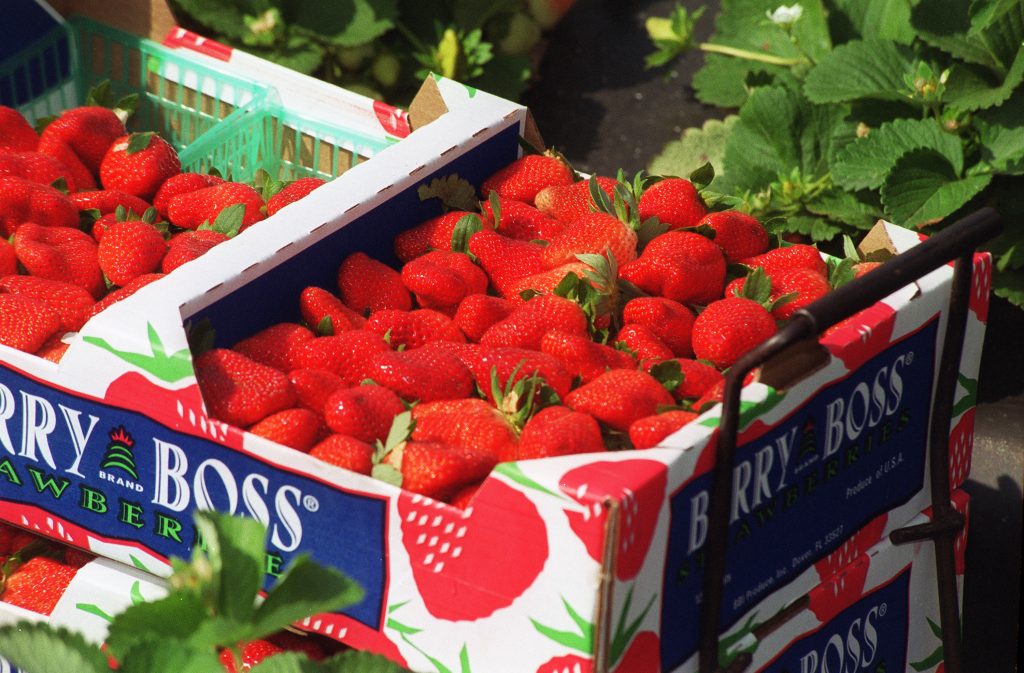
    File photo shows strawberries boxed up after harvest.

    Florida Strawberry Growers Association

    Dover, Fla. (August 18, 2020) – U.S. trade officials and federal agencies held the first of two virtual meetings on August 13 with the agriculture industry to hear testimonies on unfair trade practices with Mexico. More than 35 witnesses testified to a hearing committee consisting of representatives from the Office of the U.S. Trade Representative, U.S. Department of Agriculture, and the U.S. Department of Commerce.

    As Senator (Marco) Rubio, congressmen, Florida’s Commissioner of Agriculture and Consumer Services, economist Dr. Zengfei Guan, and producers from across the state and even the country testified, reoccurring concerns of unfair trade practices, government subsidies and loss of market share came up repeatedly.

    “We are not looking for a handout, just a fair chance in the fight,” said Executive Director of the Florida Strawberry Growers Association, Kenneth Parker.

    The concern of crisis is of the winter specialty crop market in Florida and now into Georgia and beyond.

    “In my 33 years of operating the farm, our greatest challenge has been increased Mexican competition…,” said John Sizemore of Sizemore Farms. Industry members pleaded for a Section 301 to be filed against Mexico to investigate the trade practices.

    The United States-Mexico-Canada Agreement (USMCA) that was passed and became effective on July 1, 2020, neglected to include seasonal and perishable crops. U.S. Trade Representative Robert Lighthizer made a commitment to the seasonal and perishable fruit and vegetable industry in Florida that he would address the issue of unfair trade practices with Mexico; therefore, these hearings are a result of that commitment. A second virtual hearing will take place on Thursday addressing the seasonal and perishable produce industry Georgia. The hearing will be streamed through the USTR website and transcripts will also be available from both hearings.

  • Hemp Scouting Important This Time of Year

    File photo shows a field of hemp.

    Heat and humidity in the Southeast means hemp producers face challenges this season with regards to pests and diseases.

    Matthew Brecht, cannabis grower, hemp expert and plant pathologist with Marrone Bio Innovations, said scouting is essential for growers especially since not much research has been done with this relatively new crop.

    “Right now (hemp) should be transitioning to flowers. You should be having some pre-flowers maybe or about to be there. This is a time when you could have anything come in the Southeast. The east coast, Southeast, specifically is hot and humid with lots of rain events or tropical depressions that come through. You have all kinds of bugs and diseases that show up because of the humidity and pressures you have,” Brecht said.

    Be on the Lookout for Worms

    He noted that the worst pests for hemp are worms, especially corn earworms.

    “The insects will get into the newly formed colas (cluster of buds) and basically start chewing on them. They kill the flower or parts of the flower. Once they start doing that, you could lose a good percentage of your crop. Farmers want to think about scouting for these little caterpillars and looking for either the moths or the eggs and try to time some of these applications, products that are for caterpillars during that time,” Brecht said. “Because of high humidity, you also get leaf spot. You could have hemp stem rot. You could have powdery mildew and (bud rot) towards the end.”

    Brect emphasized that there wasn’t great research done in hemp prior to 2019. Hemp farming is still in its early stages, especially in Alabama, Florida and Georgia. It’s still very new with not a lot of understanding of the different pests and diseases that can be of impact.

    Products are also sporadic from state to state in what growers can utilize, which could mean a challenging growing season for some farmers.

    “If you don’t have proper tools to control these pests and diseases, you could potentially lose a good portion of your crop,” Brecht said. “I would say growing hemp on the east coast or the Great Lakes, anywhere that has a more humid or rainy environment during the summer time is much more difficult than it is on the west coast, much more difficult.”

  • Citrus and VSC Expos Start Wednesday

    The 2020 Citrus Expo and Vegetable & Specialty Crop (VSC) Expo will be held Wednesday and Thursday, August 19-20. Due to COVID-19, this year’s event has transitioned to a virtual format, but growers can still get the same great Expo experience they are accustomed to.

    Both the citrus and VSC seminar programs will debut online at CitrusExpo.net at 9:30 a.m. Eastern both mornings. Attendees will be able to view videos of the research presentations from their computers or cell phones. Those who attend the seminars as they debut online will be eligible to win one of four $200 gift cards from Bass Pro Shops.

    One of the most anticipated features of the event will also be held virtually, as the trade show will take place. You can connect online with vendors to find every imaginable product or service your operation could ever need. Growers will be able to visit the online exhibitor corner to view videos from suppliers and obtain information about their latest products. There will be 15 premier exhibitors in the lineup with links to forms that growers can fill out. Growers who visit at least five premier booths and fill out the forms will be entered to win a $100 Bass Pro Shops gift card.

    The exhibitor corner will also debut online at 9:30 a.m. EDT at CitrusExpo.net on Aug. 19–20 along with both the citrus and VSC seminar programs. But while the seminar programs will be available throughout the end of the year, the exhibitor corner will only be offered Wednesday and Thursday, so don’t miss out. AgNet Media would like to extend a special thanks to the exhibiting vendors and sponsoring companies who are investing in the event and the Expo attendees.

    Learn more at vscexpo.net.

  • Georgia Blueberry Producer: You Don’t Have to Have a Ph.D. in Economics to See What’s happening

    Russ Goodman Talks About Impact of Unfair Trade Ahead of Thursday’s Virtual Hearing

    United States of America and Mexico waving flag

    A prominent blueberry producer in Southeast Georgia believes the future of the American family farm could hinge on any action taken as a result of the virtual hearing scheduled for Thursday.

    Russ Goodman is one of several farmers and industry leaders in Georgia who will testify in a virtual hearing on Thursday with the U.S. Trade Representative’s Office. The hearings will provide the U.S. Department of Commerce and Trump Administration an opportunity to hear from growers in Georgia about the urgent need for federal action regarding unfair trade.

    “We started growing blueberries in 2000. In 2010, we hear rumblings about (Mexico) and people saying, ‘Mexico’s going to put you guys out of business.’ I heard that kind of stuff. I normally don’t pay a lot of attention to things like that because you hear a lot of generic statements,” said Goodman, a farmer in Cogdell, Georgia. “In 2010, they sent 1.8 million pounds. Last year they shipped in 63 million pounds. I’m fearful that if something isn’t addressed what it means.

    “It’s not only with Mexico, which is what these hearings are about, USMCA and Mexico and specifically how that affects us, but my friends in the north in Michigan have been farming blueberries for three and four generations. They’re being affected the same thing with Peru right now.”

    Labor Disadvantage

    The biggest concern with farmers in Georgia and Florida – where hearings were held last week – in competing with Mexican imports is the cost of labor. What American farmers have to pay per hour, Mexican farmers can charge per day. How can American growers compete?

    “A third of your costs is going to be labor. They’re down there paying one-tenth of what we’re paying in labor. You take any business on God’s green earth where your competition has a 90% advantage over something that’s a third of your overhead, they’ll eventually put all their competition out of business. The scary thing is, that competition comes in the form of the American family farm,” Goodman said.

    He estimates Mexican farmers only have to pay 81 cents per hour as a minimum wage.

    “You don’t have to have a Ph.D. in economics to see what’s happening and what it’s going to mean long term. We’ve got a blueprint of what’s happened in the past, the tomato industry in Florida. That’s just going to keep going into other things,” Goodman said. “They’re planting 20,000 acres of pecans a year in Mexico from my understanding. I just think we’ve got to, especially in light of this pandemic, we’ve got to re-evaluate where we’re at as far as food security. What keeps us food secure is the American family farm,” Goodman said.

  • Alabama Pest Alert

    Pictured is a corn earworm moth.

    According to the Alabama Extension Commercial Horticulture Facebook page, insect pressure has increased significantly over the past two months. This was reported in 20 locations across Alabama, where moth counts from pheromone traps were collected.

    For example, the beet armyworm moth numbers were 823 as of Aug. 15, a 1.2X increase from the 682 reported on July 31. Host plants include corn, cowpea, eggplant, pepper, tomato, cotton, peanut and soybean. The fall armyworm saw a 1.6X increase from 88 to 149 over that same timeframe. It prefers to feed on grasses then move to crops.

    The southern armyworm also saw a 1.6X increase from 197 to 307. Moths are active throughout the year in Florida. Larvae have reddish brown head with white line on the body.

    The moth most widespread right now is the lesser cornstalk borer. It increased from 4,000 on July 31 to 5,060 on Aug. 15. The squash vine borer, corn earworm, soybean looper and yellow striped armyworm experienced the largest increase of 2X each.

    The squash vine borer increased from 152 to 311. It is worse on organic farms. The corn earworm feeds on corn, tomato and cotton.

    The cabbage looper increased from 192 on July 31 to 286 on Aug. 15. Its host plants include sweet potatoes, beans, peas, squash, tomato and watermelons.

  • Clemson Extension Agents Provide Crop Updates

    Clemson Extension agents provided updates in The South Carolina Grower this week about the status of various crops being produced throughout the state.

    Statewide

    Dr. Tony Keinath with a word on crop rotation. “To keep the soil on your farm productive over the long term, do not replant the same vegetable, or a related crop, in the same field “too often.” How often is “too” often depends on the crop and the pathogens present in the soil. Almost always, “too often” is less than 12 months between disking the old crop and planting the new crop.

    The main risk in replanting “too often” is building up root pathogens that survive in the soil for years. Even in the heat, diseased roots and stems take several months to decay enough so they are not a source of pathogens.

    Another risk is foliar diseases that start on volunteers from the previous crop. The pathogens may be in or on some of the seed that sprouts; for example, black rot on leafy brassica greens or gummy stem blight on cantaloupe and watermelon. A small number of infected volunteers means the disease has a head start right at the beginning of the crop.

    Controls for soilborne pathogens (fungi, water molds, and nematodes) are limited.

    • Many vegetable crops have no resistance to these pathogens.
    • Fungicides do not penetrate soil well, or they are quickly inactivated.
    • Fumigants have many restrictions that require time-consuming record keeping and air monitoring.

    Root-knot nematodes are a special problem, because they form galls on many vegetables and some field crops (cotton, for example) grown in rotation with vegetables. Summer cover crops of sunn hemp can lower nematode numbers.

    Without crop rotation, more fungicide sprays will be needed, which raises the risk of fungicide resistance. Fungicides and fumigants are not a substitute for good crop rotation.”

    Midlands

    Justin Ballew reports, “Many areas got a little more rain last week, and we had a break from the heat over the weekend. We have a lot of the fall crop planted now, including squash, zucchini, tomatoes and brassicas. So far everything is mostly growing well. We are seeing bacterial wilt develop in some of the fall-planted tomato fields. Bacterial wilt loves hot soil temperatures, which is typical this time of year. Be sure to follow a proper crop rotation plan (at least 3 years) to help manage bacterial wilt buildup in fields. Since the heavy rain we got a few weeks ago, we’ve also seen plenty of bacterial spot in what’s left of the spring tomatoes.”

    To test for bacterial wilt in tomatoes, place the cut stem in a jar of clean water. If the plant is infected, within about 30 seconds you will see milky, white bacterial ooze begin to stream from the stem. Photo from Justin Ballew.
    Bacterial wilt commonly causes discoloration of the vascular tissue within the stem. Photo from Justin Ballew.

    Pee Dee

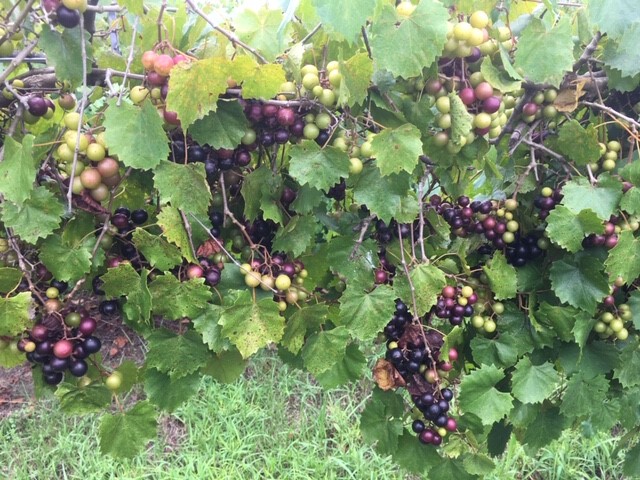
    Bruce McLean reports, “Most summer vegetable crops are starting to wind down. Peas, okra, watermelon and cantaloupe are still being harvested at some volume. Late summer/fall squash, cucumbers and tomato harvest are a couple of weeks away. Fresh market muscadines are being harvested now. Juice and wine muscadines are getting close – maybe 7 to 14 days away, depending upon location. In most juice and wine muscadine vineyards, Carlos is around 40% colored (ripe); Noble is around 60%; and Doreen is around 25%. Grape root borer (GRB) flight is still occurring, with moderately high moth counts in traps.”

    Eumorpha pandorus, a.k.a Pandorus Sphinx Moth caterpillar, found in the muscadine vineyard at Pee Dee REC. Photo from Bruce McLean.
    ‘Noble’ muscadines getting close to harvest. Photo from Bruce McLean.

    Tony Melton reports, “‘Another Crop Bites the Dust’ from spreader/stickers. I have seen too many farmers sing this sad song. Be careful and know what you are doing when adding a sticker/spreader when spraying vegetables. Short season, tender vegetable crops will burn very easy in our heat and do not have time to come back like long season row-crops. Our state’s second major watermelon/cantaloupe season is in full season in Chesterfield County. Harvest is in full swing and will continue until frost. Curculio sprays are beginning to be applied to the fall pea crop. Looks like pickle harvest will continue until frost.”

  • Schumer Asks Perdue to Delay Hemp Regulations

    Chuck Schumer

    Senate Minority Leader Chuck Schumer rarely gets involved in agricultural issues. However, the Hagstrom Report says he asked Ag Secretary Sonny Perdue to delay issuing a U.S. Domestic Hemp Production final rule until 2022. That move would allow hemp growers and producers in his home state of New York and across the country to continue to operate under the 2014 Farm Bill Pilot Program until that time.

    Schumer notes that COVID-19 is a solid reason for the delay. He also knows about some criticism for the interim final rule and says a delay “will allow USDA to address some of the more pressing regulatory critiques while giving states and producers additional time to come into compliance.”

    Allan Gandleman is President of the New York Cannabis Growers and Processors Association. He says the more than 700 registered hemp farmers in Schumer’s home state of New York would be negatively affected by USDA’s interim final rule on hemp.

    (From the National Association of Farm Broadcasters)

  • Recent Rains Beneficial for Pecan Crop

    UGA photo shows a pecan tree suffering through the heat with scorched leaves.

    Recent rainfall is a sight for sore eyes for pecan farmers on the verge of harvesting this year’s crop, according to University of Georgia Extension pecan specialist Lenny Wells.

    “We’ve had years where August and September we didn’t get a drop of rain. Even with the best irrigation the percent kernel didn’t fill out as good as you would expect,” Wells said. “A little bit of rain goes a long way during this time as far as that goes.”

    Weeks of dry conditions and extreme temperatures led to multiple counties in Alabama and Georgia being classified as ‘abnormally dry’ by the US Drought Monitor. This led to tough conditions for pecan trees producing a crop.

    “We were seeing a lot of that leaf scorch, especially on the young trees where the roots were getting a little burned from the heat. It’ll be 105 degrees down 5 or 6 inches, and that’ll burn and kill off some of those feeder roots. You get some scorching and that kind of thing,” Wells said. “This (recent rain) will give some relief from that for sure.”

    Harvest Season About to Begin

    With harvest season just a month or two away – Wells believes the Pawnee varieties will be harvested in mid-September – this is an important time in the production season for the nuts to receive water.

    “We’re into the kernel fill stage and that’s such a high energy demand process and especially when they have a heavy crop on them like we see out there this year, it just takes a lot of water to fill those nuts out as the kernel forms,” Wells said. “The crop is probably two weeks ahead of schedule. But a lot of our main varieties are right in the middle of filling those kernels. Some of the early stuff has already got kernels already in place. But the water’s still going to be beneficial to helping them go on and mature properly and open up properly.”