UGA CAES Photo/Shows an in-lab water analysis test at UGA CAES.
Well water quality and irrigation system management should be a top priority for vegetable and specialty crop producers gearing up for the spring season.
Gary Hawkins, an Assistant Professor in Water Resource Management at the University of Georgia College of Agricultural and Environmental Sciences, said a good clean well has reduced risks of pathogens and other bacteria in it.
Testing your water and irrigation systems now can prevent potential problems that may arise during the season.
“This time of year, they should be in the process of closing their systems down. Winterizing their irrigation systems is one good thing they can do. A second thing they can do this time of the year is really have an outline of how they could fix any leaks, geysers or anything else that makes their system inefficient,” Hawkins said. As they start thinking about cranking back up in the spring, late February, March, April timeframe; doing any irrigation water test.”
W33A Water Quality Test
Hawkins recommends a W33A water quality test that tests the chemistry in the water.
“That’ll test the basics, but it’ll also give us a sodium absorption ratio or an SAR number. That’ll give the farmer some indication of the combination of alkalinity Ph and what minerals are in the water itself, ground water or surface water. Is that water either going to corrode their pipes or is it going to lay down kind of a film in there that’s actually going to start clogging up their pipes?”
He also recommends a W35 bacteria test, which is especially important for producers irrigating vegetables and edible plants.
Other Points to Remember
Hawkins also emphasized that producers do not store chemicals or fertilizers close to the well head. In case there is a disconnection at the well head, any leaks of those products could get down by the well casing and to the aquifer.
It’s also important to keep the area clean around the well head so it is more visible. That way it is not at risk of getting hit with a tractor.
Southeast Regional Fruit and Vegetable Conference
Hawkins delivered a presentation about well management during this week’s virtual Southeast Fruit and Vegetable Conference. The conference, which is normally held in January in Savannah, is being held virtually this year due to COVID-19 concerns. The three-day event will be held through Thursday, Jan. 7.
A new year means a new set of peach cultivars for producers to choose from for the upcoming season. According to UGA Extension peach blog, the USDA at Byron, Georgia has released a trio of “Joy” peach cultivars, named ‘Crimson Joy’ (early mid-season), ‘Liberty Joy’ (mid-season), and ‘Rich Joy’ (late season).
The three main-season cultivars have self-fertile showy pink flowers that produce large, firm, melting and freestone fruit with high blush, yellow flesh, normal acidity and pleasant eating quality. The cultivars are suited for trials in areas with medium to high chilling accumulation.
‘Crimson Joy’ requires ~700 chill hours (CH) and typically ripens approximately with ‘Harvester’ and ‘Redhaven’ and about a week after ‘GaLa’ in mid to late June at Byron. The fruit are redder, more attractive and firmer than the three cultivars in the similar harvest window.
‘Liberty Joy’ requires ~650 CH and typically ripens in late June to early July at Byron. It could be a reliable lower-chill alternative to ‘Fireprince’, ‘Blazeprince’, ‘Scarletprince’ and ‘Redglobe’, some current commercial cultivars in the harvest window that all require ~850 CH and do not crop well when chilling accumulation is insufficient.
‘Rich Joy’ requires ~850 CH and typically ripens about a week after ‘Julyprince’ and approximately 2 weeks before ‘Flameprince’ at Byron, which can fill the harvest gap between the two cultivars. At maturity, ‘Rich Joy’ fruit have high percentage of bright red blush, making it more attractive and preferable to older, less blushed ‘Cresthaven’ and ‘Early Augustprince’, which are in the same harvest window. The freestone fruit develop excellent melting texture and pleasant rich flavor, and soften slowly on the tree as they ripen, allowing them to be picked over a relatively longer period compared to other typical melting cultivars.
The pedigrees of the three cultivars are different, so are their chill requirements, ripening days relative to ‘Elberta’ and harvesting seasons.
According to The South Carolina Grower, the USDA is accepting applications for Value Added Producer Grants. The applications are due by March 22, 2021. Click below for the application templates:
According to the application, “The purpose of the Value-Added Producer Grant (VAPG) Program is to help U.S. agricultural producers enter into value-added activities. Awards may be made for either economic planning or working capital activities related to the processing and/or marketing of valued-added agricultural products. The maximum grant amount for a planning grant is $75,000 and the maximum grant amount for a working capital grant is $250,000.”
Kyle Player of the SCDA ACRE program has planned a Value Added Producer Grant Webinar for Jan. 7, 2021 from 3-4 pm. This will be a great webinar for learning about eligibility and applying for the grant. Click on the flier below for more information.
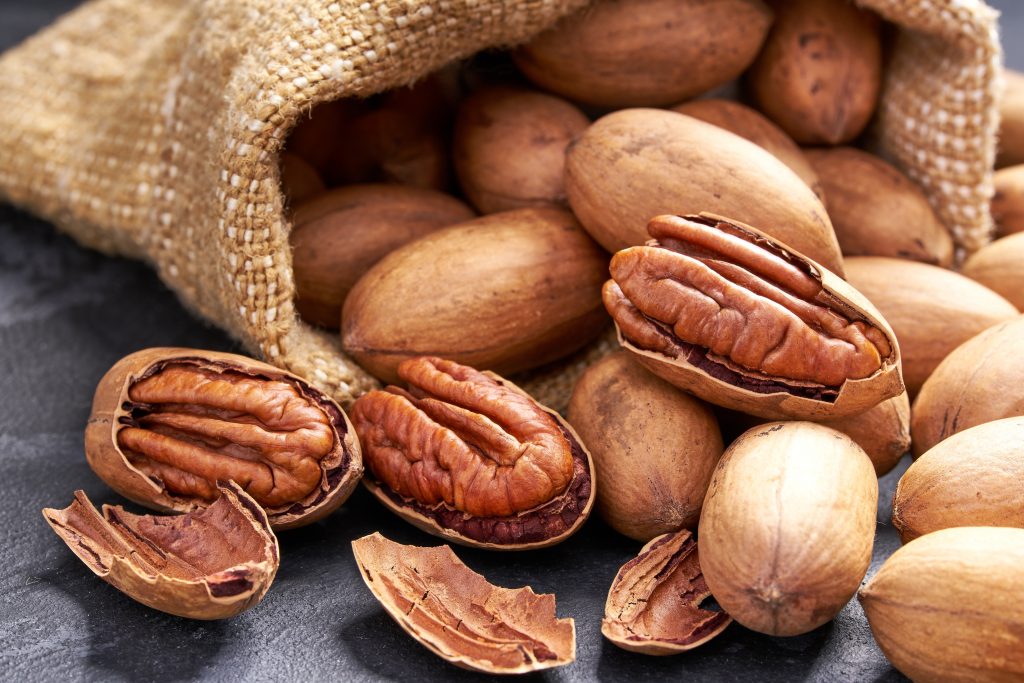
According to the USDA Federal-State Market News Service, pecan prices remain low throughout Georgia. Growers are picking up what is left in the orchards and bringing in what they have not put into cold storage. Rain and wet orchards have left some areas with excess moisture and damage from rot.
Growers are working those lots harder to clean them out and have them ready for testing and sampling. Prices remain about steady with a moderate interest from domestic buyers. Retail and gift pack purchasers are still looking for top quality pecans, while the export business to Asia has been virtually non-existent and slow as compared to previous years past. The season is rapidly winding down in Georgia. Most lots are blended varieties.
Blends with (nut count 50-65) meat yield 48% to 50% are selling for about $2.50-2.65 per point; meat yield 45% to 47% sold for about $2.40-2.50 per point; and Blends with meat yield 41% to 43% sold in a range of about $2.00-2.25 per point.
Prices paid to growers (late afternoon Tuesday, December 22, 2020 through late afternoon Tuesday, January 5, 2021) at buyers delivery point or F.O.B. the orchard including direct sales to end users, cents per pound in-shell of generally good quality in lots of 20,000 pounds or less unless otherwise stated:
Cape Fear (deliveries insufficient to establish market)
Desirables (deliveries light) yard tree lots, 80-100
Elliott (deliveries very light) yard tree lots, 90-100
Farley (deliveries very light) yard tree lots, 70-80
Moneymakers (deliveries very light) yard tree lots, 40, occasional higher
Native/Seedlings (deliveries light) yard tree lots, 40-50, occasional lower
Schley (deliveries light) yard tree lots, 70-85
Stuarts (deliveries light) yard tree lots, 50-75, mostly 70-75, few high as 90
Sumner (deliveries light) yard tree lots, 70-80
Lots over 20,000 pounds including truckloads:
Cape Fear, Desirables and Sumner (most lots are Blends, see prices above)
The Alabama Department of Agriculture & Industries (ADAI) continues to encourage producers who performed agriculture irrigation upgrades in the 2020 calendar year to complete the required irrigation questionnaire.
While ADAI is responsible for collecting completed irrigation questionnaires from producers seeking a tax credit in 2020, the Alabama Department of Revenue (ADOR) will issue any irrigation tax credits to eligible applicants.
The deadline for producers to submit a completed questionnaire is Jan. 31, 2021. It can be accessed on the ADAI website.
UGA CAES photo/Entomology researchers can study predator activity in turfgrass by the markings predators leave in clay models.
By Allison Fortner for CAES News
Modeling clay isn’t limited to art classrooms and sculpting studios. University of Georgia researchers developed a tool to track beneficial insects in turfgrass systems using clay models. Tracking these good predators can help develop eco-friendly pest management techniques for both home lawns and commercial sod growers.
In a recently published article in Entomologia Experimentalis et Applicata, UGA scientists determined that beneficial predator insects will interact with and leave distinct markings on clay models that resemble their prey, in this case the larvae of turfgrass pests. This study was led by entomology doctoral candidate Fawad Khan under the guidance of Assistant Professor Shimat Joseph in the College of Agricultural and Environmental Sciences on the UGA Griffin campus.
“We want to know who the predators are and what kind of impressions these predators will create on these clay models. Before we do anything in the field, we need to have a sense of what that looks like,” said Joseph, a turfgrass entomologist.
Though the clay model approach has been used in other disciplines to observe predator activity, Joseph and Khan found no previous use of the method in turfgrass research. This study developed clay models as a tool to aid in future research.
“It’s kind of brain hack of the predator. We want to see how much the real predator interacts with the model based only on the visual cues,” said Khan, a Fulbright scholar who came to UGA to study eco-friendly pest management options, specifically beneficial insects.
The Need for Research
The turfgrass industry contributes $9 billion to Georgia’s economy each year, but one of the high costs is pest management. Joseph said that the use of insecticides not only cuts into grower profits but requires valuable time, labor and equipment. The use of biological controls, such as natural predator insects, could mean only using chemical management when pest numbers rise beyond a certain threshold.
Harmful pests such as fall armyworms cause problems for turf growers and homeowners alike. Though there are natural predators that attack pests in their larval stage, it’s difficult to study the activity since they leave little evidence. The goal of Khan and Joseph’s research was to identify predator interactions and use that knowledge in commercial and residential turf. But before they could do so, they needed a method to measure how predators interacted with their prey.
In this study, researchers created two sizes of simulated larvae from modeling clay. Then they collected natural predators from turf lawns at UGA-Griffin. Each collected arthropod spent 48 hours in a petri dish with two sizes of clay larvae models. This was enough time for them to make their marks. Because the clay stays soft at room temperature, any markings left by the predators were preserved.
Researchers used video equipment to observe how the predators would first interact with models in the field. Outside of the petri dish controlled environment, they also placed the clay models near a fire ant mound in turfgrass. The study found different types of predators left behind distinct markings.
The researchers characterized and named the impressions left by each type of arthropod and used the knowledge of the specific markings as a tool to study the activities of these insects in the field.
“(The clay method) is good and it’s also cost-effective because it does not use a lot of expenditures like cameras or heavy equipment. You just have to put the clay models on the trees and near the turfgrass. After one or two days you see there are different markings and some activity there,” Khan said.
Fueling Pest Management Research
Because this study used a new method for measuring predator activity in turf, it created a baseline tool for further research as part of Khan’s dissertation work. The next step in the research is to compare predator activity between different systems.
“For that research, we need to identify the marks in the real field conditions of the sod farms and the residential lawns. If we did not have the baseline research on the turfgrass system, we couldn’t do that,” Khan said.
The goal in tracking predator activity between the systems is to create integrated pest management (IPM) methods against harmful insects such as fall armyworms. The clay model system will allow researchers to know which predators are present in commercial and residential situations. With that knowledge, Joseph said that they hope to manipulate existing predator insects to serve as a control method for the pests.
“In IPM, we tend to use multiple tactics. Pesticide is an important tactic, but there are others, like biological control,” Joseph said. “My viewpoint is more conservation. Here we are looking at biological control so we can … develop a population of predators and beneficial insects. When the fall armyworm attacks, (predators) can provide the first layer of control. If the population is overwhelming, we have to come up with a remedy. Chemical management comes into play if the numbers go beyond a certain threshold.”
Khan said the ecosystem-based approach of IPM considers beneficial insects including predators, parasites and pollinators, the environment, costs, economic loss and other factors surrounding any crop. However, this approach is not just important for those in the commercial agricultural sector. One of Khan’s ultimate research goals is to help homeowners know more about what is happening in their lawns.
“We have to appreciate the natural enemies and biological control that is happening around us in our residential lawns. My research will be giving an estimation technique to see what good insects are active,” Khan said.
For more information on the UGA Department of Entomology, visit ent.uga.edu.
The pecan harvest season is in the books. When farmers and industry experts reflect on the 2020 season, what will be the story?
Will it be an overwhelming crop that produced record yields for some farmers? Or will it be the low market prices that discouraged producers and forced many to store this year’s crop?
University of Georgia Cooperative Extension pecan specialist Lenny Wells offers insight into a season unlike any other.
“I think it’ll be the prices. Even though it was a huge crop, just the morale out there is really low right now. They didn’t get a lot for the crop,” Wells said.
“The volume was there enough to where I think most of them are going to be okay. My concern is, if we’re seeing low prices again like this next year and we don’t have that volume, that’s when we’ll really start to feel the pain. But we’ve got a long time to go between now and then. Who knows what will happen with China and all that in the meantime?
“There are a lot of nuts that are stored out there. That’s certainly going to play into whatever the price turns out to be next year.”
Low Prices All Season
Pecan prices were shockingly low all season. South Georgia farmer Randy Hudson said prices were anywhere from 30% to 50% less than what they’ve experienced the previous three years. All while fixed and variable costs continue to be extremely high.
During the middle of harvest season in early November, Stuart varieties sold for 75 cents per pound. Sumners were selling for $1.30 to $1.41 per pound. Even with minimal scab disease pressure, Desirable varieties sold for just $1.35 to $1.40 per pound.
Massive Yields
Wells said the latest USDA numbers estimate that Georgia pecan farmers produced about 135 million pounds. It’s an astounding number considering the state is recovering from Hurricane Michael in 2018. Trees and acres of production were lost during the October storm. Who knows how high this year’s production would have been if not for the storm?
“If we still had the acreage before we had the hurricane, this would have been a record crop, no doubt. A lot of growers had a record crop for their farm. But just because there was so much acreage lost, I think that brought it down some,” Wells said.
Alabama farmers were hurt by hurricanes that destroyed acreage and greatly reduced their crop this year.
Syngenta had a chance on Tuesday during the Southeast Regional Fruit and Vegetable Conference to showcase several new vegetable products that are sure to benefit vegetable and specialty crop growers in the Southeast.
Prevail
Prevail is a popular new beans variety that’s adaptable to a wide range of growing conditions. It produces slim, very dark green pods. In trial data, it reached maturity in 54 days and has an average pod length of 5.5 inches.
Payout
Payout is a spineless squash that matures in 45 days. The open plant produces cylindrical fruit that reaches 6.7 inches in length.
Grandprize
Grandprize is a straightneck squash that produces high quality fruit with a glossy deep yellow appearance. It boasts an enhanced disease package. The vigorous plant delivers solid yield performance over other yellow straightneck varieties.
Powerhouse
It won’t be long before watermelons are planted for the upcoming season. Powerhouse is a variety that should be considered for planting. It reaches maturity in 86 days and weighs between 13 and 16 pounds. It can develop sugars early, allowing for potential early harvest. It has a thick rind for improved shipping. It has high yield potential and full flavor.
Will Gay
“In our watermelon portfolio, we’re really excited about adding Powerhouse,” said Will Gay, a PDS in Georgia with Syngenta. “This variety is three days earlier in maturity than Captivation. With it being 86 days, it’s right between Fascination and Captivation in maturity. It is a main 45-count watermelon and it is improved on size than some other varieties that we’re competing with that may have more 60 counts. This is a good 45-count melon.”
The 2021 Southeast Regional Fruit and Vegetable Conference is normally held in January in Savannah, is being held virtually this year due to COVID-19 concerns. The three-day event will be held through Thursday, Jan. 7.
For more information, or to register for the event, click here.
Blueberry growers will soon have a chance to make their case against unfair trade practices from Mexico and other countries.
Jerome Crosby, Georgia blueberry grower and chairman of the American Blueberry Growers Alliance, confirmed on Tuesday during the Southeast Regional Fruit and Vegetable Conference that the group will present their case to the International Trade Commission (ITC) on Tuesday, Jan. 12.
“On Jan. 12, we will be providing physical testimony to the ITC Committee. All parties of leadership will be at the table. We will be speaking directly to the commissioners. We will be presenting our cases and our comments. Those of us who are making comments, we will be putting those comments in under a signed affidavit. This is where the rubber meets the road,” Crosby said.
Crosby said the blueberry group will have 60 minutes to make its case on Jan. 12, which will include testimony from legislative delegation from all states and featured speakers, including Crosby and Brittany Lee, Executive Director of the Florida Blueberry Growers Association.
However, Crosby also cautions that groups who oppose the 201 investigation will have the same amount of time to present their cases. So, it is not a slam dunk that the ITC will issue a remedy.
“It’s going to be one hour of us versus maybe five, six or seven hours of opposition. I still feel good about our case because the data and the facts are on our side. We’ve got good numbers. We’ve got a good team working with us. We’re doing all the right things,” Crosby said. “But to say it’s not a little bit intimidating would be misleading you. We’ve got a big mountain to climb.”
Crosby added that after the Jan. 12 meeting, the ITC will have 30 days to file a report.
Virtual Hearings
The meeting with the ITC stems from virtual hearings held last August. The two hearings provided the U.S. Department of Commerce and Trump Administration an opportunity to hear from seasonal produce growers in Georgia and Florida about the urgent need for federal action regarding unfair trade.
Southeast Regional Fruit and Vegetable Conference
The conference, which is normally held in January in Savannah, is being held virtually this year due to COVID-19 concerns. The three-day event will be held through Thursday, Jan. 7.
For more information, or to register for the event, click here.
The use of biological crop protection products or “biologicals” in vegetable and specialty crops is not a new idea, just one that is increasing in popularity.
The name sells itself. Biologicals represent a group of products derived from living organisms. Growers utilize environmentally friendly biologicals in combination with appropriate chemical applications to provide added protection against pests, diseases and weeds.
THE OLD WITH THE NEW “These products have been around for a long time, before the chemical age, if you will. This is how farmers farmed,” says Dean Craine, ag market business development manager with Douglas Plant Health. “This is how growers grew crops and learned how to do it well, whether with manures or compost or whatever resource they had that they turned into something useful. We call it our grandfathers’ way of farming.”
Craine says teaming today’s technology — including precision agriculture, NDVI photography and satellite imagery — with these old and very safe biologicals makes for a successful combination. “It’s where we need to head,” he says.
GROWER CHALLENGES The agricultural biological market has increased in importance due to various reasons. The world’s population continues to skyrocket. There are approximately 7.8 billion people in the world, up from 6.1 billion in 2000. A growing world population means more mouths to feed and increased dependence on farmers to be more innovative in trying to meet demand.
Sustainability is always an issue of importance as growers in the Southeast contend with pests, diseases, decreased market prices and imports from Mexico.
GETTING IT RIGHT Biologicals help meet those needs, but they need to be the right situation for the right farmer in the right region. Due to an overabundance of supplies being offered, growers need to be aware of what product is right for their farming operation.
“There have been many solutions that don’t stand up over time. They all probably worked somewhere once, but when you run across products said to work everywhere, obviously, you need to be skeptical,” Craine advises. “Look for products with a track record, some history, some data and sound science. This must be the way the grower comes at it. As a grower, it can be very frustrating to sort through all the noise.”
PAIRING PRODUCTS Industry experts classify biologicals into three categories: Biostimulants (liquid manure compost and seaweed extracts, for example), biopesticides (including Bacillus thuringiensis and mineral oil) and biofertility products (such as Rhizobium and Azotobacter bacteria).
When biofertility products get established in the soil, they can increase nutrient availability. Some of these products are synergistic, which allows for greater success when used in combination with each other.
“Those biofertilizers require the right biostimulants with them,” Craine says. “We generally define biostimulants as carbon products that feed biofertilizers and biopesticides. Biopesticides are products that have been studied carefully and can specifically target pests, whether they are diseases, insects or weeds. A lot of new work is pairing the right biostimulant with the right biofertilizer or biopesticide. This increases the biofertilizer or biopesticide’s adaptability and gives it a better shot at establishing in the soil or on a plant to do what it’s good at.
“If we’re going to replace some of the harsher chemistries, that’s how it’s going to be done, by pairing the right products to maximize their effectiveness.”