Blueberry growers and industry leaders in the Southeast had their say on Tuesday about unfair trade practices regarding imports from foreign countries, including Mexico.
They testified during a virtual hearing with the U.S. International Trade Commission (ITC) regarding a global safeguard investigation into fresh, chilled or frozen blueberries.
Jerome Crosby, Georgia blueberry grower and chairman of the American Blueberry Growers Alliance, testified about the importance of the Alliance’s formation and its role in protecting its domestic crop.
“We officially launched our Alliance in December for the same reasons we are before you today. The U.S. blueberry growers needed a new approach to protect and secure the future of their farms and to respond to the assault on the U.S. market by blueberry imports,” Crosby said. “We require a strong and unified voice for the U.S. blueberry grower without the influence of domestic or foreign marketer or retailers seeking lower and lower prices.”
Increased Imports
Crosby said imports of fresh blueberries have increased 75% over the past five years. It is only expected to worsen as prices and profits continue to plummet for U.S. producers.
“We fully expect a variable tidal wave of imported blueberries in the next several years,” Crosby said. “Substantial portions of the industry report losses on an operating and net income basis. Packing and freezing facilities have been shuttered. Blueberry acreage has declined.
“The injury to the domestic industry is serious, clear and wide spread. It’s caused by the flood of imports into the U.S. market.”
Blueberry farmers from across the United States are asking the ITC for temporary relief from a surge in imports that are harming the domestic industry
WASHINGTON, January 12, 2021 – Members of the American Blueberry Growers Alliance (ABGA), a group representing U.S. domestic blueberry farmers, today provided information to the U.S. International Trade Commission (ITC) during a hearing on the impact of rising imports during the U.S. growing and harvest seasons. American blueberry growers across the country – mostly small, family-run farms – have been devastated by an influx in blueberry imports by 75% in the past five years, according to U.S. import data.
“Because of booming domestic demand, we should be enjoying a market in which there is room for both domestic and foreign growers to profit,” said Jerome Crosby, Chairman of the ABGA Board of Directors and owner of Pineneedle Farms in Willacoochee, Georgia. “However, foreign government policies targeting the United States market and large corporate import interests have combined to bring massive volumes of blueberries into our market, increasingly during periods that in the past provided growers with the bulk of their revenues and often all of their profits for the year.”
“The massive increase in Mexican imports during our harvesting season has crippled the Florida blueberry industry and threatens its very existence,” said Brittany Lee, Executive Director of the Florida Blueberry Growers Association and owner of Florida Blue Farms. “Over the period 2009 to 2019, we saw imports from Mexico increase by 2,111%. We have experienced a significant decline in price per pound for fresh blueberries in Florida, and a huge loss of market share.”
Farmers said the U.S. blueberry industry has made extensive marketing efforts over many years to educate purchasers and consumers about blueberries, which has increased demand.
“Foreign producers are taking the benefit of those efforts, in some instances by creating industries out of nothing and exploiting cheap labor and poor environmental regulation overseas,” said Rex Schultz of Heritage Blueberries in Bangor, Michigan and President of the Michigan Blueberry Advisory Committee. “Producers in foreign countries are totally dependent on our market, and they have every incentive to keep shipping more and more product here. This is not a sustainable situation for the American blueberry farmer.”
Imports have also had a devastating effect on blueberry farmers in Western states.
“Ten years ago, imports filled an important role by ensuring supply of fresh berries in the few months is no longer the case,” said Jayson Scarborough, a blueberry farmer in Central California. “Imports from Mexico and Peru, in particular, now enter our market throughout our harvesting period in California. Prices for these imported berries are extremely low, which means that when we begin to sell our harvests, the price point has already deteriorated significantly due to the presence of large volumes of imported fruit in the market.”
Farmers said that massive amounts of fresh blueberries coming in from Mexico and South America often arrive without a buyer.
“Peruvian product can arrive in massive shipments, with hundreds of thousands and even millions of pounds of perishable fresh blueberries on one ocean-going vessel that has been in transit at least two weeks before being unloaded at U.S. ports,” said Shelly Hartmann, owner of True Blue Farms in Grand Junction, Michigan. “When these blueberries are released all at once onto the fresh market, they cause prices to crater. This pushes domestic production of blueberries grown for the fresh market into the frozen market.”
In addition, several members of Congress also testified before the ITC in support of American blueberry growers, including Reps. Austin Scott (R-Ga.), Bill Huizenga (R-Mich.), Earl L. “Buddy” Carter (R-Ga.), Gregory Steube (R-Fla.) and John Rutherford (R-Fla.).
The U.S. International Trade Commission (ITC) is conducting a global safeguard investigation into imported fresh, chilled or frozen blueberries under Section 201 of the Trade Act of 1974. The ITC will determine if the dramatic increase of foreign berries is “a substantial cause of serious injury, or the threat thereof” to American blueberry growers.
###
About American Blueberry Growers Alliance
American Blueberry Growers Alliance (ABGA) is a national association representing blueberry growers and farmers in the United States. ABGA provides a unified voice for blueberry growers in states across the country, including California, Florida, Georgia and Michigan, advocating on behalf of their interests and for the long-term viability of the domestic blueberry industry. For more information, visit: americanblueberrygrowers.com.
Nikki Fried, Florida Ag Commissioner, testified on Tuesday during a virtual hearing with the U.S. International Trade Commission (ITC) regarding a global safeguard investigation into fresh, chilled or frozen blueberries.
The investigation centers on unfair trade practices regarding blueberry imports from foreign countries, including Mexico.
Nikki Fried
Fried stated that Florida has a $62.3 million blueberry industry but its market share has declined by 38% since 2015. It has resulted in $67 million in potential production.
She added that Mexico’s market share has increased by 2,100% since 2009.
U.S. Congressman Austin Scott (GA-08) testified on Tuesday during a virtual hearing with the U.S. International Trade Commission regarding a global safeguard investigation into fresh, chilled or frozen blueberries.
Austin Scott
The investigation centers on unfair trade practices regarding blueberry imports from foreign countries, including Mexico.
The U.S. Department of Agriculture (USDA) announces details of the 97th annual Agricultural Outlook Forum, which will be held virtually on Feb. 18-19, 2021.
The 2021 Forum, themed “Building on Innovation: A Pathway to Resilience,” will focus on the central role science and innovation have played in helping the agricultural sector overcome challenges and build resilience during the COVID-19 pandemic.
The Forum’s program (PDF, 168 KB) will begin with a presentation by USDA’s new Chief Economist, Seth Meyer, on the Department’s outlook for U.S. commodity markets and trade for 2021 and the U.S. farm income situation. A keynote address by the incoming Agriculture Secretary, presentations by Congressional leaders, and a session on genetic literacy are also scheduled for the morning on the first day of the Forum.
In addition, the program will cover five key areas:
Supply Chain Resilience
Commodity Market Outlooks
Food Price and Farm Income Outlooks
U.S. Trade and the Global Market Place
Managing Risk and Ensuring Sustainability
Innovation, Technology, and Productivity
The 2021 Forum is expected to bring together more than 3,000 participants from the U.S. and around the world, including producers, processors, policymakers, government officials, and nongovernmental organizations. The Forum’s program includes more than 30 sessions and 100 expert speakers.
Registration for the Forum is free but required to attend the Forum sessions. To register, visit the 2021 Agricultural Outlook Forum website.
Clemson Extension agents provide updates in the The South Carolina Grower this week about the status of various crops being produced throughout the state.
Weekly Field Update
Coastal
Rob Last reports, “Vegetable crops are growing out of the impacts of frost well. There is active Alternaria in places on brassica crops. Insect activity in vegetable crops in the area remains low. Strawberry crops are moving well with a few spider mites and aphids being observed. Remember if mite treatment is needed, use a specific miticide to target the pest to avoid flaring populations. If you need a second pair of eyes to help scout then please give me a shout.”
Zack Snipes reports, “I’ve been getting a good many calls about strawberries in recent weeks. The warm weather has really pushed our berries, perhaps too far along for this time of year. I know of a couple of farms that are already harvesting which I’m not sure is a great thing this early in the season. Most fields look good with great growth but we only have a few crowns for each plant. Hopefully some cool weather will come in and slow them down. Make sure to sanitize the plants by removing all dead tissue and put out a preventative spray once you are done sanitizing. Good preventative sanitation right now can do wonders for disease management later in the season. Now is a good time to manage weeds before they get too large. And while I am at it…now is the perfect time to get ready for the season by checking sprayers, getting fertigation systems set up and calibrated, and purchasing pesticides you know you will need for the season.”
A sanitized plant and the dead and diseased tissue that came off of it. This needs to be taken out of the field and disposed of. Photo from Zack Snipes.Corn spurry is a weed that needs to be managed now before it is too late. Photo from Zack Snipes.
Midlands
Justin Ballew reports, “The weather has remained cool, so everything is growing pretty slowly. We had another very rainy day last week, and we got a little over 2 inches at my house. That’s over 6 inches for me so far in 2021, and I’ve had some folks tell me they’ve gotten over 8. We are seeing some cold damage to strawberry foliage, but nothing to worry about long term. Just make sure to sanitize any dead leaves and flowers as the temperatures warm in the spring. I’ve already seen some Botrytis develop on dead flowers, so we definitely need to remove these sources of disease inoculum. I’m counting 2 to 3 crowns per plant right now. If you’re behind that, it may be helpful to put row covers on for a couple weeks. Just scout for spider mites carefully first.”
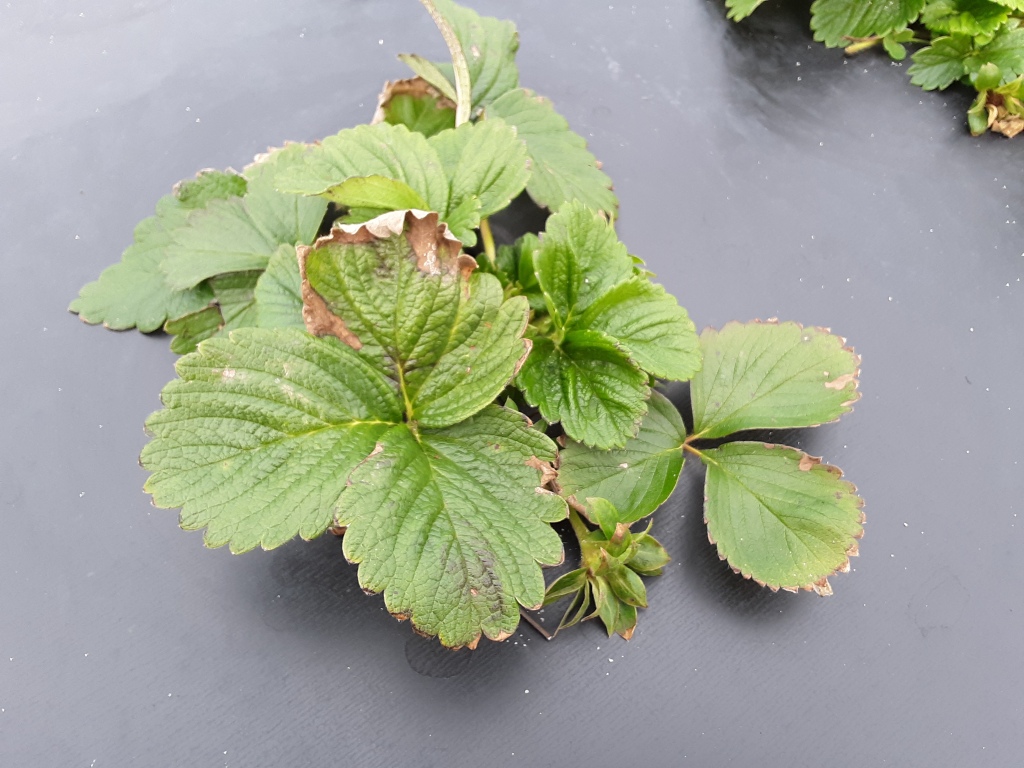
Cold damage around the margins of strawberry leaves from the hard freeze right after Christmas. It didn’t get cold enough to damage the crowns. Photo from Justin BallewThis bloom was killed by cold weather. It’s difficult to see here, but there are already a few botrytis spores developing on the flower. If not sanitized, this could become a significant source of inoculum. Photo from Justin Ballew.
Pee Dee
Tony Melton reports, “Cold hurt green winter strawberries more than ripe ones due to increased sugar in ripe ones. Still got some squash producing in high tunnels if covered inside tunnel with row covers. We’re bedding green fields to allow weeds to germinate so they can be killed using stale-bed culture.”
The U.S. International Trade Commission (USITC) is seeking input for two new general factfinding investigations on the effects of imported cucumbers and imported squashes on the U.S. seasonal cucumber and squash markets.
The investigations, Cucumbers: Effect of Imports on U.S. Seasonal Markets, with a Focus on the U.S. Southeast, and Squash: Effect of Imports on U.S. Seasonal Markets, with a Focus on the U.S. Southeast, were requested by the U.S. Trade Representative (USTR) in a letter received on December 7, 2020.
As requested, the USITC, an independent, nonpartisan, factfinding federal agency, will examine the effect of imports on the domestic seasonal markets of cucumbers and squash in separate but concurrent investigations and produce two separate reports. The reports will provide, to the extent practical:
descriptions of the effects of imports on the domestic seasonal markets of the products in question, with particular focus on production and the competitiveness of cucumbers and squash grown in the Southeastern United States;
information on recent trends in trade in these products between the United States and its trading partners, including information on seasonal patterns of trade; and
descriptions of monthly price trends for these products in the United States, including an analysis and comparison of the prices of domestically produced and imported products in the U.S. market, with a focus on the 2015-2020 time period.
The USITC expects to transmit both of its reports to the USTR no later than December 7, 2021.
The USITC will hold a public hearing in connection with the investigations at 9:30a.m. on April 8, 2021. Because COVID-19 mitigation measures are in effect, the public hearing will be held via the WebEx videoconference platform.
Requests to appear at the hearing should be filed no later than 5:15 p.m. on March 25, 2021, with the Secretary, U.S. International Trade Commission, 500 E Street SW, Washington, DC 20436. See below for important information regarding filing a request to appear at a USITC hearing.
The USITC also welcomes written submissions for the record. Written submissions should be addressed to the Secretary of the Commission and should be submitted no later than 5:15 p.m. on April 27, 2021. All written submissions, except for confidential business information, will be available for public inspection. See below for important information regarding the filing of written submissions for USITC investigations.
The deadline is Friday for Alabama vegetable and specialty crop farmers seeking financial assistance from Hurricane Zeta.
Producers who suffered losses related to Hurricane Zeta need to submit an application to the Alabama Farmers Agriculture Foundation for assistance from a Hurricane Relief Fund by this week.
According to the alfafarmers.org, the relief fund is designed to help offset farmer losses not covered by a farmowner policy, crop insurance or disaster relief programs. An independent committee will evaluate the applications based on need and award grants in February.
The application for Hurricane Zeta assistance and a link for contributions to the fund are available at AlabamaFarmersFoundation.org.
Hurricane Zeta made landfall in Louisiana as a strong Category 2 storm on Oct. 28 and maintained tropical storm winds as it raced across Alabama.
The Georgia Blueberry Commission is taking nominations for a person to fill the unexpired term of Russ Goodman. The deadline for applications is Jan. 31, 2021. If interested, a person must be a grower of blueberries in Georgia and must be willing to commit to meetings and activities of the Blueberry Commission. The term will end the Summer of 2023.
Goodman is stepping down from duties as a member of the Blueberry Commission to allow more time to devote to his responsibilities of representing District 8 in the Georgia State Senate.
The most recent U.S. Drought Monitor map shows sporadic parts of Florida, Georgia and Alabama that are classified as abnormally dry.
Rainfall this winter should mean less potential for dry conditions in the summer for vegetable and specialty crop producers in the Southeast. That could mean less need for irrigation usage for farmers during the hot summer months of June through August.
Rain has not been lacking across the Southeast, especially during the latter part of December and so far in the first couple of weeks of January. It was especially persistent during the New Year’s Holiday weekend.
“Having more rain in the winter reduces our chance to have drought in the summer, so that’s good,” said Pam Knox, University of Georgia Extension Agricultural Climatologist. “The cooler temperatures do help to keep the moisture in the soil as well. When it’s really dry, you get more evaporation, even in the winter. All of these things we’re seeing, cooler conditions and wetter conditions, mean that we’re less likely to see dry spells in the spring that would impact farmers.”
Georgia Rains
According to the Georgia Automated Weather Network, from Jan. 1 to Jan. 9, Tifton, Georgia received 4.41 inches, compared to 0.76 in 2020 and 1.32 in 2019. In Vidalia, Georgia, where onions are being produced, there was 3.65 inches recorded during that same timeframe, compared to 1.58 in 2020 and 0.77 in 2019.
“On the short term, it looks like we’re probably going to see a whole series of storm systems move through. That’s pretty not typical for a La Nina year for the Southeast. But the way the weather patterns have set up this year with that dip in the jetstream over the eastern half of the country, we’re probably going to see more storms,” Knox said. “They’re talking about potentially, although snow in the Southeast is pretty hard to get, we might see some. But it would most likely be in the mountains rather than in any other part of the state.
“But we still have the whole month of February and March to go too. We’ll just have to wait and see exactly what happens.”