Author: Clint

  • Clemson Extension Agents Provide Crop Updates

    Clemson Extension agents provide updates in the The South Carolina Grower this week about the status of various crops being produced throughout the state.

    Weekly Field Update-2/01/21

    Coastal

    Rob Last reports, “Strawberry crops are developing well, however, we are seeing gray mold phomopsis blight in forward crops. Sanitation can really help prevent botrytis spread as we move forward when allied to fungicide applications. Keep scouting for spider mites, as there are active populations in some crops. Now is a great time of year to think about maintenance of equipment, be that for bed formation, cultivation for spring crops, and most important application equipment.” 

    Zachary Boone Snipes reports, “I feel like Forrest Gump describing the weather as of late. “One day it started raining, and it didn’t stop for four months.” We are extremely wet in the Lowcountry which is delaying a lot of ground prep for the upcoming season. Stay out of the fields if they are wet, as equipment will compact soil and make matters worse than they already are. This is the perfect time of year to order and stock up on pesticides, fertilizers, seeds, calibrate sprayers, clean ditches, sharpen tools, clean packing sheds, etc. Preventative maintenance and getting prepared for the upcoming season will lead to less stress and better management decisions down the road. This would also be a great time to explore all the links that lead to resources on SCGrower.com as well as to curl up with your Southeast Vegetable Crop Handbook.” 
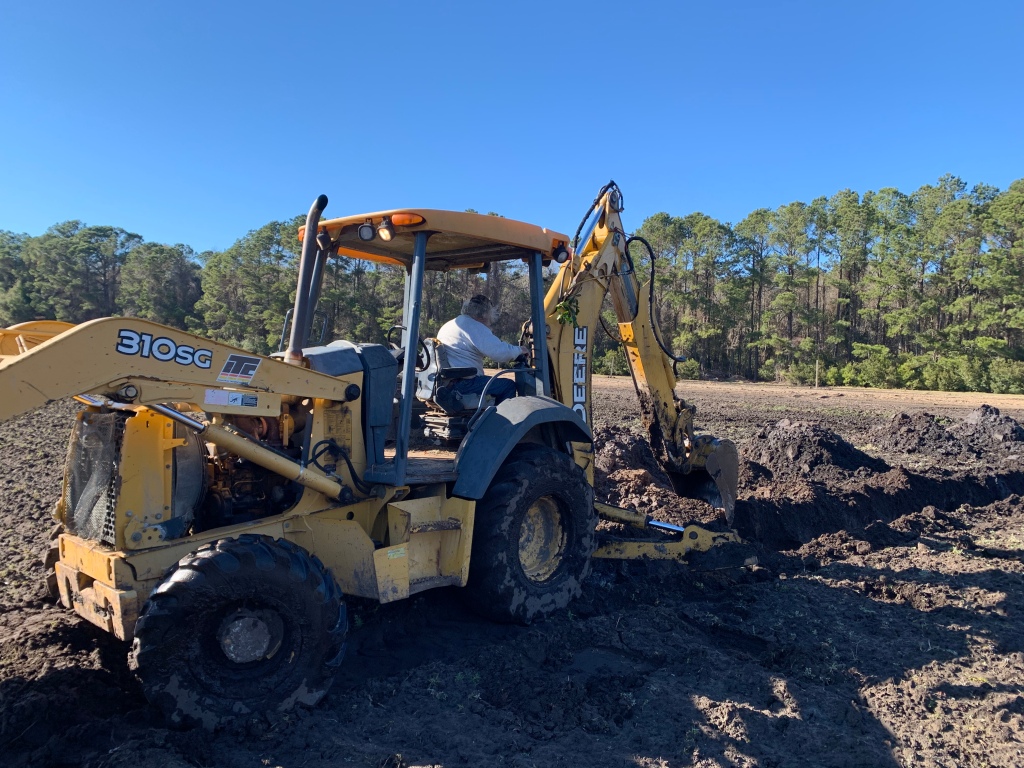
    French drains are being installed in lower lying areas of some fields. Photo from Zachary Boone Snipes.

    Midlands

    Justin Ballew reports, “The weather was a little warmer for most of the past week, and we received a little more rain. The strawberry fields I’ve looked at in the past week averaged 3 to 4 crowns. Growers have been working on sanitizing dead leaves and flower buds from their fields to keep botrytis inoculum down. I’ve gotten a couple calls recently about whether it’s time to start protecting blooms. It’s still a little early in my opinion. Remember, there is about a 4-week time span from bloom to ripe berry, so saving blooms now would have people picking around the first of March. I’m not seeing enough blooms out there right now to make saving them worthwhile. I would rather let the plants grow for a few more weeks.”

    These plants were recently sanitized and are looking good. It would be best give them a few more weeks to grow before protecting blooms. Photo from Justin Ballew.

    Sarah Scott reports, “As of this morning at Musser Farm, we are reporting 850 chilling hours and 50 chill portions. In Johnston, we are sitting at 788 chilling hours and 46 chill portions. Chilling hours are measured between temperatures of 32-45 for this calculation.” 

    Upstate

    Kerrie Roach reports, “Heavy rains over the last week have put a significant damper on any field prep and planting for early season vegetables in the upstate. Pruning tree fruits is in full swing, and chilling hours are on track.”

  • Wind’s Blowing: South Florida Melons Progressing Amid Adverse Conditions

    watermelon
    File photo shows watermelon plants in a field.

    South Florida watermelons have been in the ground almost a month. Plants are progressing, but today’s cooler temperatures and strong wind has one farmer concerned potential gummy stem damage.

    “Right now, (plants are) looking pretty good. I’m just hoping that this wind doesn’t do a lot of damage. When your line is just starting to run a little bit and you get a lot of wind, that’s when you start to get some problems,” said Carr Hussey, a watermelon farmer in Florida and Alabama, chairman of the board of the Florida Watermelon Association and co-founder of Sweet Mama Produce. “Gummy stem starts to show up and stuff like that.”

    Weather Factor

    A La Nina weather pattern was expected to bring warmer and drier winter conditions across the Southeast. But that has been opposite of what some producers in Florida, Georgia and Alabama have felt so far. In South Florida, though, temperatures can increase dramatically and quickly, which could bring added stress to the plants already in the ground.

    “We’ll have days here where it’ll be a high and today’s going to be one of them, like 58 (degrees). And two days from now, but it won’t be this week, but last week was where we had a week like that; two days later we were 80, which is 10 degrees above our normal temperature. On average it was a couple of degrees higher than normal,” Hussey said.

    “The wicked witch of the north has always said when you get temperature changes like that, that’s when you have a hollow heart situation. But I don’t think anything’s been planted long enough for that to happen. Should the weather straighten out I think we’ll be okay. I don’t think anybody actually knows where hollow heart really comes from.”

    Hussey plans to plant again around Feb. 15 in Wauchula, Florida and then again in Malone, Florida and Cottonwood, Alabama on March 15. That is also about the time when most of South Georgia producers will plant their crop.

  • Bell Pepper Imports Continue to Increase

    Data shared by UGA’s Greg Fonsah shows how much bell pepper imports have increased since 2000.

    One vegetable commodity at the center of an investigation pertaining to its imports from other countries was highlighted during Georgia’s Ag Forecast meeting last Friday.

    Greg Fonsah, University of Georgia Agribusiness Extension economist, pointed out how significantly bell pepper imports have increased over the past two decades.

    Statistically Speaking

    In 2019, 68% of bell peppers that were consumed in the U.S. were imported, amounting to 1.61 million pounds. Bell pepper imports have increased by 5% annually for the past five years. Most of the imports originate from Mexico, 75% in fact, with Canada contributing 18%.

    “You can see how the fresh imports started growing from the year 2000 and has been growing steadily. It’s doubled, it’s tripled all the way to 2020. We think by 2021, it’s going to go all the way up here, it’s still going to increase, the same as the import share for the availability,” Fonsah said. “You can see how it’s increasing, increasing, increasing, and it keeps increasing. We expect to see the same thing in 2021.”

    Encouraged by Congressional support, the U.S. Trade Representative requested a Section 332 investigation last November to the U.S. International Trade Commission into the imports of strawberry and bell pepper.

  • Chilling Stat: Peaches Looking Good for Chill Hour Accumulation

    Chill hours remain an integral part of a peach producer’s hope for a successful year. If the current numbers are any indication, Alabama growers could be in line for a productive season.

    During a webinar last week, Edgar Vinson, assistant research professor and Extension specialist in the Department of Horticulture at Auburn University, said there was 737 chill hours or 38 chill portions recorded at the Chilton Regional Research and Extension Center. He was confident that the chill hours will continue to rise heading into February.

    “Over the next several days or weeks we should have enough opportunity for chilling accumulation so that we can have enough chilling to satisfy most of the varieties that we grow,” Vinson said.

    He said 43 degrees Fahrenheit is the optimal temperature for when chill accumulation will occur.

    Chill Management

    There are multiple ways that producers can manage chilling. The first thing is to do your research before planting. Growers need to plant peach varieties that fall in line with the historical chilling accumulation for their areas. Areas in north Alabama are going to receive more chill than south Alabama.

    “You don’t want to plant varieties that have too high a chill requirement or too low. Too high, you threaten not to have enough to sufficiently eliminate dormancy. Too low, then you could break dormancy too early and be subject to late-season frost,” Vinson said.

    While this year’s cooler winter has contributed to more chill accumulation potential, that hasn’t always been the case.

    “In our area, we’re experiencing a lot of warming trends each winter. Winters are becoming increasingly warmer. It’s becoming more and more difficult to accumulate chilling. With these varieties that have a high chill requirement, they’re vulnerable to not having enough chilling,” Vinson said.

    Peaches need chill hours to mature. The required chill hours depend on the peach variety. Contender, a well-known peach variety, has 1,050 chill hour requirements.

  • Opportunity Awaits? Blueberry Exports to China Could Be Game Changer

    File photo shows blueberries on sale.

    While the pending International Trade Commission decision regarding the case of serious injury that imports have had against blueberry growers will be pivotal for producers in Florida and Georgia, another marketing opportunity may lie with producers capitalizing on exports to China.

    Greg Fonsah, University of Georgia Agribusiness Extension economist, said during Friday’s Ag Forecast meeting there is a real opportunity for blueberry growers to capitalize on an exports market, especially as Chinese consumption of blueberries has increased dramatically; from 28 million pounds in 2012 to 360 million pounds in 2018.

    Historic Agreement

    Because of the U.S.-China Economic Trade Agreement, the U.S. was granted access to export blueberries to China, as of May 2020.

    “It is about time for the U.S. to also penetrate that market and get a share of the market especially in that May 2020 we had this agreement with the Chinese government,” Fonsah said. “It is going to be an opportunity for the U.S. blueberry industry to start looking at the Chinese market and try to capture a huge market share, just like Chile, Peru, Argentina and Mexico.”

    Flooded Market

    The region’s blueberry growers need every market source they can get at this point. Increased domestic production of blueberries combined with increased imports have flooded the U.S. market. Unfortunately, when markets flood, prices plunge. This is a focal point of the American Blueberry Growers Alliance case to the International Trade Commission that a serious injury has occurred.

    “The market has totally changed in 10 years, totally changed,” Fonsah said. “We have also doubled the production. The domestic production plus imports coming from Mexico, guess what, we have flooded the market.”

    Imports from Latin America remains the primary challenge to Southeastern blueberry producers’ production. From 2010 to 2019, Peru’s export production to the United States exploded from almost nothing to 140 million pounds. Mexico’s production soared to almost 80 million pounds, according to the U.S. Department of Commerce, Bureau of the Census.

    Exports from Mexico soared to around 23 million pounds in April 2020 compared to 16 million in 2019 and 13 million in 2018.

    The domestic FOB (freight on board) price in October 2010 neared $35 per flat. In September 2019, the price plunged to $15 per flat, according to the USDA Agricultural Marketing Service.

    “The huge production from Mexico and the huge production domestically has helped flood the U.S. market and helped depress the prices,” Fonsah reiterated.

    U.S. fresh-market production of blueberries increased from about 250 million pounds in 2010 to about 370 million pounds in 2019, according to the USDA National Agricultural Statistics Service.

  • Cold Temperatures Slow Growth of Florida Blueberries

    File photo shows blueberries.

    Florida blueberries are normally in peak pollination season this time of the year. But that isn’t the case this season, however, says Ryan Atwood, who lives in Mount Dora, Florida and is one of the state’s blueberry leaders.

    “We’re starting to get some flower emergence. Normally by now we’re in peak pollination season. I don’t think we’re there yet in Central Florida, definitely not there yet in north Florida,” Atwood said. “I was down in south Florida (recently) and those guys do have bees actively in their fields pollinating.”

    Atwood farms 56 acres of blueberries, manages another 350 acres and is part-owner of the largest packing house in the Southeast United States.

    The cooler temperatures being felt across Florida have played an integral part in the slow growth of this year’s blueberry crop.

    “We’re I think on pace, we might be a little bit later than what we historically are on the crop cycle,” Atwood said. “That’s hard to say yet because you don’t know what February and March weather patterns have to offer. But definitely consistently cooler in December and January than we typically get, and it slowed us down a little bit.”

  • Quiet Insect Activity: Alabama Producers Still Need to Take Precautions

    Photo courtesy of Ayanava Majumdar

    Insect pressure is currently quiet in Alabama. But infestations could increase dramatically if producers don’t take the proper precautions, says Ayanava Majumdar, Extension Professor in Entomology and Plant Pathology at Auburn University.

    “At this point, things are kind of calm and quiet, except perhaps for people who have greenhouse crops or are trying to start their seedlings or trying to get them. I just want to caution and bring those prevention points again to focus; how to prevent some things,” Majumdar said. “Always get transplants from good sources. If they’re being bought from out of state or a store, check for small insects like aphids. That’s the one that comes to mind that hitchhikes a lot on transplants that are bought outside.

    Armyworms are also an insect to look out for.

    “For the conventional farmers, they have to look at their systemic drench insecticides, make sure they have those. There might be some areas down south where they still have maybe armyworms. Watch out for caterpillars. They may show up if someone’s having a particularly warm winter,” Majumdar said.

  • It’s Coming: Strawberry Volume Expected to Increase Soon

    Florida strawberry production has been slower than normal this season. But don’t expect that to too last much longer.

    File photo shows strawberries.

    “I think that volume’s going to be coming pretty powerfully here whether we’re ready for it or not over the next couple of weeks,” said Vance Whitaker, strawberry breeder at the University of Florida Gulf Coast Research and Education Center.

    “We’ve had an explosion of bloom over the last couple of weeks. We’re just sort of at the beginning, I think, of a really large uptick in volume. I think that we’re looking at increasing volume pretty dramatically from where we are right now as we’re heading into Valentine’s Day.”

    Slower Production So Far

    Florida producers have been harvesting consistently since around Thanksgiving, but the volume has lagged compared to previous years. Whitaker talked to growers in December. They estimated they were somewhere between 20% and 25% behind the production numbers they were at the same time last year.

    “We’re not talking like a major, major deficit. But it’s been a little tight. I think berries have been a little bit tight on the U.S. market from wherever they’re coming from, whether it be southern California or Mexico, due to the colder weather,” Whitaker said. “That’s probably been a fairly good thing since I think demand has not been super high with the lockdowns and COVID situation that we’ve been dealing with. It’s probably been a good thing, in the end, not to have any record volume so far.”

    Weather Factor

    Weather was the main culprit in decreased volume so far.

    “We’ve definitely been a little bit shy, up ’til now on volume, a little bit behind. It’s due to two things. One, we had the hottest November on record as far as average temperatures. That kind of slowed down the initiation of the blooms and the crown,” Whitaker said.

    “Once we got those flowers initiated a little bit on the late side, then we got this really nice stretch of weather; no major freezes but plenty of cold nights… nice cool weather through December and January. There was fantastic fruit quality, but it’s just slowing down the arrival of that yield.”

  • Yeast Rot in Blueberries Major Problem in 2020

    A sporadic blueberry disease caused significant problems for Georgia producers in 2020.

    Though management options are non-existent with yeast rot, Jonathan Oliver, University of Georgia (UGA) assistant professor and small fruits pathologist, believes timely harvesting and handling of ripe fruit will help minimize instances in 2021.

    Photo by Clint Thompson/Shows Jonathan Oliver talking about yeast rot during the virtual Southeast Regional Fruit and Vegetable Conference.

    “It was a major problem for our rabbiteye growers. Kind of the last half, maybe the last three-quarters of the rabbiteye harvest, at least in southern Georgia, seemed to be affected by it significantly. It probably is weather and condition dependent,” Oliver said.

    “We had a lot of warmer weather right before we had the problem, and we had a lot of rainfall. It seems to be something of a problem when fruit is already either overripe or damaged in some way. Some of the weather conditions I think led to some of those problems. That’s why it was kind of an issue last year.

    “It sporadically can be an issue in other years as well. It was a real big issue right at that one critical time last year, unfortunately, for our growers.”

    Environmental Conditions

    Warm, wet or humid conditions likely favor the growth of the fungus. There was a rapid shift to warmer overnight temperatures in Georgia in mid-to-late May. It went from the mid-50s to mid-70s very quickly. Also, there was a huge rain event that contributed as well. Alma, Georgia received 2.3 inches on May 22.

    It is a secondary or weak pathogen that colonizes fruit surfaces and wounds. This causes the fruit to collapse and take on a wet, slimy appearance. Soft, splitting rot were common, and samples that were sent to the diagnostic lab were infested with yeasts.

    Economic losses were significant. Harvested fruit was rejected and packing lines shut down early.

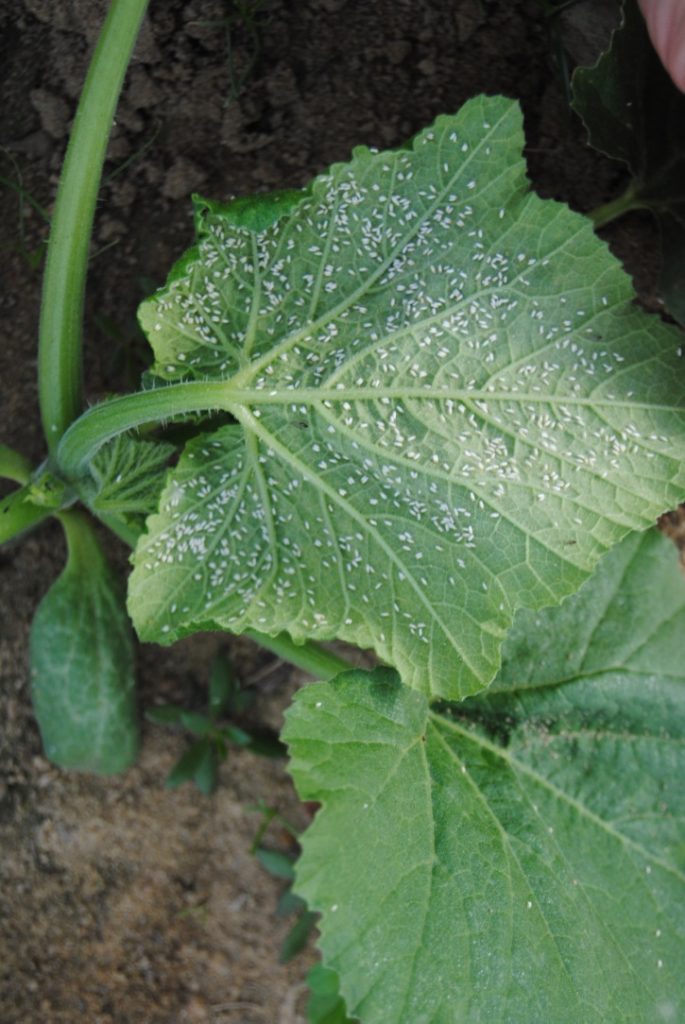
  • Whitefly Management: Don’t Get Behind in Spray Program

    Whitefly adults feed on a yellow squash seedling.

    Insecticides are available for growers managing whitefly populations. But they need to be applied early in the season when whiteflies are young and immature.

    “Most of the things we use primarily target immatures. That’s where our best control is. We’ve only got a couple of products that are really good on adults,” said Stormy Sparks, University of Georgia Cooperative Extension vegetable entomologist. “Most of them, I can’t say for certain, but most of them probably are most efficacious on very little N-star immatures.”

    Managing whiteflies when they’re young is a producer’s best management strategy considering how quickly they will reproduce.

    Whiteflies can grow by a generation in just two weeks in the heat of the summer when temperatures routinely exceed 90 degrees Fahrenheit. The time for these insects to develop is related to temperature. When temperatures are cooler, development takes longer.

    During hot and muggy conditions, which are common in Georgia and Alabama in July and August, development time for whiteflies decreases.

    “Whiteflies are one of those things you don’t want to get behind on,” Sparks said.

    Southeast producers grow cole crops, like broccoli, kale and cabbage, from September through May. Cucurbits grow in the summer, and cotton grows in the early fall. All of these crops serve as host plants for whiteflies.

    Whiteflies can also transmit cucurbit leaf crumple virus and cucurbit yellow stunting disorder virus.