It’s a matter of survival for pecan producers. After a season in which prices were drastically low, farmers need to cut costs, not corners.
UGA File Photo/Shows spraying being done in a pecan orchard.
Lenny Wells, University of Georgia Cooperative Extension pecan specialist, emphasizes the importance of reducing input costs, starting with lime applications.
“Of course, we know orchard soils need to be around 6 to 6.5; that’s where your pH needs to be. If you’re in that range, there’s never been a study that has shown any advantage to liming beyond that. Once you get that pH to 6 to 6.5, if you check your soil samples every year and you’re in that range, you don’t necessarily have to apply any lime,” Wells said. “I think probably in most cases, we could go to applying lime maybe every third year or just look at your soil samples and see and do it when it falls below 6.0.”
If growers only apply lime every third year, it could save producers as much as $27 per acre.
“On really sandy soils a lot of times, pH is going to drop faster. So, you’re going to want to keep any eye on that,” Wells said. “Of course, your herbicide strip is going to drop faster than in the middles where you have some vegetation. I would do your sampling based on the herbicide strip.”
Clemson Extension agents provide updates in the The South Carolina Grower this week about the status of various crops being produced throughout the state.
Weekly Field Update-2/15/21
Coastal
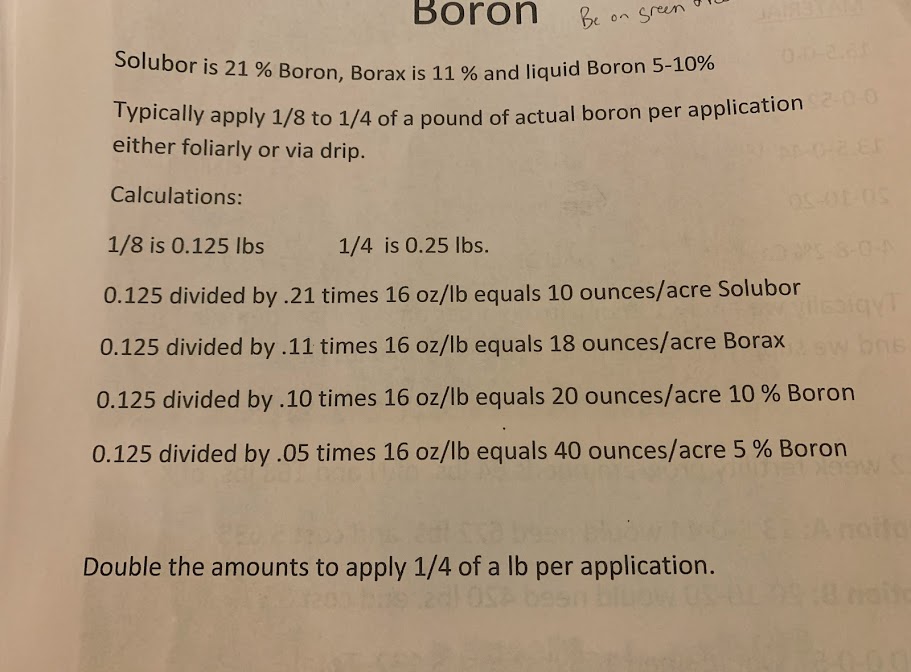
Zack Snipes reports, “I haven’t been out in the fields lately due to all of the rain. Hopefully, it will dry out some this week as we really need some bluebird sky days. If and when you are able to get out in the strawberry fields, it is time to put out boron. Boron helps with flower and fruit development. If you miss this application you will have lots of “bull nose” fruit in a few weeks. We recommend 1/8 lb of actual boron. Please see the picture for calculations of different products. Be extremely careful with mixing, calibrating, and applying boron, as boron is a great herbicide if overapplied. Boron can be sprayed or run through the drip system.”
Be sure to put out the correct amount of boron. Photo from Zack Snipes.
Midlands
Justin Ballew reports, “It’s been raining a lot since Thursday (2/11) here in the midlands. The soil is saturated in some of the less sandy areas and it will be a while before fields are dry enough to work. Sandier areas likely won’t be delayed much. Before the rain came, folks were harvesting some nice looking greens, though I am seeing some diseases pop up in places. Strawberries are still coming along. I know of one fairly large grower that has already started protecting blooms. More will probably start soon.”
Good looking mustard ready for picking. Photo from Justin Ballew.
Sarah Scott reports, “It has been extremely wet throughout Aiken and Edgefield Counties the past week, making field work challenging. In peach orchards, we are continuing to prune and trying to get out dormant oil applications and copper. It appears there is a shortage of Captan this year. There are alternatives for use during bloom as well as at petal fall, just something to look into if you usually use this product. You can read about some alternatives here https://site.extension.uga.edu/peaches/2021/02/captan-shortage/. Again, it looks like we will have plenty of chill hours for the crop this year with Musser Farm sitting at over 1000 and around 950 hours in Johnston.”
Photo by Chris Tyson/UGA: Shows an onion field that’s saturated from the excessive rains.
The wet winter weather has Georgia Vidalia onion producers concerned about not getting into their fields to apply fungicide sprays or make fertilizer applications. Certain diseases could soon become problematic considering how much rain the Vidalia onion region has received this year.
“They’re just not able to get caught up with their applications or get out there and do what they need to do,” said Chris Tyson, University of Georgia Extension Area Onion Agent at the Vidalia Onion & Vegetable Research Center in Lyons. “We are always concerned about disease. This is the time of the year when we’re spraying for fungal diseases like Botrytis and Stemphylium. They’re actually not as bad right now as they normally are. But because of the weather, we’ve had below-average temperatures, and they just haven’t gotten fired up and going like they normally would at this time of the year.
“They’re definitely creeping up on us out there. We just hope it will dry out and we can and try to play catch-up with everything. That’s the biggest concern right now.”
Rainy Conditions
Vidalia, Georgia received 9.73 inches of rain from Jan. 1 to Feb. 14 with 25 rainy days, according to the UGA Weather Network. That’s almost triple what it received in 2019 when it amassed 3.83 inches. That doesn’t even account for cloudy, overcast days when it is not raining. Sunny days have been few and far between lately.
“Looking at some of the weather data, we got almost two inches over the weekend and we were already wet. We had a half-inch to an inch last weekend and some during last week. We haven’t been able to dry out,” Tyson said.
The onions continue to progress, though, through the adverse conditions.
“The onions that are out there look good. They’re a little smaller than they usually are. But overall, I think we have a good-looking stand of onions out there across the industry. They’re a little on the smaller side right now,” Tyson said. “We know that can change real fast. We’re just looking for a little bit of warmer weather and sunny days to help them do that.”
An inside view of an over-the-row mechanical blueberry harvester.
Two issues facing University of Florida (UF)/IFAS scientists regarding the future of blueberry production are machine harvesters and blueberry flavor. Patricio Munoz, UF blueberry breeder, spoke about both issues during the recent American Seed Trade Association webinar last week.
“The major issue that I see for us is the machines that we are using nowadays, they are not to the standards that we need them to be. That’s the issue. We’re still able to harvest. We can harvest our very best cultivars for firmness characteristics,” Munoz said. “However, we need the technology, the machine robotic technology to improve. That’s something we can now work on. We can work on improving the plants. Then we have other people that work on improving the machines. That’s what is needed nowadays.
“The second one is flavor and aroma; our capacity to select new flavors and aroma and I believe they’re going to be well accepted by your consumers.”
According to Jeff Williamson, UF Professor, hand harvesting is the greatest expense for Florida blueberry producers. The lack of labor availability can also limit harvest operations. Mechanical harvesters can also lead to reduced yields by fruit dropping on the ground during harvest or immature fruit being harvested. Fruit can also be bruised from the harvester.
Munoz said there are between 50 and 60 blueberry farms in the state. Florida is the earliest producer of blueberries in the country every year.
Photo/Map by University of Florida/IFAS: Shows dragonfruit production in Florida.
HOMESTEAD, Fla. – Scientists at the University of Florida’s Institute of Food and Agricultural Sciences are providing valuable insect management information to farmers interested in producing dragon fruit. The fact sheet Pitaya (Dragon Fruit) (Hylocereus undatus) Pests and Beneficial Insects provides insight on insects and pests that can limit production by this vine-like cactus.
As is the case for any other crop in Florida, dragon fruit is vulnerable to insect attacks.
“The goal is to provide growers with a description of all pests and beneficial insects associated with dragon fruit in south Florida, together with some general control recommendations,” said Daniel Carrillo, an assistant professor of entomology and nematology at UF/IFAS Tropical Research and Education Center in Homestead.
Carrillo, who co-authored the fact sheet with biologist Rita Duncan, works with a team of scientists at the research center monitoring pests impacting the crop.
“Pitaya, or dragon fruit, is an emerging crop in South Florida,” he added. “Acreage of this fruit crop in Florida has increased rapidly and shows a good potential for commercialization. But as with most fruit plants, pests can be a problem.
Potential pests for the dragon fruit in South Florida are leaf-footed bugs, aphids, beetles, mealybugs and scales. The most dangerous are thrips.
“Thrips can be very detrimental,” said Carrillo. The unsightly damage has rendered 20% to 80% of the fruit unmarketable during years with high populations – a devastating result for the grower.”
What is Dragon Fruit?
Dragon fruit, which bears other common names such as strawberry pear and night-blooming cereusis, is a group of vine-like, climbing cacti perennial originating from Mexico and Central and South America. It was introduced and cultivated in Vietnam more than 120 years ago. Between the 1990s and 2000s, dragon fruit was introduced into other Asian countries, the Middle East, Australia, and the United States as an exotic fruit crop. In Florida, production of dragon fruit has steadily increased since the 2000s. This crop that growers can harvest in less than two years produces fruit with high-nutrient values and low calories and is enjoying increasing demand in the market.
According to Jonathan Crane, a tropical fruit crop specialist at the Homestead research center, dragon fruit is grown on about 721 acres in five Florida counties. These include Palm Beach, Charlotte, Brevard, Lee and Miami-Dade.
Chill hours are no longer a concern for peach growers in Alabama and Georgia. So, what is their biggest worry heading into the spring?
“March 28, the full moon in March. We always tend to have some cold in that full moon in March. But with it being later, maybe we’ll be out of the woods and in the clear. You just never know. March can be so up and down. Even the last few years, February has gotten pretty warm,” said Jeff Cook, University of Georgia Cooperative Extension Agriculture and Natural Resources agent for Peach and Taylor counties.
Cook said there are early varieties that begin to bloom towards the end of the third week in February.
Growers in both states are cautiously optimistic about the state of the peach crop. The cold winter temperatures provided enough chilling hours for the trees to make a crop this year. But what will happen if temperatures warm up? Trees will be vulnerable to a late-season freeze.
“We’ve got some peach producers around. They’re not all in one area, they’re kind of spread out. When I talked to them, they’ve done some pruning,” said Eric Schavey, Alabama Regional Extension agent in Northeast Alabama. “They’re just hoping we don’t get one of those late freezes. Their early varieties, they’re not blooming but they’re swelling. Those buds are swelling. That’s because we had those 68 and 70-degree days.
“I guess that early crop is always kind of a gamble here in our area.”
That makes what happened on Feb. 2 so important for farmers eyeing the upcoming weather forecast. Punxsutawney Phil saw his shadow and predicted six more weeks of winter.
“When the groundhog saw his shadow, it was like, ‘Okay, that’s good. Stay cool,’” Cook said.
The group issued a statement following the ITC’s unanimous vote in which it deemed that imports of fresh, chilled or frozen blueberries are not a serious injury to the domestic industry, ending the Section 201 investigation.
“The Blueberry Coalition for Progress and Health applauds the U.S. International Trade Commission’s (ITC) determination that imported blueberries have not injured the domestic industry. The U.S. blueberry industry is healthy and thriving.
“Together with imports, the U.S. industry is working hard to keep up with the year-round and growing marketplace demand for this healthy and nutritious fruit. U.S. per capita consumption of blueberries has experienced a more than 300% since 2005 and is now at an all-time high of 1.79 pounds per person.
“Restricting blueberry imports into the U.S. would have limited consumers’ access to these healthy, delicious and nutritional berries with no benefit to U.S. producers.
“We look forward to continuing to provide the American market with our healthy and delicious fruit.”
The verdict was rendered in the coalition’s favor despite overwhelming evidence by the American Blueberry Growers Alliance against imports.
Production for the 26 estimated vegetable and melon crops totaled 720 million cwt, down slightly from 2019. Area harvested last year was 2.33 million acres, down 1% from 2019.
The top three vegetables, relating to harvested areas, were sweet corn, tomatoes and snap beans. The three largest crops in terms of total production were tomatoes, onions and sweet corn. They combined for 53% of all the vegetables.
Florida and Georgia ranked second and fourth respectively in value of utilized production nationally. They accounted for 13.4% of the total value of utilized production. The value of utilized production in Florida totaled $1.17 billion, down 4% from 2019. Tomatoes were the state’s leading crop with a $463 million value.
The value of utilized production in Georgia totaled $583 million, up 13% from 2019. Sweet corn was the state’s leading crop with $138 million.
Photo taken by Clint Thompson/Shows wet, muddy conditions in a field in Tifton, Georgia.
Excessive winter rains have kept some Georgia farmers out of the field because of saturated conditions. But they provides hope that a potential summer drought is less likely than originally feared.
“We were expecting a more typical La Nina winter which is usually warm and dry in that part of the country. It has not been that way so far this year,” said Pam Knox, University of Georgia Extension Agricultural Climatologist. “La Nina winters, anytime we make a forecast, it’s based on statistics, but this has not been a very typical year. Instead of having that storm track farther to the north, it’s been perched right over that area.
“It’s good because usually when we have a La Nina winter, it means that we’re much more likely to go into a drought next summer. For me at least, this has alleviated some of the worries about going into drought early in the season. Now, it brings up a whole set of other issues. It delays people getting out into the field and they’re late planting. That could run into issues at the other end of the growing season.”
Wet Winter
According to the University of Georgia Weather Network, Tifton, Georgia has received almost twice as much rainfall (9.86 inches) so far this year than in 2020 (4.94) and 2019 (5.24). The same can be said for Moultrie, Georgia where rainfall totals 9.15 for 2021, compared to 4.87 in 2020 and 5.87 in 2019.
“The weather pattern this year has sort of gotten stuck in place. There’s this band of rain that’s gone from southwest Georgia stretching up to the northeast all the way through North Carolina and Virginia. I’ve heard from farmers all along that band that they’re having a lot of trouble getting out into the field,” Knox said.
Farmers had La Nina concerns last November. Since the weather pattern’s normal tendency is to bring warm and dry weather conditions, there were concerns of insufficient chilling hours for fruit farmers and lack of moisture in the soil prior to vegetable and specialty crop producers planting the spring crops. Chill hours are no longer a concern. Neither is soil moisture.
“Even if we go into a more typical La Nina situation at this point, that moisture’s not going to go away, at least not immediately,” Knox said.
BASF remains committed to improving melon varieties with an emphasis on flavor. Matthew DeCeault, produce chain specialist at BASF Vegetable Seeds, talked about the challenges that lie ahead with regards to melon research during an American Seed Trade Association webinar.
“We’re working on a lot of things. Where we’re really focused is on improvements to flavor. Based off research that we’ve done, and I don’t think it’s come to any surprise that flavor is No. 1 in preference, flavor improvements. We continue to work on flavor to improve it, both learning from the consumer and taking those learnings back to make those incremental improvements,” DeCeault said. “Whether that’s sweeter melons or more consistent, I think those are two separate things we continue to tackle those problems with our team.”
Melon consumption has decreased steadily since 2011, equating to a 1.7% decline per year. Cantaloupes have experienced the steepest decline at 2.5% every year. Honeydews are increasing, however, at 2.3% annually.
Consumer Research
BASF has conducted research to gauge people’s preferences with respect to all aspects of the consumer experience – sight, smell, flavor. The feedback led to the development of the Sweet Spark cantaloupe that should generate renewed interest in the cantaloupe market.
“This variety, named Sweet Spark is a variety with consistent sugar, firmness, but most importantly consistent flavor. The flavor profile allows it to eat well, even in adverse conditions affecting its sugar content. Identifying these attributes and this response from consumers during tasting allowed the retailer to deliver the variety in their own label and feel confident offering the variety to consumers in the winter months,” DeCeault added.