Author: Clint

  • Plastic Makes Perfect: Vegetable System Producers More, Cleaner Fruit

    File photo shows tomatoes growing in plasticulture.

    Planting season is nearing for Alabama vegetable producers. One system that all farmers need to consider is plasticulture. Plastic mulches can lead to cleaner fruit with much more yields.

    Joe Kemble, Alabama Extension vegetable specialist, discussed the benefits of producing tomatoes in a plasticulture system during a webinar on Tuesday.

    It starts with yields.

    “Using these plastic mulches just by themselves can result in yields 1.5 to 3 times over average of what you would normally produce,” Kemble said.

    Plastic mulches also allow farmers to apply nutrients and water more efficiently, since they would be applied underground.

    “It allows you to precisely apply fertilizer and water because you have drip irrigation tape underneath. There’s no other way to get water under there because these are raised beds, so you’ve got to use drip irrigation along with it,” Kemble said.

    The use of drip irrigation also leads to cleaner fruit. There is less water splashing on the bottom of the fruit and subsequent splashing up into the plant canopy.

    One of its most important features, though, is it allows farmers to reach the market earlier.

    “Earliness in the fresh market is typically when you make more money. If I’m a commercial grower and I’m earlier than my neighbor, chances are I’m going to make a little bit more money than they would,” Kemble said.

    A plasticulture system can be utilized on various scales, from large-scale farmers to homeowners’ gardens.

    “There’s lots of options for people wanting to try something like this,” Kemble said.

  • Brighter Days: Sunshine Sparks Growth in Vidalia Onions

    Georgia Vidalia onion producers experienced much-needed sunshine last week. It allowed them to get back into the field and apply fertilizer and fungicide sprays, says Chris Tyson, University of Georgia Extension Area Onion Agent at the Vidalia Onion & Vegetable Research Center in Lyons, Georgia.

    Photo by UGA/Shows Chris Tyson in an onion field.

    “Growers were wide open last week trying to get caught up with fertilizer and with fungicides. I feel like, for the most part, we got caught up or close to being caught up with what we needed to be,” Tyson said. “If we had another rainy week, we would have probably been in trouble then, if we weren’t able to get in the fields last week.”

    Plants had been slowed a bit amidst the excessive rainfall Georgia experienced most of February. But they showed encouraging signs of growth during the 70- and 80-degree temperatures.

    “I tell you, they really have made some headway in the last week with the warm weather and sunshine. They have grown a lot,” Tyson said. “They have that ability to catch up really fast when we get favorable weather. We are still a little below average on our size of the crop and where we should be, but we’ve gained a lot of ground in the last 10 days.”

    Main Concern Now

    Tyson said growers’ biggest concern now is staying up to date on their fungicide applications.

    “We just want to make sure we’re caught up in managing our diseases with our fungicide sprays to the best of our ability. As we enter into this second phase of the crop where it’s going to start to get big tops and start bulbing, we’re watching for Botrytis and Stemphylium, (Center Rot) and Downy Mildew. That’s the main thing really, that’s on a lot of their minds I think,” Tyson said.

  • Increasing Infestations: Asian Bean Thrips Remain a Problem for Florida Farmers

    UF/IFAS photo shows an Asian Bean Thrip.

    Asian bean thrips (ABT) continue to be problematic for vegetable producers in South Florida. According to the University of Florida/IFAS, populations are increasing consistently across the region.

    Reports from the Homestead region indicate Asian bean thrips are the predominate species, though have decreased from 100% ABT to 70% ABT and 30% F. palmi. Other thrips species are increasing north of Homestead. Most farms are reporting thrips infestations besides ABT.

    ABT populations increased to 1.0 ABT per bloom in northeastern Hendry County, with an increase during vegetative stages. In the southeastern part of the county, base populations range from 0.2 to 0.8 ABT per bloom in plantings that are at full bloom. Populations of up to 1.3 ABT per bud were also reported. Later plantings have also reached 4.2 ABT per bloom in early pod development.

    ABT was reported at 0.4 ABT per bloom in plantings in northern Collier County, reaching 2.2 ABT per bloom in plantings nearing harvest.

    Aggressive insecticide programs have slowed populations to 0.3 ABT per bloom in eastern Palm Beach County.

    Click here for management recommendations.

  • COVID Impact: Financial Sting Comparable to Hurricane Irma

    COVID-19 adversely affected Florida’s vegetable and specialty crop producers in 2020. The financial impact was staggering, comparable to hurricanes that ravage the region almost every year.

    Christa Court, an assistant professor of regional economics at the University of Florida/IFAS, compares the pandemic’s impact to Hurricane Irma, which impacted the state in 2017.

    Court

    “The one that I typically compare it to is the estimates we have that are relatively comparable for Hurricane Irma. If you remember, Hurricane Irma came straight up the peninsula of Florida and impacted nearly every county that had agricultural production in some way where it was large enough that the tropical storm forced winds covered just about the entire state,” Court said. “That I believe was just over $1 billion. Looking at (COVID’s impact of) $895 million of just that one season, it’s not $895 million for all production that occurred in 2020 but just what was going on in that March-to-mid-May season.

    “It’s a significant impact and comparable to some of these larger hurricanes that we’ve experienced.”

    As restaurants closed down nationwide, farmers felt the sting of a normal sales outlet not being an available option anymore. Farmers had to think inside the box with their marketing strategies. Many resorted to selling boxed produce direct to consumers. While they didn’t recoup all the profits they would have gotten selling to restaurants, their marketing efforts helped make people aware of the importance of buying American.  

  • Agriculture Address: Troxler Remarks About Industry in North Carolina

    By Ashley Robinson

    North Carolina Agriculture Commissioner Steve Troxler praised the state’s agricultural sector for its continued prosperity during the COVID-19 pandemic during his annual State of Agriculture Address.

    Troxler

    “I am proud of the work that we’ve done to grow agriculture markets, preserve our farmland, protect our food supply and help position the next generation for success,” said Troxler during the address on Feb. 24, streamed on Facebook by the North Carolina Farm Bureau. “I’ve never been more proud of our industry or our farmers.

    “I’m proud to say that agriculture and agribusiness continue to rep the state’s No. 1 industry at $92.7 billion,” Troxler said. “I believe we’re on the cusp of becoming a $100 billion industry in terms of economic impact.”

    Troxler reports that both pork and poultry exports to China were up 20% in 2020. He also reports that exports of prepared foods have increased from $45 million to more than $400 million over the last 10 years.

    North Carolina’s tobacco market has also seen a major turn-around with China coming back into play, purchasing U.S. flue-cured tobacco again. In 2021, contracted pounds are expected to return to over 300 million pounds.

    North Carolina’s agriculture industry accounts for approximately 20% of the state’s workforce, which has pushed safety precautions to the top of the Department of Agriculture’s agenda.

    “We’re continuing to work on vaccines timetables and when they are rolled out we are in regular communication with state health officials advocate acting for priority status for Ag workers. We continue to advocate for the need to protect these essential first line workers,” Troxler said.

    Troxler was joined by Blake Brown, N.C. State University economist, who provided an agricultural economic outlook for the state.

    According to Brown, the U.S. Department of Agriculture forecasts a decrease in U.S. farm income for 2021. But he predicts North Carolina producers may see an increase this year.

    “Despite lower U.S. farm payments, we’re probably going to see our income go up in 2021 because of the improvements that we’re going to see in the animal and poultry industry and because of the improvement that the commissioner mentioned with our tobacco pounds,” Brown said.

    Brown also reports strong exports opportunities for pork, poultry, soybeans and corn for 2021, favorable for many North Carolina producers.

  • Crop Updates: Clemson Extension Agents Discuss Latest Developments Across State

    Clemson Extension agents provide updates in the The South Carolina Grower this week about the status of various crops being produced throughout the state.

    Weekly Field Update-3/1/21

    Coastal

    Rob Last reports, “Following a few days of warmer conditions, crops are moving on strongly. Flowering and fruit set is occurring in strawberry crops. At present, spider mites in treated crops are at very low populations, but with warmer weather, populations can increase rapidly. As we are entering flowering and fruit set, sanitation and fungicide applications will be required to keep gray mold managed. Remember to rotate FRAC codes to avoid resistance build-up. Fertigation is being applied and it will be well worthwhile taking a tissue test from crops. Blueberries in the area are showing bud swell with early varieties showing open flower.”

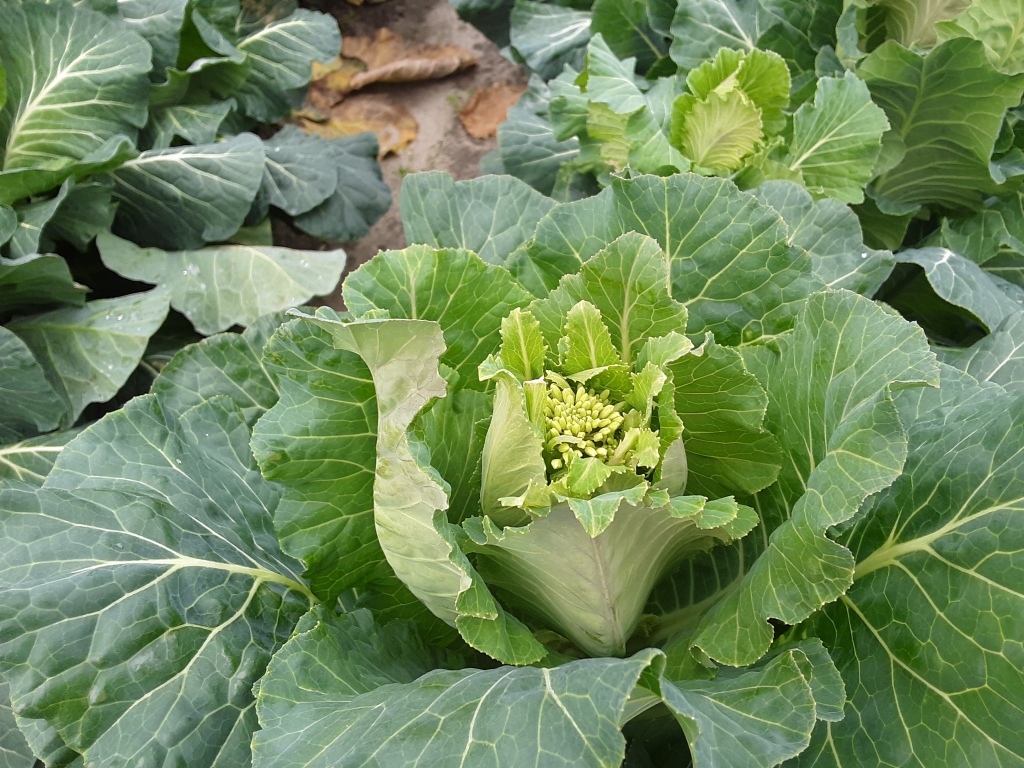
    Zack Snipes reports, “With the warm and DRY weather last week and for most of the week this week, farmers have been able to get out and work in the fields. Spring crops are going in the ground where it is dry enough to plant. The warm weather this past week and this coming week will probably push 2020 brassicas to bolt (flower). If you have any left in the fields, it might be best to get them out as soon as possible. Stay on top of sanitation for berries and it’s time to start fertigating them if you haven’t started that already.”

    Warm weather can cause collards that have grown through the winter to bolt (flower). This plant is just beginning to develop a flower head. Photo from Zack Snipes.

    Midlands

    Justin Ballew reports, “We had several beautiful, warm days last week. Strawberry growers used that opportunity to pull the row covers off the fields, allowing the plants to catch some rays. Growth is starting to pick up and I’m seeing many good blooms. The weather conditions are favorable now for Botrytis development (high moisture and temps in the 60s-70s), so we need to begin protecting our blooms with preventative fungicide sprays. Check out this great video put together by Dr. Guido Schnabel’s former student Madeline Dowling for a refresher on the Botrytis life cycle. Download the MyIPM app for more disease and fungicide information. Now is also a good time to start tissue sampling to make sure we’re fertigating the right amounts of nutrients.

    Starting to see plenty of blooms on the strawberries around the midlands. Photo from Justin Ballew.

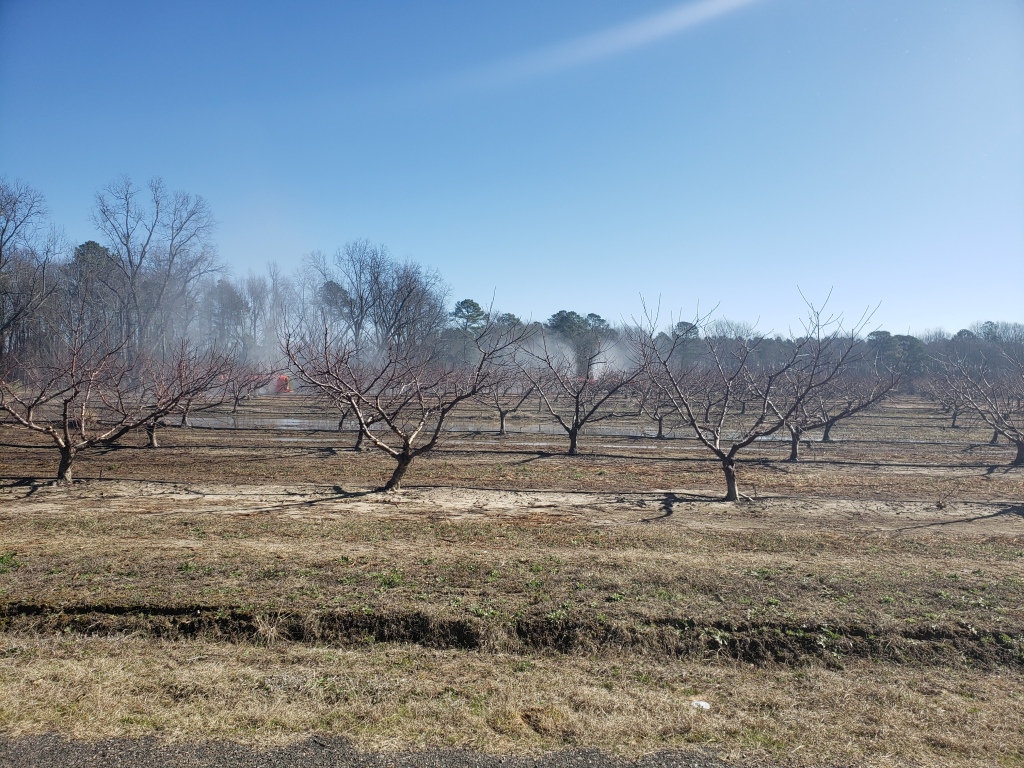
    Sarah Scott reports, “Growers took advantage of some sunny, dry weather and continued to apply copper and dormant oil sprays in peach fields to combat potential bacterial spot issues, as well as scale in the coming season. Pruning and orchard floor management continue as well as some late planting, due to wet field conditions. Strawberries have been covered to give them a pre-season push. Some mite issues are present but under control.”

    Workers apply a dormant oil application on peach field in Edgefield Co. Photo from Sarah Scott.

    Upstate

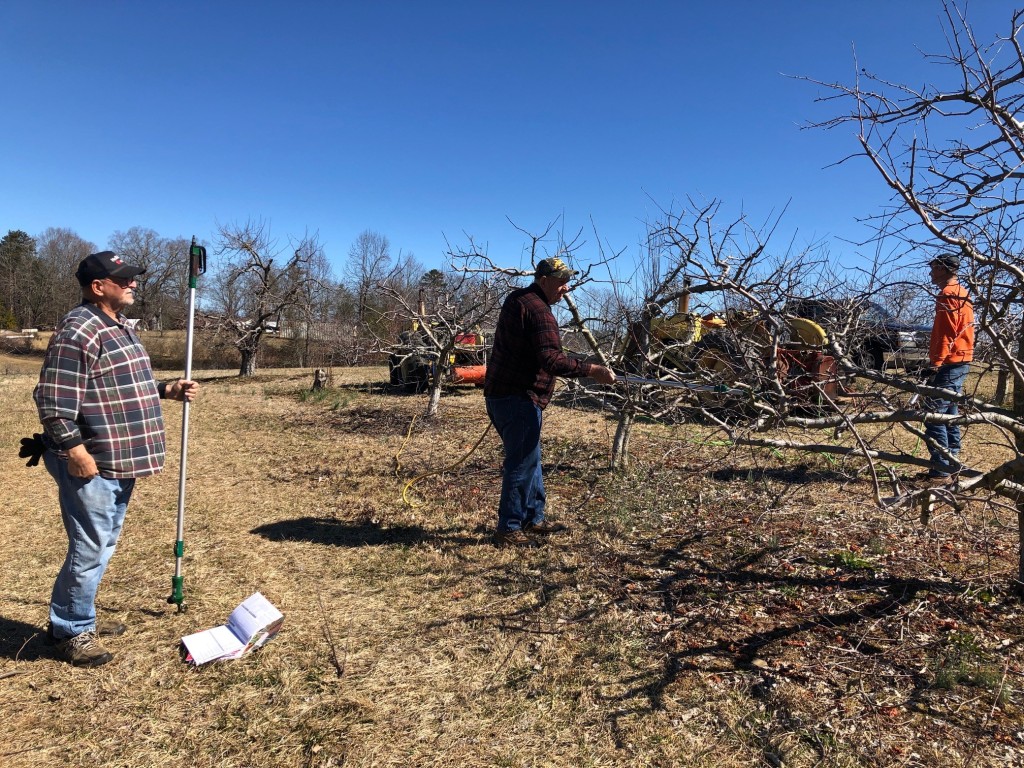
    Kerrie Roach reports, “Growers are working between the rains to finish up pruning. The South Carolina Apple Grower meeting was held on Thursday afternoon virtually with lots of great presentations and discussion. During the meeting, Mike Parker (NCSU) mentioned the distinct difference in apple and peach pruning, and how using the same crews can sometimes lead to problems. Peaches fruit laterally along limbs which means heading cuts (pruning off the tip of a branch) is the common and acceptable practice.  Whereas apples fruit terminally, so heading cuts could potentially remove a significant amount of potential fruit. Make sure crews are well aware of the difference!”

    Pruning apples at Hollifield’s Orchard with pneumatic pruners. Photo from Kerrie Roach.
  • Feeding South Carolina: Food Hub Network Helped Farmers Feed More in 2020

    COLUMBIA — From the field to the table, food distribution in South Carolina was strengthened in 2020. It was due in large part to the South Carolina Food Hub Network. It assisted food distributors in the Palmetto State buy and distribute more than $1.3 million of food grown in South Carolina.

    Weathers

    This strengthened local food systems and aided farmers during the COVID-19 pandemic.

    The Food Hub Network staff collaborated with four South Carolina distributors on their successful applications for contracts through the U.S. Department of Agriculture Farmers to Families Food Box program. Distributors bought, boxed and distributed more than $5 million in fresh food, $1.3 million of it from South Carolina farmers.

    “The South Carolina Food Hub Network has helped build capacity for the state’s food hubs, ultimately helping farmers grow more and feed more people,” said Commissioner of Agriculture Hugh Weathers. “We’ve supported the Network through our Agribusiness Center for Research and Entrepreneurship (ACRE) and Specialty Crop Block Grants, and so far, it’s been a great investment for South Carolinians.”

    Food hubs connect farmers to buyers like restaurants and grocery stores, increasing consumers’ access to local food. Hubs often help identify marketing opportunities and support farmers in crop-planning accordingly, while shouldering some of the burden of marketing and reducing the carbon footprint of buying local through logistics and distribution coordination.

    For more information, see South Carolina Department of Ag.

  • Sweet Success: Syngenta Watermelon Excursion Excels in Diverse Climates

    Watermelon research remains a key focus for scientists at Syngenta. Watermelon varieties need to withstand any type of diverse climate, especially for growers in Florida, Georgia, Indiana and California.

    Syngenta photo shows Excursion watermelon variety.

    Rebecca Wente-Naylor, breeding trial specialist at Syngenta, discussed the challenges of finding new varieties amid climate change during an American Seed Trade Association webinar.

    “With climate change, we’re already seeing a lot of fluctuations in temperature and weather patterns as well as some increases in extreme weather events. To combat this variability, we’re really trying to select the most resilient new varieties that are widely adapted and can withstand adverse weather conditions better than their predecessors,” said Rebecca Wente-Naylor, breeding trial specialist at Syngenta. “We do this by testing our new experimental hybrids with our current commercial growers throughout the United States.

    “A good example of this would be our watermelon variety called Excursion. I’ve seen this produce fruit in some of the worst environmental conditions from South Florida to Indiana to California. It’s really widely adapted, and honestly, seems to flourish, especially when it takes a beating.”

    According to Syngenta, Excursion is a large fruit size with 50% or more 36-count fruit. It excels in early to main season plantings and matures up to seven days earlier than the current “standard” to hit early markets.

    Maybe most importantly, it has improved disease resistance with intermediate resistance to Fusarium wilt race 1 and Anthracnose race 1. It has shown stronger Fusarium tolerance than comparable varieties.

    Watermelon Plantings

    All of South Florida’s crop has been planted for about a month. Central Florida producers normally plant in mid-February. North Florida, Alabama and Georgia are slated to start around mid-March.

  • Knowing Nitrogen: How Much Should Pecan Producers Apply?

    UGA CAES photo/Shows pecan trees being planted.

    One of University of Georgia Cooperative Extension pecan specialist Lenny Wells’ points of emphasis this winter has been the need for growers to cut costs, not corners amid low prices.

    One way to do that is by considering how much nitrogen is needed and in what form. Wells provides insight for growers who need to save money every chance they get.

    “Nitrogen, depending on what you use, the cost can be variable,” said Wells during a winter production meeting. “I see a lot of people using 200 pounds an acre or more of nitrogen. I can tell you, from doing research on this myself and from reading the research that has been done for 100 years on pecans, in the Southeastern U.S., there’s not really benefit at all to applying more than 100 to 125 pounds of nitrogen per acre. If you’re applying more than that, you’re probably applying too much.”

    Nitrogen Forms

    Producers also must decide how to apply the nitrogen. There’s different dry nitrogen forms that farmers can use, including ammonium nitrate, ammonium sulfate and urea.

    “Ammonium nitrate has gotten expensive and hard to find because of some of the storage issues that are related to it now, the safety involved. Ammonium sulfate is a good source of nitrogen and urea; those three are about the only three we have used here,” Wells said.

    Based on a research study on the UGA Tifton campus the past six years, Wells has researched the different nitrogen forms and their impact on yield, percent kernel, nut count. There is no difference in all three. Wells’ recommendation is to proceed with the least expensive, which is Urea at $34.56 per acre at 100 pounds per acre. Ammonium sulfate costs around $63.09 per acre.

    Wells also recommends that growers split their nitrogen applications, applying 75% in April and an additional spray in June and late August if needed.

  • Wacky Weather: Alabama Planting Season Nears Amid Excessive Rainfall, Drought

    The most recent US Drought Monitor shows parts of Alabama in a moderate drought.

    Planting season nears for Alabama vegetable producers. Once again, weather will play a key role as farmers prepare to plant this spring’s crops.

    Joe Kemble, Alabama Extension vegetable specialist, implores producers to wait until soil temperatures increase above a certain level and stay that way for several days straight. That will be a better environment for seed to germinate and transplants to grow.

    “We like to plant by the calendar but unfortunately that just doesn’t work out really well sometimes. So, the best way to do that is to measure your soil temperature. For small and large growers, you want your soil temperature to be above 60, 65 degrees Fahrenheit for several days in a row,” Kemble said. “That’s actually a better indicator of when it’s time to put in your squash planting or your tomatoes. Anything below that, it can hamper seed germination and stand establishment. It can also knock back some of the warm season crops that go in as transplants.”

    Excessive Moisture

    Some growers may not have much choice than to wait for soil temperatures to warm. Parts of the state have experienced excessive rainfall this month. Some growers are still waiting for fields to dry out.

    “Between Alabama and South Georgia, we’ve gotten a lot of rain over the last couple of weeks. That’s hampering a lot of growers getting in the field and getting things prepared,” Kemble said.

    Moderate Drought

    But then there is a portion of southwest Alabama that could use some rainfall. According to the US Drought Monitor, Dallas County, Lowndes County, Marengo County, Monroe County, Wilcox County are classified in a moderate drought why surrounding counties are abnormally dry.

    “They’re definitely drier than the rest of Alabama. Most of Alabama got a lot of rain over the last couple of weeks. A little dry is okay,” Kemble said. “You still need a little bit of moisture though to plow effectively. If it’s too dry, you end up plowing and you create soil clots. You can sort of create a real mess for yourself.”