The most important decision farmers can make when growing tomatoes in Alabama is variety selection.
Joe Kemble, Alabama Extension vegetable specialist, insists that growers understand what varieties grow well in Alabama before they plant this spring.
“Easily the most important decision you can make is picking which varieties to grow. You can buy local transplants. It’s always great when you can do that. But what I’ve typically found is, often, the selection tends to be pretty narrow,” Kemble said. “There are literally thousands of tomato varieties out there. Many of them are adapted very well to growth in Alabama but unfortunately, some of them are not.
“Sometimes you may be growing varieties and you’ll say to yourself, I really don’t know why these are doing so poorly. The problem is, it may be the fact that it’s just not a very good variety to grow.”
Kemble said it is important to choose variety that will spread your season. Some are better for early in the season. Others are more tolerant of the high summer temperatures and can be grown in mid-to-late season.
“Try to pick varieties that are actually suited to the time of year you wish to grow them,” Kemble said.
Disease resistance is also an important factor to consider. Try to select varieties with resistance to tomato spotted wilt virus, nematodes, fusarium, late blight and early blight. Resistant varieties mean growers don’t have to apply fungicides to control the disease.
Kemble recommends the following tomato varieties: Bella Rosa, Carolina Gold, Crista, Mountain Gem, Mountain Magic, Mountain Merit, Red Bounty, Red Defender, Red Mountain, Rocky Top and Tribute.
Another vegetable season means another chance for Mexican imports to deflate market prices. For one Florida producer, the consistent supply of imported cucumbers and squash could lead to an unexpected early retirement.
Cucumbers.
“We cannot make a move without checking to see what Mexico’s doing first. It’s very disheartening for a man that was charged by God to feed the world,” Sam Accursio said. “It’s a strange feeling that this is all I’ve done for the last 35 years and I see it ending.
“Free trade is putting growers out of business. The ones that are lucky enough to have assets, they will sell their assets, and we will rely on third-world countries to feed this great nation. We’re selling what we harvest but at below production costs.”
Background
Accursio produces pickle and cucumber, green beans, and yellow and green squash on 4,400 acres in the Homestead, Florida area. Between unfair trade and the lack of skilled labor, challenges continue to mount for Accursio and other producers like himself. He insists they will farm next year. But who knows after that?
“We still have (around) 60 days of harvest. I feel we’re going to pay the bills. I’m optimistic that we are,” Accursio said. “We will go again next year. But the battle we’re fighting, I think there’s too many obstacles.”
USITC Investigation
The U.S. International Trade Commission is currently seeking input for two factfinding investigations on the impact of imported cucumbers and squash on the domestic seasonal markets. The USITC will hold a public hearing with the investigations on April 8. But considering the unanimous verdict the USITC already rendered that said imported blueberries do not cause serious injury to the domestic crop, there is little hope for vegetable farmers like Accursio.
“I think as a nation we’re screwed until we do something about the imports coming through that border. We’ve been fighting this fight for 40 years, 35 years. Growers are dropping left and right and there’s no young bucks coming in to take our place,” Accursio added. “It’s a little scary for young people.”
A changing climate could lead to a new crop for Florida producers.
A coffee plant in a pot in a greenhouse. The red berries contain coffee beans. Photo by Juan Giuliani.
University of Florida (UF) scientists are already growing coffee plants at the UF/IFAS Plant Science Research and Education Unit. This could lead to coffee being produced in the Sunshine State one day.
“Coffee is a crop of global interest that is already facing major challenges due to climate change. At present, the world knows very little about coffee plant roots, their architectures and their function under climate change conditions. The roots are key points in this process,” Rowland said.
Use of Minirhizotrons
Researchers are using minirhizotrons, which are clear plastic tubes with tiny cameras inside. This helps them better understand how coffee grows in the field. The devices record images of their roots, as they are placed underground next to the plants.
Because Minirhizotrons collects so much data, UF/IFAS scientists are collaborating with Alina Zare and Sanjeev Koppal in the College of Engineering to apply artificial intelligence (AI) and machine learning technology to improve and speed up the process.
Zare will develop artificial intelligence approaches to automatically process and understand the minirhizotron imagery. Koppal will develop new computer vision-based hyperspectral imaging systems to capture more information about the roots and the soil surrounding them than can be obtained from current minirhizotron systems.
“Minirhizotron datasets are extremely large, require lots of image processing, and are fraught with tremendous measurement variability given the small apertures involved. All of these problems are amenable to machine learning approaches,” Rowland said. “We believe that current algorithms under development by our collaboration will be able to automate and accelerate substantial portions of data collection from minirhizotron data.”
Minirhizotrons will collect data from the coffee plants growing at the UF/IFAS Plant Science Research and Education Unit, where the researchers have planted coffee alongside existing citrus trees.
“Coffee is very sensitive to the cold, so our thought was to try to grow it with another tree that could shelter it. In addition, the citrus grove has freeze protection systems installed, so that could also protect the coffee,” Rowland said.
While the researchers are growing coffee alongside citrus for practical reasons right now, the combination could one day be economically advantageous, they said.
“As we thought more about it, we could also explore the combination of citrus and coffee as a possible cropping system in Florida — perhaps a future option the citrus growers might consider. This is a ways off — different questions and logistics would have to be worked out — but definitely worth exploring,” Wilson said.
The research team is growing Arabica coffee. Globally, Arabica is the most commonly grown variety and the most valuable one on the market.
Clemson Extension agents provide updates in the The South Carolina Grower this week about the status of various crops being produced throughout the state.
Weekly Field Update-3/8/21
Statewide
Dr. Matt Cutulle reports, “Anyone planting spring broccoli should be wary of the cold weather we have had regarding soil herbicide interactions. Be careful with Pre-transplant applications of Devrinol and to a lesser extent Dual Magnum, as they can cause some stunting when soil temperatures are cooler. Goal or Goaltender is the safest pre-transplant herbicide applied when the soil temperatures based on field studies in Charleston.”
Coastal
Zack Snipes reports, “We had some sunshine last week which really brightened everything up. The last few nights have been cool with some frost on the ground in the mornings. Things are starting to green up, and fields are drying out enough to plant. We are still direct-seeding crops around the region and will begin transplanting tomatoes in some areas this week. I spent last week checking strawberry fields to make sure things were good to go before they really bust out. I have been helping folks calibrate their drip fertigation systems for the upcoming season. If you think you need a hand with this please let me know. Dialing in exactly how much fertilizer to use each day or week can really increase yields and lessen the amount of fertilizer that is leached. Leaching fertilizer means your plants aren’t taking it up, thus costing you money.”
Venturi type fertigation injector on a strawberry farm. Dialing in your fertility can really increase yields and reduce leaching of fertilizer. Photo from Zack Snipes.A nice patch of ball clover in the drive row of strawberry. We planted this to hold the soil, reduce sand on the berries, withstand foot traffic and bring in early season beneficial insects to help with thrips control. Photo from Zack Snipes.
Midlands
Justin Ballew reports, “We had several beautiful, sunny days last week. The warm days seemed to really push the plants along. Last night, it got cool (29 degrees at my house), and strawberry growers had to pull row covers over the fields to protect the blooms. We have some small, developing fruit now that would easily be damaged without row covers. I’m seeing very few spider mites in fields, even though conditions have turned dry here in the midlands. Remember that Botrytis spore production is high when temperatures are in the 60-to-70 degree range, so we need to be staying on top of our spray programs right now. In other news, brassica planting continues, and for now, caterpillar pressure seems to be light.”
Small developing strawberries like this one can be damaged easily by the cold. Photo from Justin BallewInternal discoloration of the two strawberries on top indicate cold damage. These fruit will not ripen and will become excellent sources of Botrytis inoculum. Photo from Justin Ballew.
Pee Dee
Bruce McLean reports, “Boy, it got a bit chilly last night. Still looking at temperatures for the area, but it would be a safe bet that much of the area saw 28 degrees or lower. Strawberries were covered, so little problems there. Blueberries did see some damage on blooms that had fully opened. Most of the flowers were still in the Early Pink Bud stage or at budbreak, so no damage to those blooms. Frost protection could have saved those flowers and potential fruit, but it is still early in the season. Keeping our fingers crossed that we don’t see any more nights of freezing temperatures.”
Early pink stage in blueberry flowering. Photo from Bruce McLean.Damaged corollas (flowers) on blueberries. Likely experienced 28 degrees or lower. Photo from Bruce McLean.
Georgia’s blueberry producers can vote until March 30 on the continuation of the Georgia Commission Blueberry Marketing Order. This allows for the assessment of blueberries produced in Georgia.
Growers who annually produce and market 2,000 pounds or more of blueberries are eligible to vote. The current assessment amount is set at $5 per ton.
Growers can vote and return the addressed envelope with the ballot by March 30, 2021. They must also sign and fill out the back of the envelope to certify they are a qualified Georgia blueberry producer, so the ballot can be counted.
A percentage of two-thirds of the returned eligible ballots are required for the continuation of the market order.
The Georgia Agriculture Commodity Commission for Blueberries uses the funds for research, education and promotion of Georgia blueberries.
If a grower does not receive a ballot, please contact:
Andy Harrison Manager, Commodity Commissions Georgia Department of Agriculture Andy.harrison@agr.georgia.gov (404) 710-1196
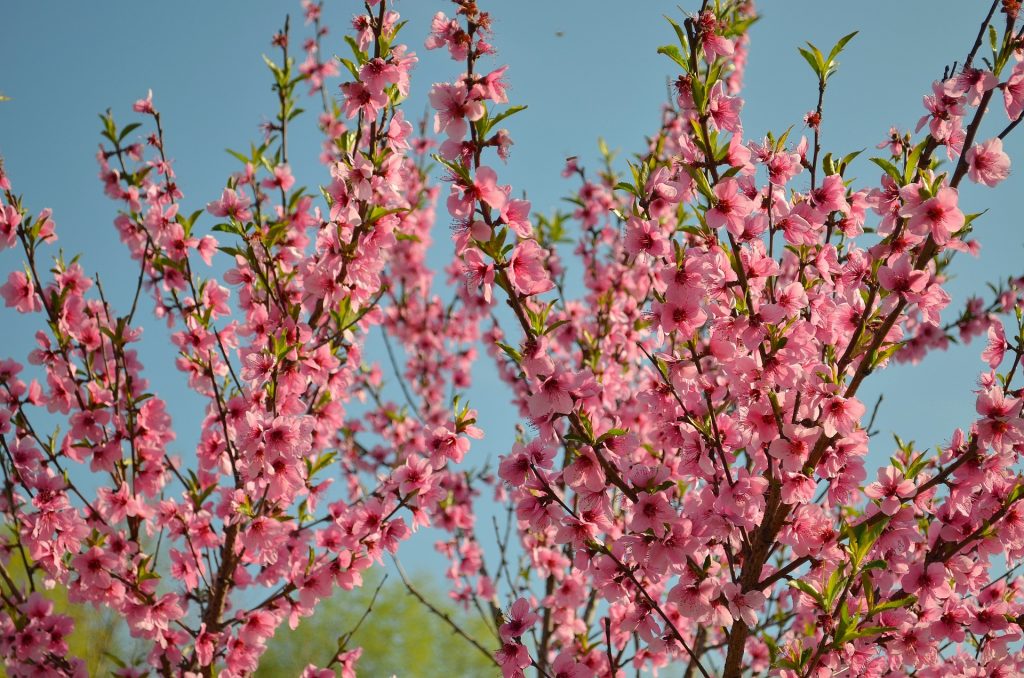
This is what peach trees are beginning to look like in the Southeast; blooms everywhere.
Chilling hours is not a concern for Alabama peach producers for the upcoming season. Potential damage from freezing temperatures is, however, something that may impact this year’s crop, according to Elina Coneva, Extension specialist in the Horticulture Department at Auburn University.
“Feb. 15 was an important day for all fruit growers in the state. There were two things that were accomplished on that day. First of all, we have reached, at least in Chilton County, we have reached 1,009 chilling hour accumulation,” Coneva said during a ‘Q&A Friday’ segment on the Alabama Extension Commercial Horticulture Facebook page.
“We thought, ‘Wow, our peaches are going to produce this year.’ We won’t have those concerns like in previous years when we were experiencing insufficiencies in chilling accumulation.
“Good news comes with a caveat (however). On the night of the 15th of February and throughout the 16th, the same county, Chilton County, experienced temperatures of 15 degrees Fahrenheit. There are consequences, especially for our peaches, but for fruit crops to some extent.”
Freeze Impact
Extreme low temperatures have the potential to impact fruit tree production, especially if those trees have already started blooming. However, Alabama producers may have dodged the proverbial bullet with respect to susceptibility of those early varieties.
Coneva said Edgar Vinson, an assistant research professor and Extension specialist in the Department of Horticulture at Auburn University, conducted a survey on 85 cultivars and their status following the freeze event.
Results indicated that the early ripening cultivars that are more advanced and expected to be damaged higher seemed to fare better than cultivars that were completely dormant.
“Our theory is that probably the humidity in those buds that were more advanced at this point of time helped overcome the wind effect that came with that cold. Flower buds on more advanced cultivars were faring better as well as the buds that were distributed on the lower part of the canopy. They did better than the middle and upper part of the trees, which was kind of unusual,” Coneva said.
Peaches need chill hours to mature. The required chill hours depend on the peach variety, but most growers hope to get around 1,000 chill hours before spring.
If it’s not at the top of the list of concerns for vegetable and specialty crop producers, it’s near the top – immigration reform, specifically H-2A reform.
One potential remedy could be on the way. The Farm Workforce Modernization Act, introduced last week by two members of the House of Representatives, is the latest attempt to help farmers who are utilizing the H-2A guestworker program.
Allison Crittenden, director of Congressional Relations at the American Farm Bureau Federation, commented on this potential solution.
“Our organization acknowledges that there are severe shortcomings in the Farm Work Modernization Act. While this is a bill introduced in the House, we recognize that in the Senate, there’s a real opportunity for an Ag Labor Bill to come forward that better meets agriculture’s needs,” said Crittenden. “With that being said the main points of the Farm Work Modernization Act are that it does provide legal status to undocumented farm workers; it seeks to make some changes to the H-2A program; and then it also requires farmers in the agriculture industry to adhere to mandatory E-Verify after a certain time period.”
State of Crisis
Farm labor is in a state of crisis. Farmers in states like Florida and Georgia are largely dependent on foreign workers to meet the demands on the farm, especially since the supply of U.S. workers is low.
Reforms to the current H-2A program are mainly needed because wage rates have increased dramatically.
“What we hear from our membership about is the Adverse Effect Wage Rate (AEWR). AEWR is calculated by regions, but if you create a national average, that national average has increased by 20% in the last five years. But we know that the prices that farmers are receiving for their crops has not kept up at that same rate,” Crittenden said. “Your labor costs have increased so drastically but what you’re getting paid for your product has not kept up. It’s getting to a point where a farmer’s ability to stay in business is becoming harder.”
Wage Impact
The Farm Workforce Modernization Act would reform H-2A wages to better reflect real-world wages, while protecting against sudden wage increases. It would disaggregate wages for agricultural occupations and freeze wages for one year and cap wage fluctuations for most of the country at 3.25% for the next nine years.
That may be too little too late, though, with respect to the recent AEWR.
“We see there’s a financial benefit to freezing the AEWR and capping those increases, but we’re already starting at a rate that has increased so drastically over the past five years. Farmers are already struggling with the 2021 AEWR,” Crittenden said.
Click here for a full text of the bill. U.S. Representatives Zoe Lofgren, D-CA, and Dan Newhouse, R-WA, reintroduced the Farm Workforce Modernization Act, H.R. 1537 on Wednesday, March 3.
One of Florida’s most challenging strawberry seasons is nearing the homestretch of its 2020-21 season. Between insects, Neopestalotiopsis disease and rising imports from Mexico, strawberry farmers have faced an uphill battle all season, says Dustin Grooms, strawberry producer with Fancy Farms in Plant City, Florida.
“Things have been challenging this year. It’s been a tough year. The volume was off for pretty much, and it’s still off, all year. We’ve been dealing with chili thrips that seem to be giving us a fit. They’ll actually bronze the berry and take away from that red look. It becomes unmarketable,” Grooms said. “They’ll eat the plant down to nothing. We’ve been fighting them all year. We’ve got spider mites that this year have been relentless and have thrown everything and the book at them. They just keep on coming.”
Neopestalotiopsis Disease
The main problem has been Neopestalotiopsis. The disease was first discovered during the 2018-19 season and has increased in instances and intensity ever since. It develops quickly, produces spores on the leaves and causes leaf spots on strawberry plants. It can cause severe leaf spotting and fruit rot under favorable weather conditions.
“This year we’ve seen it right away. It’s been a thorn in our side all season. I think everybody has tried everything they can think of and other people’s thought of, nothing seems to combat it very well,” Grooms said. “It appears that it can actually live in the crown of the plant and if we transplant next year, it may pick it up. That’s where we’re at right now, thinking about next year of what we can do to mitigate that problem.”
Grooms said the disease flares up with rain and hot weather, a consistent combination in Florida. One weather event of rain and extreme heat contributed to the disease exploding overnight.
“It’s just been one problem after another. It seems that we can’t get out of one problem before we’re in another one. We’ve just been dealing with all this off and on all year. None of it has ever went away,” said Grooms, who estimates that about 40% of his 125 acres have been impacted by the disease.
End of Season
Florida strawberry producers are nearing an end to this season. Grooms added that how long it lasts will depend on how long the chain stores continue buying.
“We always like to say we’d like to go to Easter. On my personal farm, I couldn’t tell you the last time we went to Easter was. It’s been probably a decade ago,” Grooms said. “We would love to get to the end of the month. The fruit’s here. It’s just, what’s going to happen? We don’t know.”
When the light goes on, it’s lights out for a ruinous strawberry pathogen.
Just imagine this: Pulling an ultraviolet lamp behind a tractor out into your farm in the middle of the night, pointing the UV light at the strawberries and zapping powdery mildew right out of the leaves and fruit.
The UV equipment has to be custom-built, but the cost is much lower than that of sprayer equipment, and there is no additional cost other than labor after the unit is built, she said. Since UV applications have to be done at night, Peres and her team have been collaborating with Saga Robotics from Norway on a UV robot-like system that could reduce the labor cost.
Benefits of the UV light system come as good news to strawberry farmers. UF/IFAS economic research shows strawberries are about a $300 million-per-year industry in Florida.
WASHINGTON, March 5, 2021 – Vegetable and specialty crop producers in the Southeast that want to apply for the Quality Loss Adjustment (QLA) Program now have an extra month to submit an application.
The U.S. Department of Agriculture (USDA) extended the deadline from March 5 to April 9 for producers to apply, due to recent winter storms and some clarifications to program rules. This program assists producers who suffered crop quality losses due to qualifying 2018 and 2019 natural disasters.
“Because of recent winter storms and some program updates, we want to provide five additional weeks for producers to apply for the program,” said Zach Ducheneaux, Administrator of the Farm Service Agency (FSA). “I want to make sure eligible producers have the opportunity to apply and to work with our team members to help with any questions. We recently clarified policy to ensure producers who sold grain to the feed market due to quality issues are adequately compensated.”
About the Program
The QLA program assists producers whose eligible crops suffered quality losses due to qualifying drought, excessive moisture, flooding, hurricanes, snowstorms, tornadoes, typhoons, volcanic activity, or wildfires.
Eligible crops include those for which federal crop insurance or Noninsured Crop Disaster Assistance Program (NAP) coverage is available, except for grazed crops and value loss crops, such as honey, maple sap, aquaculture, floriculture, mushrooms, ginseng root, ornamental nursery, Christmas trees, and turfgrass sod.
Additionally, crops that were sold or fed to livestock or that are in storage may be eligible.
More Information
FSA began accepting applications on Jan. 6 and has received more than 8,100 applications so far.
To apply, contact your local USDA Service Center. Additional information is also available at farmers.gov/quality-loss. Producers can also obtain one-on-one support with applications by calling 877-508-8364.