Author: Clint

  • Ag Industry Hopes Georgia Grown Message Reaps Bountiful Harvest

    blueberry
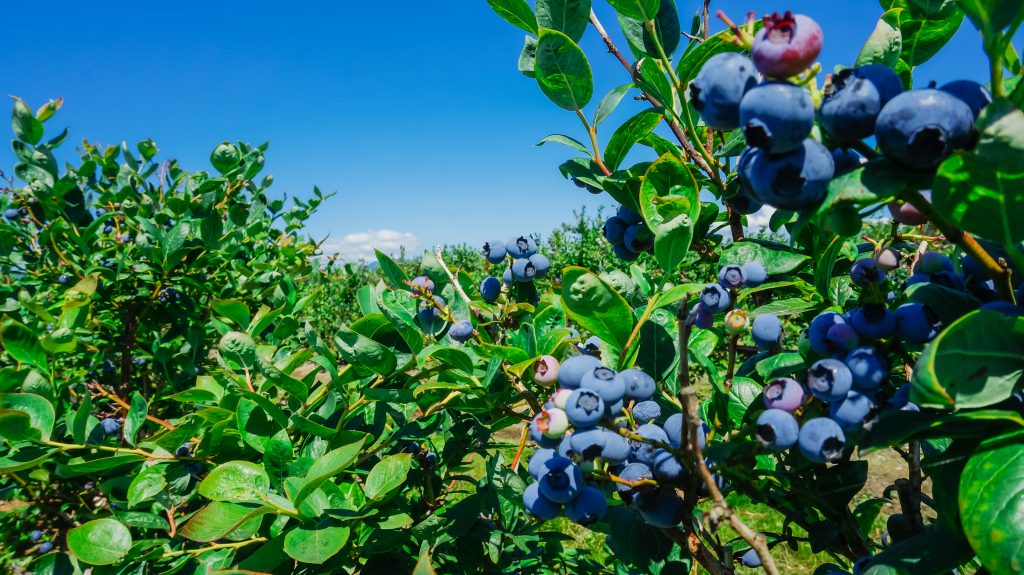
    File photo of blueberry production in Georgia.

    By Clint Thompson

    Now more than ever, buy Georgia Grown. Georgia’s agricultural industries are highlighting this message during the state’s peak season of harvesting produce. Georgia Farm Bureau, University of Georgia Cooperative Extension and Georgia Fruit and Vegetable Association are promoting Georgia Grown produce at a time when the state’s farmers need them the most.

    “We need folks asking their produce managers, if they go into a grocery store and there’s not Georgia Grown or American Grown produce in there, they need to ask where is it at,” said Charles Hall, executive director of the Georgia Fruit and Vegetable Association. “We need for consumers to support the American farmer, to get American Grown, Georgia Grown produce. Because, as that slogan says it’s, ‘Now, more than ever.’”

    The impact of the ongoing coronavirus pandemic has devastated markets for fruit and vegetable farmers across the country. The absence of the foodservice industry for almost two months derailed producers’ bid for a productive season. Farmers in Florida have had to leave produce in the field just because of the lack of potential buyers.

    Alternate Way of Doing Business

    Georgia farmer Bill Brim, co-owner of Lewis Taylor Farms in Tifton, Georgia said he’s lost thousands of boxes of orders due to the pandemic. But he’s found a way to sell part of his excess produce. He’s boxed up produce with different fruit and vegetables and sold directly to consumers for $20 each the last three weeks. Last week, Brim sold between 1,300 and 1,400 of boxed produce. It’s lessened the sting a bit. It also helps consumers become more aware of buying local produce.   

    “I think that growers are looking at alternatives. Boxing up and having a direct farm sale is not going to replace tractor trailers that are going out of the packing shed packed with produce. That’s not going to replace the need for getting produce into the produce chain,” Hall said. “Most of our growers are shipping to the north of us, into South Carolina and North Carolina, into the Midwest and Northeast. Direct sales off the farm is not 100% of the solution. But it certainly helps, when you can move 1,000, 500, 300, whatever it might be. Boxes of produce to your friends and neighbors. They are able to get it fresh. They know it’s fresh coming off land near them.”

    Quick Turnaround?

    While market prices are less than ideal, they could make a turnaround as businesses and restaurants begin to open back up. This could benefit Georgia farmers as they hit their peak season.

    “I think it’s cautious concern to what the market is going to do. The movement on the market right now is slow,” Hall said. “If some of the restaurants and foodservice chains begin to open back up, we are just getting into our peak season, so we could see additional markets there. It’s slower than we want it to be right now, but it could pick up.”

  • Spring Is a Perfect Time to Start Composting

    University of Georgia photo/Creating a compost pile keeps unnecessary waste out of landfills, as landscape refuse, such as leaves, grass clippings and trimmings, accounts for up to 20% of landfill waste.

    By Maria M. Lameiras for CAES News

    With more time at home on many people’s hands these days, lots of yard work is being tackled, making this year’s International Compost Awareness Week, May 3 through 9, a perfect time to create a home composting system.

    For the new composter, first find an ideal spot on your property to locate your composting pile or receptacle, says composting expert and Agriculture and Natural Resources Program Development Coordinator Amanda Tedrow, who represents University of Georgia Cooperative Extension’s Northeast District.

    “If you are just starting out, go for the pile. The ideal minimum size for a compost pile is four by four by four (4 feet wide by 4 feet long by 4 feet deep). That is the right size to reach the temperatures needed for decomposition. A smaller pile will decompose at a slower rate due to lower temperatures,” Tedrow said.

    Locate the compost pile downhill and away from vegetable gardens to prevent potential runoff from the compost pile, which could transmit plant diseases to the garden.

    While heat is an important element to composting, the heat is generated within the composting pile, so it is not necessary to locate a composting system in direct sun. A compost pile located in direct sun may need additional supplemental water during the heat of the summer months.

    Next, it’s important to add the right mix of materials to the pile.

    “The general recommendation is to do two-thirds to three-quarters browns and one-third to one-quarter greens,” she said. Brown materials — such as dried leaves, sticks and old mulch — are a source of carbon, while green materials — such as grass clippings, vegetable and fruit scraps, coffee grounds and egg shells — are sources of nitrogen, both important for proper composting to occur.

    Avoid adding any kitchen waste that contains meat, dairy products or greasy substances, Tedrow warns.

    “Vegetable peelings, fruit rinds, stalks from broccoli, things like that are all fine. Something like peach pits might take a long time to compost, but they are perfectly fine to put in,” she said.

    Moisture is essential, but a compost pile should only stay “as wet as a wrung-out sponge,” Tedrow said.

    “In an ideal world, a compost pile should be turned when the temperature in the center of the pile starts dropping (below the ideal temperature of 130 to 160 degrees Fahrenheit). Most people don’t have a compost thermometer, so many composters will turn their pile every week to two weeks to keep the process moving,” Tedrow said. Compost thermometers are available in stores or online starting at about $20, she added.

    If wildlife is a possible concern, an enclosed composting bin may be a better option, she said.

    If you have a free-form compost pile and you are having a hard time keeping compost materials together, consider using a piece of fencing or other material to make a hoop around the pile to keep it contained, Tedrow added. 

    While creating a compost pile can, in time, produce material usable for gardening, the best thing about a compost pile is keeping unnecessary waste out of landfills, as landscape refuse, such as leaves, grass clippings and trimmings, accounts for up to 20% of the waste being placed in landfills.

    In honor of International Compost Awareness Week, the UGA Extension office in Athens-Clarke County is offering a number of online and interactive events throughout the week, including a composting lecture on Wednesday, May 6, at 6 p.m. For information, go to facebook.com/AthensClarkeCountyExtension or visit athensclarkecounty.com/6542/International-Compost-Awareness-Week.

    For more detailed information on composting, visit extension.uga.edu/publications and search for UGA Extension Circular 816, “Composting and Mulching.” For further assistance or to check for local composting week events, locate your local UGA Extension office at extension.uga.edu/county-offices.

  • USDA Report Yields Results for 2019 noncitrus/nuts season

    Georgia’s pecan crop accounts for 29% of the nation’s production.

    By Clint Thompson

    The United States Department of Agriculture National Agricultural Statistics Service released its findings for noncitrus fruits and nuts in the Southern Region for the 2019 crop year. These estimates were based on grower surveys.

    Avocados: Florida’s production of avocados was up 88% from 2018. Its value of production was up 54%. Yields rebounded in 2019. Utilized production for the 2019 crop year was 25,540 tons.

    Blueberries: Georgia led the nation with 21,700 harvested acres in 2019. Utilized production was up 76%, and value of production was up 52% from 2018’s hurricane-damaged crop. Georgia produced 95,900 pounds. Utilized production in Florida was up 16%, while value of production was up 3%. Florida produced 24,200 pounds.

    Peaches: In Georgia, utilized production was up 44% and value of production was up 58% from the crop in 2018. Georgia utilized 33,780 tons of production. South Carolina’s utilized production was up 8%, while value of production was up 20%.

    Pecans: Georgia’s pecan crop accounts for 29% of the nation’s production. It had a 4% increase in utilized production and a 21% increase in value of production in 2019. The lingering impact from Hurricane Michael in 2018 and the dry summer in 2019 impacted the crop. Georgia produced 73,000 pounds.

    Strawberries: Florida’s utilized production was down 18% from last year, while its associated value of production was up 9%.

    For more information, see full USDA report.

  • A Berry Good Deed

    Story is from N.C. State College of Agriculture and Life Sciences News website.

    May 6, 2020  |  Dee Shore

    With unemployment rates hitting record levels in the United States and North Carolina, hunger-relief agencies and nonprofit organizations are encouraging donations. At NC State, Extension Small Fruit Specialist Mark Hoffmann is heeding the call.

    For each of the past three weeks, Hoffmann has harvested between 75 and 100 pounds of strawberries from his experimental plots in Clayton and delivered them to the Inter-Faith Food Shuttle Farm along Tryon Road.

    The need is greater than we have ever seen as an organization.

    Farm Manager Kayla Clark says the donation meets an important and timely need in central North Carolina, contributing to the food shuttle’s efforts to end hunger in Wake, Durham, Johnston, Orange, Chatham, Nash and Edgecombe counties.

    The food shuttle provides not only shelf-stable food but also healthy, fresh produce, and the organization has been “low on produce these days,” Clark says.

    “With the unemployment rate rising so quickly, the need is greater than we have ever seen as an organization,” she says.

    The organization is delivering the strawberries through its Mobile Markets and Grocery Bags for Seniors programs.

    Solving problems for growers and others

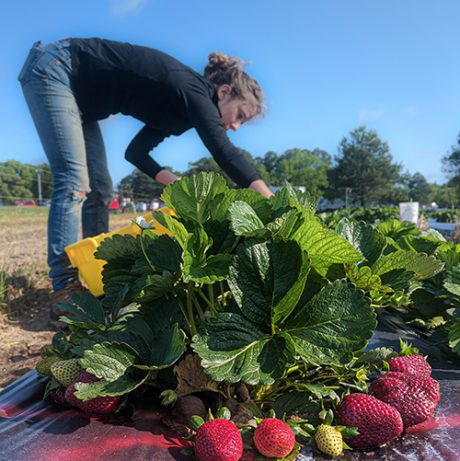
    Woman picking strawberries at a research station
    Technician Emma Volk examines strawberry plants at the Central Crops Research Station in Clayton.

    Hoffmann passes the nonprofit’s farm on his way home from work, where he conducts research and extension education programs aimed at helping growers improve the economic and environmental sustainability of their farms. It occurred to him that donating the berries to the food shuttle would mean that they would benefit not just those growers but also families and individuals hard hit by the economic downturn associated with the COVID-19 pandemic.

    A warm winter set the stage for a strawberry season that’s the best the state has seen in years, Hoffmann says. Production has hit its stride, and the crop has been both beautiful and bountiful.

    In fact, the harvest has been so good that Hoffmann wasn’t sure what he could do with hundreds of pounds of strawberries he’s been harvesting from his research plot at the Central Crops Research Station.

    We have a bumper crop …, and I didn’t want to throw them away.

    Normally, Hoffmann and his associates would distribute the berries to others on campus to acknowledge their support of the university’s small fruits team and their research and Extension work.

    “The strawberries were really good this year, and the season has gone well so we have a bumper crop. It’s a lot of strawberries, and I didn’t want to throw them away and didn’t see any other option,” Hoffmann says.

    “I’m actually eating strawberries every day right now, but they’re way too many strawberries for me to eat by myself,” he adds. “Even if I could distribute them among my students, there’d still be too many left over.”

    Small but important

    Hoffmann expects the crop will amount to 450 to 550 pounds – a small fraction of the 6 million pounds of food that the food shuttle distributes each year to people with low incomes.

    Still, Clark says the donation makes a significant difference – and so does the advice he’s provided the farm on managing and expanding its muscadine grape operation.

    Clark says she’s happy “that our neighbors in need will be able to enjoy the freshest and sweetest strawberries that they possibly could.”

  • Let the Peach Harvest Season Begin

    Peach harvest season is set to begin soon in Georgia.

    By Clint Thompson

    Those peach lovers ready for a ripe, juicy peach won’t have to wait too much longer. Peach harvest season is just a few days away, says Jeff Cook, University of Georgia Cooperative Extension Agriculture and Natural Resources agent for Peach and Taylor counties.

    “If they’re not picking any by Friday, they’ll be picking some by Monday,” Cook said. “They’ll be picking by next week.”

    Cook said Georgia’s peach crop are projected to be good, not great but definitely an improvement from previous down years where farmers were hurt by mild winters and late spring freeze events.

    “It’s kind of a normal year,” Cook said. “They used to say 80% of a crop is a full crop, and we’re probably a little bit less than that. We’ll have peaches all year. It’s definitely not like anything we’ve had in the past, the last few bad years.”

    Alabama Peaches

    He said peaches in Alabama may be hurt by the abnormally mild winter. Peaches need a certain number of chill hours to produce a crop. If they don’t receive enough, it could impact their yield and quality. Much of the peaches are grown in Chilton County, which is on a slightly higher elevation.

    “They’re still growing a lot of higher chill peaches. With the winter we had, I talked with one of the specialists over there and at the time I talked with him, he said they weren’t real happy about the crop they were seeing,” Cook said. “I don’t think they’ve really shifted their varieties to the lower chill peach varieties. I think this winter kind of got them.”

    Cook estimates that growers will harvest peaches through at least mid-August.

    “By mid-August, prices are starting to come down and the rest of the eastern United State is into it big. Everybody’s out there and peaches are everywhere. We’ve really positioned ourselves to get in early and get out early, the growers have,” Cook said.

  • Georgia’s Ag Industry Launches ‘Now More Than Ever, Buy Georgia Grown’ Campaign

    Black

    ATLANTA, GA– To help mitigate potential losses due to the COVID-19 response, Georgia Department of Agriculture’s Georgia Grown program has joined with partners from Georgia Farm Bureau, University of Georgia Extension Service and Georgia Fruit and Vegetable Association to promote Georgia Grown produce through retail and direct-to-consumer channels.

    Georgia’s spring fruit and vegetable harvest has an estimated farm gate value of $500-$750 million, and roughly 50% of that is traditionally marketed through foodservice.  However, with much of the foodservice channel closed due to the COVID-19 response, farmers could find their promising crops have no place to go. 

    “The supply is there. The food is there. The quality is there. We just need to make sure the demand is there as well,” says Georgia Agriculture Commissioner Gary W. Black. “Consumers often ask what they can do to help our Georgia farmers and the answer is simple.  Expect Georgia Grown, ask for Georgia Grown and buy Georgia Grown.”

    Long

    A mixed media campaign will encourage consumers to Buy Georgia Grown, Now More Than Ever.  The collaborative effort includes PSAs, direct to consumer purchasing platforms, recipes. and preservation tips for fresh produce, all supported by a targeted social media campaign using the hashtags #NowMoreThanEver, #BuyGeorgiaGrown.   

    “It is important that we support Georgia’s number one industry, agriculture,” says Georgia Farm Bureau President Gerald Long.  “We are pleased to partner with Georgia Grown and the UGA Extension in helping remind consumers that our farmers feed and clothe the world by producing the finest food and fiber.”

    Consumers can purchase from Georgia Grown businesses with e-commerce and home delivery capabilities by visiting www.georgiagrown.com. In collaboration with Georgia Grown, UGA Extension is using its network of county Extension offices to connect agricultural producers with consumers looking for fresh, Georgia-grown products at https://extension.uga.edu.

    Johnson

    “UGA Extension is excited to be able to use our statewide local network of Extension offices to help connect Georgia citizens with the farmers that provide delicious, Georgia Grown products,” says Laura Perry Johnson, Associate Dean for UGA Extension. “It is in all of our best interest to work collaboratively to keep Georgia’s top economic driver – agriculture – healthy and prosperous as we fulfill our mission to serve the state.”

    Agriculture is the top industry in Georgia with production and related industries representing $76 billion in output and more than 399,000 jobs. 

    “This is not the first time our fruit and vegetable farmers have had to overcome challenges,” says Commissioner Black.  “In the last several years they have endured historic hurricanes, late freezes and trade wars.  Georgia’s agricultural sector is strong because our farmers are strong, and I feel confident that Georgia consumers are strong as well and will rise with them to meet this new challenge before us.”

    Georgia Department of Agriculture

  • UF/IFAS Scientists Help National Team Breed Better Pomegranates

    UF photo shows pomegranates growing.

    By: Brad Buck, bradbuck@ufl.edu

    BALM, Fla. — You can enjoy pomegranates in myriad ways. You can toss them in salads, sprinkle their seeds on yogurt or oatmeal or add them to smoothies. When you consume pomegranates, you’ll savor their sweet and sour flavor. You may be drawn not only to their taste, but perhaps to their nutritional value. They contain antioxidants that help boost your heath.

    How special is this fruit? One of the most popular varieties is literally called ‘Wonderful.’ Scientists nationwide, including researchers at the University of Florida, soon will try to improve the ‘Wonderful’ pomegranate and other varieties of the fruit. In Florida, research will start as soon as scientists can return to their fields and labs.

    California farmers produce 90% of the nation’s pomegranates, but ‘Wonderful’ pomegranates come from cuttings in Florida. Some Florida farmers seeking alternative crops see pomegranates as among their options.

    Zhanao Deng, a professor of environmental horticulture at the UF/IFAS Gulf Coast Research and Education Center (GCREC), will soon collaborate with researchers nationwide to breed more disease- and pest-resistant pomegranates.

    “For Florida pomegranate growers to be successful and sustainable, we need new varieties that are better adapted to our climate and more resistant to diseases commonly found in Florida,” Deng said.

    To find these new varieties, Deng tests about 2,000 plants from sets of parent plants that were grown several years ago.

    “We plan to create new breeding populations and screen them for better disease resistance, higher crop yield and better fruit quality,” he said.

    At the GCREC, Deng will work with Gary Vallad, a UF/IFAS plant pathology associate professor. The two scientists also will work with Florida growers to find plants that show the best disease resistance. When promising new cultivars become available, they will be tested in growers’ orchards.

    As part of the national research team, Deng will work with scientists at the University of California-Riverside, Texas A&M University, California State University and the U.S. Department of Agriculture. UC-Riverside leads the grant, after it received an $885,801 grant from the USDA’s Agricultural Marketing Service through the California Department of Food and Agriculture’s Specialty Crop Multi-State Program.

    Initially, in 2017, Deng started testing pomegranates to see if they would grow at his farm at the research center. This is called “trialing.”

    “Our trials have shown that the pomegranate plants can grow really well in Florida,” he said. “But the most challenging issue comes from several fungal diseases that can cause severe defoliation, fruit rot and fruit drop.”

    Those issues – along with bugs and mites — reduce crop yield and quality. Commercial farmers see the same issues with pomegranates, Deng said.

    Despite issues with fungi and pests, “Farmers have been very supportive to our pomegranate research, and we have been working together for years,” he said.

    “Florida specialty crop growers have faced a tough situation in recent years, due to devastating diseases and international competition, and they have been looking for alternative crops to grow,” Deng said. “Pomegranate seems to make sense to Florida growers as it can be grown with the same irrigation, fertilization and spray equipment that have been used for growing citrus or some other crops.”

  • N.C. Small Fruit Producers Be Ready for Colder Temps

    File photo shows muscadine grapes. North Carolina producers need to be ready for colder temperatures.

    North Carolina strawberry and grape producers need to be wary of colder temperatures this week, according Mark Hoffmann, North Carolina State Small Fruits Extension Specialist, in his message to producers.

    Temperatures will fall significantly this week, with a slight chance of rain in North Carolina on Friday and Saturday, and clouds coming in from the Northwest. These weather conditions will lead to minimum temperatures below 40 degrees during the night from Saturday to Sunday in the mountains and wide areas of the Piedmont.

    Hoffmann said to check your local weather if you are in an area that can get a lot of frost. If there is a chance of frost, please use row covers to protect your blooms from Saturday to Sunday.

    Please see here on how to manage frost damage.

  • Severe Drought in Alabama Having Little Impact on Produce

    By Clint Thompson

    A severe drought in Mobile County, Alabama and Baldwin County, Alabama is not negatively influencing fruit and vegetable production, says Joe Kemble, Alabama Extension vegetable specialist.

    “Most of the veggies down there are irrigated,” Kemble said. “I don’t know anyone that doesn’t irrigate, frankly, in that area.”

    Irrigation is important in that area right now. In the most recent release of the U.S. Drought Monitor, parts of both counties are classified as ‘D2’ status or a severe drought.

    “Mobile and Baldwin Counties, they’re opposite each other, Mobile Bay. They are definitely well under. I think there was a trending hashtag of #mobilethedesert or #desertmobile. Guys were saying how dry it is down there,” Kemble said.

    There’s cause for concern, especially considering how much produce is grown in that area. Growers cater to a lot of road-side produce stands and farmers markets in that area.

    “In that area, it’s pretty diverse, production wise. Large acreage wise, sweet potatoes are still a pretty important crop in that area, and to a lesser extent, some irish potatoes as well. After that it’s tomatoes, watermelons, corn are probably the staples in that area, as well as peppers,” Kemble said. “There’s a lot of road-side stands in those areas, farmer’s markets in that area. They tend to feed a lot of product into those. They’re always looking for a diverse background of crops. But I would say the major ones are still going to be the tomatoes, watermelons and sweet corn.”

    Kemble said the crops are progressing well.

    “I was speaking to a regional agent down there. He was saying things are on track,” Kemble said.

  • Nutsedge Management Key to Vegetable Production in South Carolina

    By Clint Thompson

    Weed management in vegetables is critical for growers in South Carolina, says Matthew Cutulle, Clemson Extension vegetable weed specialist.

    Photo submitted by Matthew Cutulle, Clemson/Shows nutsedge in sweet potato.

    Especially for sweet potato growers, yellow nutsedge is a problem in South Carolina fields. It will rob sweet potatoes of essential water and nutrients if growers don’t successfully manage it..

    “What makes a weed so successful is that their initial growth or competition is greater than the crop. The crop, usually at the end of the season, they’re more competitive. That early competition is really problematic,” Cutulle said. “That underground competition seems to have more of a negative effect on sweet potato and tuber production.”

    Why is it Such a Problem?

    Nutsedge, which can be prevalent in any field with any crop, adapts to different growing conditions and thrives on intense sunlight. It is most prevalent in fields with a lot of spacing between rows or between plants in rows.

    “I think (where) it’s one or two plants per square foot, you’re going to get an 80% reduction in yield,” Cutulle said. “I feel that if you have a field that’s inundated with nutsedge, that’s almost like 100% yield loss. The grower’s not going to want to go in with a sweet potato digger.”

    Cutulle said there are multiple options to try to contain nutsedge. The best way is to use a cover crop.

    “A good way to do it is to rotate the field. There’s a cover crop called ladino clover that Brian Ward, the horticulturist I work with, has used. He’s seen ladino clover suppress nutsedge 75% relative to the non-cover crop control. That’s a good way, if you can take the field out of rotation, grow ladino clover,” Cutulle said. “A technique we tried to reduce the weed seedbank or weed tuber bank is stale seedbed technique. You cultivate the land, almost treat it like you’re about to plant. Allow the weeds to come up and cultivate again and burn them down with a residual herbicide or a flame weeder. Get it multiple times to try to reduce the amount of viable weeds in that field.”