Gainesville, Fla. – Florida Farm Bureau President John L. Hoblick will provide public comment to the Office of the U.S. Trade Representative (USTR) and the U.S. Departments of Commerce and Agriculture on Thursday, August 13, 2020 at 9 a.m. EST to address concerns of unfair trade practices with Mexico.
In this virtual hearing, federal officials will hear firsthand from Florida growers, lawmakers, industry leaders and other agricultural-related entities to help provide feedback on how the Administration can better support producers and redress any unfair harm.
The hearings were originally scheduled to take place in Florida and Georgia in April, but in light of the COVID-19 pandemic, will be held virtually. A second virtual hearing will be August 20, 2020 at 9 a.m. EST.
To view the live recording of the hearing, visit USTR’s website here. The livestream will be made available on August 13. Click here to view the hearing schedule and list of participants on August 13. Additional information regarding the August 20 hearing will be released closer to the date.
The Federal Register notice regarding the hearings can be viewed here.
NOTE: Full transcripts of the hearings will be posted online after the hearings.
File photo showsa research vineyard in North Carolina.
It is nearing harvest time for North Carolina grape producers. Unfortunately, original projections remain true for this year’s crop. It is expected to be a down year for grape farmers.
“With the vinefera grapes for the wine industry in the western part because of all of the frost events we had in the spring, most vineyards are down at least 50% this year in yield,” said Mark Hoffmann, North Carolina State small fruits Extension specialist. “We had a few who weren’t infected, and they actually had a real nice crop on the wine. But most vineyards have 50% to 60% loss this year, and very uneven number of clusters to wine, too. Some wines got more affected than others.”
Back in June, Hoffmann said a May frost impacted the western part of the Piedmont region as well as the Yadkin Valley. The area where the frost left the most impact produces about 80% of the state’s production. That is a big reason for the gloomy projection for this year’s crop.
“It was clear after the frost that it wasn’t going to be a bumper year this year,” Hoffmann said. “It’s not going to be a great year for the wine industry this year.”
He added that production is about two weeks late due to the frost and cool temperatures in the spring. Grape harvests in the Yadkin Valley are expected to start next week. Harvests are expected to last through mid-October.
Muscadine harvests are also expected to begin this week at the earliest, next week at the latest.
The Florida Department of Agriculture and Consumers Services (FDACS) has an updated website to help the state’s residents know how to proceed if they receive unsolicited seeds in the mail. Those who do receive seeds, please click here.
The Florida Department of Agriculture and Consumer Services(FDACS) is warning Floridians about unsolicited packages of seeds received through the mail. The seed packets may arrive unexpectedly in packages bearing Chinese characters, may bear the name China Post, and may be labeled as jewelry. They have been reported in multiple states.
Brushing Scam
The USDA’s Animal and Plant Health Inspection Service (APHIS), the lead regulatory body on this matter, issued guidance. The USDA believes the seeds to be part of a “brushing” scam, where unsolicited items are sent in order to post false customer reviews and boost online sales. Upon receiving seed packages from recipients, the USDA will test the contents to determine if a risk is posed to agriculture or the environment.
The introduction of plant seeds into the United States is tightly regulated by the USDA. Seeds of unknown origin may constitute agricultural smuggling; may be invasive; may introduce pathogens, toxins or plant and animal diseases; may pose a risk of foodborne illness; and may pose a threat to plant, animal and human health. FDACS is continuing to work closely to receive additional guidance from the USDA and APHIS, in consultation with U.S. Customs and Border Protection.
Report Immediately
“Anyone receiving these suspicious seed packets should not plant them, but should report it to our department immediately, so that our inspectors can safely collect them for analysis,” said Florida Agriculture Commissioner Nikki Fried.
Here’s what to do if you receive an unsolicited seed package from another country:
• Do not open the seed packet and avoid opening outer packaging or mailing materials, if possible.
• Place the seed packet and mailing materials into a sealable plastic bag. This is important to determine the origin of the seeds.
• Do not plant the seeds or discard them in trash that will be landfilled.
Again, if you receive these seeds, please click here to find out how to proceed.
This isn’t the first time in 2020 that Florida agriculture has been concerned about shipments of agricultural products from China. USDA’s APHIS on April 14 authorized the importation of five types of commercially produced citrus from China. Read about the official Florida opposition to that action.
Source: Florida Department of Agriculture and Consumer Services
Sweet Grown Alabama Director Ellie Watson with a representative from Alabama Farm Credit.
MONTGOMERY, Ala.— Sweet Grown Alabama, the state’s agricultural branding program, is pleased to welcome Alabama Farm Credit as a founding member of the non-profit organization.
“Alabama Farm Credit is proud to be a founding member of Sweet Grown Alabama. We believe that the strength of agriculture in our state is dependent on finding every way possible to maximize the value of our farmers’ products,” said Mel Koller, President and CEO of Alabama Farm Credit. “Sweet Grown Alabama provides a new avenue for our growers to connect with customers and increase the strength of their individual brands. At Alabama Farm Credit we believe ‘Together We Grow.’ We know by supporting the Sweet Grown [Alabama] branding together Alabama agriculture will indeed grow.”
Alabama Farm Credit’s financial support will help Sweet Grown Alabama connect Alabama farmers and families. Funds will be utilized to encourage purchasing of locally grown products through traditional and digital marketing. Consumers can search for a variety of locally grown products at SweetGrownAlabama.org.
“We are thrilled to add Alabama Farm Credit to our network of founding members,” said Ellie Watson, Sweet Grown Alabama Director. “This contribution will allow us to educate and connect more consumers to Alabama grown products, and I am grateful that Alabama Farm Credit is committed to support local through our program.”
With this commitment, Alabama Farm Credit becomes the eighth founding member supporter of Sweet Grown Alabama.
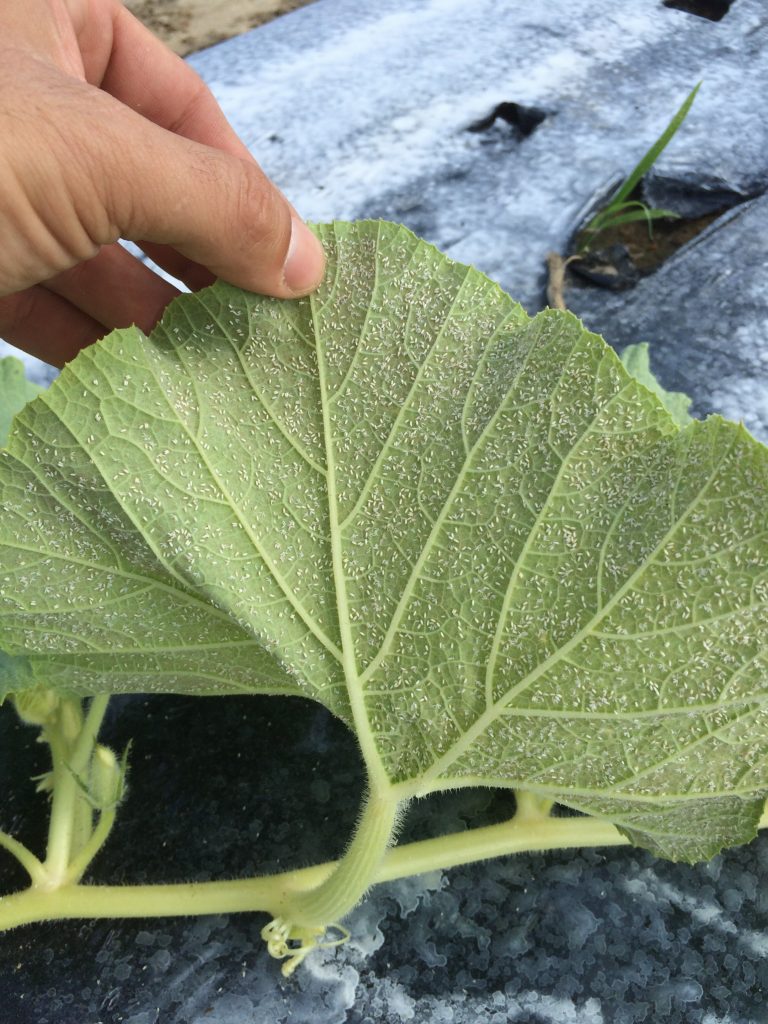
File photo shows how whiteflies infest fall cucurbits.
Unless more rain in the upcoming weeks can knock back populations, whiteflies are a huge concern for fall vegetable growers, according to Stormy Sparks, University of Georgia (UGA) Extension vegetable entomologist.
“Right now, it’s looking pretty bad. It could be devastating. The populations are really high, and we’re just now getting started,” Sparks said. “I’ve got squash where the adult counts are 200-plus per leaf. We’re just starting to see some virus. It’s pretty low, but that can increase rapidly.”
According to the most recent release of the US Drought Monitor, about half of Georgia’s counties are classified as ‘abnormally dry,’ including Tift County where Sparks is based at the UGA Tifton campus.
“They love hot, dry weather. I saw some cotton the other day. I haven’t seen cotton that looked that bad since I was in Rio Grande Valley of Texas,” Sparks said. “Those bad spots are very spotty right now, but if we stay hot and dry, it can get ugly in a hurry. It’s already ugly in some spots.”
Rainfall is needed to, not only help the crops grow, but knock back some of the whitefly populations.
Whiteflies Everywhere
Alabama Extension cotton entomologist Ron Smith said they’re finding whiteflies as far north as Quitman County (Georgia), which is just across from Eufala, Alabama. There’s also some in the Panhandle of Florida and in some fields in the corner of Alabama down in the extreme tip between Georgia and Florida. For more information about whiteflies’ impact in cotton, click here.
Crop Devastation
Whiteflies are especially dangerous since they can also transmit cucurbit leaf crumple virus and cucurbit yellow stunting disorder virus. According to UGA crop loss estimates for fall 2017, these viruses caused between 30% and 50% of crop loss in squash and cucumbers and nearly 80% of crop loss in snap beans. While this year’s whitefly infestation does not rival 2017 yet, the numbers are still bad and a concern for growers in the middle of planting this fall’s crop.
“We can battle the whitefly, it gets real ugly and real expensive but we can battle the whitefly in most crops. It’s those crops where we have virus problems where we don’t have resistance to that are the greatest concern,” Sparks said. “The yellow squash is extremely sensitive. Zucchini is tolerant but not really resistant. Cucumbers, you can produce a crop despite the virus. Tomatoes, we’ve got tomato yellow leaf curl, if you’re not growing a leaf curl resistant variety, you have the potential to losing the crop. But most people now are growing leaf curl resistant varieties in the fall.”
Lack of Cold Winter Temperatures
While colder temperatures do not eliminate whiteflies, they do kill many of their wild hosts. They also slow population development in cultivated hosts. Warmer temperatures this winter allowed for larger whitefly populations to overwinter and become mobile earlier.
(Washington, D.C., Aug. 11, 2020) – U.S. Secretary of Agriculture Sonny Perdue announced today that additional commodities are covered by the Coronavirus Food Assistance Program (CFAP) in response to public comments and data. Additionally, the U.S. Department of Agriculture (USDA) is extending the deadline to apply for the program to Sept. 11, and producers with approved applications will receive their final payment. After reviewing over 1,700 responses, even more farmers and ranchers will have the opportunity for assistance to help keep operations afloat during these tough times.
Perdue
“President Trump is standing with America’s farmers and ranchers to ensure they get through this pandemic and continue to produce enough food and fiber to feed America and the world. That is why he authorized this $16 billion of direct support in the CFAP program, and today we are pleased to add additional commodities eligible to receive much needed assistance,” said Secretary Perdue. “CFAP is just one of the many ways USDA is helping producers weather the impacts of the pandemic. From deferring payments on loans to adding flexibilities to crop insurance and reporting deadlines, USDA has been leveraging many tools to help producers.”
Background
Background: USDA collected comments and supporting data for consideration of additional commodities through June 22, 2020. The following additional commodities are now eligible for CFAP:
Specialty Crops – aloe leaves, bananas, batatas, bok choy, carambola (star fruit), cherimoya, chervil (french parsley), citron, curry leaves, daikon, dates, dill, donqua (winter melon), dragon fruit (red pitaya), endive, escarole, filberts, frisee, horseradish, kohlrabi, kumquats, leeks, mamey sapote, maple sap (for maple syrup), mesculin mix, microgreens, nectarines, parsley, persimmons, plantains, pomegranates, pummelos, pumpkins, rutabagas, shallots, tangelos, turnips/celeriac, turmeric, upland/winter cress, water cress, yautia/malanga, and yuca/cassava.
Non-Specialty Crops and Livestock – liquid eggs, frozen eggs and all sheep. Only lambs and yearlings (sheep less than two years old) were previously eligible.
Aquaculture – catfish, crawfish, largemouth bass and carp sold live as foodfish, hybrid striped bass, red drum, salmon, sturgeon, tilapia, trout, ornamental/tropical fish, and recreational sportfish.
Nursery Crops and Flowers – nursery crops and cut flowers. Other changes to CFAP include: Seven commodities – onions (green), pistachios, peppermint, spearmint, walnuts and watermelons – are now eligible for Coronavirus Aid, Relief, and Economic Stability (CARES) Act funding for sales losses. Originally, these commodities were only eligible for payments on marketing adjustments.
Correcting payment rates for onions (green), pistachios, peppermint, spearmint, walnuts, and watermelons.
Producers Who Have Applied: To ensure availability of funding, producers with approved applications initially received 80% of their payments. The Farm Service Agency (FSA) will automatically issue the remaining 20 percent of the calculated payment to eligible producers. Going forward, producers who apply for CFAP will receive 100% of their total payment, not to exceed the payment limit, when their applications are approved.
Applying for CFAP: Producers, especially those who have not worked with FSA previously, are recommended to call 877-508-8364 to begin the application process. An FSA staff member can help producers start their application during the phone call.
On farmers.gov/cfap, producers can: Download the AD-3114 application form and manually complete the form to submit to their local USDA Service Center by mail, electronically or by hand delivery to their local office or office drop box. Complete the application form using the CFAP Application Generator and Payment Calculator. This Excel workbook allows customers to input information specific to their operation to determine estimated payments and populate the application form, which can be printed, then signed and submitted to their local USDA Service Center. If producers have login credentials known as eAuthentication, they can use the online CFAP Application Portal to certify eligible commodities online, digitally sign applications and submit directly to the local USDA Service Center. All other eligibility forms, such as those related to adjusted gross income and payment information, can be downloaded from farmers.gov/cfap. For existing FSA customers, these documents are likely already on file.
All USDA Service Centers are open for business, including some that are open to visitors to conduct business in person by appointment only. All Service Center visitors wishing to conduct business with FSA, Natural Resources Conservation Service or any other Service Center agency should call ahead and schedule an appointment. Service Centers that are open for appointments will pre-screen visitors based on health concerns or recent travel, and visitors must adhere to social distancing guidelines. Visitors are also required to wear a face covering during their appointment. Our program delivery staff will be in the office, and they will be working with our producers in the office, by phone and using online tools. More information can be found at farmers.gov/coronavirus.
House Agriculture Committee members seek more Coronavirus Food Assistance Program relief for specialty crop growers. The group recently sent a letter to Agriculture Secretary Sonny Perdue with the request.
Led by Congresswoman Stacey Plaskett, a Democrat from the U.S. Virgin Islands, the lawmakers say, “The direct payment program under CFAP has failed to provide equitable relief to the specialty crop sector.”
Plaskett
The lawmakers say the funds have been particularly difficult to access for specialty crop farmers who are young, socially disadvantaged or rely on local markets with diversified production practices.
As of August 3, 2020, USDA had provided more than $6.8 billion in direct payments to domestic farmers and ranchers. Out of that total, only $270 million has been provided to specialty crop producers, representing less than 4% of overall assistance.
To remedy the issue, the lawmakers requested, “USDA must do more to assist the specialty crop sector, particularly those farmers who are young, socially disadvantaged, or sell into local markets.”
(From the National Association of Farm Broadcasters)
MONTGOMERY, Ala. – The Alabama Cooperative Extension System is partnering with the Alabama Department of Agriculture and Industries (ADAI) to assist in collecting unsolicited seed packages being sent to Alabama residents from China. The packages often indicate that they contain jewelry rather than seeds. ADAI field inspectors are currently collecting these seed packages to test their contents for unknown compounds, noxious weed seed and invasive species.
Gary Lemme, Alabama Extension director, said each county Extension office will serve as a drop-off point for residents who may have received these mystery packages containing seeds.
“This partnership will allow inspectors at ADAI to process these seed samples more quickly,” Lemme said. “Alabama Extension is proud to take part in this process to continue serving Alabama residents.”
Commissioner of Agriculture and Industries Rick Pate said, “We appreciate Extension’s offer to assist our department by providing a designated drop off point in each county. We will continue to collect packages as along as we receive reports that they are being delivered to Alabama citizens.”
How to Drop Off Seeds
Those who have received unsolicited seed packages should not open the package containing the seeds or plant the seeds. Deliver these packages to the county Extension office nearest you. Find the address and contact information to county offices in the Alabama Extension directory at www.aces.edu/directory. When you deliver the package, professionals at that office will assist in filling out the ADAI Mysterious Seed Package Report. (www.agi.alabama.gov/reportseeds).
Figure 1. Stunted ‘starving’ strawberry plants (foreground) caused by sting nematodes in Florida.
By Johan Desaeger
Florida’s subtropical climate offers unique opportunities to grow crops outside of the typical growing season of other states. Such is the case for strawberries and many vegetables. There are high expectations that hemp could be another such crop, although nematodes may have something to say about that.
Plant-parasitic nematodes, such as root-knot and sting nematodes, can cause severe damage to many of Florida’s crops, especially in sandy soils, which comprise much of the state (Figure 1). Nematodes are microscopic roundworms that live in the soil and are one of the least-known and most difficult-to-manage pests that growers can face. Because of nematodes’ small size, belowground nature and lack of easily recognizable symptoms, nematode damage is often not recognized as such. Symptoms typically occur randomly in a field and are easily confused with other pests and diseases, nutritional deficiencies, plugged drip tapes or too much or too little water.
Figure 2. Swollen and galled roots caused by root-knot nematodes on tomato (left) and hemp (right).
The most important nematodes in Florida are root-knot nematodes. They can cause damage to a wide variety of crops and are extremely widespread throughout the state (Figure 2).
HEMP HAS SOME NEMATODE TOLERANCE
With the considerable interest that hemp is gaining in Florida, the Gulf Coast Research and Education Center (GCREC) nematology lab started to investigate how root-knot and other nematodes may affect this new crop. The hemp-nematode research is the focus of Jackie Coburn, a master’s student in the nematology lab.
Coburn screened several hemp cultivars in the greenhouse at the GCREC, including fiber, seed and CBD (cannabidiol) hemp types, originating from Europe, China and the United States. Initial data show that hemp is a good host for root-knot nematodes (Figure 2). However, the crop appears to be relatively tolerant, meaning the nematodes can feed and reproduce, but do not seem to negatively affect hemp growth.
Figure 3. Hemp plots at the Gulf Coast Research and Education Center have strings with LED lights and hops in the background.
Certain CBD varieties showed less nematode root damage than others, which will be useful for future breeding efforts. Currently, Coburn is screening hemp varieties for sting nematode, another important nematode in Florida, especially in strawberry fields (Figure 1).
In addition to the greenhouse studies, hemp research was also initiated in the field at the University of Florida Institute of Food and Agricultural Sciences (UF/IFAS) farm in Balm. Here, hemp cultivars are planted throughout the year. In addition to nematode sampling, plants are being monitored for other pests and diseases.
HEMP-HOPS INTERCROP
An interesting feature in the field trials here is that hemp is grown with and without adding supplemental light, a practice that has worked well for hops in Florida (Figure 3 and Figure 4). It quickly became clear that adding supplemental light during the vegetative state makes a huge difference when growing hemp. In field trials, hemp was intercropped with hops, and both crops received the same light and fertilizer regimen.
Figure 4. Hemp (left) and hops (right) at night at the Gulf Coast Research and Education Center.
Hops and hemp belong to the same plant family, and in addition to both being daylength-sensitive plants, they also share many of the same flavor and aroma compounds. The field trials at the GCREC showed that with supplemental light, a hops-hemp intercrop can be an attractive option, as both crops will similarly benefit, allowing for two hop harvests per year and two to three hemp harvests per year.
MORE RESEARCH RESULTS TO COME
With increasing interest in hemp as an alternative crop, we will continue to provide updates on the hemp research at the GCREC. Future focus will be on CBD varieties and how to integrate hemp in the high-value cropping systems (vegetables and strawberries) in our area.
Finally, in order to help researchers better understand the real importance of nematodes in commercial hemp fields, we invite any hemp grower in Florida to contact us if they notice abnormal plants in their field, or simply wish to have their fields analyzed for nematodes.
Paul Allen, president of R.C. Hatton Farms in Belle Glade, Florida and chairman of the Florida Fruit and Vegetable Association, believes the outcome of the upcoming virtual hearings about unfair trade practices with the U.S. Trade Representative’s Office could have significant ramifications come November.
This file photo showsFlorida Agriculture Commissioner Nikki Fried visiting with farmer Paul Allen, Palm Beach County Commissioner Melissa McKinlay and Tom MacVicar of MacVicar Consulting.
“This administration better realize that the American people are very well aware of this Florida deal. They need to think hard about it. You’re in an election year, and it isn’t just the people in Florida, it’s people all over this country are aware of this deal,” said a frustrated Allen, referring to the competitive imbalance with Mexican imports. “They’ve been made aware of it through the pandemic. I think the administration needs to be real careful about what they’re doing here. They need to help the Florida farmer, and I think it could probably assure another term, to be honest with you. If not, I don’t know.”
Hearings Scheduled
The hearings, scheduled for Aug. 13 and Aug. 20, will allow the U.S. Department of Commerce and Trump Administration the chance to hear from seasonal produce growers in Florida and Georgia. Farmers such as Allen and Georgia producer Bill Brim are pleading for federal action to be taken regarding unfair trade, specifically with respect to Mexican imports.
“I think we’ve got to challenge this administration to realize this is bigger than just push and pull. This is about national security. In World War II our country understood what that was about, they didn’t require farmers to go into the draft. They understood the importance of being able to feed our country. Our government needs to be reminded of that,” Allen said. “The fact that the Mexican administration is putting out such a big to-do about it, a big fight, shows you how important it is. They know it’s going to put the Florida farmers out of business. That’s why they’re really reacting strong to the fact that we’re even considering doing something different.”
Unfair Trade
The reality of unfair trade was especially harsh this year against the backdrop of the coronavirus pandemic. Farmers disposed of harvested produce just because there wasn’t a market, while Mexican produce was constantly being brought into the country.
The idea of fair trade is a fantasy more than reality when it comes to Mexico says American farmers.
“This pandemic when it came last March and April, we asked the government to pull a force majeure on the trade deal because of what was going on. We were destroying food. They wouldn’t do it. We begged them and begged them, had our representatives call but they wouldn’t close the border down, and we just kept destroying food,” Allen said. “We put a cry out to the American people, and the American people started supporting us and started doing what they could to buy American food and not food from other countries. It really bailed us out and helped us.”
Real Change?
Allen is hopeful and confident these hearings will lead to real change.
“We’re farmers, we’re people of faith. We’ve got to believe, and we’ve got to think positive,” Allen said. “I’m not thinking we’re wasting our time.
Additional information on USTR field hearing dates, deadlines, and submission instructions can be found in the Federal Register notice.