Alabama fruit and vegetable growers need to be aware that moths are still active across the state. According to the Alabama Extension Commercial Horticulture Facebook page, the number of fall and yellowstriped armyworms, soybean loopers, corn earworms and vine borers continues to rise.
Pictured is a fall armyworm.
There is a risk of infestations in vegetable crops from caterpillars. Scout and control these early. According to the Alabama Extension Commercial Horticulture Facebook page, moth counts were collected from pheromone traps in 20 locations across the state.
As of Sept. 8, there was 269 fall armyworms moths collected, compared to 149 on Aug. 15. This is a 1.8x increase over two weeks. They are very migratory and move up from Florida where they overwinter. There are 4 to 5 generations per year.
The moth numbers for yellowstriped armyworm were 133, compared to 97 on Aug. 15. They have four generations per year. The larvae have black triangular markings dorsally with white or yellow lines below.
Soybean loopers increased from 139 to 214. Loopers feed on host plants like soybeans, peanuts and other legumes.
Squash vine borers increased from 311 to 466, a 1.5x increase. These are day flying moths and are worse on organic farms.
Corn earworms increased from 139 to 214. They are highly migratory moths with five to six generations per year. Their host plants are corn, tomato and cotton.
Moth species with more than 1.5x activity increase over the previous reporting period are a high risk to crops.
University of Georgia picture shows Pawnee variety compared to Desirable and Stuart.
Some of Georgia’s pecan farmers will begin harvesting their crop during the week of Sept. 14, according to Lenny Wells, University of Georgia Cooperative Extension pecan specialist.
Wells estimates that the Pawnee pecan, which is typically the first variety harvested in Georgia every year, is on track to be picked sometime this week.
“We’re usually harvesting Pawnee towards the end of September. But the crop is a couple of weeks early this year. They’re about ready now,” Wells said. “We’re already seeing shuck split going pretty well. Next week, we expect harvest to begin on those.”
Once Pawnee pecans are harvested, there is normally about a three-week gap before other varieties are harvested. Wells said the Pawnee variety has been the most planted variety in the state since 2012.
“There’s a fair amount of it, but a lot of it is young plantings,” Wells said.
The ability to harvest and sell pecans early has been an attractive selling point for producers to grow the Pawnee variety.
“Usually the earlier varieties are going to bring a better price; the earlier you can get to market, that’s generally the case. Pawnee has always been the highest value nut just because of being the first one to market,” Wells said.
Wells estimates that pecan maturity is a couple of weeks early compared to previous seasons.
“Just because our bud break was so early this year because of the conditions we had over the winter and spring. We had an early bud break and things have all moved along at that pace that it started out with. So, we’re a couple of weeks early,” Wells said.
Not all produce groups are pleased the Trump Administration is taking action regarding fresh produce imports. Last week, U.S. Trade Representative Robert Lighthizer outlined a plan that includes investigations of imports of blueberries and potentially strawberries and bell peppers. The plan also outlines actions that would impact U.S. companies distributing imported produce.
The Fresh Produce Association of the Americas says, “This politically motivated action directly undermines the new U.S. Mexico Canada Agreement, positioning the U.S. as an unreliable trading partner.” The association says using the rarely invoked trade law cited would impose costly tariffs on seasonal produce, raise consumer prices and would launch numerous and unending “tit for tat” trade wars.
The Fresh Produce Association of the Americas is a nonprofit trade association headquartered in Arizona that represents over 120 U.S. member companies involved in importing and marketing fresh fruits and vegetables grown in Mexico and distributed across North America and the world.
(From the National Association of Farm Broadcasters)
Photo via U.S. Sugar, shows pre-harvest cane burn.
The use of pre-harvest burns is necessary for Florida sugarcane farmers and does not endanger the surrounding communities. That is the message members of the U.S. Sugar company are conveying to alleviate any concerns people or special interest groups may have.
Pre-harvest burns promote healthy plant regrowth for future crops and improves the quality and efficiency of the harvest. Sugarcane stalks have high moisture content but contain dry leaves on the outside, like corn stalks. The burn removes those leaves from the sugarcane stalk, making it safe for the workers as they can see where they are going in the field.
Sugarcane is harvested, taken to a railhead, and then transported to the mill by train. Without the burn, much of the leaves and dry material would stay on the sugarcane, which means that the transports carry more leaf-trash. This results in transport inefficiency.
Also, much of the leaf and dry material is left in the field, creating a “leaf-trash blanket.” In a dry year, this could spark a wildfire. It could also increase rodent and insect pressure, which could damage the subsequent regrowth of the next sugarcane crop.
Ryan Duffy, director of corporate communications for U.S. Sugar, says specialty interest groups who argue against pre-harvest burns do not present all the facts when making their argument.
“They have selectively chosen a piece of the research and said you can get the same yield if you don’t burn the cane versus cane that’s burnt. What that misses is that if you leave all of that leaf trash on the field, it will impact the next year’s crop, and there may not be the same yield next year,” Duffy said.
Burn Permits
Duffy and Judy Sanchez, senior director for corporate communications and public affairs at U.S. Sugar, reassure Florida residents that all controlled pre-harvest burns are regulated by the Florida Forest Service. Every controlled pre-harvest burn requires an individual burn permit for each field, which will only be issued for that day. The Florida Forest Service grants or denies the permit based upon that day’s weather conditions.
Certain criteria must be met for a sugarcane grower to be approved for a burn permit. These include wind direction and speed, atmospheric conditions and location relative to sensitive areas like hospitals, schools and highways.
“For (special interest groups) to say that some communities are protected and some are not, that permit protects everyone every day. Based on wind speed and wind direction and location, that permit will not be given if any of those sensitive areas would be impacted by issuing that permit on that day,” Sanchez said.
She added that farmers do not apply for permits near schools during the school week.
University of Florida Study
According to a research study by the University of Florida in 2013, harvesting without burning can have negative consequences to subsequent sugarcane crops. It found that due to excess vegetation left on the fields with sugarcane that was not burned, young shoots that emerged from green cane harvest fields may suffer frost damage and delayed growth when temperatures are near or below freezing.
Leftover plant matter can also reduce available soil nitrogen to the crop.
“When we burn it in the field, our nutrients, like potassium and phosphorus are going to remain in the ash and stay in the field. That’s what we want to put it back in for anyway for the nutritional value of it,” University of Florida Extension agent Stewart Swanson. “We (also) cultivate our fields to keep the weeds out in the row middles. You get that trash layer in there and the equipment just balls it up and bundles it up, so it makes it really hard to cultivate, which is an important weed control practice.”
Whiteflies are not just impacting vegetables and cotton this year. According to the University of Georgia Integrated Pest Management blog, whitefly populations are impacting blueberries in Georgia. Since harvest season ended, University of Georgia blueberry entomologist Ash Sial has fielded calls of whitefly infestations in major blueberry-producing counties in Georgia.
Photo by Lance Osborne/Associate Center Director Professor, IPM-Biological Control of Insects and Mites Mid-Florida Research and Education Center UF/IFAS
In the past, UGA blueberry experts have identified heavy infestations of Tetraleurodes ursorum Cockerell (Aleyrodidae: Hemiptera). Also referred to as the “bearberry whitefly,” it was first reported on the common bearberry (Arctostaphylos uva-ursi) on Flagstaff Mountain in Boulder, Colorado.
Bearberry whiteflies are primarily postharvest feeders, and the prevalence of whitefly infestation in Georgia blueberries has significantly increased over the past couple of years. In most instances, infestations occur in small patches and do not seem to cause economic damage. However, if high level of infestations is observed throughout the field, insecticide treatment may be needed to control this pest.
Treatment Options
An application of Admire Pro (via drip irrigation), Assail (foliar spray application) or Movento (foliar spray application) will help with control. When using insecticides, always read and follow the label instructions. Because whiteflies are small and feed on underside of the leaves, spray coverage is extremely important to control them. Thus, using high spray volumes (~80-100 gallons per acre) is highly recommended to achieve the desired level of spray coverage to control whiteflies.
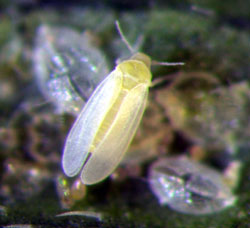
Bearberry whitefly pupae are oval, shiny black, about 0.7 mm (0.03 inch) long and 0.5 mm (0.02 inch) broad. Adults are about 1 mm (0.04 inch) long. The body from the above is blackish and covered with white mealy wax. The base and sides of the abdomen are white, the extreme base of wings yellow, and lower surface of the abdomen is light yellow with the last two segments gray. The eyes are black and completely divided, and the wings are white.
Eggs hatch to a mobile first instar, commonly known as crawlers. Once crawlers find a suitable location to feed and settle, they mature through a few stationary nymphal stages that feed to a final non-feeding nymphal instar, often called a pupa. The term pupa is a misnomer, a loose use of entomological nomenclature, because whiteflies do not truly develop through complete metamorphosis. Bearberry whiteflies colonize the underside of the blueberry leaves; the adults and eggs are commonly found on the lower surface of younger leaves whereas nymphal stages on somewhat older and mature leaves. Whiteflies have piercing-sucking (needle-like) mouthparts.
They feed by inserting mouthparts into plant tissue and sucking the flowing sap or phloem. While feeding, they excrete a sweet, sticky liquid referred to as “honeydew”. Sometimes, they reach such high populations that cover the lower surface of the leaves with nymphs, pupae, and their associated honeydew. The honeydew excreted by nymphs can collect dust, lead to growth of sooty mold, and attract ants.
Growing pumpkins is popular in South Alabama, but it comes with its challenges. Neil Kelly, Alabama Regional Extension agent, said disease management is a huge concern for any grower interested in producing pumpkins.
“The pumpkin crop is a difficult crop to grow in my part of the state. I just throw that out to there to everybody that calls about growing pumpkins. Yes we can do it, but I’m going to tell you up front, it’s difficult and it’s not real consistent,” said Kelly, who serves 10 counties in the southeast part of the state, including Barbour County, Bullock County and Coffee County. “With the different mildews and things they can get, diseases are always an issue because we’re growing them during a time of the year when it’s warm and humid. That warm weather and hot weather and humid weather, coupled with the occasional summer shower and moisture, diseases are very difficult to control in pumpkins.”
Downy Mildew
Joe Kemble, Alabama Extension vegetable specialist, said pumpkin farmers need to be wary of downy mildew, which can be devastating on pumpkins. It requires conventional fungicides, but they must be applied before the disease develops. There are not any fungicides that are curative. He said downy mildew has been found in every county in Alabama.
“You’re going to have to spray your pumpkin crop for disease management on a very regular schedule much like we do watermelons and much like we do tomatoes. You’re going to have to stay on top of disease control in the pumpkins if you want to grow good, healthy pumpkin,” Kelly said.
Curing Pumpkins
Curing pumpkins can also be a problem. It is a process that involves elevating storage temperatures to 80 degrees F or 85 degrees F with 75% to 80% relative humidity for approximately 10 days. The curing process heals wounds, helps ripen immature fruit, enhances color and ensures a longer post-harvest life.
“The next problem that we have with pumpkins, if we get past all of the diseases and we produce a good pumpkin and we get past all of the insects…the next big problem we have with pumpkins in my part of the state is them curing out. When the pumpkin starts to ripen and they start to turn that nice bright orange color and they start to cure out, because of our high humidity and our high temperatures that time of year, a lot of times what you’ll see those pumpkins do is just get soft and start to rot instead of cure out like a gourd; like the typical hard-shelled pumpkin you see in the grocery store,” Kelly said.
Kelly said large pumpkin production areas like Arizona and New Mexico have low humidity, which leads to low disease pressure and pumpkins curing out really well.
“I would say the disease issue and curing are two of the biggest problems that we fight in pumpkin production and there’s really not a lot we can do about some of those. We can put out preventative stuff for the diseases and do the best that we can to head off any kind of issue but very few diseases do we have a curative spray for,” Kelly said.
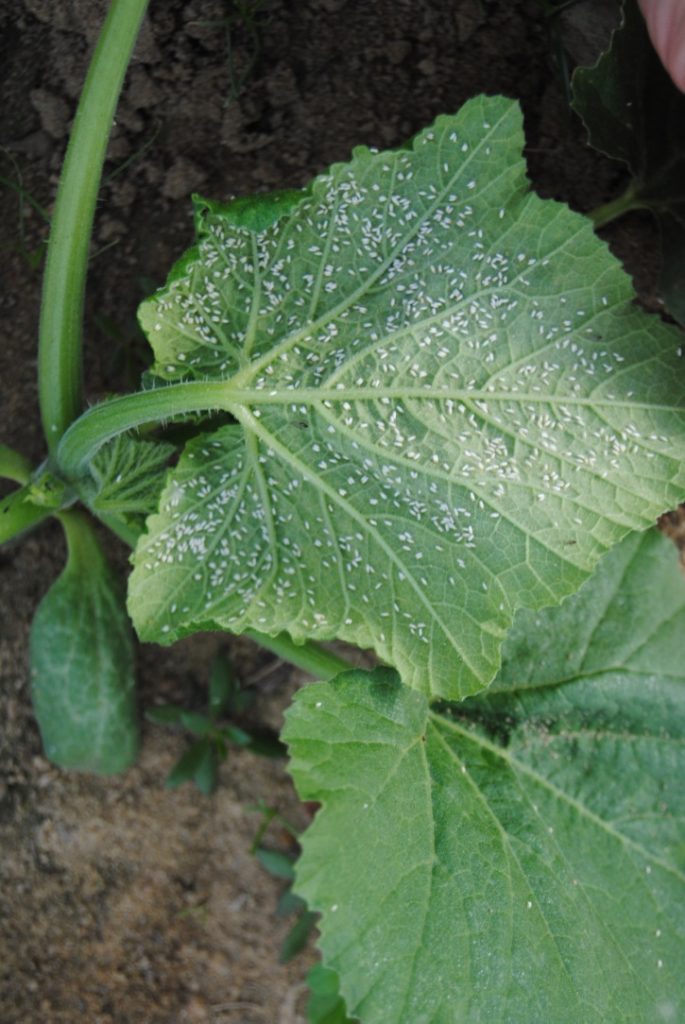
University of Georgia Cooperative Extension vegetable entomologist Stormy Sparks paints an ominous picture of the potential devastation whiteflies will have on this year’s fall vegetable crop.
“We’re probably a month ahead of the last two years. This is going to be challenging fall for whiteflies,” Sparks said.
Vegetable producers across the Southeast have either planted or are currently planting their fall crop. Sparks insists that farmers use resistant varieties when possible to protect against whiteflies and the diseases they spread. Unfortunately, there is not many that are commercially available, except in tomatoes.
“Really, when you’re dealing with viruses, particularly the whitefly-transmitted viruses, the solution to the problem is resistant varieties. The problem is in many cases we don’t have that. The one where we do have it is Tomato Yellow Leaf Curl (virus),” Sparks said. “Fortunately, we have resistant varieties in tomatoes that are commercially available. In the fall you’ve got to have a resistant variety.”
In most cases, whitefly-transmitted viruses are just as devastating as the whiteflies themselves. There is no resistance in yellow squash. In snap beans, there are severe problems with Cucurbit Leaf Crumple Virus and Sida Golden Mosaic Virus.
“With leaf crumple virus right now, in squash; I’ve been planting squash for two months, the most recent planting I’ve probably got about 20% virus right now. If you look at it historically, you go from very low to about 20%. Once you get about 20%, give it about another week or two weeks, you’re typically looking at close to 100%,” Sparks said. “As far as viruses are concerned, at this point, it’s not as bad as I thought it would already be, but I still suspect it’s going to get very ugly in the near future. We did have virus detected in the spring crops late in the season; more than normal. Dr. (Josh) Freeman down in Quincy (Fla.), said in some of his tomato trials in the spring, at the end of the season he had as much as 30% Yellow Leaf Curl Virus. Normally, it’s going to be 5% or less.”
Proper Sanitation
Sparks insists growers practice proper sanitation to protect against future whitefly infestations. Once farmers are through harvesting their crop, they need to get rid of it. If plants are left in the field, they could potentially serve as hosts for whiteflies.
Problem This Year
This is the worst year for whiteflies since 2017. They are a greater problem this year due in large part to the mild winter. While colder temperatures do not eliminate whiteflies, they do kill off many of their wild hosts and slow population development in cultivated hosts. Warmer temperatures allowed for larger whitefly populations to overwinter and become mobile earlier this summer.
Whiteflies migrate from winter vegetables to spring vegetables to agronomic crops, like cotton, to fall vegetables and back to winter vegetables. Whiteflies cause feeding injury issues in vegetables and transmit two new viruses: cucurbit leaf crumple virus and cucurbit yellow stunting disorder virus.
Fire ants continue to be a problem for Alabama hemp producers. It started early in the season and has not let up with more young plants being put in the ground at the end of July.
“We have a real staggered kind of planting date going on because hemp’s a new crop and everyone’s getting their land prepped and seeds approved. There were still fields going in as late as a couple of weeks ago at the end of July,” said Katelyn Kesheimer, Alabama Extension entomologist. “The plants are especially susceptible when they’re really young, short seedlings. With all of the rain we’ve had, there’s been a lot of mating flights of fire ants. You look the morning after a rain, there’s brand new mounds everywhere. That was our first major pest in hemp earlier in the season and it’s continued through.”
So how can farmers avoid a similar fate next season? Kesheimer implores farmers to act this fall.
“If you plan on growing hemp next year, I would highly recommend you take care of your fire ant problem by putting out a bait this fall and maybe again in the spring before you plant. (Otherwise) by the time your plants are in the ground and if you have fire ants nearby, they will find it and you will most likely lose substantial yield to them,” Kesheimer said.
Kesheimer recommends that growers apply bait in October when the weather has cooled and then in April or May.
“I think a lot of people got caught off guard with how bad the ants are. I’ve been getting calls from all different states across the Southeast that have fire ants issues,” Kesheimer said. “With fire ants, I just think they never really stopped. We’ve had some rains and these big mating swarms. They’ll just move around and around so there’s more plants that they’re destroying.”
Clemson Extension agents provided updates in The South Carolina Grower this week about the status of various crops being produced throughout the state.
Statewide
Dr. Matt Cutulle reports, “With all the rain we had in August the weed seed bank is starting to pop. Nutsedge pressure can be really tough in September. For fall cole crop plantings, it is important to initiate the stale seed bed technique (allow weeds to come up and burn them down multiple times before planting). In some cole crops, such as broccoli, Dual Magnum may be used, which provides some pre-emergent suppression of yellow nutsedge (max 60% probably). Following with an in-row cultivation several weeks after planting will strain the photosynthate reserves of nutsedge, which could be lethal to the nutsedge if we get a cold snap in late October.”
Coastal
Zack Snipes reports, “I saw whiteflies everywhere last week. I saw them on just about every crop in the field: squash, zucchini, tomato, peas, eggplant, okra. We have very good options to manage whiteflies so consult with your local agent or look up the specific products for the crop you are growing in the Southeast Crop Handbook. Be careful not to use pyrethroids for whiteflies, as resistance will develop very quickly. Longer lasting, more specific options are available that are better options. I also saw a good many worms last week such as the melonworm in cucurbits and the beet armyworm in other crops. If you have whiteflies and worms in a crop then the group 28 insecticides (Coragen, Verimark/Exirel, Harvanta) are excellent options to take care of both pests at the same time with good residual.”
Whitefly infestations are severe in some places on the Coast. Photo from Zack Snipes.Whiteflies on tomato leaves. Photo from Zack Snipes.
Midlands
Justin Ballew reports, “Last week was extremely hot and dry, though we finally got some relief from the heat over the weekend. Crops are progressing well, though we are seeing caterpillar activity increase. We’re seeing diamondback moth and cabbage loopers in brassica crops and armyworms in tomatoes. Be sure to rotate insecticide MOA’s when treating for caterpillars. I’m also seeing a few whiteflies around but nothing severe yet. Black rot is starting to show up on some brassicas. Strawberry growers are starting to apply their pre-plant fertilizers in preparation for shaping the beds.”
Black rot getting started on a young collard plant. Photo from Justin Ballew
Pee Dee
Bruce McLean reports, “Muscadine harvest is starting to wind down. Harvest looked good and had very good yields. Brix averaged out at 13.5% to 14.5%, depending upon the cultivar and the vineyard. Now is a good time to evaluate successes and problems from this season and write them down while they’re fresh on your mind. Also, look at the overall amount of foliage on the vines. Is it too much? Not quite enough? Start planning how you need to adjust fertility for next year. A post-harvest potassium fertilizer application has proven to be beneficial to the crop (in on-farm settings), especially in wet years. Overall plant health, spring emergence and vigor, and next year’s yields should be well improved.”
A bin of Carlos muscadines ready to be loaded and delivered for processing. Photo from Bruce McLean.
Tony Melton reports, “Getting dry and need some rain. Busy planting turnips, mustard and collards. Harvesting processing sweet potatoes as quickly as they can process them (problems in the plant). Picking pickles and yielding much better with dryer conditions. Also, pickling plants having trouble with getting enough labor so very few peppers harvested. Still spraying processing peas for cowpea curculio. Watch out for southern stem blight. It is still raging havoc.”
Upstate
Kerrie Roach reports, “The last few peaches are making their way to stands and markets. Things are continuing to look good as the apple crop progresses in the upstate. Growers to the north in Hendersonville, North Carolina suffered multiple hail events, causing a large amount of damage, but South Carolina growers seem to have escaped the worst of it. Vegetable production has slowed significantly with many small growers finishing for the season over the next few weeks. Muscadines are coming into their prime and look to be highly productive this year.”
Golden Delicious apples that still have a little ways to ripen for optimum sugar content, but work great for baking. Notice the green tint. As they continue to ripen, a yellow cast & even a blush may appear. Photo from Kerrie Roach.
Andy Rollins reports, “These plants were found positive for Phytopthora root rot last week in an early upstate strawberry planting. Inspection of plants when they arrive can accurately diagnose this problem. Brown to blackish colored roots are characteristic. A small portion of this material is taken from 5 to 10 plants then placed into a pouch that accurately identifies the presence of Phytopthora within a few minutes. As in picture, one line tells you the test worked properly and two lines indicates presence of the fungus. Early treatment with Ridomil and or any of the phosphite (Rampart/Prophyt) is very helpful but must begin quickly if plants are widely infected for the best results.”
Dark colored roots are a characteristic symptom of Phytophthora root rot. Photo from Any Rollins.An immunostrip test can be used to diagnose phytophthora. Two horizontal red lines on the strip (right side of the bag) means the sample is positive for phytophthora. Photo from Andy Rollins.
Many specialty crop producers are eligible for aid payments under USDA’s Coronavirus Food Assistance Program (CFAP), which covers more than 130 types of specialty crops.
That was Administrator for the U.S. Department of Agriculture’s (USDA’s)Agricultural Marketing Service (AMS), Bruce Summers, who urges specialty crop producers to take another look at CFAP before the Sept. 11 deadline.