Auburn University Assistant Professor and Extension economist Adam Rabinowitz expects more growers to participate during this current sign-up period for the Coronavirus Food Assistance Program 2.
There’s no reason for growers to wait, go ahead and sign up for the program, which continues through Dec. 11, 2020.
Rabinowitz
“I do expect more participation. I would encourage producers to look at this as a program that’s certainly there to help them through this current period,” Rabinowitz said. “There’s a lot of coverage there in terms of the CFAP 2 program. Anything you can imagine that’s being produced in our region is covered.”
Vegetable and Specialty Crops Impact
It’s especially true for vegetables and specialty crops. More than 230 fruit, vegetable, horticulture and tree nut commodities are eligible for CFAP 2. Visit farmers.gov/cfap/specialty for a full list of eligible commodities and more information on CFAP 2 eligibility and payment details related to these commodities.
“Virtually every specialty crop is included and is based on 2019 sales. As a percentage of those sales depending on what those total gross sales are in 2019 will be what that payment is under the CFAP 2 program,” Rabinowitz said. “There’s very little from a specialty crop standpoint that was excluded; well over 230 fruits and vegetables, nuts, nursery products as well; cut flowers, plants. We’re talking agricultural products that have never received federal assistance in the past are included in this.”
Financial Impact
According to the USDA, an additional $14 billion is made available for agricultural producers. The USDA will use funds being made available from the Commodity Credit Corporation (CCC) Charter Act and CARES Act to support row crops, livestock, specialty crops, dairy, aquaculture and many additional commodities.
“The USDA is confident in the numbers and there’s enough funds there to cover all that. I think historically we know that in some of the specialty crop grower cases, they don’t have these programs, so they often don’t know about them and don’t take advantage of it. I’m not sure if it’s an expectation that a little uptake will take care of it or if USDA has that much confidence in their calculations, but it is pretty substantial,” Rabinowitz said. “There are payment limits that do come into play.”
The most dangerous threat to the peach industry in the Southeast is Oak Root Rot, a soil-borne fungus that can wipe out peach trees, according to Edgar Vinson, Alabama Extension Professor of Horticulture.
Oak Root Rot or Armillaria Root Rot, causes stunted leaves, yellow defoliation, chlorotic leaves, death of branches and, ultimately, death of the tree.
Unfortunately for peach producers, there’s not many management options available to offset the death sentence for peach trees that are planted in a field with this disease.
“As far as we know, once it’s in the soil it’s there probably for good,” Vinson said. “Once the tree starts to succumb to it, there’s no remedy for it. There’s some things to delay it, if you have a tree that’s planted in the soil that has Oak Root Rot. If you’re planting into soil that has Oak Root Rot, there’s really no remedy for it. It will eventually take over the tree and take the tree out.”
One Option
Farmers can implement a root collar excavation. This is a management tactic that producers utilize to remove soil from the crown of the tree to prevent the fungus from growing on the crown. This only delays the inevitable. Eventually the tree will succumb to the disease, but this practice extends the life of the tree so the grower can get more harvests out of it.
The best option would be to plant a resistant root stock. However, one is not broadly available yet.
“Most peaches don’t come from the nursery on their own roots. They’re budded onto a rootstock that’s tolerant to a particular soil condition or diseases. You have a desirable peach variety that’s grafted onto a resistant rootstock. That’s typically how we receive our peaches, apples and a number of other crops,” Vinson said.
Oak Root Rot symptoms usually appear between 5 to 7 years after planting.
“It’s a disease that’s recognized all over the Southeast. We’re currently working on ways to mitigate the damage,” Vinson said.
There is currently little to no science-based information on the efficacy and safety of most essential oils in pest management of fruit crops like blueberries, so a multistate team is working together to learn more.
By Josh Paine for UGA CAES News
Organic fruit and vegetable growers want to meet the recent uptick in national consumer demand, but they need additional tools to battle pests and diseases that often accompany organic crop growth.
One such tool may be the use of essential oils. That’s why the U.S. Department of Agriculture National Institute of Food and Agriculture awarded a nearly $2 million grant to a team of scientists for an Organic Agriculture Research and Extension Initiative project to study the degree to which essential oils can help suppress certain pathogens and pests.
Jonathan Oliver, assistant professor in the University of Georgia College of Agricultural and Environmental Sciences at the UGA Tifton campus, is part of the team of 15 scientists who will work on this project nationwide. Researchers from the University of Florida, Clemson University, the University of California, Riverside, the University of Hawai’i at Manoa and the USDA Agricultural Research Service will collaborate on the project.
In his role as a small fruit pathologist in the Department of Plant Pathology, Oliver will investigate the use of essential oils in organic blueberry production, the state’s top fruit crop.
“Blueberries are the highest value fruit crop in Georgia, and organic blueberry production represents a growing proportion of our total acreage,” said Oliver. “Nonetheless, organic production of blueberries in Georgia faces many challenges, because our hot, humid climate is ideal for many disease issues including fruit rots and leaf spots. Our growers need better tools to help them manage these disease problems.”
Funding for the four-year research program will support scientists with expertise in fruit crop management and physiology, plant pathology, entomology, postharvest biology and organic production.
To carry out the project, scientists will:
Evaluate the plant safety and horticultural impact of essential oils in managing diseases in fruits including blueberries, peaches, mangos and avocados.
Begin to test plant disease efficacy claims of essential oil products marketed for organic producers.
Evaluate organically certified plant essential oils on targeted pathogens such as algal stem blotch, brown rot, scabs, gray mold and powdery mildew.
Determine the efficiency of essential oils on fruit shelf life through postharvest testing.
Test the efficacy of essential oils against insects including scales, thrips and mites, although arthropod pests are not the primary focus of this research.
After they gather their new data, participating scientists will communicate the results of their research to organic fruit farmers and those who grow conventional crops, so that those producers can rapidly adopt any new practices. Scientists will also evaluate the effectiveness of the project through continuous feedback from stakeholders.
“Through this research project, we hope to provide Georgia growers with the information they need to make decisions regarding the use of essential oils as a part of their organic fruit disease management program,” said Oliver. “Since Georgia is the largest producer of blueberries in the Southeastern U.S. and one of the top producers in the nation, providing Georgia growers with information and tools for safe and effective organic disease management has the potential to have a broad impact in Georgia and on the Southeastern organic blueberry production industry as a whole.”
Organic food sales topped $50 billion in the U.S. in 2018. Statistics from the Organic Trade Association tell part of the story of this growing market: fruits, vegetables and other specialty crops combined to make up 36.3% of total organic sales, up 5.6% from the previous year.
A cover crop mix of sorghum and sunn hemp produces positive results for Honeyside Farms.
By Tiffany Bailey and Ida Vandamme
It was about 18 months ago when we began planning our first crop to be planted on our newly certified organic field at Honeyside Farms in Parrish, Florida. The field was previously used for pastureland. It was easy to see that we would be starting from a soil structure that is common in our area: very sandy with low amounts of existing organic matter. We quickly learned that building these soils would need to become a priority.
It can be common for issues to surface during the first few months of converting from perennial pastureland to vegetable production, and that is exactly what we experienced. Our first major problem was due to the microbe populations living in the soil. We were tilling the land for the first time in possibly decades, and we believe that practice turned the existing microbial ecosystem on its head.
Without the introduction of good bacteria and fungi suited for vegetable farming, our organic crops were especially vulnerable to disease pathogens coming from infected seeds, neighboring farms and even on our equipment and shoes. It was a huge challenge! But, over time, we began to build up the proper microbe population for our farm. Planting cover crops proved to be an important part of building healthy soil.
COVER CROPS OFFER BIG BENEFITS
Cover crops are a very helpful tool in aiding and maintaining this transition. Unlike perennial pastureland, cover crops for vegetable farming are annual, covering the ground for a few months at a time (very convenient for your off season when it’s not practical to grow your main crop). Cover crops grow very fast, covering and protecting the soil from erosion.
Root mass grows down, infiltrating, breaking up compaction, improving structure and excreting exudates that condition the soil and attract good bacteria. Above ground, leaf matter adds literally tons of biomass that contributes to organic matter when broken down and attracts all kinds of beneficial insects and wildlife. There are so many more benefits to cover crops; these are just the main ones.
COVER CROP OPTIONS
Honeyside Farms has grown sorghum-sudangrass, sunn hemp, buckwheat and cowpeas for cover crops. As an organic farm, we preferably use organic seed. However, organic cover crop seed is not always widely available. Most certifying agencies will make exceptions when certified organic seed is not available.
Sunn hemp is probably our favorite cover crop. According to a Sustainable Agriculture Research and Education publication, sunn hemp can produce 5,000 pounds of dry matter per acre and 120 pounds of nitrogen per acre. That’s enough slowly available nitrogen to feed some crops from start to finish without needing to add any extra nitrogen.
Sorghum is also very beneficial. The sorghum-sundangrass hybrid is more productive in biomass and leaf matter, which is more beneficial as a cover crop than grain sorghum. Sorghum-sudangrass has been recorded to produce up to 18,000 pounds of dry matter per acre. The roots are perfect for scavenging any leached nutrients from the previous crop and putting them within reach of the next crop, thus minimizing pollution and making effective use of nutrition. Sorghum is also known to suppress diseases and nematodes by breaking up their life cycle and producing compounds toxic to them.
Cowpea is a legume. As a climber, it can be a nice addition to any tall cover crop mix like sunn hemp and sorghum. We have seen that cowpeas and buckwheat can provide significant sources of nectar and food for beneficial insects that we want to attract to the farm. Buckwheat acts as a great short-term cover and easily breaks down. It’s perfect for the 40- to 50-day gap between crops when other covers would take too long.
COVER CROP MANAGEMENT
When planting, it’s important to broadcast the proper amount of seed per acre. If the seed is planted too thin, one can miss out on biomass production. But there is no need to waste seed and money planting too thick. Before applying any fertilizer to the cover crops, we take samples and follow what the soil report recommends at planting.
The best time to knock down the cover crop is when the biomass is optimized, but before the carbon-to-nitrogen ratio gets too high and before seed set to prevent weeds. We allow a few weeks to let the cover crop break down enough so that it is not tying up nitrogen that should be available for our main crop. Sometimes before planting a cover crop, we can tell that this timing will not match when we need the field ready to grow a crop. But we find it better to still plant cover crops and gain some of the benefits rather than let the land sit bare and gain nothing or possibly even lose valuable soil due to erosion. Allow a few weeks to let the cover crop break down enough that it is not tying up nitrogen that should be for your main crop.
Most challenges come from what is limited by resources, time and practicality. Nothing will be gained if no time is taken to plan for cover crop management. But with proper intention and planning, planting cover crops will provide long-term benefits for many seasons to come.
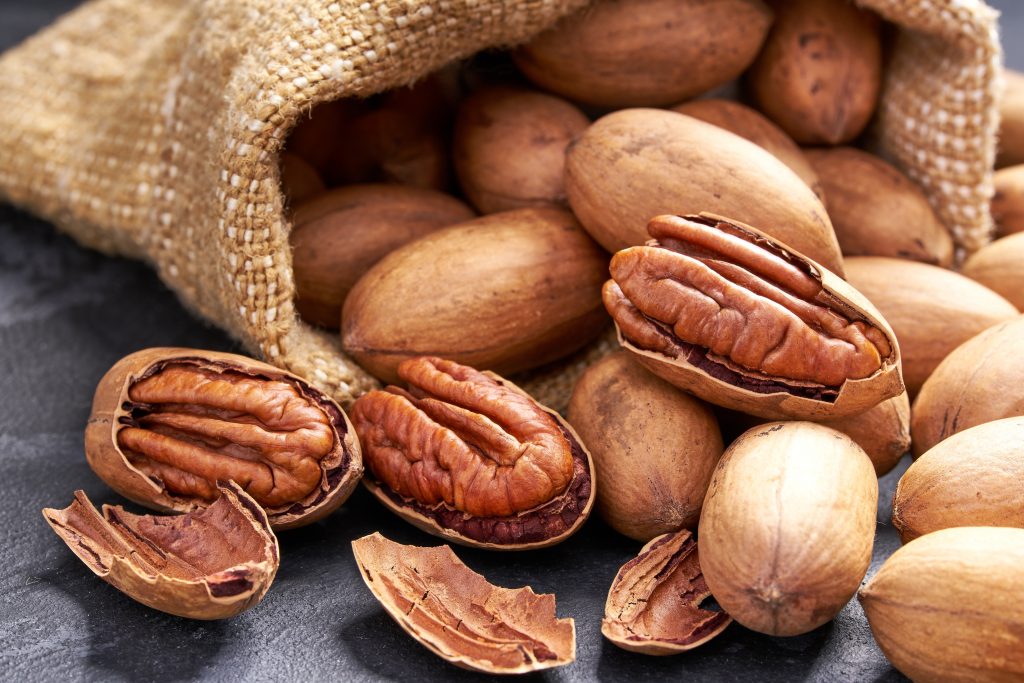
The pecan crop in the Southeast remains ahead of its normal production schedule, though cooler temperatures in recent weeks have slowed the crop’s progress, says Andrew Sawyer, University of Georgia Cooperative Extension area pecan agent for Southeast District.
“I think the cool (weather) has actually slowed us down a little bit,” Sawyer said. “The crop was already 10 (days) to two weeks ahead anyway. We’ll still be ahead in the long run.”
Farmers have already begun harvesting pawnee varieties. In normal production years, pawnees are usually the first varieties harvested, and then there is a gap before the rest of varieties are mature enough for harvest. However, others are already showing signs of being ready to be picked, Sawyer said.
“Desirables are cracking pretty strong which is probably on the early side for them, too. They’re looking good. Everything’s about to really get ramping up,” Sawyer said.
All in all, this year’s pecan crop is projected to be one of the largest crops in recent memory, especially since Hurricane Michael impacted the region in 2018, disrupting production.
“Definitely the biggest in a long time. It is going to be a big crop,” Sawyer said. “Expect some lower prices for sure.”
Fire ant control is essential for Alabama vegetable growers hoping to protect their crop this fall. Alabama Cooperative Extension warns producers that fire ants are known to be pests of numerous vegetable crops, including okra and potatoes.
Ayanava Majumdar, Alabama Extension Professor, said fire ants can especially be harmful to vegetables because they’ll congregate on plants that have a heavy load of aphids. They will tend to protect aphids and other honeydew producers on vegetables. Fire ants can also damage the crops themselves and contaminate the produce.
“I think the issue is they get on plants that get a heavy load of aphids. They follow aphids. If plants have aphids you often have the ants protecting the aphids,” Majumdar said.
Few Management Options
Alabama Cooperative Extension offers producers a few management options. Control fire ant mounds around or outside the vegetable production area to prevent them from moving into the garden or field. Also, manage excessive plant residue on the soil. This will help increase detection of foraging ants, provides ants fewer places to hide and make it easier to scatter bait insecticides on open ground.
The best time to apply broadcast baits is now through Oct. 15. Mound treatments may be done year-round on warm, sunny days above 65 degrees F when the fire ants are active. Majumdar attests that the ants are active now.
“They’re pretty active in my peanut fields. They’re pretty active in and around my vegetable fields and my garden. They’re very active,” Majumdar said.
“We are so excited to announce Bay and Lake Pharmacy as our first pharmacy partner,” stated Jammie Treadwell, co-owner of Treadwell Farms. “They truly care about the community and the people who live here. By carrying our Treadwell Farms hemp CBD extract product line, they will make a lasting impact on those who are looking for a more natural option for their body’s wellbeing.”
Treadwell Farms officially launched the first of its CBD product line in May 2020, in tandem with the announcement of receiving one of the first hemp cultivation licenses in Florida. After receiving its food permit in February 2020, the company was able to process the first of its high potency, artisanal CBD line – 1200mg bottles of Essential Blend Hemp CBD Extract Oil and Citrus Spice Hemp CBD Extract Oil. Both are infused with organic MCT oil and Sunflower Lecithin. The Citrus Spice Extract also contains organic Orange, Cinnamon, Turmeric and Ginger.
“We are excited to be working with a locally-owned CBD company who’s embodies high quality and production of its products,” said Gordon Punt, registered pharmacist for Bay Pharmacy. “Treadwell Farms high potency CBD, combined with essential oils, provide a unique product to offer our patients. Supporting local businesses is important to us, especially supporting our local farmers. We’re looking forward to a successful future – together – with Treadwell Farms.”
All the Treadwell Farms CBD Hemp Extract tincture droppers come with .25mL, .50mL, .75mL, and 1mL measurements to help manage dosage intake. “We approach our products with purposeful intent – especially for the clients of our trusted partners like Bay and Lake Pharmacy,” said Jammie Treadwell, co-owner of Treadwell Farms. “Each bottle contains 1200mg of CBD, and that’s a beautiful thing because it means you’re receiving high potency, high-quality CBD oil every time. It’s also by design because it makes dosing easy – 10mg per quarter dropper.”
All Treadwell Farms products are produced in the company’s processing facility in Umatilla, Fla. The company’s ultimate plan is to be a cultivator of the hemp industry for the region by advising local farmers through the planting, harvesting, and processing of the plants, and then ultimately extracting the cannabinoids (CANNA-BIN-OIDS), including CBD, from Florida-grown hemp plants for packaging and sale.
For more information about Treadwell Farms, visit www.TreadwellFarms.com. Follow the Treadwell Farms blog, which provides insightful information about CBD and the hemp plant – amongst other details throughout the year. Follow on Facebook and Instagram at Treadwell Farms.
The nation’s essential agricultural industry has worked relentlessly through the COVID-19 pandemic to ensure food is put on the tables of American families. Agricultural employers recognize that the health and safety of their employees are imperative to the success of their operations. These employers also recognize consumer demand for fresh, safe and nutritious produce. For years, agricultural employers have adhered to strict policies assuring the health, hygiene and safety of their employees. Now, these employers have implemented even more protocols in response to the COVID-19 pandemic.
During the 46th annual Agricultural Labor Relations Forum presented by the Florida Specialty Crop Foundation, Michael Marsh, president and CEO of the National Council of Agricultural Employers (NCAE), spoke about essential protections for agricultural workers during the COVID-19 pandemic.
Marsh says growers have been doing a great job following the Centers for Disease Control (CDC) guidelines for agricultural workers by promoting safety on and off the farm.
Across the agriculture sector, employers have instituted best practices including social distancing, enhanced hygiene and sanitation stations and procedures, special COVID-19 employee training, the use of personal protective equipment (PPE) and limitation of non-essential visits and travel.
In addition to following CDC guidelines, industry members are also calling for the federal government to take additional steps and devote new resources to help growers protect their employees.
Alternative housing structures to facilitate greater social distancing, accessible and timely COVID-19 testing resources, and prioritizing PPE and future vaccine distribution for the food and fiber supply chain are among the list of items that the agriculture industry would like to see addressed.
Since hotels aren’t always available in rural communities, housing with more rooms and more beds would allow for additional social distancing among employers.
The NCAE published a frequently asked questions document for H-2A employers regarding COVID-19 issues. See the document.
Ashley Robinson, AgNet Media communications intern, wrote this article.
According to the UGA Extension blog, Pam Knox, University of Georgia Cooperative Extension Agricultural Climatologist, said the impacts for the Southeast from soon-to-be Hurricane Delta remain the same, with the biggest effects in Alabama, western Georgia and western end of the Florida Panhandle.
A stronger storm means that storm surge along the coast is likely to be higher than it would be if the storm were weaker. By the time it makes landfall Friday night, it should be moving pretty good, which will reduce the amount of rainfall at any one location. You can get updated information from the National Hurricane Center.
Delta developed six weeks earlier than the only other time we have had a storm Delta back in 2005, another very active year.
Early results on low-chill varieties are expected next year from an olive research grove in Hardee County.
By Michael O’Hara Garcia
With weather and soils similar to the Mediterranean Basin, olives grow in Florida and throughout much of the southeastern United States.
Currently, Florida has approximately 800 acres of olives under active cultivation by 60 to 80 individual farmers in 20 counties. The groves range from backyard hobby plots with several trees to high-density commercial operations of 100 or more acres.
There are two modern olive mills, and several Florida nurseries propagate olive trees for fruit and ornamental purposes. A few miles over the Florida line, the Swiss agricultural management firm, Agrigrada, operates a 4,000-acre olive grove near Colquitt, Georgia, and a 300-acre olive grove and a modern olive mill serving growers near Valdosta, Georgia.
PRODUCTION AND VALUE
Thought to originate in the Fertile Crescent (Syria, Iraq and Iran), olive is the world’s oldest known continuously cultivated crop. For thousands of years, olives were gathered in the wild. The oil was crudely extracted by crushing fruit between stones and sieving or straining the pulp. Today, olive oil is a major commodity traded throughout the world and prized for its gastronomic and heart-healthy characteristics.
Michael O’Hara Garcia (left) and Don Mueller show off freshly harvested olives at Greengate Olive Grove in the Florida Panhandle.
Spain is by far the largest producer of olive oil, followed by Italy and Greece. In the United States, olives are commercially grown in California, Oregon, Washington, Texas, Arizona, Georgia and Florida. There are hobby and experimental olive plantings in Louisiana and Alabama.
The United States consumes 80 to 90 million gallons of olive oil per year or about 1 liter per person. Domestic farmers, going at full throttle, produced less than 5 percent of total annual consumption.
European Union market data from 2019 reveal 1 liter of olive oil sells for $5.56 or $21 per gallon. California Olive Ranch, the largest U.S. producer, retails 1 gallon of extra virgin olive oil (EVOO) for $67.36.
Organic certification brings even higher prices. Braggs organic EVOO (imported from Greece), sells for $70 per gallon. Apollo, a top California producer, retails its Mistral and Sierra organic blends for the equivalent of around $200 per gallon. Mistral oil is based on the Ascolana, an olive variety currently producing at Greengate Olive Grove near Marianna in the Florida Panhandle.
NEED FOR RESEARCH
Although the olive grows in Florida, it has been considered more of a curiosity than a commercial crop. While the University of Florida/Institute of Food and Agricultural Sciences (UF/IFAS) and Florida A&M University have olive observation plots, and agribusiness giants like Mosaic and Lykes Brothers have small experimental groves, little formal research on Florida olive cultivation is available to support industry development.
Bill Lambert shows an olive graft in a Hardee County research plot that includes 45 olive varieties under trial.
With the notable exception of work by the UF/IFAS Department of Entomology and Nematology, most information on the UF/IFAS Extension website dates from 2012 and is focused on California olive research and production. The Texas A&M University website provides significantly more information on growing olives in the Southeast.
The Florida Olive Council, a non-profit grower organization, conducts some research, and the Hardee County Industrial Development Authority has several thousand olive trees at its research facility near Wauchula, Florida.
Erroneously, some fear Florida’s humidity harms olive pollination, summer storms damage the olive crop, or disease prohibits profitable cultivation. While extreme weather impacts all crops, UF/IFAS researchers determined principal pests and diseases like olive fly, olive knot and peacock spot are not found in Florida.
The main problem cultivating olives for commercial purposes in Florida is the availability of varieties adapted to lower latitudes where there is less winter chill. Olive varieties (Arbequina, Koroneiki, Manzanilla, etc.) commonly used in commercial operations are native to northern Mediterranean countries like Spain, Italy and Greece (38° to 41° north latitude), where 300 to 400 hours of winter chilling are common. Olives must accumulate enough chill hours between November and March to bloom. A chill hour is one hour between 32 and 45° F.
While northern Mediterranean varieties grow throughout Florida and reliably produce in the Panhandle, they rarely bloom and fruit south of Interstate 4 (27° north latitude).
As Florida searches for a solution to citrus greening, many acres below Interstate 4 are fallow, and farmers need an alternative crop to augment citrus. New crop ideas like industrial hemp are popular, but the U.S. Department of Agriculture (USDA) suggests returns on industrial hemp are between $116 to $475 per acre compared with Florida citrus at $2,800 per acre and California olives at $2,688 per acre.
Responding to the need for olive research, the Hardee County Industrial Development Authority enlisted the support of the Florida Olive Council and UF/IFAS to begin research developing a market-viable, “low-chill” olive for southern Florida.
After installing several thousand mature olive trees on an old citrus grove, the Hardee County researchers secured 45 olive varieties from the USDA olive germplasm in California. Varieties were selected based on geographic origin. The researchers wanted olives adapted to areas around 27° north latitude.
100-year-old olive trees are growing in Ruskin, Florida.
In June 2018, the Hardee research team grafted 45 varieties from Morocco, Tunisia, Algeria, Syria, Pakistan, Egypt, Israel and several countries in the southern hemisphere (Chile, Peru, Argentina and southern Australia) onto mature olive trees at the 20-acre Hardee County research farm near Wauchula, Florida.
Bill Lambert, executive director of the Hardee County Economic Development Council, hopes to see some early results next year. “It takes at least three years for the grafts to mature enough to bloom, so we expect to start looking for our low-chill candidates next year,” Lambert said.
In addition to the grafting experiment, Lambert is in discussions with UF/IFAS to explore developing a low-chill variety using a new gene-editing process called CRISPR-Cas9.
Kevin Folta, a noted UF/IFAS genetic scientist, has begun basic research. He hopes to get the program fully funded soon. “The science is there, we just need to get to work,” he said.