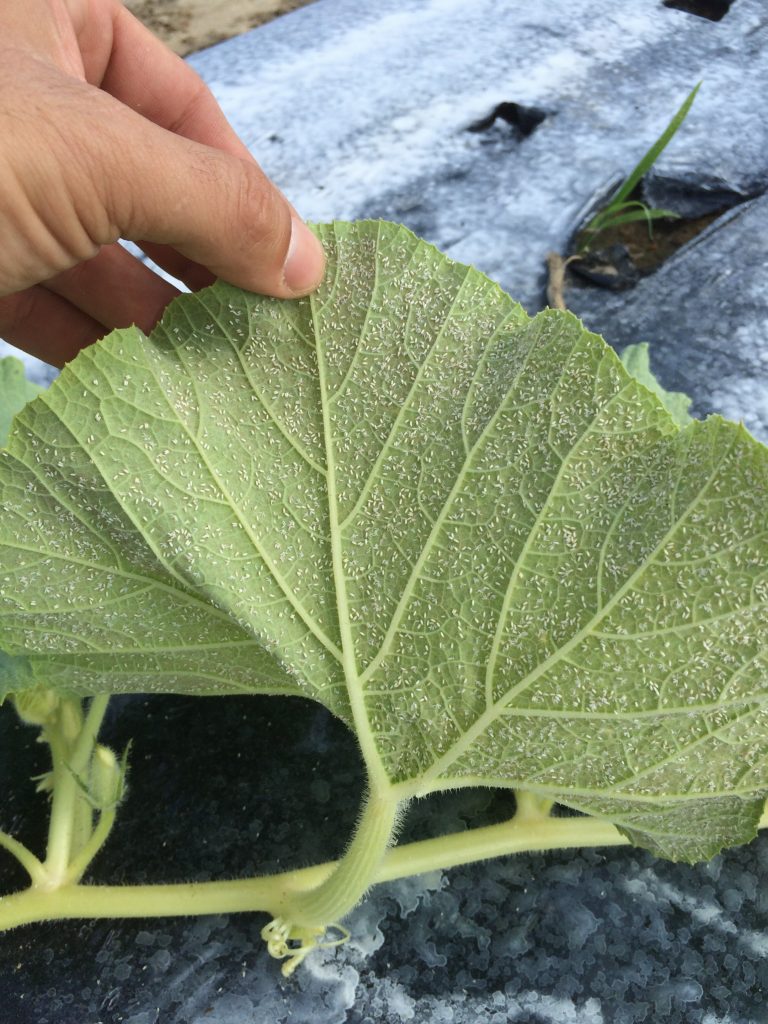
Around the Central Florida area, respondents report that whiteflies remain active in tomato and melons at mostly low numbers.
Growers and scouts in Southwest Florida report that whitefly pressure has declined with recent rains. Scouts report finding mostly low numbers in cucurbits, eggplant and tomato. But there are flare-ups reported with higher numbers showing up in eggplant and squash.
Scouts are reporting finding mostly low numbers of whitefly in eggplant on the east coast.
Reports from Homestead indicate that whiteflies are present in oriental vegetables.
Management
Management of whiteflies later in the season depends on early suppression of whitefly populations. Growers need to be aggressive with the best systemic materials like Venom, Sivanto Prime and Verimark, early in the season. Growers who are on seepage and not drip are at a particular disadvantage if whiteflies and virus are high early in the season.
Preventative soil applications of either imidacloprid, thiamethoxam, dinotefuran, flupyradifurone or cyanatraniliprole should be used preventatively in tomato and cucurbits.
Proper scouting is essential to manage silverleaf whitefly. Over the years, University of Florida entomologists have developed usable action thresholds that have been successful for many tomato farmers. However, these thresholds are only guidelines. Farm managers may modify them to fit their situations and expectations.
Thresholds
Silverleaf whitefly thresholds
0-3 true leaves 10 adults/plant
3-7 true leaves 1 adult/leaflet
Field hygiene should be a high priority and should be an integral part of the overall strategy for managing whitefly populations, whitefly-vectored viruses and insecticide resistance. Growers are advised to be alert for volunteer tomato or cucurbits that may be present in row middles and field margins as these may be a source of whiteflies and virus.
Florida-grown tomatoes – particularly the UF/IFAS-bred Garden Gem – pack a tasty punch for tomato juice, new University of Florida research shows.
By and large, the biggest market for Florida tomatoes remains food services. They’re not generally harvested for processed products, such as juice, paste and more. But they’re still fresh, whole tomatoes.
For years, researchers have toiled to help breeders develop the genetic traits to give UF/IFAS-bred tomatoes more flavor.
Now, for a newly published study, scientists used six UF/IFAS varieties to process into six different tomato juices. In three testing panels comprising a total of 255 consumers, researchers asked the testers at the UF Sensory Lab how they tasted and smelled. The verdict: two “thumbs-up.” While other varieties fared well in the tests, panelists consistently rated juice made from the Garden Gem significantly higher for aroma, flavor and texture.
“I think this study shows that Florida tomatoes are viable for making processed tomato products,” said Paul Sarnoski, a UF/IFAS associate professor of food science and human nutrition. “Our juice exhibited better flavor – with more fresh and fruity attributes closer to that of a fresh-picked tomato.”
Better Tasting Tomatoes Lead to Improved Tomato Juice Flavors
Sarnoski, lead author of the new paper that summarizes the research, said better-tasting tomatoes lead to improved tomato juice flavors. So, it behooves tomato growers to produce tomatoes that go beyond the bland flavors of the past and deliver tasty products to consumers.
Sam Hutton, a UF/IFAS associate professor of horticultural sciences and tomato breeder at the Gulf Coast Research and Education Center, believes the new data on tomato juice will help his efforts to develop tastier tomatoes for farmers to grow.
“This research is interesting to me because the chemistry of better-tasting juice is very similar to the chemistry of better-tasting tomatoes,” Hutton said. “So, these results help to direct my program’s efforts to develop varieties with improved flavor, especially ones with more of these fruity attributes. Such varieties may then be more preferred by consumers and could help boost demand and consumption of Florida tomatoes.”
Better Marketing Opportunity?
Now that researchers know Florida-grown tomatoes are good for tomato juice, scientists want to know whether Florida tomatoes can be marketed at a cost-effective price. Once they clear those hurdles, scientists hope to help producers stock grocery stores with Florida-grown tomato products. Generally, processed tomatoes are sold for less money than fresh-market ones and need to be processed into a juice, sauce, paste and so forth, Sarnoski said.
Toward that end, scientists need to find out whether — working with farmers — they can produce tomatoes at a cost that’s competitive with other regions. They also need to know whether Florida has the food-processing infrastructure in place. If not, does the industry need to adapt existing food processing infrastructure to produce processed tomato products?
“I think these two questions relating to costs need to be answered before juice from Florida processed tomato products end up in a supermarket,” Sarnoski said. “Right now, in Florida, most of the juice processing is focused toward citrus. Perhaps some of that infrastructure can be modified to make tomato juice.”
RALEIGH – After several years of weather-related setbacks, North Carolina pecan growers are reporting a strong crop. That is welcome news for farmers such as Tim Haithcock, who has been growing pecans for over 25 years.
“My trees have been heavy,” Haithcock said. “They are looking very, very good with plenty of pecans on every variety.”
Haithcock owns Indian Springs Pecans in Goldsboro. The 107-acre farm has about 30 acres of pecan trees as well as a nursery that grows trees for other commercial pecan operations. Haithcock attributes the good crop to adequate moisture and sunshine throughout the growing season. In addition, no major storms impacted eastern North Carolina during this year’s hurricane season.
Haithcock began hand harvesting early-variety pecans at the end of September. He plans to start full-scale harvesting in the coming weeks. North Carolina’s pecan season will ramp up in early November and run through the end of the year.
“Consumers should have no trouble finding North Carolina pecans this season,” said Agriculture Commissioner Steve Troxler. “Local pecans will be available in retail stores, at area farmers markets and directly on the farm. Wherever you shop, be sure to look for the Got To Be NC logo to know you’re getting a quality product from North Carolina farmers.”
North Carolina is one of the top 10 pecan-producing states in the nation. Local farmers grow between 4-to-5 million pounds of in-shell pecans annually. While pecan trees can be found across the state, most commercial orchards are in eastern and southeastern North Carolina. To find a local orchard near you, go to www.buyncpecans.com.
Hemp harvest is under way in Alabama, but quality may not be what farmers had hoped for in their second year of production.
It’s understandable, though, considering the challenges that producers dealt with during the growing season, says Katelyn Kesheimer, Auburn University Assistant Professor and Extension Specialist.
“It’s not fantastic. I wouldn’t say there’s a lot of good quality hemp out there, just between disease, insects and rain and late plantings. I fear that we’re not going to have the quality that a lot had hoped for,” Kesheimer said. “I’ve gotten calls from buyers that are looking for smokable flower grade hemp and they can’t find enough. Folks from Georgia are looking in Alabama and I was like ‘eh’; a lot of it is going to be harvested and extracted but the flower, and quality just isn’t there that I think a lot of the buyers are looking for.”
Kesheimer said the price of CBD oil has dropped significantly, which doesn’t make it economically feasible to extract the oil and then sell. This has forced buyers to consider other options.
Tough Growing Season
Hot and dry conditions highlighted last year’s production season. But it’s been much different this year with the wet environment the hemp has grown in. It’s led to countless battles with plant diseases. Ant swarms were also problematic throughout the season.
“The price of CBD oil has gone down so much and it’s going to cost you to extract that oil and it’s not always economically feasible to pay someone to get the oil out of that plant and then sell it. You can’t afford it. You’re not going to make a profit,” Kesheimer said. “The other option is large quantities of high grade smokable flower, but it can’t be full of bud rot or have caterpillar damage or any other disease. I think some of the large groves didn’t end up with the great quality that some buyers are looking for, and then there are some people that will process it but they won’t buy your end product. We’ve been talking about this for a year but the supply chain, it’s not there yet.”
One University of Georgia (UGA) research project in 2021 will be aimed at protecting produce packing plants from Listeria, according to Francisco Diez, Director and Professor at the UGA Center for Food Safety in Griffin, Georgia.
The lead investigator is Diez. The grant project is funded by the Center for Produce Safety and covers the entire 2021 year. His objective will be to see if the antimicrobial blue light, which has shown antimicrobial effects and is considered safe for humans, can kill the Listeria monocytogenes.
“It’s been found by a number of reports that blue light can be lethal for some bacteria. There’s been applications of blue light in some settings like hospitals in which they can leave the blue light on and eventually that protects if there’s any presence of bacteria on the surface in the room; on floors, on walls or other materials,” Diez said. “What we’re trying to address in this proposal is under simulated conditions in the laboratory that will resemble surfaces that would be found in a packing plant is whether we can kill Listeria monocytogenes.”
Grant Description
According to the award description, Listeria monocytogenes as dried cells or biofilms will be placed on a wide range of surfaces (stainless steel, plastic, etc.) and exposed to blue light to evaluate its antimicrobial efficacy.
Diez stresses that this research would not replace the normal sanitizing and cleaning procedures that are already in place at packing plants across the Southeast. Blue light would be used only as a supplement. It could really be useful in case a piece of equipment or spot on a wall or floor was missed and was left exposed to the Listeria pathogen.
“Listeria is not so easy to control. Most treatments can kill listeria. A good sanitizing program with a combination of good cleaning and sanitizing may control listeria in most cases but the organism is so capable of surviving that it can remain on surfaces or equipment, in small niches and crannies,” Diez said. “If a piece of equipment has a little corner that didn’t get cleaned or sanitized properly and gets in contact with vegetables, either packing or cutting or cleaning, then (the bacteria) could get into the product.”
What is Listeria?
Listeria is one of the major food-borne pathogens that is extremely dangerous if consumed.
“Fortunately, it doesn’t cause as many cases per year as salmonella. But we’re very concerned because Listeria Monocytogenes has a relatively high death rate. About 20% of people that contract Listeria, they die or they develop serious conditions,” he said. “Listeria is a very pervasive organism in nature. It’s found in many, many natural environments. Plants or plant tissues could be colonized by Listeria.”
Tampa, FL – HELM Agro US, Inc., a global manufacturer of high-quality crop protection and fertilizer products announced that Gamma™ herbicide has received federal registration from the U.S. Environmental Protection Agency.
Gamma is a non-selective PPO-inhibitor herbicide with a novel active ingredient called Tergeo™ for directed postemergence applications in grapes.
In product development trials and regulatory studies, Gamma has demonstrated extremely promising performance ratings in burndown control for more than 50 broadleaf and grass weeds, including ALS, triazine and glyphosate-resistant species.
Additional characteristics of the new herbicide include an ultra-low use rate, broad tank mix compatibility and a signal word of Caution. The new product is also fast-acting with herbicidal effects occurring within 24 hours after application.
Classified as a Group 14 herbicide, Gamma is formulated as a water-dispersible granule (WG) and contains 0.70 pounds of active ingredient per pound of formulated product.
“HELM is excited to bring new weed control technology to the U.S. grape industry,” says Dave Schumacher, President of HELM Agro US. “Not only will Gamma help with long-standing weed challenges, but as a new herbicide with a novel active ingredient, this product will be a critical option for growers to add to their toolbox specific to resistance management.
Tergeo is a new molecule discovered by Farm Hannong, a Korean agrochemical company, and developed and registered by ISK Biosciences Corporation, a subsidiary of Ishihara Sangyo Kaisha, Ltd., for use in the United States. Earlier this year, HELM Agro US and ISK Biosciences Corporation agreed to collaborate regarding the distribution of Gamma herbicide for the U.S. crop protection market.
“At a time when few new herbicides are being brought to market, Gamma is truly breakthrough technology,” says Schumacher. “At HELM, we have a passion for discovering new technology that will help shape the future of agriculture while creating greater value and profitability for our customers.”
To learn more about new Gamma herbicide, go to discoverhelm.com, call 813-621-8846 or contact your local HELM sales representative.
Stunted young trifoliates in the plant center (compact leaf mass). (Photos by Sriyanka Lahiri, UF/IFAS)
By Sriyanka Lahiri
Several arthropod pests occur in strawberries in Florida during the various stages of the crop cycle.
Cyclamen mites (Phytonemus pallidus), if present, originate from strawberry nurseries as hitchhikers on transplants. Thankfully, a very small percentage of growers reported a cyclamen mite infestation during the strawberry season of 2019–2020.
Soon after planting, armyworms (Spodoptera spp.), twospotted spider mites (TSSM, Tetranychus urticae) and the invasive polyphagous chilli thrips (Scirtothrips dorsalis) are typically found infesting plants.
TSSM can also arrive as hitchhikers on transplants, occasionally. The presence of armyworms on young foliage becomes immediately evident due to feeding holes left by their biting-chewing mouthparts. Both TSSM and chilli thrips feed on foliage using their piercing-sucking mouthparts. TSSM produce webbing on the surface of the foliage and lay eggs on these webs. However, chilli thrips differ in their oviposition practices.
The more devastating chilli thrips prefer feeding on the youngest open leaflets. Eggs are laid by the chilli thrips female into the leaf tissue using a saw-like ovipositor. This protects eggs from insecticides and predators. Both chilli thrips adults and larvae find refuge in concealed areas of the foliage, which makes them a very effective cryptic pest.
As plants progress toward flowering and fruiting, more thrips species appear, such as western flower thrips (WFT, Frankliniella occidentalis), common blossom thrips (F. schultzei) and Florida flower thrips (F. bispinosa) in addition to chilli thrips. Of these thrips species, both chilli thrips and WFT cause significant economic damage and develop resistance to insecticides easily.
DAMAGE
A cyclamen mite infestation can lead to severely stunted and crinkled leaves, aborted flowers, and bronzed and cracked fruits.
Chilli thrips larvae and adult. (Photo by Joseph D. Montemayor, UF/IFAS)
Chilli thrips cause necrosis at the site of feeding, which leads to darkening along the leaf mid-rib, followed by the spread of the dark coloration to lateral veins and petioles. Leaf bronzing, crinkling and deformation occurs during severe chilli thrips infestation.
Severe thrips and cyclamen mite infestations lead to bronzed and cracked fruits that are unmarketable.
An infestation of TSSM will lead to stippling of leaves initially. Uncontrolled TSSM populations become evident by the appearance of webbing.
MANAGEMENT
Management of cyclamen mites is best done with a preventive approach. Therefore, obtaining clean transplants is of utmost importance. Since all life stages of cyclamen mites show high mortality when exposed to hot water, a dip of frozen transplants into hot water at 111 °F for 10 minutes before planting may help. Alternatively, infested plants should be removed from the field.
The most significant early-season strawberry pest that is currently posing a management challenge in Florida is the invasive chilli thrips. Conventional insecticides are being used to manage thrips pests, but there are several naturally occurring beneficial insects that could be used. These include predators such as the big-eyed bug (Geocoris spp.) and the minute pirate bug (Orius insidiosus). Additionally, University of Florida Institute of Food and Agricultural Sciences (UF/IFAS) greenhouse experiments using potted strawberry plants have confirmed the efficacy of the WFT predator Amblyseius swirskii as effective for suppression of chilli thrips larvae.
An infestation of TSSM in open-field strawberries is best controlled by releasing the specialized predatory mite Phytoseiulus persimilis.
Armyworms are effectively managed by early-season application of biological insecticide formulations of Bacillus thuringiensis, subsp. kurstaki.
Pesticides registered for various strawberry pests are listed in the UF/IFAS Vegetable Production Handbook of Florida (https://edis.ifas.ufl.edu/pdffiles/CV/CV13400.pdf). It is important to select pesticides that are least harmful to beneficial arthropods, rotate modes of action and follow the label.
With hemp harvest beginning across the Southeast, predictions are already being made about what next year’s crop might look like. One Extension economist believes there will not be an acreage increase in 2021.
Auburn University Assistant Professor and Extension economist Adam Rabinowitz does not expect acres in the Southeast to increase until the market shows significant recovery.
Rabinowitz
“I don’t think we’ll see more acres in the Southeast. We’re not seeing the price rebound back up to the point to where there was this huge interest of getting into that production,” Rabinowitz said. “I think we’re going to have to see a little bit more of the market really play out in terms of what the real consumer demand is and get a better understanding of that, and then potentially, try to find some efficiencies in the production practice before we’ll see an acreage increase.”
Alabama Hemp Applications
Hemp applications for the 2021 season are already being accepted in Alabama. They are available at agi.alabama.gov/hempapp. The final day to apply for a hemp license is Nov. 30, 2020 by 5:00 pm (CST).
It will be the third year that the Alabama Department of Agriculture and Industries has administered the program.
Georgia Hemp
According to Tim Coolong, University of Georgia Cooperative Extension specialist, he estimates that between 300 and 400 acres were planted this year with 108 licenses issued by the Georgia Department of Agriculture. Some of those, though, may be processors and others may be farmers who decided not to plant.
Florida Hemp
According to Holly Bell, director of cannabis for the Florida Department of Agriculture and Consumer Services (FDACS), “Florida is becoming the leader in the country – if not the world – on how we’re getting our hemp rolled out and the standards we’re setting.” On April 27, FDACS began issuing hemp cultivation permits for the 2020 growing season. As of mid-August, 550 permits were issued and another 400 were being processed. The 550 permits encompass 18,000 acres of indoor- and outdoor-grown hemp.
Clemson Extension agents provided updates in The South Carolina Grower this week about the status of various crops being produced throughout the state.
Rob Last reports, “As we approach the time where strawberry plants will be delivered, I would urge all growers to inspect plants before planting. Whiteflies continue to be numerous along with caterpillars in fall brassica crops. Scouting, as always, will remain very important.”
Zack Snipes reports, “Hide ya collards, hide ya tomatoes, they eatin’ everything! The Southern Armyworm is wreaking havoc on crops in the Lowcountry. The Southern Armyworm is a heavy feeder on a wide range of crops. They are dark in color, with yellow to cream colored horizontal lines and a reddish/orange head. If inspected closely, one will find a yellow “Y” shape on their head. I see this pest in fields with a variety of crops as well as weedy field borders. We have a full offering of insecticides to battle this pest but remember to rotate insecticides each time you spray. We are also finding some Tomato Yellow Leaf Curl Virus (TYLC) in tomato. This virus is transmitted via the whitefly. Strawberry cut-offs and plugs are going in. Be sure to inspect roots and crown before planting. Give me a shout if you need an extra pair of eyes to check them out.”
Two Southern Armyworm larvae that are just about large enough to pupate. Photo from Zack Snipes.
Midlands
Justin Ballew reports, “We had a welcome light rain towards the end of last week and the temperatures cooled off nicely. Strawberry planting has begun and is progressing well. Remember to supervise planting crews closely to make sure plants are being set at the proper depth. Now is also the time to get deer fences up. Once the plants develop new leaves, it won’t take the deer long to find them. We’re still seeing a fair amount of powdery mildew and downy mildew in cucurbits and anthracnose in pepper. Caterpillar populations remain high in brassicas as well.
We’re seeing a fair amount of anthracnose fruit rot on pepper in the midlands. Photo from Justin Ballew.
Pee Dee
Tony Melton reports, “Greens are loving cool weather and growing well. Very little disease or insect problems. Large numbers of armyworm moths in some green fields but they are not feeding on greens but on the purslane, pigweed, and other weeds – control the weeds. Sweet potatoes are being harvested as quickly as possible. Many strawberries are planted – already seen some deer damage. I have seen large fields of peas without a pea left on top of the plants – from deer damage. Pickle harvest is finished for the year. Cool weather is slowing bean and pea growth and production. Agri-tourism is flourishing because people want to get out of the house.”