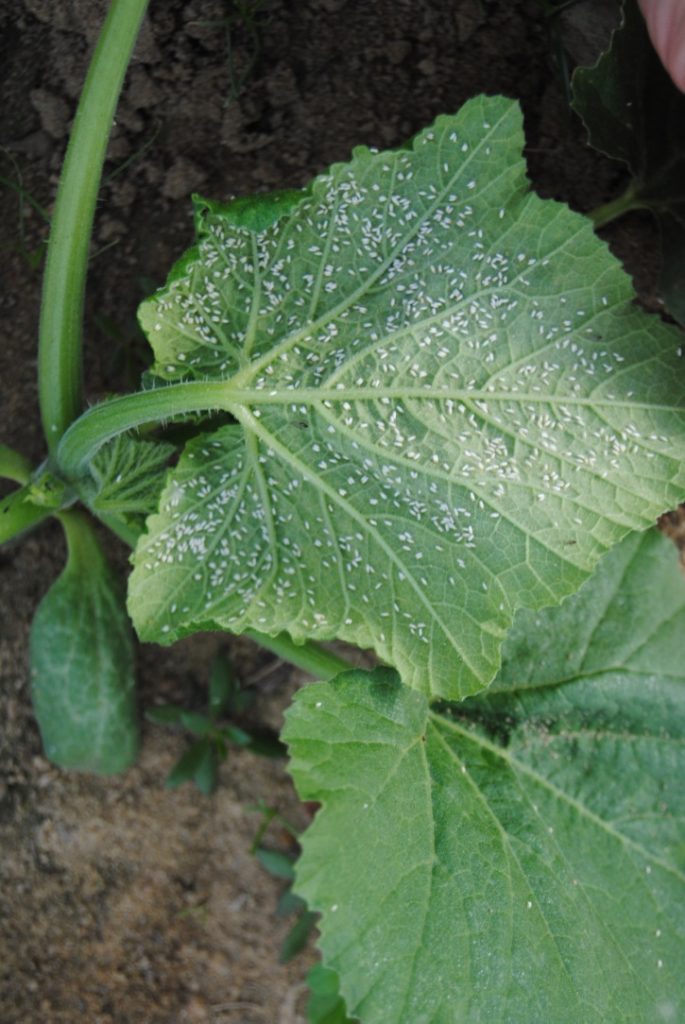
File photo shows whitefly adults feed on a yellow squash seedling.
This has been the year of the whitefly for vegetable producers in the Southeast. Even as they have been a problem for Georgia vegetable producers, they have also been a nuisance for Alabama farmers.
Ed Sikora, an Alabama Extension Specialist Professor in Entomology and Plant Pathology at Auburn University, said he’s seen quite a few whiteflies on some of the cucurbit crops like zucchini, yellow squash and pumpkin. The whitefly pressure has increased this year and is impacting locations not used to whitefly damage.
“I don’t work with insects typically, but they seem more common on the cucurbit crops in some of our monitoring plots this year than in past years. Every so often I’ll see the silverleaf damage on squash and so forth,” Sikora said. “This year they seem to be more common than I’ve seen in the last five years on that crop. I saw some last year in the Brewton area. This year I’m seeing them up around, even Auburn. It was heavy down in the Dothan area and in Brewton again.”
What’s most concerning for Alabama vegetable growers are the viruses whiteflies can transmit. They are responsible for transmitting multiple viruses, including cucurbit leaf crumple virus and cucurbit yellow stunting disorder virus. They’re also concerning for vegetable producers in Georgia where whiteflies are before coming to Alabama.
According to the University of Georgia crop loss estimates for fall 2017, the last major infestation period prior to this year, these viruses caused between 30% and 50% crop loss in squash and cucumbers and nearly 80% crop loss in snap beans that year. Vegetables like squash, zucchini, cucumber, cantaloupe and snap beans are highly susceptible to these viruses.
“We’re a little bit concerned because we know that they can transmit some plant viruses. These are occurring in Florida and we assume they are occurring in Alabama as well. We think with more whiteflies in the southern tier of the state that we’re probably seeing more whitefly-transmitted virus problems. That’s something we’re looking into, currently,” Sikora said.
UGA CAES photo/Erica Head, a student in the Organic Horticulture Entrepreneurship class and student assistant herb manager at UGArden, sells teas from herbs she’s grown and processed at a weekly student farmers market.
By Austin Clark for UGA CAES News
Balancing academic coursework with a job is a challenge many University of Georgia students face. But for students in the new Organic Horticulture Entrepreneurship class, their classwork is both academic and economic.
This semester is also harvest season for the four horticulture students in the class, who are gaining experience planning, planting and marketing their crops through a weekly student farmers market.
Taught by Associate Professor David Berle and Professor Tim Coolong in the Department of Horticulture, the new course in the College of Agricultural and Environmental Sciences (CAES) empowers students to learn the process of growing their own produce and build the interpersonal communication skills necessary to sell their crops.
Every Thursday
Every Thursday from 4:30 to 6 p.m., the students load up tables at UGArden with the crops they’ve grown during the semester — leafy mounds of lettuce, kale, turnip greens and bok choy, as well as radishes, turnips and teas made from herbs they’ve grown — and sell their wares to the public. Customers are able to buy field-fresh produce and the students practice educating members of the Athens community about the process of organic farming.
The class, which is being taught for the second time this semester, was created after Berle, who focuses on organic horticulture, and Coolong, a vegetable specialist, were approached by a donor interested in supporting the development of an immersive course addressing both sustainability and entrepreneurship.
Part of the donor funding goes to compensate Sarah Rucker, assistant farm manager for the UGArden.
“(Rucker) is the one who helps coach the students and manage the farmer’s market,” Berle said. Through her role in the course, Rucker essentially serves as a teaching assistant for the course by answering any questions the students may have about their crops, best practices and marketing techniques.
Course Adjustments
As the course progresses, Berle continually makes adjustments to give students the best opportunities to gain experience in both growing and selling organic produce.
One tweak is the way students sell their produce. During the first semester the course was offered, students were selling primarily to university vendors such as UGA Dining Services and the University of Georgia Center for Continuing Education & Hotel. But after realizing that students were missing out on face-to-face interaction with customers, Berle and Coolong combined their class with the weekly UGArden farmers market so that students could interact directly with consumers rather than just delivering to vendors.
Students Appreciative for Opportunity
Students in the course are grateful for the opportunity to give back to the Athens community by providing fresh produce while learning what it takes to be an entrepreneur in the organic horticulture industry.
“I am probably out here (in the garden) for four or five hours every day,” stated Sarah Kate Duncan, a senior horticulture major who is taking the course. “But it is totally worth it … Some of my favorite things to grow are turnip greens, different types of lettuces, fresh cut flowers and herbs.”
Another student in the course, Erica Head, works as the student assistant herb manager for UGArden.
“I see the whole process from beginning to end: I seed the plants, I put them in the field, I dry and process them into teas. I like seeing people enjoy the teas and telling them about their medicinal effects,” Head said. “It’s also really good to see the other students selling the crops they have worked hard on all semester.”
Chris Rhodes, director of industry partnerships at CAES, explains that industry leaders are looking for graduates with the creativity, communication and problem-solving skills that students in this course are gaining.
“There is no substitute for running a business to learn how to run a business,” Rhodes stated. Through his role in the college, Rhodes wants to ensure that every student has the confidence to recognize a path they want to achieve and then to be connected to resources to ensure success after their time at UGA.
Produce Availability
Student-grown produce from the course will be available through the weekly farmers market until Thanksgiving. For more information on this course and other experiential learning opportunities available at CAES, visit caes.uga.edu/students/experiential-learning.
Doug Chapman, Alabama Extension agent for Commercial Horticulture in North Alabama, says the ramifications of having scab disease in your pecan orchards can’t be understated.
“It’s the difference between having pecans and not having them,” Chapman said.
Even as pecan harvest is under way across Alabama, soon it will be time to plant new pecan trees. Pecan planting is usually done during December and January when the trees are dormant.
However, before commercial growers and homeowners begin putting trees in the ground, they must consider their fungicide spray options to manage scab disease. If they don’t have a management strategy, they shouldn’t expect pecans to start falling in 8 to 10 years.
“Scab is My First Suspect”
“Scab can wipe you out. I’ve seen it to where, even if you were to make a few nuts, if there was a scab problem, they tend not to fill out,” Chapman said. “We get a lot of questions like, okay I’ve got pecans and they’re not filling. Here again, scab is my first suspect and until you can eliminate that, there’s not much point in talking about the rest of it.”
Unpredictable Weather
Weather was unpredictable this year for pecan growers. Chapman said it was really wet in the spring, but then it turned off dry. He doesn’t think scab was nearly as bad as it has been in other years. But the dry weather has also affected the nut size. If you didn’t have irrigation, the nuts didn’t size up when they should have.
Scab Disease
Scab disease does not usually kill trees, but it can greatly reduce yields. The fungal pathogen that causes scab overwinters in the tree as lesions on stems and old nut shucks that remain in the tree after harvest. When temperatures begin to warm in the spring, the fungus becomes active and starts to produce new spores that are spread by rain and wind.
All South Georgia vegetable farmer Sam Watson wants when competing against Mexican imports is a level playing field. Right now, that does not exist and has the Moultrie, Georgia farmer concerned about the future of the American farmer.
Watson
“When you look at what we have to do from our cost of production standpoint and you look at our labor costs mainly, where we have to pay (hourly) H-2A wages that are in the $12 range and yet you can go to Mexico and have the same labor down there and pay $8 a day on the high end; and then there’s no regulatory environment,” Watson said.
“You don’t have EPD and Department of Agriculture and FDA and OSHA. The food safety requirements exist on this side, but do we know how much of that is being regulated on their side? The whole regulatory environment is different.”
Virtual Hearings
Watson was one of many Georgia farmers and Florida farmers who testified in virtual hearings with the U.S. Trade Representative’s Office about unfair trade practices with Mexico. All who testified voiced similar concerns that they are unable to compete now and in the future.
Not a Level Playing Field
“It’s a totally different playing field. If I didn’t have to pay but $8 a day, I could do a whole lot better job probably when it comes to quality and harvesting and that kind of stuff,” Watson said. “They’ve got state of the art facilities down there that we can’t compete with. The government is subsidizing those guys down there. Their government is pumping a ton of money into economic development and growing that sector of their economy down there.
“You’ve got cost of production, you’ve got regulatory environment and you’ve got subsidies. When you put all of that together; the cost of production continues to go up. Our regulatory environment continues to get worse. Our labor costs continue to go up.
“You reach a point where it’s just not worth it anymore.”
Federal Response
Federal agencies responded to the hearings with a plan to help farmers of seasonal and perishable fruits and vegetables, including those from Georgia and Florida. Click here to view details of the plan.
“We’re not saying we want to stop the production. We just want there to be a level playing field. They shouldn’t be sending product into the United States of America open on a $16 squash market. That’s called dumping. I’ve got evidence of it,” Watson said. “That happens all the time.”
Pestalotia fruit rot lesions on ripe fruit; symptoms are very similar to those of anthracnose fruit rot caused by Colletotrichum accutatum. Photo by UF/IFAS GCREC
Pestalotiopsis is not necessarily new to strawberry. A strawberry fruit rot caused by Pestalotia longisetula (or Pestalotiopsis) was reported for the first timein Florida in 1972. However, the fungus has always been considered a secondary pathogen. But this was not the case during the past two strawberry seasons (2018–19 and 2019–20), when severe outbreaks were reported in Florida commercial fields. Root, crown, petiole, fruit and leaf symptoms were observed. Yield was severely affected, and several acres of strawberry fields were destroyed before the end of the season.
University of Florida Institute of Food and Agricultural Sciences (UF/IFAS) studies indicate that isolates from the recent outbreaks are more aggressive and may belong to a new species of the genus Neopestalotiopsis.
Many growers consider the disease a new threat to strawberry production. Several questions are being asked: Where did this come from? Why is it so aggressive? How does it spread? What are the conditions for the spread? Will it survive in Florida fields? How can it be controlled? UF/IFAS researchers are working hard on trials to understand the new disease and develop best management practices to control it.
SUSCEPTIBILITY AND SPREAD
UF/IFAS studies found the disease apparently originated from other hosts around strawberry nursery fields. Thus, strawberry cultivars do not seem to have any immunity to it, and all cultivars that are currently grown commercially in Florida (Florida Beauty, Florida Brilliance, Florida Radiance and FL127 SensationTM) are susceptible.
The fungus is favored by high temperatures (77 to 86º F) and produces spores on the surface of infected tissues that are spread by water. Extended rainy periods or overcast conditions with prolonged leaf wetness during the strawberry season, such as those that occurred last December, are problematic. To minimize dispersal from field to field, growers are advised to limit their operations (such as harvesting or moving equipment through fields) when plants are wet. Current studies are focusing on sampling other hosts and weeds around Florida strawberry fields during the off-season to determine whether the fungus could become endemic in Florida.
MANAGEMENT METHODS
Growers want to know how to manage the disease, and many different fungicide products have been screened in the laboratory and evaluated in field trials at the UF/IFAS Gulf Coast Research and Education Center (GCREC). In the field trials, the fungicide pre-mix of fludioxonil + cyprodinil (Switch® 62.5 WG) and thiram (Thiram® SC) significantly reduced disease incidence.
Only a few other fungicides that are not currently labeled for strawberry use were somewhat effective. Since the overuse of fungicide products can lead to increased selection for fungicide resistance, applications need to be limited to the maximum the label recommends, and research needs to continue to seek alternatives.
For the upcoming season, growers should closely scout plants arriving from nurseries for leaf spot symptoms. Unfortunately, there are many leaf spot diseases that look alike, so it is important to get the correct diagnosis. If caught early and at low levels, removing the symptomatic plants from the fields is advisable.
The current seasonal forecast is for La Niña, which is known to bring a warmer than normal and dry climate pattern to Florida and the Southeast. The dry weather during La Niña years is usually not conducive to fungal diseases such as pestalotia leaf spot as well as anthracnose and botrytis.
The Southeast Regional Fruit and Vegetable Conference typically includes a trade show of hundreds of exhibitors. This year it will be held virtually amid COVID-19. Photo courtesy of the Georgia Fruit and Vegetable Growers Association.
Registration is ongoing for the 2021 Southeast Regional Fruit and Vegetable Conference, which will be held virtually on Jan. 5 through Jan. 7, 2021.
All events this year, including the educational sessions from university researchers and industry leaders, will take place online this year amid COVID-19 concerns. The conference will have the latest in production and crop operational information that attendees have come to expect from the SE Regional Conference.
All educational and exhibitor content will be available for on-demand viewing until April 30 to all registered attendees.
An All Access pass is $125 and includes access to all educational sessions, virtual trade show, poster sessions and networking events until April 30. A Trade Show Pass is free and includes admission to the virtual trade show and networking sessions but does not include access to any educational sessions. Access to the trade show floor will be available until April 30.
You must register for the trade show to access the trade show floor.
According to Georgia Farm Bureau, Rep. Sanford Bishop (D-Ga. 2nd District) and Sen. Kelly Loeffler (R-Ga.) each announced funding for Georgia agricultural research.
On Oct. 16, Bishop, chairman of the U.S. House Appropriations Subcommittee on Agriculture, Rural Development, Food and Drug Administration, and Related Agencies, provided funding for pecan and peanut research in the FY2021 Agriculture Appropriations bill.
The bill included 1.5 million for research on pecan cracking and pasteurization technology, $1.5 million for pecan breeding and genetics research and $1.51 million for aflatoxin research at the ARS Peanut Lab in Dawson and Fort Valley State University.
“One of the most important things to me as the agriculture appropriations chairman is making sure the crops we grow here in Georgia continue their massive contributions to our local, state, and national economies while also feeding our citizens nutritious food,” Bishop said. “Pecans and peanuts are very healthy and are also two of our largest agricultural exports as a state.”
Loeffler
On Oct. 22, Loeffler, a member of the U.S. Senate Committee on Agriculture, Nutrition and Forestry, announced the University of Georgia will be receiving $323,834 from the USDA National Institute of Food and Agriculture to research and improve crop protection and pest management. The grant will allow UGA to study and develop tools to resist the diamondback moth, which causes severe damage to crops in Georgia’s agriculture regions.
“Farmers are the backbone of Georgia and this nation, and they deserve all the help and resources they can get to ensure their crops are protected,” Loeffler said. “I applaud USDA for awarding UGA with this grant, which will bolster its premier agriculture research program – which is already a leader in the nation – and help safeguard Georgia crops from the diamondback moth and other threats for years to come.”
When Patricio Muñoz developed the University of Florida’s newest blueberry variety, he wanted to name the fruit in honor of Alto Straughn, a longtime, strong supporter of UF’s blueberry breeding program.
Muñoz decided to call the new variety the ‘Sentinel.’
“A ‘sentinel’ is a watcher or guardian,” said Muñoz, a UF/IFAS assistant professor of horticultural sciences. “It is symbolic. We came up with the idea to name the blueberry after Alto because he ‘watched and guarded’ the blueberry breeding program for many years.”
For years, Straughn, an alumnus of the UF/IFAS College of Agricultural and Life Sciences and a former UF/IFAS Extension administrator, owned blueberry farms near Waldo, Florida, northeast of the main UF campus in Gainesville.
Now in his 80s, Straughn still meets regularly with the UF/IFAS blueberry breeder.
“Since I arrived at the program, Alto and I have discussed much about blueberries: cultivars, production, packing, marketing and more,” said Muñoz. “Alto has seen the industry from the beginning, and I am glad he has shared all that information with me and the blueberry breeding program team.”
Scientists first tested the new UF/IFAS variety on Straughn’s farm in Waldo, and later in fields stretching as far south as Arcadia, Florida.
“So, we have determined that the best area for its production is the central and northern parts of Florida,” Muñoz said.
Blueberries are about a $60 million-a-year industry in Florida. To put the impact of blueberries into further economic perspective, Florida’s blueberry farmers produce about 10 to 12 million tons annually in Florida, according to the U.S. Department of Agriculture’s National Agricultural Statistics Service.
The new blueberry variety ‘Sentinel’ increases the farmers’ yield for central and northern Florida. It’s a low-chill southern highbush variety. UF/IFAS breeds southern highbush blueberries, which are synonymous with low-chill and can be grown in the South, Muñoz said.
It’s a higher quality fruit than previous UF/IFAS cultivars. It also gives the grower fruit at the best market window, Muñoz said.
And it tastes good. This variety was tested in multiple flavor panels at UF, and they rated ‘Sentinel’ “high” regarding flavor, Muñoz said.
The release of the new blueberry variety couldn’t come at a better time, Muñoz said.
“While 2020 has been a tough year – with hurricanes and COVID, among other issues — some good things are still happening, including a new blueberry that farmers and consumers will both enjoy,” Muñoz said.
According to Alabama Extension, the demand for organic crop production has experienced an upward trajectory in recent years. This increasing demand means there is a need for more farmers to produce organic vegetables at a reasonable cost, while also being environmentally sustainable.
For these producers, insect pest management is one of the aspects where they must watch their costs and consider the environmental impact of the management strategies they implement. Luckily, there are several integrated pest management (IPM) practices that can help producers do both.
Pest Exclusion Systems
Vegetable production in the Southeast already comes with risks, as insect pests threaten crops from seedling to harvest. According to surveys of specialty crop producers, potential crop losses from pest feeding average 55%. Crop contamination from insect excrement and other factors can also affect farm profits. These are referred to as the yield-limiting and yield-reducing factors, which all depend on how the crop is managed.
IPM practices, such as pest exclusion, can help with these factors.
Pest exclusion is based on the practice of physically blocking insects from reaching their host plants and is often overlooked by producers. Moths and large pests, such as stink bugs or leaffooted bugs, can be good targets of a well-designed pest exclusion system, especially on small acres with intensive vegetable production. There are two types of pest exclusion systems; temporary and permanent.
Temporary, or time-limited, systems are suitable for early season pest management to protect seedlings.
Permanent pest exclusion systems are a more intense use of pest exclusion fabric that provides season-long crop protection in high tunnels. This is called the high tunnel pest exclusion (HTPE) system, which is being intensively evaluated at 14 farm locations across Alabama.
There are numerous benefits that a pest exclusion system can offer in an organic vegetable production.
Short-term or season-long pest reduction.
Variable cost depending on material and design of the system.
Minimal training for implementation.
Growth and season extension from use of insect barrier fabric.
Overall reduction in the use of biorational insecticides with increase in natural enemy activity.
It’s important to note that not all crops and varieties may lend themselves to pest exclusion systems. Contact the Alabama Extension commercial horticulture regional agent in your area before making a major purchase decision. It is recommended that pest exclusion systems be integrated with the use of insect monitoring systems or traps and natural enemies for practicing true IPM.
Organizers of the Florida Ag Expo, an annual trade show with educational seminars for vegetable and specialty crop growers, have decided to forego this year’s event amid COVID-19 concerns.
“While we see businesses re-open and people are returning to a sense of normalcy, we know that has only been made possible by everyone doing their part. Therefore, we made the decision not to go forward with this year’s show,” said Robin Loftin, president of AgNet Media.
“The Florida Ag Expo brings attendees from across the state and beyond. While we would love to host those attendees for another great event, we believe attendees’ health and safety must come first.”
Event Details
Rechcigl
Hosted at the Gulf Coast Research and Education Center (GCREC) and managed by AgNet Media, the Florida Ag Expo is an annual gathering of growers and industry leaders. The one-day educational and networking event includes a full schedule of field tours, research presentations and a trade show.
“Due to the pandemic, we are unfortunately having to cancel this year’s Florida Ag Expo,” says Jack Rechcigl, professor and director of the University of Florida Institute of Food and Agricultural Sciences Gulf Coast Research and Education Center and Fort Lauderdale Research and Education Center.
“However, next year, we will have the expo at the regularly scheduled time (Nov. 17, 2021).”
The Florida Ag Expo began in 2006 after the GCREC opened in 2005 in Wimauma, Florida. AgNet Media managed the first Florida Ag Expo in 2019 when record attendance was achieved.
Mark your calendars for the 2021 Florida Ag Expo on Nov. 17, 2021. More details will follow.