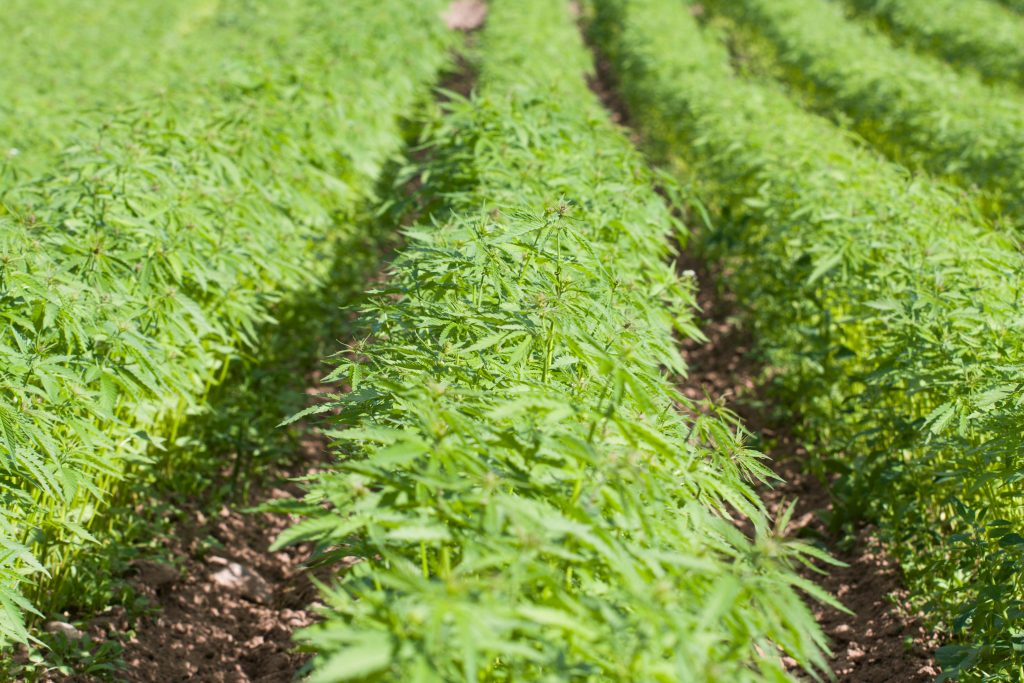
Some Georgia hemp producers were victimized this year by having their crop’s THC level exceed 0.3 level. Subsequently, the hemp was destroyed, which was the case for 11 producers.
Tim Coolong, associate professor in the University of Georgia (UGA) College of Agricultural and Environmental Sciences and leader in hemp research at UGA, said he heard farmers in east Georgia who had a crop that tested hot. He believes next year that producers will test their hemp more frequently to avoid instances where the crop must be disposed of.
Testing Benefits
“I think certainly that anyone who tested hot this year that decides to grow again will certainly be doing it. I think for the most part, the growers that I did visit with last year understood the value of testing and how important it was,” Coolong said. “I think going into it next year, depending on how many growers we have, I think they will be a little more targeted perhaps or maybe just have a little bit better plan because they’ll have more time.”
Coolong added that he is still waiting to see how farmers fared financially after the state’s first commercial growing season.
“That’s obviously where, it doesn’t matter how good your yields are or quality, the bottom line is how much profit did growers make. People are still processing their product and all those sort of things right now. I’m not sure the profit levels on some of the growers I worked with,” Coolong said.
According to the Georgia Department of Agriculture, applications for new Georgia hemp grower licenses and hemp processor permits will be accepted, beginning in January, 2021.
According to Alabama Extension, colder temperatures means that it is time to begin planting and pruning certain ornamental plants. These plants, grown primarily for their aesthetic value, benefit greatly from selective cutting. Pruning keeps the plants in shape and growing successfully. Also known as trimming, pruning is a necessary strategy for gardeners and landscapers alike.
Planting Ornamentals
Different times of year are optimal for planting different ornamentals. Paying attention to which plants grow best in colder months is crucial. Note that these do not include semi-hardy and marginal plants that benefit from spring planting.
“Know the plants you are working with to avoid mistakes,” said Hayes Jackson, an Alabama Extension home grounds, gardens and home pests urban regional agent.
The ideal soil for most plants is rich, well-drained garden loam. When planting, it is important to keep in mind not to dig the hole too deep. Taper the planting hole with a wider opening and a large enough bottom to hold the entire root system. Adding a ring of soil around the edge of the plant can help hold moisture when the area is filling with water.
“Planting the right plant in the right place is crucial to avoid unnecessary pruning or maintenance issues,” Jackson said.
Pruning Ornamentals
According to Jackson, pruning ornamentals creates better plant shape, discourages diseases and increases fruiting and flowering. During the pruning process, cutting or trimming overgrown stems or branches is key for optimal plant growth. The time of year to prune is specific to each plant, so researching the proper pruning time for each plant is crucial.
“Some plants need to be pruned after flowering to avoid removing flower buds, such as hydrangeas and azaleas,” Jackson said.
Gardeners and landscapers alike often use a variety of tools for pruning, including hedge shears, floral scissors, hand pruners and pruning saws.
“A proper pruning cut utilizes proper pruning methods and proper tools,” Jackson said. “Proper methods and tools are important because any new growth stimulated by the pruning will develop close to where the cut is made.”
More Information
More information is available in the Alabama Extension content piece Pruning Ornamental Trees. For further information on planting and pruning ornamental plants, visit the Lawn and Garden section of the Alabama Extension website www.aces.edu. People can also contact the home grounds, gardens and home pests regional agent serving their area.
Photo submitted by Patricio Munoz/Shows Sentinel variety.
The University of Florida’s (UF) newest blueberry variety possesses the quality all growers want in the Sunshine State.
“It can make you money,” said Patricio Munoz, UF blueberry breeder.
Munoz emphasized the attributes that make the Sentinel variety highly sought after from Florida farmers.
“We can go around to yield, quality and everything but, yes, this one can make you money. I think we have consistent data since 2017 when the plant was already two years old and we started looking at it,” Munoz said.
“It’s a consistent variety in terms of high yields and a consistent variety in terms of different locations. We have good supporting data for releasing this variety for consistent yields across locations and across years and in the best time of the season, which is early.”
Years of Research
Sentinel, released in October, was the culmination of 12 years of research by three different plant breeders, including Munoz. His relationship with Florida growers is vital to producing a variety that exceeds expectations. Communication is key to know what their needs are.
“If you ask the growers what do they want, they say we want yield, high fruit quality and in the right time of the season, which is early for us in Florida,” Munoz said. “Their wish is long and very complex.”
Munoz insists there is no perfect variety and doubts there will ever be.
“In some cases you compromise fruit quality to produce the yield, and in other cases you compromise yield to produce quality. The more fruit you produce, usually the quality decreases,” Munoz said. “We use an index of selection where we combine all of these traits. We give them different weights and based on that, we try to compromise.”
Sweet Flavor
One characteristic of Sentinel that does not disappoint, though, is flavor.
“Flavor is very subjective. One of us, if we tried the same blueberries, we might have different perceptions of how that blueberry tastes. It’s a difficult job for the breeder because he needs to breed for what he believes the people will like,” Munoz said. “We are trying to take subjectivity out of the equation here by doing tasting panels. We provide the fruit to a bunch of people at a tasting panel and they give us scores. What do think about it? In this case, this (Sentinel) cultivar was tasted by over 200 people and they put it in a very good place regarding the commercial cultivars that we have.
“We need to breed for the growers, but we also need to breed for the consumers, because if the consumers are not happy with the fruit that they are consuming, they’re not going to go back. If they don’t go back to buy more fruit, the growers are not going to have a place to sell the fruit. We need to please the whole chain.”
Munoz said Sentinel is a good cultivar for central and north Florida. It is not recommended for growers in south Florida where conditions are different.
The University of Georgia Cooperative Extension will hold pecan production meetings virtually in January, February and March.
UGA Pecan Team members include Lenny Wells (Extension pecan specialist), Angel Acebes (entomologist), Andrew Sawyer (Area Pecan Agent-Southeast District) and Jason Brock (plant disease diagnostician). All will give presentations and be available for questions over Zoom. Tentative dates for the meetings are as follows:
Jan. 21-6 p.m.
Feb. 9-9 a.m.
March 9-6 p.m.
According to UGA Extension, the various times are provided so people have the options of the best times that may work for them.
“We are still working out the details of setting things up for this with regard to registration, pesticide credits, etc., but I will be posting more information here as the plan comes together,” Wells said.
The January issue of VSCNews magazine will be the blueberry grower’s handbook heading into the 2021 season.
Chilli thrips are a growing threat for blueberry growers. Without proper management of the pest, overall plant vigor and yields can be affected. Oscar Liburd, a professor at the University of Florida Institute of Food and Agricultural Sciences (UF/IFAS) in Gainesville, Fla., shares conventional and organic management tactics that growers can implement to help control these pesky pests.
UF/IFAS has unveiled its newest blueberry variety, Sentinel, named in honor of UF alumna, Alto Straughn. It is a low-chill southern highbush variety and offers increased yields for growers. Brad Buck, UF/IFAS public relations specialist, mentions that Sentinel was ranked “high” in flavor among flavor panels.
America was built on its rich agricultural history. Ryan Atwood, co-owner of H&AFarms in Mt. Dora, Florida, shares the struggles blueberry growers faced in 2020 and growers’ optimism for the year to come. Atwood also discusses the increasing Mexican blueberry volume during the Florida harvest window and its impact on the U.S.
In 2020, mild winter conditions followed by a wet spring contributed to the development of significant disease issues on Georgia blueberries. Jonathan Oliver, an assistant professor at the University of Georgia in Tifton, Georgia, updates Georgia growers on disease management strategies.
Outside of the blueberry spotlight, Kimberly Morgan, an associate professor and Extension economist, and Tara Wade, an assistant professor, both at the UF/IFAS Southwest Florida Research and Education, share how growers could benefit from enterprise budgets.
Morgan is also joined by Jessica Ryals, a sustainable food systems agent for UF/IFAS, for another article in this month’s issue. These two discuss how an imperfect market system can yield profitable market opportunities for growers.
To receive future issues of VSCNews magazine, click here.
Rows of watermelon in North Florida, trees, leaves. UF/IFAS Photo: Thomas Wright.
On July 1, 2020, new record-keeping requirements went into effect for nitrogen and phosphorus amounts applied by growers enrolled in the Florida Department of Agriculture and Consumer Services (FDACS) Best Management Practices (BMP) program. These records are required due to the passage of Senate Bill 712, the Clean Waterways Act.
Growers have been asking many questions about this new requirement and what they must do to be in compliance with the law. This article is comprised of questions and answers designed to help growers understand their requirements as a FDACS BMP program participant, and the records submission process moving forward.
Matt Warren, environmental manager with the FDACS Office of Agricultural Water Policy in Hardee County answers some of the common questions from growers:
Q: Who does this new law apply to?
A: Any grower enrolled in the FDACS BMP program, regardless of whether or not they are located in an area with a Basin Management Action Plan (BMAP).
Q: The new requirement states that growers must submit their application records for nitrogen and phosphorus to FDACS. When do I submit my records?
A: You will submit your records of nitrogen and phosphorus applications only when requested by a FDACS representative during an implementation verification visit. These visits are done by FDACS to verify that a grower is in compliance with the program, by properly implementing the BMPs they committed to in their Notice of Intent to Implement BMPs.
Q: When will these implementation verification visits take place?
A: The visits will be done once every two years. Initially, priority will be focused on visits to growers located in BMAP areas, but every grower enrolled in the BMP program will be visited.
Q: Who will be conducting the implementation verification visits, and how will I be notified when I am receiving a visit?
A: A FDACS field representative will contact the grower to schedule a visit. The visits are not unannounced.
Q: I received a letter in the mail with record-keeping examples and instructions. Do I need to submit my records online?
A: The letter was to inform you of the new requirements and offer a form that you may use to record your nitrogen and phosphorus application information. Do not submit any records at this time. You will only be required to submit your records to the FDACS field representative during your implementation verification visit.
Q: What information am I required to record for submission?
A: Growers are required to keep a record of the total pounds of nitrogen and phosphorus (in the form of P2O5) that are applied to their fields on a monthly basis. Total pounds of nitrogen and phosphorus must be accounted for from all sources applied, including biosolids. Growers do not need to submit records of other nutrient applications, such as minor elements or soil amendments such as lime.
Important note: Growers must continue to keep records for their own files on all nutrient and soil amendment applications, in order to be in compliance as stated in their Notice of Intent to Implement BMPs and BMP checklist requirements.
Q: What form do I use to record my nitrogen and phosphorus application information?
A: FDACS has provided a suggested form for you to use. You are not required to use this form, but it is easy to follow and clearly shows what information is needed and where to input it. FDACS has this form available as a hard copy, printable PDF or in electronic form as an Excel spreadsheet. The Excel spreadsheet is recommended, as the information can be uploaded automatically.
Q: Do I have to give them my only copies of my records?
A: No, you must keep your original copies of your records. Give the FDACS representative a copy of the form mentioned above, or something similar, as your records submission.
Q: How far back do my records need to go for this new requirement?
A: You must submit nitrogen and phosphorus monthly totals for the past two years from the date of your scheduled implementation verification visit. For example, if you have an implementation verification visit scheduled for Dec. 20, 2020, you must submit nitrogen and phosphorus application records dating back to Dec. 20, 2018.
Q: How does FDACS determine if I am in compliance? Is it based on University of Florida Institute of Food and Agricultural Sciences (UF/IFAS) recommendations for crop production? What about soil and leaf samples?
A: UF/IFAS recommendations are used to determine if a grower is in compliance. For more information, please refer to these FDACS publications at fdacs.gov/Agriculture-Industry/Water/Agricultural-Best-Management-Practices:
Water Quality/Quantity Best Management Practices for Florida Vegetable and Agronomic Crops
Water Quality/Quantity Best Management Practices for Florida Specialty Fruit and Nut Crops
Soil and leaf samples are a requirement under the FDACS BMP program, and the results will also be used to determine if a grower is in compliance with the BMP program. Be sure to keep up with soil and leaf samples, as they may also be needed for justification.
Q: What if I do not have this information available for my FDACS field representative at the time of the implementation verification visit?
A: You will have to work with your FDACS representative. You may be placed in remedial action and given a certain time period to submit your records. If you choose not to submit your records, you may be referred to the Florida Department of Environmental Protection for regulatory action.
Q: Are my nitrogen and phosphorus application totals considered public records once they are submitted?
No, they are not considered public record. But, FDACS must provide them to the Florida Department of Environmental Protection, if requested, as long as the confidentiality specified for the records is maintained.
See blogs.ifas.ufl.edu/clue/2020/08/31/from-senate-bill-712-to-the-clean-waterways-act-and-agricultural-best-management-practices for more details and information about the Clean Waterways Act.
If you have more questions or would like a copy of the suggested record-keeping form, contact your FDACS Office of Agricultural Water Policy field representative or your UF/IFAS Extension agent.
Alabama Commissioner of Agriculture and Industries Rick Pate announced that the U.S. Department of Agriculture (USDA) has designated 13 Alabama counties as primary disaster areas, due to damage and losses caused by Hurricane Zeta Oct. 28–29.
USDA reviewed the Loss Assessment Reports and determined that there were sufficient production losses to warrant a Secretarial natural disaster designation. In accordance with section 321(a) of the Consolidated Farm and Rural Development Act, additional areas of Alabama and adjacent states also have been named as contiguous disaster counties.
Primary Disaster Designation Areas (13 counties): Autauga, Cherokee, Chilton, Choctaw, Clarke, Dallas, Elmore, Lowndes, Marengo, Mobile, Monroe, Washington and Wilcox
A Secretarial disaster designation makes farm operators in primary counties and those counties contiguous to such primary counties eligible for certain assistance from the Farm Service Agency (FSA), provided eligibility requirements are met. This assistance includes FSA emergency loans. Farmers in eligible counties have eight months from the date of a Secretarial disaster declaration to apply for emergency loans. FSA considers each emergency loan application on its own merits, taking into account the extent of production losses on the farm and the security and repayment ability of the operator.
A chilly December should have alleviated some concerns of Southeast fruit farmers worried about chill hours in a La Nina winter, according to Pam Knox, University of Georgia Extension Agricultural Climatologist.
“If you look at the plot of chill hours over this year, November was quite warm. I think they were running way below normal in the number of chill hours. That was a real concern for the fruit farmers,” Knox said. “But with the cold outbreaks we’ve had in December and the one we saw (over Christmas), that’s really going to bring up the chill hours. I’m sure the fruit farmers are going to be happy. You always wonder about that in a La Nina year.”
Previous Concerns
It was a concern for Edgar Vinson, assistant research professor and Extension specialist in the Department of Horticulture at Auburn University. He was worried about peach producers lagging in chill hours as he projected they only had about 172 in mid-December. But with cold outbreaks, the most recent of which came last week over the Christmas holidays, it should have increased those chill hours needed to produce a crop.
Knox said that while a La Nina weather pattern is characterized by warmer temperatures and drier conditions, cold outbreaks are not uncommon.
“The thing about La Nina is, even though the winter as a whole may be warmer than normal, we’re still going to get these cold outbreaks. This definitely is not the kind of weather we expect in a La Nina, but it goes up and down a lot in the winter,” Knox said.
“Every La Nina is different, too. Even though statistically we expect it to be warmer and drier than usual, there still are outliers. It’s possible we could have a colder winter than usual, even in a La Nina, although it would be unlikely.
“It’s winter, we expect some cold weather. It’s not surprising that we should have this cold outbreak. The weather depends on what’s going on in other parts of the world. It’s not just La Nina, it’s what is going on in the Arctic and what’s going on in the oceans. It’s part of a big puzzle and we have to try to put that together. A La Nina is certainly one factor but it’s not the only factor.”
File photo shows drip irrigation in a tomato field.
Drip irrigation vs. overhead irrigation? That truly is the question for vegetable and specialty crop producers in Alabama who are poised to produce a crop in 2021.
Eric Schavey, Regional Extension agent in Northeast Alabama, advises producers to choose drip irrigation. It is more efficient in delivering water to the plant roots.
“As far as a production standpoint, the drip irrigation is more efficient. You’re actually putting the water where it needs to be,” Schavey said. “Drip irrigation puts it there at the plant where it can go into the ground where the roots can take it up. You don’t get any of that splash from an overhead droplet like you get during a rain. If we have any fungus or anything that is on our soil surface and it splashes up, it gets on the lower leaves, especially tomatoes.
“When you’re looking at early blight (disease), it’s naturally in our soil. When we get rainfall or overhead irrigation it splashes up and starts on the bottom leaves first and moves its way up the plant.”
Water Lost Using Overhead Irrigation
There is also a misconception that if farmers are using overhead irrigation, all of that water is getting to to the plants. However, much of that water evaporates before hitting the soil.
“Depending on how our weather has been, you take a July day here in Alabama, 90 degrees and you go to water and that air is dry with overhead, you’re probably losing 40% of it, at least,” Schavey said. “And it’s not on target. I know water is cheap. In Alabama, we have an abundance of water, but we’re two weeks away from a drought at any time.”
Why is Drip Irrigation so Efficient?
Sub-surface drip irrigation is primarily used for vegetable production. Most commercial farmers grow vegetables on a plastic covering that lies above the drip irrigation system. The water is applied directly to the plants’ roots. It is thereby more efficient.
“Once it starts dripping, that emitter or that drip tape is dripping it out right on that soil surface, then it actually fans out in a ‘V’ in that soil column. It’s really narrow to the plant at first and then widens out,” Schavey said. “It’s good, because you want those roots going deeper. If you’ve got a triangle and it’s inverted down in the ground, those roots that ran left and right, they’re going to run down to that water and you’re going to have a deeper root system.”
Mexican imports still a problem for Southeast producers.
This year was a season unlike any other for produce farmers in the Southeast.
Not only did COVID-19 strike at the worst time, but lingering international trade issues with Mexico resulted in diminished market prices for producers like Tifton, Georgia farmer Bill Brim.
If something isn’t done soon, 2021 will be no different than 2020.
“We’ve been fighting Mexico since probably the last week of October through now. It’s just been one battle after another with squash prices dipping down to $3, $2, whatever you can get for it to cucumbers at $9 when it ought to be $20. Squash at $3 or $2 should be $12 or $14,” Brim said.
“It’s hard when you don’t make any money. It’s one of those things where farmers are resilient thinking, they’re going to make a million dollars next year instead of losing a million. We’re kind of stupid, I guess. We think we can outsmart them, but I don’t think we’re smart enough to do that anymore.”
Virtual Hearings
Brim and fellow farmers testified in August during virtual hearings with the U.S. Trade Representative’s Office regarding unfair trade practices with Mexico. The hearings provided the U.S. Department of Commerce and Trump Administration an opportunity to hear from growers in Georgia about the urgent need for federal action regarding unfair trade.
Federal agencies responded in September by outlining the Trump Administration’s plan to address the threat posed by increased imports. The plan included a request to the International Trade Commission to initiate a Section 201 global safeguard investigation into imports of blueberries.
In November, Georgia Congressmen requested a Section 332 Investigation on squash and cucumbers which was already being done for strawberries and bell pepper.
Cucumbers, Squash Included
On Dec. 4, U.S. Trade Representative Robert Lighthizer requested that the U.S. ITC include in its investigations the import of cucumbers and squash and the effect on the domestic seasonal markets.
Hopefully, a long-term solution is in the works and will be imminent. It will not be a moment too soon.
“The last four seasons have been the toughest. We did benefit in the fall, early a little bit, so that helped us. In the spring late, in the last week of May and the first week or two of June, we did fairly well because Mexico wasn’t in. Of course, they weren’t in early on the fall deal. But as soon as they open that door, it’s like somebody just shut the lights off,” Brim said.
“Pepper undoubtedly must have been a little later in Mexico because they didn’t hit in our market until right at the tail end of it. It went from like $22 to like $14 overnight. It doesn’t seem to change. People just don’t get it.
“We’ve got to have something, or we won’t survive. I just don’t know how they can continue to think we can survive when (Mexico is) paying their people down there 81 cents an hour and we’re paying $11.77 plus free housing, free transportation and everything else. We’ve got about $15 an hour in it by the time we finish up doing everything for them.”