Greenhouse lettuce production has its risks and rewards in Alabama. Jeremy Pickens, Alabama Assistant Extension Professor in Horticulture at Auburn University, cautions producers to do their homework before diving headfirst into this potentially rewarding venture.
“It’s a considerable amount of expense compared to field production. You just really need to know what you’re doing before you commit to it,” Pickens said. “The benefits of growing in a greenhouse are, you can turn out a crop faster. It’s going to be a high-quality crop. In many cases, there’s less pesticide use. But the downside is, it costs more money to grow indoors.”
Greenhouse Expenses
It is expensive just to build a greenhouse and operate it year-round. Pickens estimates to build and own a greenhouse can cost producers anywhere from $20,000 to $100,000 depending on how many bells and whistles you want to accessorize the greenhouse with. Labor is a major expense as well. Labor can cost as much as 28 cents per head of lettuce.
Producers must also consider competition from states out west. California and Arizona account for 95% of all the lettuce produced in the U.S.
“It is a high-quality product and produced very inexpensively and can get shipped across the country in very little time. It is most often for chefs and be available in a bag, chopped product. It’s already triple rinsed, they don’t have to do anything with it but open the bag and go,” Pickens said. “I don’t think you need to compete head-to-head with those guys because you’re going to lose. They can grow it so much cheaper than we can just because of their great climate and economy of scale.”
Marketing
Those Alabama producers who follow through on lettuce production need to market their crop as a premium product if they are to be successful. They are selling local, fresh and flavor.
“There is a certain size pie, and you’re not going to make the pie any bigger. There’s a chance you could, but you’re trying to get a piece of it by maybe convincing a chef to switch over to your product. There are some opportunities in some of the more urban areas with these CSAs coming along for lettuce to make its way into a box. As far as selling it as a farmer’s market, it’s like anything, it’s got its risks. I don’t want to say there’s not an upside to it, but I wouldn’t go chasing for gold with it,” Pickens said.
Stink bugs are a diverse species that can wreak havoc on Florida’s tomato crop. With a piercing-sucking mouthpart, stink bugs pierce the fruit and suck out fluids. They also secrete enzymes while doing so, which damages the cells right under the skin of the fruit. This leads to little spots forming all over the fruit.
Picture submitted by Craig Frey/Shows a brown stink bug.
It is more visible once the fruit ripens, but packinghouses can identify it on green fruit as well. Ultimately, the fruit is unmarketable for producers to sell.
But for farmers, it is important to identify what stink bug species are on their crop. Some are predators, others are minor pests, while a few can cause major economic loss. Life cycles in tomatoes can range from five to 10 weeks, which is another important reason for proper identification.
“If it’s a 5-week life cycle versus a 10-week life cycle, a producer will have to spray twice as a frequently. It’s therefore critically important to know what species it is so we can know what their life cycle is and make sure our management fits accordingly,” said Craig Frey, University of Florida/IFAS Hendry County Extension Director.
Two Most Problematic Species
The two species tomato producers must contend with the most are the brown stink bug, Euschistus servus, and southern green stink bug, Nezara viridula.
“It was interesting to see that what I found in my master’s research in 2016-2017 correlated with what Dr. Amanda Hodges has seen in her traps over the last couple of years of surveying. There appears to be higher numbers of those two species than anything else,” Frey said.
Proper identification is key, but it is also essential to start management early and avoid playing catch-up.
Frey said stink bugs are more of an issue for grape tomatoes. Producers harvest them more frequently, and due to the required intervals between pesticide application and harvest, it is harder to find time to make an appropriate chemical application and keep the pest in check.
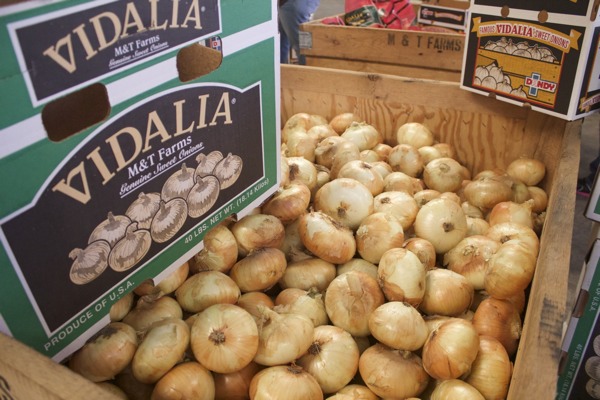
It has been a tale of two winters for Georgia Vidalia onion producers. Last year’s abnormally mild winter was highlighted by warmer temperatures. This season has been characterized by wetter conditions and cooler temperatures.
It has impacted the growth of the state’s onion crop so far this season, says Chris Tyson, University of Georgia Extension Area Onion Agent at the Vidalia Onion & Vegetable Research Center in Lyons, Georgia.
“We had some warm weather in December and January last year and it really got the onions up jumping. This year they’re just off to a much slower start. That’s okay. It’s not a problem. It’s just been a cool, cold, slow start. The growth has just been really slow to begin with,” Tyson said.
Slow Start, Just Not a Bad Start
A slow start is not necessarily a bad thing either for onion producers.
“The sooner the onions get big and get growing, the sooner we have to fight disease and manage fertility. I think recent years have been uncharacteristically warmer, above average; we almost have gotten used to that the last few years. But this year it may be more of an average year,” Tyson said. “You talk to these Vidalia onion growers and they’ll tell you about years when we’ve had really cold weather and we’ve had hard freezes. It’s caused problems in the past. We haven’t seen any extremes like that (this year).
“We don’t want to get the onions too big and have a bad freeze or something like that. When they get big like that, the freeze damage can hurt them worse.”
Sufficient Moisture
Moisture is not a problem either for Georgia onion farmers. According to the US Drought Monitor, only a few coastal counties and some in the southwestern part of the state are abnormally dry. Most of the state got saturated during the New Year’s Holiday weekend.
“A lot of places in the onion belt got 3 to 5 inches. In this time of the year when it’s cold and not much evaporation, it makes things really wet and takes a while to dry off,” Tyson said.
“As far as moisture goes for the onions, we feel like we’re in pretty good shape right now.”
Wanna go fishin’? Have you ever wondered why we don’t ask who wants to go catching fish?
Entrepreneurial adventures in farming may be compared to the distinction between fishing and catching any fish at all, regardless of hours spent throwing out a line, varying techniques, bait types, pole qualities and past experiences at previously abundant locales. Similarly, the farm financial planning process tends to be viewed as murky and mysterious. As a result, financial planning is often underutilized and misinterpreted. This is especially true when farmers are looking to make changes in existing operations or venturing into new enterprises.
While financial documentation is viewed as a tedious task, it is the bedrock of any decision about farming. Further, any future financial decisions should be made in tandem with production, marketing, legal, regulatory and human resource management to ensure all departments are considered prior to the investment.
Business risks are defined as “uncertainty that matters.” This article highlights key aspects of the enterprise budget useful to address and mitigate the uncertainties that are inherent to entrepreneurial pursuit of farming for profits.
Enterprise budgets are long-run planning tools. They differ from other budgets, such as income and cash flow statements, balance sheets and owners’ equity statements, which are used to study past farm financial performance. Enterprise budgets give farmers the numbers needed to make timely allocations of resources (land, labor and capital) specific to growing conditions that capture the feasible production and marketing costs and revenues.
USEFUL FEATURES
A key benefit to the enterprise budget is the ability to assess the opportunity costs, captured as interest paid on operating costs. Economic opportunity cost measures the entrepreneurial value of the enterprise by calculating what farmers must give up to get what they want the most.
One alternative to borrowing annual operating capital and paying a 6 percent interest rate on the loan is to invest those dollars and earn a 6 percent return. The interest rate on the operating loan is charged to the enterprise in the budget to ensure the farmer is recovering this cost. Knowing what they are giving up allows farmers to make informed decisions on whether to choose a new enterprise.
The University of Florida provides online tools to help growers with budgets.
The enterprise budget contains another valuable risk mitigation tool: It allows farmers to examine whether they can stretch their resources into a new venture. Fixed costs, also described as ownership costs, represent long-term expenses that must be paid every year regardless of what commodity is produced or if any are produced at all. A fixed-cost charge in the form of returns to overhead and farm management is represented by a percentage of total operating costs. This percentage captures returns to the farmer’s own long-term investment of their expertise and efforts into this enterprise. Economics tells us there is no such thing as a free lunch, and this is the only financial tool that reminds the farmer to make sure any new activity results in a paycheck to cover their own involvement with the enterprise.
A motivating factor for tackling a new enterprise is the desire to find new ways to use existing resources that are costing the business money yet sit idle all or part of a year, such as equipment, buildings or irrigation systems. The enterprise planning tool allows a farmer to adjust the variable (operating) and fixed (ownership) cost numbers to represent their existing resources and expenses. This can easily be done by utilizing information/numbers from the farm’s historical financial statements.
Another valuable feature of the enterprise budget arises when farmers choose to spend time studying and learning how to utilize the tool to plan for future profits. Specifically, annual updates to the budgets capture information related to changes in input prices and/or technology.
Examples of changes to input prices important to the farm budget are fuel or fertilizer costs resulting from adjustments in trade, labor or regulatory policies. Similarly, changes in technology such as new equipment features and/or availability can significantly impact overhead/fixed costs. Moreover, predicted yields may be changed to allow for varying physical conditions across the state, such as soil health and weather patterns that are specific to a farm location. Estimated costs of materials may be adjusted to capture savings from purchasing inputs in bulk for use across other farm activities or sharing packing and harvesting costs through cooperative arrangements.
Estimated revenues are based on average market prices and can be altered to accurately identify prices received by an individual farmer year over year at each market outlet. This includes sales made through a broker, at a roadside stand or online farmers’ market, or via direct marketing connections like restaurants or retailers.
From the viewpoint of an economist, assessing benefits resulting from the investment in a new enterprise extends beyond the explicit gains in profit. Farmers are often motivated by the implicit gains in managing business risks that may be achieved when adding a new enterprise.
For example, the ability to employ labor year-round may ensure continued access to staff. This reduces the time and stressors related to attracting and training new people repeatedly, while building trusting relationships between owners and employees. This extends to finding ways for the next generation to stay on the farm through expansion into enterprises that provide the foundation for a long-term career in the family business.
INTERNET RESOURCE
To help organize the math behind these economic choices, the University of Florida Institute of Food and Agricultural Resources (UF/IFAS) provides enterprise budgets for a variety of Florida-grown commodities. These decision tools are built collaboratively with economists, horticulturists and farmers who share lifetimes of experience from the fields to provide a baseline of inputs and outputs for an operation.
Visit fred.ifas.ufl.edu/extension/commodity-production-budgets for more information and to access the UF/IFAS Commodity Production Budgets. These tools will help you assess your farm’s readiness to capture your next entrepreneurial field of green. Available enterprise budgets include potatoes, strawberries, tomatoes, green peppers, watermelons, sweet corn, cabbage, tropical fruit, beef cattle and forages, tropical ornamentals, tropical vegetables, citrus and cucumbers.
The February issue of VSCNews Magazine explores a variety of topics, including America’s changing farming landscape, onion disease management tips, nematode management strategies and tools for tomato production.
Every five years, the U.S. Department of Agriculture’s National Agricultural Statistics Service conducts a census. The 2017 Census of Agriculture captured in numbers what we see happening all around us: farming is changing. Sarah Bostick, a University of Florida Institute of Food and Agricultural Sciences (UF/IFAS) sustainable agriculture Extension agent in Sarasota, Florida, shares how the industry is working to cultivate the next generation of farmers.
Southeastern Georgia’s climate is conducive to many Vidalia onion diseases. Bhabesh Dutta, an associate professor and Extension vegetable disease specialist at the University of Georgia (UGA) in Tifton talks about disease seasonality and management strategies.
Johan Desaeger, an assistant professor for UF/IFAS, is featured in the Organic Corner. According to Desaeger, cover crops are one of the more practical options for nematode management. He discusses various cover crops and their benefits.
Additonally, Abolfazl Hajihassani, an assistant professor and Extension specialist at UGA, provides readers with tools to solve tomato pathogen issues.
Finally, readers will get an inside look at the recent virtual Southeast Regional Fruit and Vegetable Conference from AgNet Media’s senior multimedia journalist Clint Thompson. The 25th annual event provided a unique educational experience, as the event was moved to an online format amid COVID-19 concerns. Thompson shares some brief summaries from a few of the educational sessions offered during this year’s event.
If you would like to receive future issues of VSCNews magazine, click here.
According to UF/IFAS, high population densities of Asian Bean Thrips (ABT) continue to appear only in isolated locations.
ABT populations have reached 1.0 per bloom early bloom plantings across multiple farms in southeastern Hendry County. In some cases, populations reached as high as 1.7 per bloom.
Populations reached 8.5 per bloom in plantings within a week of harvest. It’s the highest reported outside of Miami-Dade County.
The late increase in population may affect nearby and/or subsequent plantings.
In northern Collier County, ABT has not yet been reported in plants at the early bloom stage or younger. The pest was found for the first time at up to 0.3 ABT per bloom in older plantings.
In eastern Palm Beach County, populations appear to remain low, at less than 0.1 per bloom.
ABT populations were not reported in southern Glades County and southern Martin County. This indications population density is below sampling threshold.
Clemson Extension agents provide updates in the The South Carolina Grower this week about the status of various crops being produced throughout the state.
Rob Last reports, “Strawberry crops in the area are looking good with good crown development. We are seeing open flowers and some fruit set based on warmer conditions. These crops are cause for some concern as we are likely to see damage from forecast cold snaps. There is evidence of botrytis (gray mold) in crops on cold damaged flowers and fruit. Sanitation can really help to mitigate the spread of the disease. Spider mites remain active and in places are requiring treatment. Remember to avoid pyrethroids for mite control as these can flare mite populations.”
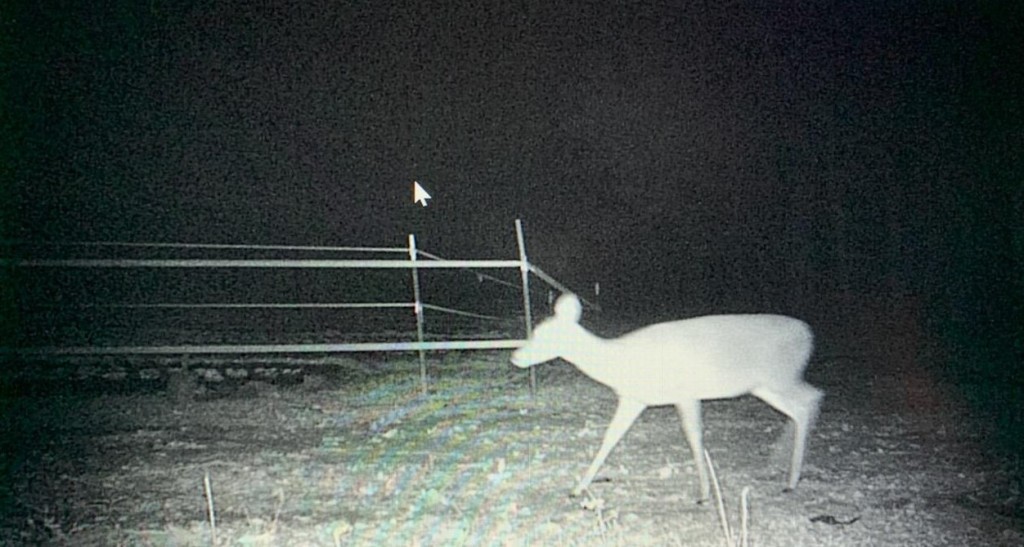
Zack Snipes reports, “The three components of the disease triangle are a conducive environment, the host plant present and a virulent pathogen. With that being said; it has been pretty wet as of late. We have warmer weather coming this week, and I have seen pathogens in our fields. I fully expect some diseases to really take hold and start to spread this week. For strawberries, make sure to clean dead tissue (leaves, blooms, fruit, etc) and for other crops removal of dead tissue and a preventative fungicide application (conventional or organic) can really help you get ahead of the fight against diseases. Also, my pet peeve…get your deer fences up!!!! This is the time of year that deer run out of food (and corn piles) and will meander into your strawberries and eat thousands of dollars’ worth of profits.”
The two-tiered fencing system, like the one shown in this trail cam photo, will keep curious deer out of your fields. Deer Fencing. Photo from Zack Snipes.
Midlands
Justin Ballew reports, “This past week was a little warmer and more sunny, but not by much. Crops are still growing slowly as a result. I’m seeing a lot of deer damage in strawberry fields that border the woods. Nothing reduces yield potential in strawberries faster than deer. Once they start nibbling leaves off, those plants will always be behind and they’ll never yield the same as a healthy, undamaged plant. Keep in mind that wildlife in the field is also a significant food safety risk. Once we get into bloom, this will become a major concern. Fencing is the most effective means of keeping deer out of the field. Fencing doesn’t have to be expensive or permanent. Check out this publication.”
Look at all those stems where leaves used to be. The deer have set these plants way back and they will never catch up. Photo from Justin Ballew.
Sarah Scott reports, “New plantings of peach trees are going in along the Ridge. A weather station went up in Johnston at one of our variety trials this past fall, and we are watching to see chilling hours accumulated. Currently, we are at 714 chill hours and 43 chill portions, looking at temperatures between 32 and 45 degrees. The upstate at the Musser location is sitting at 773 chill hours and 46 chill portions. It’s looking like we will have no problem meeting all of our chilling requirements for the season.”
Pee Dee
Tony Melton reports, “I keep finding more strawberry fields with spidermites. Some fields are damaged or devastated by deer. If you ever let deer get a taste of strawberry plants it is very difficult or almost impossible to stop them.”
Upstate
Andy Rollins reports, “Strawberry plants are doing well in the upstate of SC. Some plants are smaller than others mainly due to planting time. Growers need to look for uneven growth within a field which can be an indication of root rot. Also, some growers are spraying Rovral because of early dead blooms producing excessively high amounts of grey mold. Some are using it with Captan; others with Thiram. Thiram would give some deer deterrence. Growers need to be very careful with covers this time of year. They can force even more unwanted early blooms. Remember 18 degrees hurts crown; 30 degrees kill blooms. So, we are still in the protect plant time, not the protect bloom time. There are several farms planting peach trees now and still others finishing ground preparations. We also have a new pecan farm whose trees I was able to inspect and help with last minute details before planting this week. I hope and pray all of you stay safe amid the COVID-19 pressure around us. The loss of a farming friend and leader of men, Mr. Ervin Lineberger, will be greatly missed.”
Strawberries are looking good in the Upstate. Photo from Andy Rollins.Strawberries are looking good in the upstate. Photo from Andy Rollins.
Five Georgia wine producers have been appointed to serve on the Georgia Wine and Grape Commission.
North Georgia Region – Eric Seifarth, Towns County; Central Georgia Region – Simone Bergese, Barrow County; South Georgia Region – Gary Paulk, Irwin County; Appointed as at large members – Gary Engal, Gilmer County and Eric Miller, White County.
Engal and Bergese will serve terms of three years, and the other appointees will serve terms of two years. These individuals will be eligible to be reappointed following their terms.
The Georgia Agriculture Commodity Commission for Wine and Grapes was established by the Georgia General Assembly in 2020 at the request of the Georgia wine industry. The Georgia Wine and Grape Commission can implement a marketing order which will allow for collection of assessment from producers upon approval of the growers. Funds collected must be used for research education and promotion of the commodity.
For more information please contact Andy Harrison:
A tree (left) with phony peach disease has shortened internodes, a flattened top and darker green foliage compared to a healthy tree (right).
By Ashley Robinson
Peach trees are plagued by several different diseases throughout the growing season. But one disease is causing noticeable losses within orchards in Georgia.
Phony peach disease, caused by the bacterium Xylella fastidiosa, has been challenging for growers ever since its first detection in 1885 near Marshallville, Georgia.
Recently, growers across the southeast have reported an increase in disease prevalence, which is a threat to production. The disease results in stunted tree growth and reduced fruit size and quality.
Kendall Johnson, a graduate research assistant at the University of Georgia (UGA), discussed phony peach disease during the 2021 virtual Southeast Regional Fruit and Vegetable Conference. According to Johnson, warmer winters may be to blame for increased disease pressure. Phony peach disease is vectored by sharpshooter insects, which are widespread in warm southeastern climates.
Through on-site surveying, Johnson confirmed phony peach disease is very much prevalent in the central and southern parts of Georgia, Alabama and Florida. However, the disease was not found in north Georgia or South Carolina, likely due to higher altitudes and cooler temperatures.
Johnson reported that phony peach incidence in sample orchards ranged from 12.12% to 30.5%.
Since phony peach is not a curable disease, control is directed toward prevention and minimizing the spread. To date, the most often used detection method is visual assessment. However, according to Johnson’s research, this method may not be an effective form of management as experts can’t accurately identify symptomatic trees. Non-symptomatic trees are often infected.
Visual detection is highly dependent on an isothermal DNA amplification and detection system, which through field trials, proved to be 95.5% accurate in detecting the disease.
Although a 4.5% error rate may not seem devastating, infected trees that are not detected and left in the orchard could serve as inoculum sources for additional disease spread throughout the orchard, disrupting production.
Currently, Johnson is working with UGA to utilize hyperspectral imaging for early detection of the disease. She is also working to develop a phony peach disease identification training session for growers, scouts and Extension agents in hopes of better controlling disease spread.
Marketing remains one of the top challenges facing Alabama hemp producers. It’s also a topic that Katelyn Kesheimer, Auburn University Assistant Professor and Extension Specialist, hopes to address during a series of informative webinars this spring.
“A lot of questions are revolving around, ‘What does the market look like?’ ‘How do I market and sell my hemp?’ ‘What variety should I be growing?’” Kesheimer said.
“I think a lot of it is around the market stability and consumption of the product. Are people still holding on to it? Should they sell it to be turned into crude oil? How do you find a buyer? Should you go into a vertical integration where you’re processing and doing everything on your own. Should I even get into this business because of the market? The biggest questions are around, what does it look like and can I actually make money off this crop?”
Kesheimer said she is working to schedule multiple webinar sessions designed to educate potential producers about hemp. It will include speakers from across the Southeast, including economists, agronomists, plant pathologists and entomologists.
Further details of the meetings are still being finalized.