A projected La Nina weather pattern consisting of drier conditions and warmer temperatures has been anything but this winter for Georgia fruit and vegetable producers. With colder temperatures and consistent rainfall, producers have had to adjust.
The latest US Drought Monitor shows the majority of Georgia has received enough moisture this winter. Only a few counties are abnormally dry.
“Overall, I think everything’s looking pretty good. It’s been a wet winter and then a cold winter. Now, we’re back into a little bit of a cold snap. I think overall, it was a little wetter than what we would like for it to be. But you have to just deal with what Mother Nature gives you. You can’t be real choosy about that,” said Charles Hall, executive director of the Georgia Fruit and Vegetable Association.
According to the most recent US Drought Monitor, only a few areas of the state are abnormally dry; a small area in north Georgia, a section of about 10 counties in western Georgia and then along the Atlantic Coast, from Effingham County to Camden County and into Echols County along the Georgia-Florida state line.
The cooler temperatures should boost the state’s peach crop potential. Chill hours are needed for peaches to properly mature. The specific chill hour requirements depend on what variety is planted.
“I think they’re where they need to be or better than where they normally are with chill hours at this time. If everything turned warm, the issue would be early bloom. Hopefully, the weather continues on a normal pattern and we move on into the peach season the way we ought to,” Hall said.
Watermelons being researched on the UGA Tifton Campus. By Clint Thompson 6–6-17
It is never too early to start thinking about watermelon season in the Southeast. After all, south Florida’s crop has been in the ground for about a month. Central Florida producers will plant in mid-February. North Florida, Alabama and Georgia are slated to start around mid-March.
It is never too early to start thinking about another dream season to follow last year’s bountiful season.
“I’ve been at this 40-some odd years. Could you have two bountiful years back to back? Yes, indeed. Is it likely? Probably not,” said Carr Hussey, a watermelon farmer in Florida and Alabama, chairman of the board of the Florida Watermelon Association and co-founder of Sweet Mama Produce. “That’s a very difficult question because weather is such a big deterrent. I think it’s going to be an okay year, but I don’t know if it’ll be as bountiful as last year.”
Short Supply, High Demand in 2020
Watermelons were in short supply last year that contributed to higher prices for Southeast farmers. Hussey predicted in May there could be a watermelon shortage by Memorial Day. Prices in mid-May were around 20 cents per pound. Florida’s watermelon supply diminished due to three straight weekends of rain events. Heavy rains on mature vines lead to a quick harvest season.
But those farmers that had a crop were able to sell and sell at high prices for most of the season.
“In my 40-something years I’ve seen about three of those. I hate to say it, but I think COVID had a little bit to do with it last year. People were staying home, doing more Bar-B-Quing. I really think it helped the pricing. The bountifulness was already there, but the demand was higher which kept the price good,” Hussey said. “Will that happen again this year? I hope so. I don’t hope for COVID, of course.”
Prices also could be impacted by an increase in acres. Georgia’s acreage dropped to around 19,000 last year. It was a significant decline from the 23,000-acre average from it had from 2016 to 2018. But with word of higher prices in 2020, it should entice farmers to plant more acres this year.
“Anytime there’s a really good year, everybody and their brother want to get on it next year. That’s what will probably deter the price from being as good,” Hussey said. “But that being said, if they don’t increase it dramatically, it’ll still be a good year; if they don’t increase acreage dramatically.”
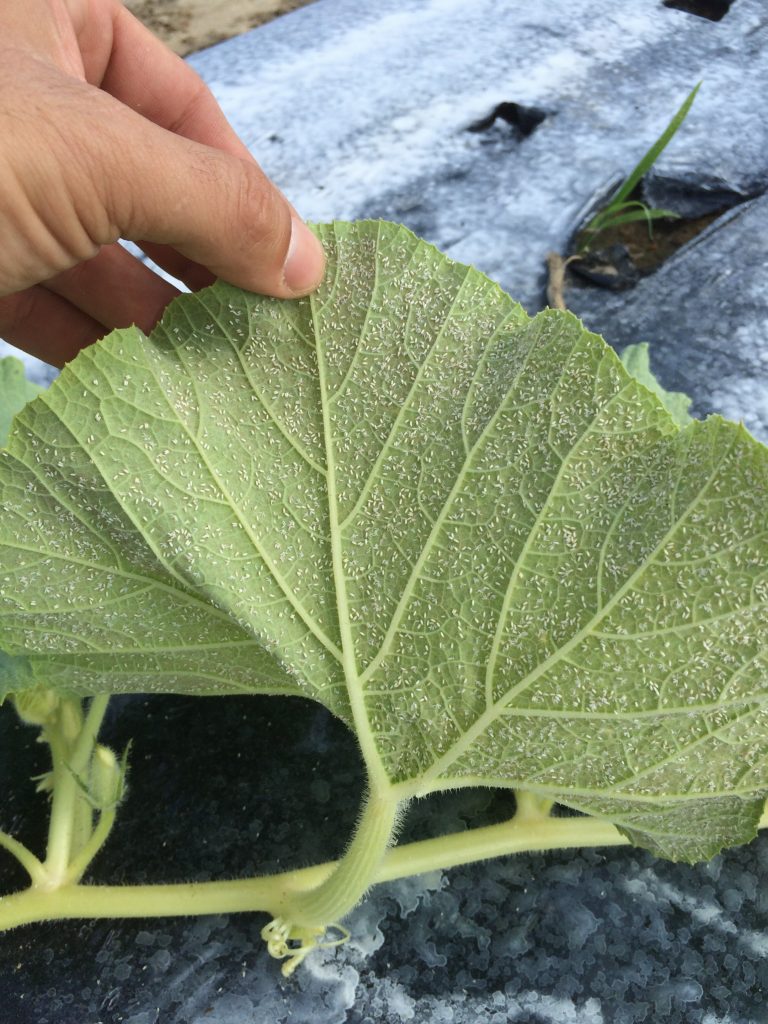
According to today’s release of the South Florida Pest and Disease Hotline, whitefly numbers are increasing in some older tomato fields across the southwest Florida region. As many as 5 to 10 whiteflies per leaflet have been detected.
Whiteflies are also present in high numbers in cucumbers, squash and eggplant. They are beginning to show up in some young tomato and watermelons as well.
Pressure remains light in the Manatee Ruskin area, though growers are just now planting.
Whitefly infestations are high in some older eggplant and reaching moderate levels in tomato along the East Coast. In Homestead, Florida, whiteflies are increasing in various crops. There are also reports that Tomato Yellow Leaf Curl Virus, a disease caused by whiteflies, is widespread in tomato.
Management of whiteflies later in the season depends on suppression of whitefly populations early in the season. Growers need to be aggressive with the best systemic materials such as Venom, Sivanto Prime and Verimark.
Whiteflies are difficult to control because of their prolific reproductive cycle. A female can lay between 150 and 200 eggs. It only takes those whiteflies two to four weeks to mature into the adult stage and begin reproducing.
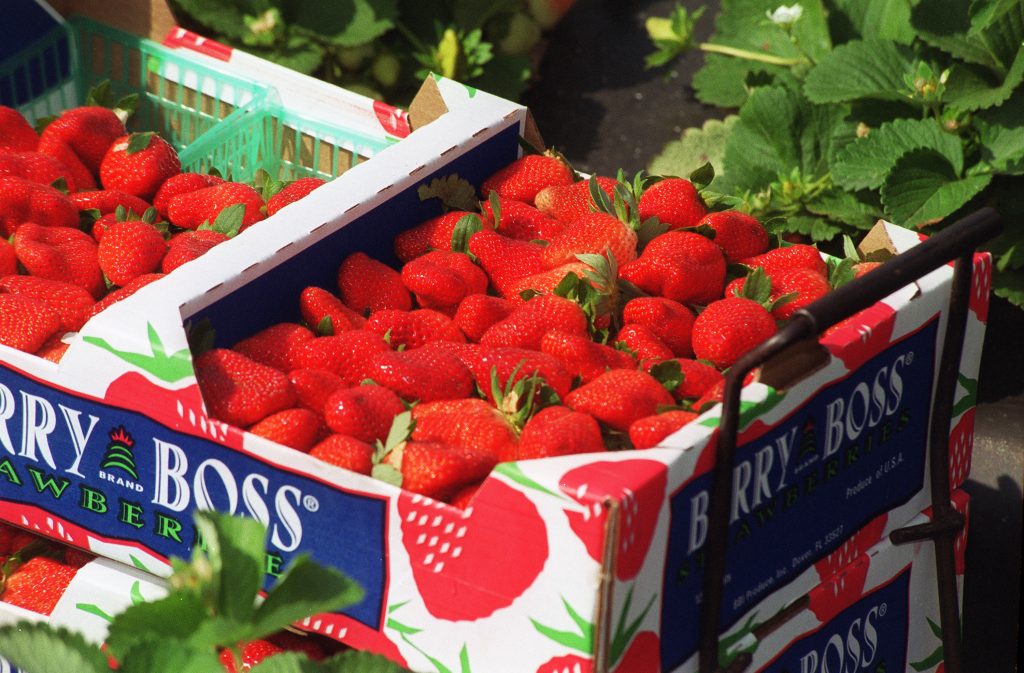
File photo shows strawberries packaged in the field.
Cooler temperatures this winter have slowed the growth of Florida’s strawberry crop. But the quality of the berries the state has produced since Thanksgiving remains top-notch.
“With all of this nice cool weather, we’ve had fantastic quality. The flavor has been really good. The size of the fruit has been really good. The firmness of the fruit has been really good. The fruit that we’ve produced has been great quality,” said Vance Whitaker, strawberry breeder at the University of Florida Gulf Coast Research and Education Center.
Whitaker said the combination of the hot November temperatures and subsequent cooler temperatures in December and January have slowed the crop’s emergence and ripening of the fruit as well.
He predicts that volume will increase substantially, however, over the next two weeks leading in Valentine’s Day.
An increasing number of today’s growers are first-generation farmers like Ida Vandamme. Photo by Sarasota Headshots
By Sarah Bostick
Every five years, the U.S. Department of Agriculture’s National Agricultural Statistics Service conducts a census. The 2017 Census of Agriculture captured in numbers what we see happening all around us: Farming is changing.
GREENER GROWERS
One of the most notable changes is that a growing number of farms in America are run by new and beginner producers — those who have operated a farm for fewer than 10 years.
As of 2017, more than a quarter of all producers in America had farmed for 10 years or less. In 2017, there were 908,274 new and beginning farmers producing on over 193 million acres of land. In Georgia, Florida and Alabama, the percentage of beginning farmers is even higher than the national average: 33, 31 and 30 percent, respectively.
This growing demographic of new farmers is also younger than the average farmer in America: 46.3 years old compared to 57.5 years old. Nationwide, 26 percent of beginning farmers are under the age of 35 compared to only 8 percent of all U.S. farmers.
New farmers are much more likely to operate a small acreage farm. Beginning farmers are also significantly more likely than the average American farmer to work off-farm, earn the majority of household income from off-farm jobs, have a higher debt-to-asset ratio and have a higher expense-to-sales ratio.
Another reality is that beginning farmers are more likely to be first-generation farmers. For as long as humans have farmed, knowledge and land have been passed down from one generation of a family to another. That time-honored tradition is changing.
The National Young Farmers Coalition (NYFC) is a non-profit organization with a mission of supporting young beginning farmers. In 2017, with the help of 94 partner organizations, NYFC surveyed 4,746 farmers across the nation. The survey (see www.youngfarmers.org/wp-content/uploads/2018/02/NYFC-Report-2017.pdf) showed that 75 percent of the respondents under the age of 40 did not grow up on a farm.
So how is the next generation of farmers learning to farm?
There are countless ways that organizations and individuals are creatively helping new farmers learn. Some of those ways are through incubator farms, farmer training programs, farm apprenticeships, conferences, farmer-to-farmer networks, and college and university student farms.
INTERNING AND VOLUNTEERING
In 2016, I was managing the University of Florida’s Field and Fork Farm and Garden program. The program provides an accessible place for students to get their hands dirty and learn to grow food. The program offered a dozen internships each semester, with many more applications than positions. A bright-eyed sophomore named Ida Vandamme applied that fall.
I still remember Vandamme’s interview. She met us in the carrot field and we showed her how to weed. Without hesitating, she started the delicate work of hand weeding a 150-foot bed. While working together, we asked her formal interview questions. She didn’t skip a beat. She was clearly a natural at thinking, talking and doing at the same time — a skill that is essential in farming.
Most students, including Vandamme, did not get an internship that year. We encouraged them all to volunteer that semester and apply next year. Vandamme took that advice to heart. She became one of the most consistent volunteers, happily harvesting cucumbers and stringing tomatoes while asking an endless stream of questions. She wanted to know how the things she was learning in plant science and sustainable food production classes related to what she was experiencing on the farm. Vandamme got the internship the next year and worked with Field and Fork until graduating in 2018.
TRANSFER OF KNOWLEDGE
One of the first farmers I met when I started my job as the sustainable agriculture Extension Agent in Sarasota County was Tiffany Bailey, a fifth-generation farmer and owner of both Bayside Sod Farm and Honeyside Farm, which produces vegetables. She grew up operating tractors, fixing machinery and understanding how to manage an agricultural business. In my first conversation with Bailey, she told me that she feels privileged that she grew up knowing how to farm and had a family farm to take over when her dad retired. She realized that most young people who want to farm start from scratch and she wanted to find a way to help change that for someone.
Tiffany Bailey (left), owner of Honeyside Farm, makes it a priority to give her farm manager, Ida Vandamme, hands-on training. Photo by Sarasota Headshots
A few months later, Bailey decided that it was time to train someone else to run Honeyside. She wanted Honeyside to grow and knew that she didn’t have enough time to do it herself. She decided to hire a farm manager. One of the people who applied for the job was Vandamme.
When asked how qualified she was for the farm manager job that she has now held for a year and a half, Vandamme bursts into laughter and says, “Not at all!” Bailey knew that Vandamme wasn’t an experienced farmer. But she didn’t see this as a bad thing; she saw it as an opportunity.
Bailey said she decided to take a chance on hiring Vandamme to manage her farm because “It is important to think about the responsibility that you have as an agriculture leader. You get to positively impact someone’s life. It doesn’t always work great. You have good days and bad days. But at the end of the day, the thanks you get from the people you have empowered to learn to grow food is amazing.”
Hiring Vandamme forced Bailey to get all the details out of her head and create systems that other people could easily plug into. “If only you know how to do everything, you can’t grow and you can’t further your impact,” says Bailey. “You are going to stay where you are.”
Bailey has some advice for established farmers who want to be part of training the next generation of farmers: The transfer of technical knowledge has to be hands-on. “Keep it teachable and keep it repeatable,” she advises. What doesn’t work is thinking that everyone is going to be good at doing everything from the get-go — that take times.
Vandamme has some advice, too: Aspiring farmers can’t be scared to take the leap when an opportunity presents itself. For Vandamme, applying for a job managing a 10-acre vegetable farm was her big leap.
“Coming to Honeyside is the best thing that has ever happened to me,” says Vandamme. “I think I won the lottery with Tiffany.”
For Vandamme, a young first-generation farmer, the hardest thing to learn about managing a farm has been putting all the little pieces together into the big picture. Bailey is committed to helping her with this process.
An increasing number of today’s growers are first-generation farmers like Ida Vandamme. Photo by Sarasota Headshots
Vandamme dreams of owning her own farm someday. Land access is the No. 1 barrier to farming for young farmers, and Vandamme is no exception. Bailey hopes that Vandamme stays with Honeyside for a long time. But she knows that Vandamme will probably move on someday — either to start her own farm or work on a larger farm. Bailey hopes that by the time Vandamme moves on, she will leave with the skills she needs to succeed as the next generation of farmers.
Farming in America is changing. Farming was once something that the younger generation learned from their parents, just as land was passed down through the generations. As more and more farm kids grow up and leave the farm, that generational knowledge is being lost. But it doesn’t have to be lost, and you can be a part of making sure that deep agricultural knowledge is passed on. I encourage new and established farmers to reach out to one another in the great American tradition of cultivating the next generation of farmers.
According to the University of Georgia Extension Pecan blog, now is the time of year where producers need to be wary of ambrosia beetles. This is especially important for farmers with trees that are less than 5 years old.
Photo by UGA’s Andrew Sawyer shows ambrosia beetle damage to a pecan tree.
Winter rains mean some trees are prone to flooded conditions, where they are susceptible to ambrosia beetle attacks. Angel Acebes-Doria, University of Georgia Cooperative Extension pecan entomologist, said that if the soil remains wet for several days, growers need to scout trees in those areas for signs of attacks once beetle activity has been detected or when temperature consistently reaches 68 degrees Fahrenheit or higher.
Beetle activity is identified by the toothpick-sized sawdust tubes they leave sticking out of holes bored in pecan trees. Farmers are strongly encouraged to deploy traps, which help to indicate when beetles are active. Immediate action is required if growers detect beetles and suspect their trees are damaged.
If trees are being attacked, producers can apply pyrethroids at the trunk of the tree. The more often beetles attack a tree, the less likely that tree will survive an attack.
In her blog, Acebes-Doria said traps have been deployed in the Cook County, Georgia area, though beetle activity has not been observed yet. Activity normally starts in early February and peaks in late February to mid-March.
Click here to see what traps to use and when to put them out.
The best way to protect your trees from ambrosia beetle attacks is to maintain healthy trees.
Clemson Extension agents provide updates in the The South Carolina Grower this week about the status of various crops being produced throughout the state.
Weekly Field Update-2/01/21
Coastal
Rob Last reports, “Strawberry crops are developing well, however, we are seeing gray mold phomopsis blight in forward crops. Sanitation can really help prevent botrytis spread as we move forward when allied to fungicide applications. Keep scouting for spider mites, as there are active populations in some crops. Now is a great time of year to think about maintenance of equipment, be that for bed formation, cultivation for spring crops, and most important application equipment.”
Zachary Boone Snipes reports, “I feel like Forrest Gump describing the weather as of late. “One day it started raining, and it didn’t stop for four months.” We are extremely wet in the Lowcountry which is delaying a lot of ground prep for the upcoming season. Stay out of the fields if they are wet, as equipment will compact soil and make matters worse than they already are. This is the perfect time of year to order and stock up on pesticides, fertilizers, seeds, calibrate sprayers, clean ditches, sharpen tools, clean packing sheds, etc. Preventative maintenance and getting prepared for the upcoming season will lead to less stress and better management decisions down the road. This would also be a great time to explore all the links that lead to resources on SCGrower.com as well as to curl up with your Southeast Vegetable Crop Handbook.”
French drains are being installed in lower lying areas of some fields. Photo from Zachary Boone Snipes.
Midlands
Justin Ballew reports, “The weather was a little warmer for most of the past week, and we received a little more rain. The strawberry fields I’ve looked at in the past week averaged 3 to 4 crowns. Growers have been working on sanitizing dead leaves and flower buds from their fields to keep botrytis inoculum down. I’ve gotten a couple calls recently about whether it’s time to start protecting blooms. It’s still a little early in my opinion. Remember, there is about a 4-week time span from bloom to ripe berry, so saving blooms now would have people picking around the first of March. I’m not seeing enough blooms out there right now to make saving them worthwhile. I would rather let the plants grow for a few more weeks.”
These plants were recently sanitized and are looking good. It would be best give them a few more weeks to grow before protecting blooms. Photo from Justin Ballew.
Sarah Scott reports, “As of this morning at Musser Farm, we are reporting 850 chilling hours and 50 chill portions. In Johnston, we are sitting at 788 chilling hours and 46 chill portions. Chilling hours are measured between temperatures of 32-45 for this calculation.”
Upstate
Kerrie Roach reports, “Heavy rains over the last week have put a significant damper on any field prep and planting for early season vegetables in the upstate. Pruning tree fruits is in full swing, and chilling hours are on track.”
South Florida watermelons have been in the ground almost a month. Plants are progressing, but today’s cooler temperatures and strong wind has one farmer concerned potential gummy stem damage.
“Right now, (plants are) looking pretty good. I’m just hoping that this wind doesn’t do a lot of damage. When your line is just starting to run a little bit and you get a lot of wind, that’s when you start to get some problems,” said Carr Hussey, a watermelon farmer in Florida and Alabama, chairman of the board of the Florida Watermelon Association and co-founder of Sweet Mama Produce. “Gummy stem starts to show up and stuff like that.”
Weather Factor
A La Nina weather pattern was expected to bring warmer and drier winter conditions across the Southeast. But that has been opposite of what some producers in Florida, Georgia and Alabama have felt so far. In South Florida, though, temperatures can increase dramatically and quickly, which could bring added stress to the plants already in the ground.
“We’ll have days here where it’ll be a high and today’s going to be one of them, like 58 (degrees). And two days from now, but it won’t be this week, but last week was where we had a week like that; two days later we were 80, which is 10 degrees above our normal temperature. On average it was a couple of degrees higher than normal,” Hussey said.
“The wicked witch of the north has always said when you get temperature changes like that, that’s when you have a hollow heart situation. But I don’t think anything’s been planted long enough for that to happen. Should the weather straighten out I think we’ll be okay. I don’t think anybody actually knows where hollow heart really comes from.”
Hussey plans to plant again around Feb. 15 in Wauchula, Florida and then again in Malone, Florida and Cottonwood, Alabama on March 15. That is also about the time when most of South Georgia producers will plant their crop.
Data shared by UGA’s Greg Fonsah shows how much bell pepper imports have increased since 2000.
One vegetable commodity at the center of an investigation pertaining to its imports from other countries was highlighted during Georgia’s Ag Forecast meeting last Friday.
Greg Fonsah, University of Georgia Agribusiness Extension economist, pointed out how significantly bell pepper imports have increased over the past two decades.
Statistically Speaking
In 2019, 68% of bell peppers that were consumed in the U.S. were imported, amounting to 1.61 million pounds. Bell pepper imports have increased by 5% annually for the past five years. Most of the imports originate from Mexico, 75% in fact, with Canada contributing 18%.
“You can see how the fresh imports started growing from the year 2000 and has been growing steadily. It’s doubled, it’s tripled all the way to 2020. We think by 2021, it’s going to go all the way up here, it’s still going to increase, the same as the import share for the availability,” Fonsah said. “You can see how it’s increasing, increasing, increasing, and it keeps increasing. We expect to see the same thing in 2021.”
Chill hours remain an integral part of a peach producer’s hope for a successful year. If the current numbers are any indication, Alabama growers could be in line for a productive season.
During a webinar last week, Edgar Vinson, assistant research professor and Extension specialist in the Department of Horticulture at Auburn University, said there was 737 chill hours or 38 chill portions recorded at the Chilton Regional Research and Extension Center. He was confident that the chill hours will continue to rise heading into February.
“Over the next several days or weeks we should have enough opportunity for chilling accumulation so that we can have enough chilling to satisfy most of the varieties that we grow,” Vinson said.
He said 43 degrees Fahrenheit is the optimal temperature for when chill accumulation will occur.
Chill Management
There are multiple ways that producers can manage chilling. The first thing is to do your research before planting. Growers need to plant peach varieties that fall in line with the historical chilling accumulation for their areas. Areas in north Alabama are going to receive more chill than south Alabama.
“You don’t want to plant varieties that have too high a chill requirement or too low. Too high, you threaten not to have enough to sufficiently eliminate dormancy. Too low, then you could break dormancy too early and be subject to late-season frost,” Vinson said.
While this year’s cooler winter has contributed to more chill accumulation potential, that hasn’t always been the case.
“In our area, we’re experiencing a lot of warming trends each winter. Winters are becoming increasingly warmer. It’s becoming more and more difficult to accumulate chilling. With these varieties that have a high chill requirement, they’re vulnerable to not having enough chilling,” Vinson said.
Peaches need chill hours to mature. The required chill hours depend on the peach variety. Contender, a well-known peach variety, has 1,050 chill hour requirements.