It’s that time of year when Georgia pecan producers need to start protecting their trees against fungal diseases, including scab. According to the University of Georgia Extension pecan blog, sprays vary among the different cultivars and their specific level of resistance.
Low Input Cultivars
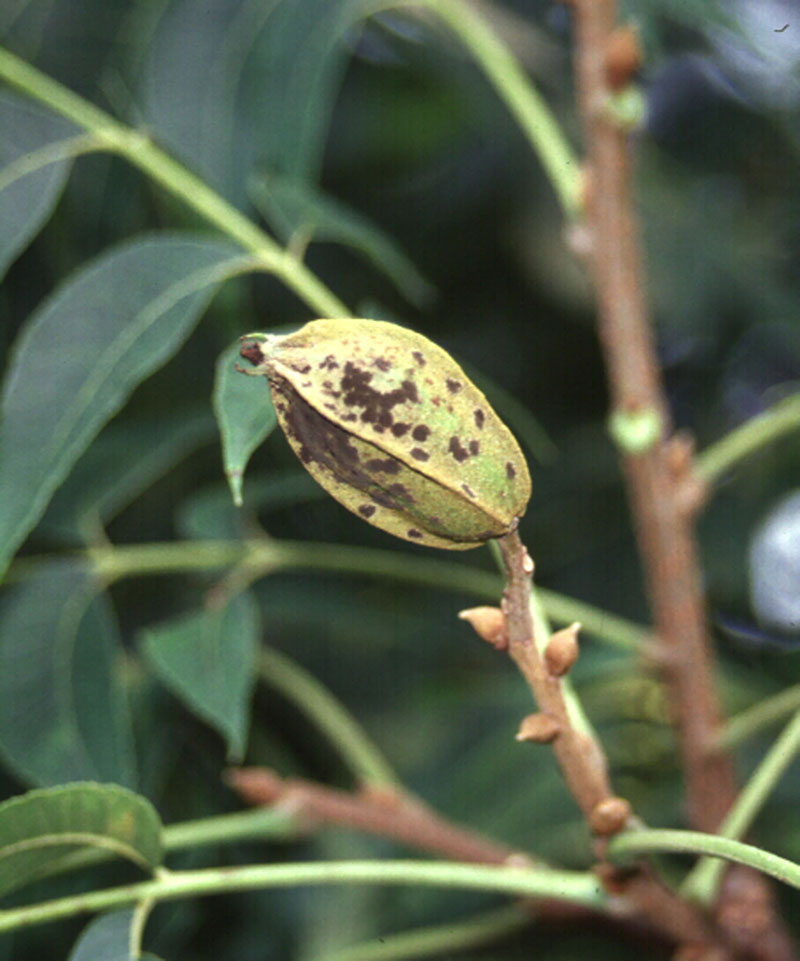
Pictured is what scab disease looks like on pecans.
Those that are considered low input cultivars include Avalon, Elliot, Excel, Kanza, Lakota and McMillan. These require a minimum of three sprays which help manage minor diseases like powdery mildew, anthracnose and downy spot, while also maintaining scab resistance. UGA Extension recommends growers apply a phosphite in mid-to-late April; another in mid-to-late May; and an 11+3 mix in early-to-mid June.
Medium Input Cultivars
Those medium input cultivars include Creek, Kiowa, Oconee, Sumner, Zinner, Ellis and Gloria Grande. These require fungicides to manage scab, which can be controlled without an intensive spray program.
Scab should be controlled with seven sprays. UGA Extension recommends growers apply a phosphite in mid-to-late April; a phosphite or 11+3 in mid-May; Miravis Top in early-to-mid June; Elast+Tin or phosphite in mid-to-late June; Miravis Top in early-to-mid July; Tin or Elast+Tin in mid-to-late July; and Miravis Top in early-to-mid August.
High Input Cultivars
Those high input cultivars include Byrd, Cunard, Desirable, Morrill, Pawnee and Treadwell. These must be sprayed intensively if growers expect to produce a crop. They require at least 10 sprays and likely more in some locations. If you need more than 10, continue rotating Miravis Top and Elast+Tin.
UGA Extension recommends growers apply a phosphite; another phosphite; 11+3 mix; Miravis Top+phosphite; Elast+Tin; Miravis Top; Elast+Tin; Miravis Top; Elast+Tin; and Miravis Top.
Those medium-high cultivars include Caddo, Cape Fear, Huffman, Schley, Stuart, Tanner, Tom and Whiddon. These could fall into either of the other two categories.
Group 3 and Group 11 fungicides contain both a Triazole and Strobilurin fungicide chemistry.
Fungicide sprays should continue through shell hardening.
The Growing Matters Coalition is kicking off its 2021 BeSure campaign that reinforces practical stewardship practices. “(The campaign) is to remind growers and applicators of some simple steps that they can take to ensure pesticides don’t harm pollinators and other wildlife,” Valent USA Sustainability & Stewardship Manager Leslie Garcia said.
One of the ways the industry can achieve this is by remembering to check the labels on their products. “We have a fun little rule here in our industry. The four corners of that label are the law,” Garcia said. Labels also can change year to year. Garcia noted it’s important to check that information before using a newly purchased product. “We like to change up the labels, keep them fresh and updated. As you get new inventory, make sure you are re-reading that label,” she said.
Listen to Garcia’s full interview.
This was a message from the BeSure campaign brought to you by the Growing Matters Coalition, an initiative reminding farmers and applicators to follow stewardship best practices to protect pollinators and other wildlife. Visit growingmatters.org for more information.
Figure 1. Shade nets can prevent crops from receiving too much light.
By Juan Carlos Díaz Pérez
Vegetable growers know well about the importance of light to plants. Light is necessary for the process of photosynthesis through which plants convert light energy into chemical energy (sugars) needed for plant growth and development.
LIGHT AND HEAT
Light is electromagnetic radiation that comes from the sun. The portion of the electromagnetic spectrum that can be seen or perceived by humans, the “visible light,” is within 400 to 780 nanometers (nm). (A nanometer is a billionth of a meter.) Photosynthesis also occurs within this visible range.
In addition to the visible light, infrared is an important region of the electromagnetic spectrum that is for plant growth. The infrared light covers the range from 780 nm to 1 millimeter. A little more than half of the electromagnetic energy received from the sun is in the form of infrared radiation. Objects such as plants, animals and the soil emit heat as infrared radiation.
Heatis energy that flows because of differences in temperature. Although visible light and other electromagnetic radiations may produce heat, the majority of heat at the Earth’s surface is associated with infrared radiation. Thus, plant heat stress due to excessive light and temperature are related to high exposure to infrared radiation.
Although not all scientists agree with the concept of global warming, most climate experts believe that Earth’s temperature has been increasing since the time of the Industrial Revolution. The rise in temperature affects agricultural crops and may increase incidences of pests and diseases. New pests and diseases have been detected in the last decades that have been linked, at least partially, to changes in climatic conditions.
Vegetable crops are particularly sensitive to high temperature and high light intensity conditions. Vegetables typically require soil moisture availability to reach high fruit yield and quality. Under conditions of high light and high temperature, crops such as pepper plants show drought stress, reduced fruit yields and high incidences of fruit physiological disorders such as fruit sunburn and blossom-end rot.
PROTECTIVE TOOL
Figure 2. Bell pepper plants are grown under shade net supported with a metallic cable and posts forming a pyramidal structure at the University of Georgia in Tifton.
Shade nets are a type of technology used extensively to protect vegetables and other horticultural crops from damage by high solar radiation, wind, birds and hail. Black nets are the most common and the least expensive (Figure 1).
Shade nets help reduce the heat load on crops by absorbing a portion of the solar radiation (visible light and infrared) and may reflect or refract some of the radiation, depending on the color and chemical composition of the net. The percentage of the solar radiation reduced by the net (called the “shade factor”) may vary from as low as 15% to as high as 80%. The type of net shade factor to use depends on the crop.
RESEARCH RESULTS
A study at the University of Georgia (UGA) in Tifton was conducted to determine the response of bell pepper plants to nets with different shade factors. Bell pepper plants (cultivars Camelot, Lafayette, Sirius and Stiletto) were grown in the field following the recommendations of the UGA Extension Service. Plants were planted in the field during the spring season of two years.
Table 1. Bell pepper fruit yield under field conditions in Tifton, Georgia, as influenced by shade factor of black nets. Values are the means of four cultivars (Camelot, Lafayette, Sirius and Stiletto).
Plants were grown in unshaded conditions (0% shade factor) and under nets with 30, 47, 63 and 80% shade factors (Figure 2). Results showed that fruit marketable yield of the four cultivars was highest under nets with 30 and 47% shade factors (Table 1). The yield of nonmarketable fruit decreased with increasing shade factor, indicating that reduced light levels were associated with diminished incidences of fruit physiological disorders (sunburn). The fruit size also increased with higher shade levels. See doi.org/10.21273/HORTSCI.49.7.891 for a more detailed report of this study.
In conclusion, shade nets with shade factors between 30 and 47% resulted in the following benefits:
Increased fruit marketable yield
Improved fruit size
Decreased incidences of fruit sunburn
Juan Carlos Díaz-Pérez (jcdiaz@uga.edu) is a professor in the Department of Horticulture at the University of Georgia in Tifton.
What should be an advantage to Southeast producers against Mexico is anything but, believes Georgia vegetable farmer Dick Minor.
Freight prices continue to spike, which has only worsened since gas prices continue to increase. But that doesn’t matter to produce originating out of Mexico, Minor added.
“High freight rates are our friend or should be technically our friend from a business point because Mexico’s got to transport it further than we’ve got to transport it. Every time freight goes up, that should help us, give us a competitive advantage,” Minor said. “The only problem is, they’re still shipping just as much product regardless of freight costs. That tells us, they don’t care. I know for a fact they’ve got boxes into New York for $1 a box net back to them. That doesn’t even pay for the box. They’re just trying to move product.
“If they’re making real business decisions, when freight got really high like it did in ’11, ’12, and ’13 when we had $3.50 gasoline, they should have been shut down. But no, they still shipped product regardless of freight costs.”
Freight was one of several points of contention during the most recent U.S. International Trade Commission hearing that centered on the impact of squash and cucumber imports on the Southeast domestic market.
Increased Freight Costs
Increased input costs are a challenge for Southeast producers. Freight is no exception. It was established during the hearing that between 2015 and 2020, freight costs have at least doubled. There are fewer drivers and more regulations on the road. Drivers must be shut down for eight hours.
“Everything’s going up,” Florida farmer Sam Accursio said during the hearing. “Insurance is going up tremendously for these independent operators. Fuel has been fluctuating back and forth, but their biggest expense is tires and mechanics insurance. Their biggest complaint is insurance and tags.”
Those same input costs are not swaying the intentions of Mexican producers who are focused on the U.S. markets. Whether it is strawberries, blueberries, squash, cucumbers, tomatoes, imports are increasing exponentially. Freight is just another factor that doesn’t seem to matter to Mexican growers.
“The cheaper you can get the freight on a delivered price, then you can make more money,” added Georgia producer Bill Brim during the hearing. “If we take it on an open market and we ship it up there and have $6,000 in freight and they pay you $3 a pack, then you’ve lost your you know what.”
Weather conditions are conducive to certain plant diseases being a problem this year. Joe Kemble, Alabama Extension vegetable specialist, cautions Alabama producers about certain fungal diseases that could become problematic.
“One of the things that’s important this time of the year is there are a lot of foliar fungal diseases. They cause problems in strawberries, but they also cause problems in vegetable crops,” Kemble said. “I’ve seen quite a bit of scattered anthracnose around the state. It’s a common fungal disease. It also goes to strawberries, different species of the disease. Basically, if the weather conditions are favorable for one, they’re favorable for all the different versions of that disease.”
While diagnosing the disease is not an issue, managing it can be a problem if you’re an organic producer. They don’t have the same options to control diseases as a conventional grower would.
“If you’re a conventional grower, there’s herbicides that work quite well to manage these. But if you’re growing organically, you’ve got a bit of a mixed bag in terms of what you need to do. There aren’t any products out there that are curative. It’s really a preventative measure,” Kemble said. “If I’m an organic grower, this time of the year, I think it’s safe to assume that you’re going to have these diseases. It’s a good idea to put on any type of protectant sprays that you’d like to use. If the spray’s not there, you’re not going to get any type of control. It’s very hard after the fact once you see the disease.”
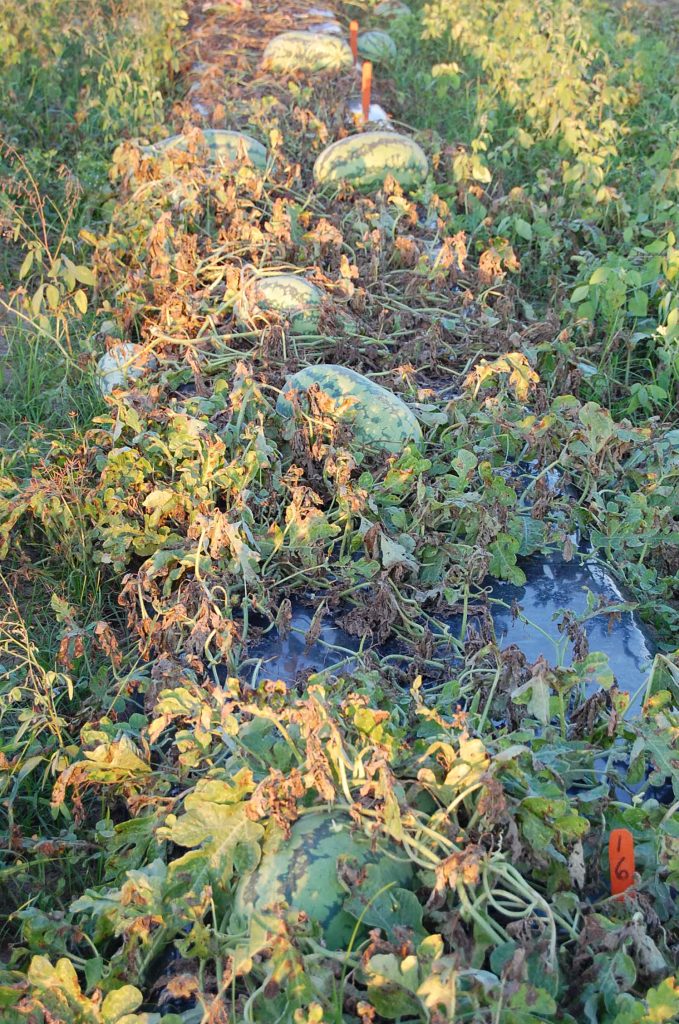
File photo/Wilting is common in a heavy gummy stem blight outbreak.
Rainfall over the weekend in north Florida has watermelon producers wary of potential diseases that could potentially occur. Bob Hochmuth, UF/IFAS Regional Specialized Extension agent in Live Oak, Florida, cautions farmers to look for any new symptoms that could occur.
“Most of our fungicides are in fact preventative. Trying to play catch-up with a preventative fungicide after a disease has gotten started is not the best plan,” Hochmuth said. “There are some systemic fungicides that have good activity once we see the disease start. But for sure, we want to try to stay on a really good, early-season preventative maintenance program. What we try to do as we move into these next few weeks is to keep a close eye on new diseases and then begin to target the fungicide application to the best-case scenario for the diseases that show up.
“We don’t have a lot of silver bullets to correct a problem once it occurs.”
Farmers Prefer Dry Conditions
Florida watermelon producers prefer a dry production season since the crop is vulnerable to various diseases. Farmers utilize drip irrigation to supply ample amount of water. But any extra moisture leaves the crop susceptible to potentially devastating diseases.
“The drier conditions typically help reduce the disease pressure. The only exception to that is powdery mildew. It can still be a problem, even in dry weather,” Hochmuth said. “But the other diseases, the primary ones being downy mildew, gummy stem blight and bacterial diseases, those are all encouraged by, especially, multi-day rain events.”
He added that watermelon fields were disease-free heading into the weekend. But chances are that could change this week.
“There was pretty significant rainfall throughout the watermelon growing region. A little bit on Friday but pretty significant on/off showers over the weekend,” Hochmuth said. “We were clean going into the weekend I feel like. We haven’t really seen anything other than the fusarium wilt, which has nothing to do with rain.
Spinach experienced the biggest decline, dropping 28.7% a year after increasing 49.8%. Cauliflower dropped 25%. A year after increasing 22.8%, cabbage production dropped 18.2%. Bell peppers dropped 11.2%, while Carrots declined 7.1%. Dry onions also dropped 14.5%.
Sweet corn experienced the biggest increase with an 18.5% jump from 2019. Sweet potatoes also increased 9.7%
First Quarter 2021 Prices Down
The Producer Price Index (PPI) reveals fresh vegetable producer prices decreased by 8% through the first quarter of 2021. Lettuce was down 23%; sweet potatoes down 8%; tomatoes down 46%; and broccoli down 8%.
Consumer Preference
Consumers also demanded more organic vegetables. First quarter non-organic prices for fresh cucumbers were down 44%, while organic cucumber retail prices rose by 138%. Prices for organic white round potatoes increased by 151% from 50 cents to $1.25 per pound. However, prices for non-organic white round potatoes increased by just 1.9%.
Imports Increased, Exports Decreased
The U.S. continues to import vegetables, increasing by 3% in 2020. However, exports were down 4% in 2020. The U.S. imported 4.05 billion pounds of tomatoes in 2020, a 1% increase from 2019. There were 2.19 billion pounds of cucumbers imported in 2020, a 2% increase from 2019. Bell peppers also increased 3% to 1.66 billion pounds in 2020.
Broccoli imports increased by 10% to 542 million pounds in 2020. Lettuce imports also increased by 4% to 821 pounds.
Stormy Impact
The National Oceanic and Atmospheric Administration (NOAA) reported $22 billion weather events, which cost the U.S. $95 billion. Wildfires in California, Oregon, Washington and Colorado were devastating.
Excessive rains at the end of the growing season in 2020 hurt sweet potato yields in North Carolina, the largest producer of the crop.
A record-breaking number of hurricanes in 2020 affected sweet potato production in Louisiana as well. More than 660 acres of sweet potatoes were lost in the state due to hurricanes/tropical depressions and excessive moisture/rain.
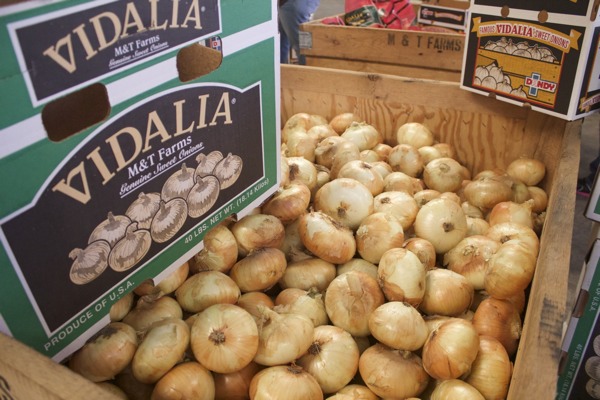
Today is the pack date for Georgia Vidalia onions. An advisory panel comprised of industry leaders determined that April 19 be the first day of the year consumers could buy Vidalia onions.
“A lot of growers were getting ramped up with harvest end of (two weeks ago) to really have onions that would be ready to sell for the pack date,” said Chris Tyson, University of Georgia Extension Area Onion Agent at the Vidalia Onion & Vegetable Research Center in Lyons, Georgia. “We’re still digging onions, clipping and grading. We’ve got a little bit of everything going on now. We’re starting to get into full swing of things.”
Growers in Southeast Georgia also could not have asked for better weather conditions to harvest their crop.
“It’s been clear and sunny. It hasn’t been too hot, yet We’ve had highs in the 80s, that’s almost perfect weather conditions for field curing onions,” Tyson said. “We start to get a little concerned when temperatures get hot. When it gets into the 90s, it’s harder on the onions. When it’s wet too, it’s the same thing. But it’s been mild and dry. It’s been really nice for them.”
Growers first dig onions and let them field cure. Then they’ll clip the onions and send to the grading house to be packaged and boxed up.
“I think we have a good, quality crop out there for the most part. This weather we’ve had up until now has really helped that,” Tyson said. “The weather can make us or break us. It’s been on our side so far. We’ve got a good-looking crop out there. I think the quality’s going to be really good.”
Two farmers. Two states. One message: The government needs to do more to support the American farmer.
In an era of increasing costs and imports that continue to flood the marketplace, more and more farmers express concern about the decreasing role American farms have in feeding our country.
“Florida specialty crops is really getting the raw end of the deal here. There are people that are making lots of money off exporting. It’s not us,” said Florida strawberry producer Dustin Grooms. “Our berries are meant to be eaten fresh right here locally and around the U.S. We can’t compete with (Mexico’s) labor. That’s one of the main things is their labor. We just can not compete with their low prices. They know that. Every time it seems that we’re starting to get somewhere with the government, we take one step forward and about 10 steps backwards. It’s a losing battle.”
Labor Battle
Labor is at the forefront of this battle and one that Mexico is winning. It was established during the USITC hearing on cucumbers and squash that labor rates in Mexico were just shy of $12 per day; which is comparable or even less than what some American farmers have to pay for workers per hour.
“I just don’t understand how in America we expect the farmer to grow things under certain environmental regulations and labor regulations and that comes with a cost. If you’re going to regulate the American farmer then you’ve got to protect them against countries that don’t have similar regulations,” said Georgia blueberry farmer Russ Goodman. “If nothing’s done about it, and we’re already starting to feel the repercussions in rural communities across the country, it’s just going to get worse.”
Increasing Frustration
Goodman is especially frustrated about the report that says the Biden Administration plans to manage the immigration crisis by asking private U.S. companies to invest in Mexico and Central America.
“I hope at some point in time our government will recognize it’s a national security issue,” Goodman said. “If you take anybody that has a 90% advantage over something that is 40% of their costs of doing business, they’re going to put their competitor out of business. The sad thing is that competition comes in the form of the American family farm. I just don’t know what the future holds. It’s absolutely amazing to me that our country is not trying to do something to protect farmers.”
Food security and food awareness need to be heightened in this country. Consumers need to be made aware of how and where they get their food.
“We need the support of the government. We also need the support of the American people to buy our products and not foreign imports,” Grooms said. “That’s what it’s going to take, a movement.”
Here’s its statement: On behalf of the millions of Americans who gained access to healthy fresh produce throughout the COVID-19 pandemic, we are deeply disappointed in USDA’s decision to end the food box program.
This decision is shortsighted, and comments disparaging the program are a slap in the face to the thousands of volunteers, non-profits, regional food distributors and farmers who worked together in communities across the country to deliver healthy foods to people in their time of greatest need.
For a major new program put together rapidly in a time of crisis, the food box program certainly included challenges. Yet, hundreds of community non-profits and nutrition advocates have found delivering fresh produce directly to those in need has great potential to truly make a difference in the health of millions of Americans.
Speaking personally, United Fresh has worked with small farmers, distributors, food banks and community organizations over the past several months to submit more than 30 recommendations to USDA on ways to improve efficiency, accountability and assured delivery of high-quality produce to people in need.
Yet, it is apparent that USDA neither considered these recommendations nor listened to the wide range of support for the program in its recent public listening session. This sudden decision seems more a political statement repudiating a program begun in a former Administration than an objective evaluation of the program’s ability to improve Americans’ health.
Ending the program abruptly rather than looking for ways to continue funding and to improve its execution is a terrible mistake as the COVID crisis has most seriously impacted those with diet-related diseases such as obesity and diabetes, with greater hospitalization rates and even death compared with healthier populations.
Now that the Administration has ended this program, USDA bears a tremendous responsibility to develop new programs to get fresh, healthy foods to people in need.
We cannot afford to go back to old, tired feeding programs that do not prioritize nutrition security as much as calorie security.
It is time for bold action to address the nutrition health crisis facing our nation, and USDA needs to lead the way.