Blog

  • Rain, Rain Go Away: Dry Weather Needed

    Excessive rainfall in January and so far in February has vegetable producers playing catch-up in preparing for the upcoming season.

    Field in Tift County, Georgia shows how wet and muddy it is right now.

    “We’re way behind as far as laying new plastic for the spring and everything,” said Bill Brim, part owner of Lewis Taylor Farms in Tifton, Georgia on Friday. “We probably still like about 600 acres of plastic to lay. We laid a little bit (Thursday) and a little bit (Friday) and that’s it; about 40 or 50 acres. We really need some dry weather now to try to get some stuff done.”

    Brim and other farmers in south Georgia got some sunshine on Sunday and Monday. But according to weather.com, there is a high chance of rain the rest of the week.

    According to the University of Georgia Weather Network, Tifton, Georgia has received 8.67 inches from Jan. 1 to Feb. 7, compared to 4.93 in 2020 and 5.18 in 2019. In Moultrie, Georgia where the Sunbelt Ag Expo is located, it has recorded 8.37 inches from Jan. 1 to Feb. 7, compared to 4.86 in 2020 and 5.83 in 2019.

    The Lewis Taylor Farms website states it produces more than 6,500 acres of produce every year. Fortunately, it started laying plastic when it did near the end of 2020. If not, it would really be behind in getting row beds ready to plant.

    “We started back at the end of November laying (plastic). I’m sure glad we did, because if we hadn’t, we’d be in a real mess. We wouldn’t have gotten anything laid, probably from mid-December to now,” Brim said.    

  • American Blueberry Growers Alliance Confident Ahead of ITC Decision

    The American Blueberry Growers Alliance’s (ABGA) case has been made. The data supports its stance of serious injury regarding blueberry imports. It’s now up to the International Trade Committee (ITC) which will vote on Thursday to determine whether the domestic industry has been seriously injured.

    “We feel like we presented a good case. The numbers do not lie,” said Jerome Crosby, Georgia blueberry grower and chairman of the American Blueberry Growers Alliance. “There’s a lot of people that have different opinions. I’m looking at the numbers and the pricing and the effects of what we see on the blueberry farmers. One of our strongest arguments is you’ve got to look at the net income of a blueberry farming operation. When you see the downward spiral we’ve experienced, then that is the sum total of the effects of the import markets. That is to us the defining factor.”

    January Hearing

    Thursday’s decision by the ITC will come a month after the ABGA and opposition groups testified during a virtual hearing regarding the impact of blueberry imports.

    “Once they reach a decision, then we will move to the next step. If it’s affirmative, we’ll be into the remedy phase, and if it’s not affirmative, then there are other options we will be pursuing. We really won’t know until Thursday. It’s in their hands,” Crosby said.

    Data Supports Their Case

    Crosby and other blueberry growers who testified in January believe the data supports their claim of serious injury. Blueberry imports from countries like Mexico, Peru, Chile, Argentina and Canada have increased by 62% since 2015, according to the ABGA. The National Farmers Union submitted a letter to the ITC on Friday, Feb. 5, noting that growers’ operating returns fell 32.4% between 2015 and 2019.

    Nikki Fried, Florida Ag Commissioner, testified during the January hearing. She stated that Florida has a $62.3 million blueberry industry, but its market share has declined by 38% since 2015. It has resulted in $67 million in lost potential production. She added that Mexico’s market share has increased by 2,100% since 2009.

    Letters of Support

    A coalition of industry groups, including the Florida Farm Bureau Federation, Georgia Farm Bureau and Georgia Fruit and Vegetable Growers Association, submitted letters to the ITC last week, spotlighting the consequences of blueberry imports.

    “Not only do these imports threaten domestic businesses and livelihoods, they also expose U.S. consumers to products from countries with poor or inconsistent product safety records,” John Hoblick, president of the 136,000-member Florida Farm Bureau Federation, said in a ABGA press release.

    Elected officials and state agricultural leaders are also in the ABGA’s corner. These include U.S. Sens. Debbie Stabenow (MI) and Gary Peters (MI). Both co-signed a letter of support that was submitted to the ITC on Feb. 3. Representatives and industry leaders also testified during the January hearing.

    About the ABGA

    According to its website, the American Blueberry Growers Alliance is a national association representing blueberry growers and farmers in the United States. ABGA provides a unified voice for blueberry growers in states across the country, including California, Florida, Georgia and Michigan. It advocates on behalf of their interests and for the long-term viability of the domestic blueberry industry.

  • March 2 is Deadline for Georgia Vegetable Growers to Vote on Assessment

    Georgia vegetable growers have until March 2 to vote on a Georgia Vegetable Commission marketing order that allows the assessment of one cent per marketing unit of vegetables, which is described in the current marketing order.

    Pictured are bell peppers.

    The order is applicable only to growers who produce at least 50 acres of the following crops: beans, bell pepper, specialty pepper, broccoli, beets, cabbage, cantaloupe, carrots, cucumbers, eggplant, greens (including collards, turnip greens, mustard and kale), squash (including yellow, zucchini and winter squash), sweet potato and tomato. 

    If you are a qualified grower and have not received a ballot in the mail by Feb. 10, please contact Andy Harrison: Manager, Commodity Commissions, Georgia Department of Agriculture, Andy.harrison@agr.georgia.gov, (404) 710-1196

    The Georgia Vegetable Commission was established by the Georgia General Assembly in 2006. The marketing order must be re-approved by eligible vegetable growers every three years by a two-thirds affirmative vote. 

  • Clemson Extension Agents Provide Crop Updates

    Clemson Extension agents provide updates in the The South Carolina Grower this week about the status of various crops being produced throughout the state.

    Weekly Field Update-2/8/21

    Statewide

    Dr. Matt Cutulle reports, “With the cold temperatures we have been consistently having, it might be good to use Prefar or Dacthal for PRE herbicides instead of Treflan in new collard plantings to avoid injury.”

    Midlands

    Justin Ballew reports, “Last week was pretty cool and it looks like this week will be about the same. Things are a little slow in the fields, but folks are preparing land for spring plantings and harvesting a little mustard, collards, and herbs. Strawberry growers are still working on sanitizing. Now is also a good time to make sure drip systems are hooked up and ready to go when it’s time to start fertigating. Deer are still wearing out the plants in some fields. Temporary deer fences aren’t that expensive and they can pay for themselves by preventing the degree of damage seen in the photo below.”

    This picture was taken last Thursday (2/4). After 3 and a half months in the ground, these plants should be significantly larger, but the deer are wearing them out. A fence should have been used here. Photo from Justin Ballew.
    Busted feeding on strawberry leaves. Photo from Justin Ballew.

    Upstate

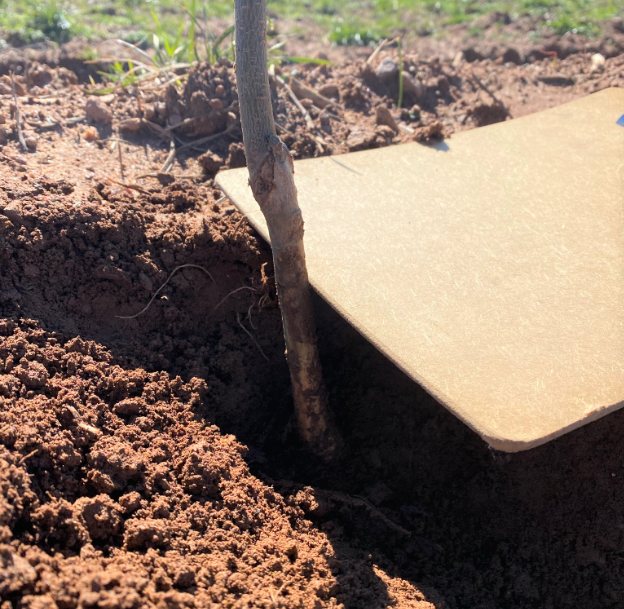
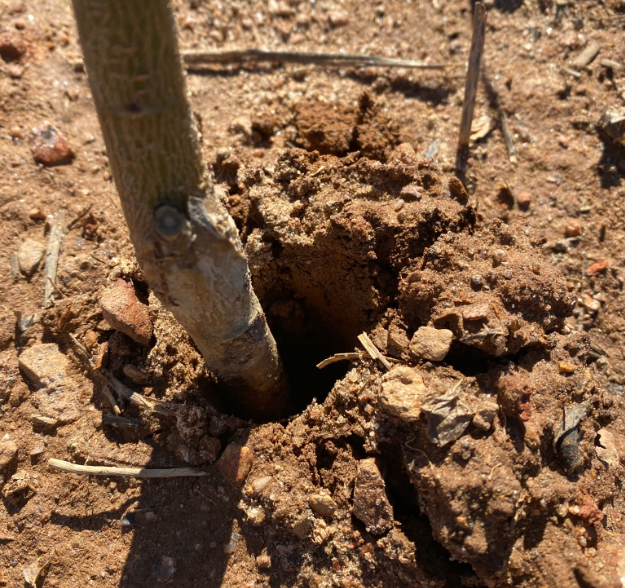
    Andy Rollins reports, “We are still in the middle of establishing new peach orchards and inspecting strawberry plantings. I met with new and experienced growers and want to point out most common mistake made. Strawberry wise, I found mites on only one farm growing chandler plugs. Some of the mites were still in diapause (hibernation) and will be orangeish in color, but there were plenty of active adults and eggs out as well on that farm. Expensive miticides are not effective if mites are not present. The most common mistake made in planting peaches is planting them too deep. To look at the picture below, you wouldn’t think anything was wrong, but the first main root is actually about 4 inches too deep. Please make sure when you are finished planting that the first main root is within the top inch of the soil. An easy way to tell they are too deep is if they have created a hole around the stem from wind movement. Anywhere you are growing in heavier clay soil this becomes even more important. We are still spraying oil and copper on peaches and probably will continue till bloom.”

    This peach tree was planted about 4 inches too deep. Photo from Andy Rollins.
    If trees are planted too deep they will create a hole in the soil around them as they move in the wind. Photo from Andy Rollins.
  • GDA Announces Specialty Crop Block Grant Program

    The Georgia Department of Agriculture (GDA) announces the competitive solicitation process to award the 2021 Specialty Crop Block Grant.

    The Specialty Crop Block Grant Program (SCBGP) funds projects that “enhance the competitiveness of specialty crops.”

    Please see the specific listing of all eligible and ineligible crops at https://www.ams.usda.gov/services/grants/scbgp/specialty-crop. These include fruits and tree nuts, vegetables and horticulture crops.

    “The goal of this grant program is to help fund research, marketing, and education projects that can produce the highest degree of measurable benefits to Georgia’s specialty crop producers, in relation to each dollar spent,” said Agriculture Commissioner Gary W. Black.

    According to USDA-AMS guidelines, grant funds will not be awarded for projects whose sole purpose is to benefit a particular commercial product or provide a profit to a single organization, institution, or individual.

    The GDA will accept completed concept proposals no later than noon on Feb. 26, 2021. Approximately, the top 30 most impactful project proposals will be invited to submit a full application. Each application will be carefully reviewed and evaluated by a Review Committee sometime in April or May,” said Jen Erdmann, Director of Grants for the Department.

    Please refer to the links available on the GDA grants webpage located at www.agr.georgia.gov/grants.aspx for the 2021 Request for Applications (RFA), the Concept Proposal form and for additional information. For questions, please contact GrantsDivision@agr.georgia.gov 

  • White Out: Florida Pearl Attracting Interest from Growers

    It may be produced only in limited acreage this year, but the Florida Pearl strawberry is already a hot commodity. One of University of Florida (UF)/IFAS strawberry breeder Vance Whitaker’s newest releases is attracting attention from farmers due to its unique whiteish color and pineapple aroma.

    UF photo shows white strawberries picked.

    “There’s been a lot of media coverage of it. We’ve gotten a lot of calls from people wanting to figure out where they can get them. I would just say the sense from the response is that people are responding well to them,” Whitaker said. “The fact that growers are committing to grow and substantially increase their acreage next year tells me wherever they’re test-marketing them, they’re getting interest. They’re not interested in growing anything they don’t think they can sell.”

    Also Known as Pineberry

    Whitaker said the white strawberry is also known as the pineberry, since there is a hint of pineapple aroma sometimes when you bite into it. Pineberry is a name that’s been used for some white-fruited strawberries that have existed in small amounts over the years.

    The white strawberry’s origin at UF dates to 2012 when strawberry seeds from Japan were sown at the University of Florida. A few small plants recovered. The plants’ pollen was crossed with a Florida variety, and the fruit’s seedlings ranged from white to pink to red.

    Leveraging the Market

    Whitaker said farmers are looking for a tool to leverage the market, something the other production regions don’t already have. The white strawberry qualifies.

    “The 12 acres isn’t a lot, but early returns on the variety have been good. Grower commitments for next season are going way up as far as what they’re wanting to grow and market in the next year. I think it’s been really positive,” Whitaker said.

  • Winter Weather Impact: Alabama Strawberries Progressing

    Strawberries in north Alabama are progressing despite sporadic temperatures and high wind speeds.

    florida
    File photo shows strawberries picked in a field in a prior season.

    “Our cold weather hasn’t been like a constant. It’s been more of a, we’ll have three or four days, maybe seven or eight days of colder weather, and then we’re back up in the 50s and 60s,” said Eric Schavey, Alabama Regional Extension agent in Northeast Alabama. He admits the plants are almost confused when growing through the different spikes or drops in temperature.

    “It’s like, I want to work but no I don’t need to. I feel like a plant burns a lot of energy when that happens. We’ve had wet weather. We’ve had wind. We’ve had a lot of days here in the past month or so where the wind has blown 12, 15 miles per hour. You’re just keeping frost cloth on and trying not to damage plants. It doesn’t help the situation.”

    Moving Forward

    The biggest challenge producers face moving forward is the uncertainty of what February will hold. According to weather.com, temperatures in Gadsden, Alabama are expected to climb as high as 63 degrees on Tuesday before dropping steadily over the next several days to highs that are only in the low to mid 30s next weekend.

    “For the most part, strawberries are on track to be good this year; depends on what February brings. You never know about February here in north Alabama,” Schavey said. “February has always been one of the coldest months. It seems like in my lifetime growing up here in north Alabama, February has always been one of the coldest months.”

  • Bacterial Wilt: Disease Challenging Blueberry Producers

    Photo taken by Jonathan Oliver/UGA: Shows bacterial wilt disease in a blueberry plant.

    A blueberry disease that has impacted the Florida industry since 2016 was found in Georgia for the first time in 2020. While there is no cure for bacterial wilt, producers can apply preventative measures to slow down the disease’s progression.

    “In Florida, they seem to be having increasing problems with it year after year, probably because the bacteria spreads so easily from farm to farm or even within a farm. It spreads by soil, water, anything that picks up soil or water can move the disease around,” said Jonathan Oliver, University of Georgia (UGA) assistant professor and small fruits pathologist.

    Disease Background

    Bacterial wilt was first identified in three separate locations in Florida in 2016. The disease was observed for the first time on Georgia blueberries last year at two locations in Clinch County.

    Initial symptoms of the disease include marginal leaf necrosis, wilting and plant death, sometimes as quickly as three weeks after infection. Farmers need to be wary that symptoms can resemble bacterial leaf scorch or phytophthora root rot.

    Certain Cultivars More Susceptible

    Unfortunately, certain cultivars are more susceptible than others, including Arcadia, Indigocrisp and Keekrisp. Cultivars that are moderately susceptible include Emerald, Farthing and Meadowlark.

    “It looks like based on what they’ve seen in Florida that certain cultivars have much bigger problems with it. Unfortunately, those are cultivars that are increasingly being grown in Florida and also in Georgia because they have other traits that are good,” Oliver said.

    “The more we grow of those cultivars, we definitely will probably see more issues with bacteria wilt. But we may also see it just due to spread. We don’t really have a good handle on what it’s going to look like in Georgia. But in Florida, every year a few more farms are found. I think it’s fairly widespread in parts of Florida now.”

    Management relies mainly on prevention; keeping the pathogen out or limiting the movement of infected plants, equipment and soil between farms. Infected plant materials need to be burned.

  • Looking Ahead: How to Compensate for Low Pecan Prices?

    File photo shows pecans in a bag.

    As disappointing and disheartening last year’s pecan season was for Southeast producers, 2021 has the potential to be worse – if producers don’t take action or if prices don’t improve.

    It was a bountiful crop for Georgia with yields projected at 135 million pounds. But considering that pecan trees are alternate bearing (if they produce a good crop one year, they are less likely to produce a similar result the following year), a decreased crop next season will not compensate for the market, if low prices linger.

    “If our prices are as bad as they were last year, and we don’t have the volume there, growers are really going to feel the pain then. This year, the prices were low, but it was a really good crop and most growers had enough volume to offset some of the low prices. It may have hurt their feelings but most of them would have gotten enough to pay their bills and keep going,” University of Georgia Cooperative Extension pecan specialist Lenny Wells said.

    “If we have a similar situation this year and have a lighter crop as we would expect after such a big year, it could get ugly in that situation.”

    Trimming Expenses

    Wells is encouraging producers to trim expenses when possible.

    “Certainly in the situation that our market is in right now and just not knowing, it may be better than it was last year or it may be the same or it may be worse; we have no way of knowing. In that situation, it would really help to watch your inputs closely,” Wells said.

    The two main areas are in fertility and with fungicide sprays. Fertility, which includes lime, potassium, nitrogen, phosphorous and zinc, account for a little more than 10% of variable costs. Fungicides, which include sprays for scab disease, account for about 12%.

    “Between those two, if you can find some savings, you can really make a dent in your costs of production,” Wells said.

    Soil and Leaf Samples

    Soil and leaf samples are crucial in helping producers understand the conditions of nutrients in their orchards. In many instances, nutrient levels in the soil in older orchards don’t need to be replenished every year. That will save producer additional input costs.

    “We did a survey back in 2007 that showed for a lot of these nutrients like phosphorus, potassium, zinc, a lot of the older mature orchards, the soil levels are good. There’s going to be some variation based on soil type and location. But some of these nutrients, like phosphorus and zinc especially when you get them to the point they need to be, they’re going to be there for a while. You don’t necessarily have to apply them every single year,” Wells said.

    While fungicide sprays for scab disease are essential, especially in production seasons with a lot of rainfall, one alternative is to plant varieties that are much more scab resistant, like Avalon.

  • Vidalia Onion Crop and Disease Update

    The 2021 Vidalia Onion Crop and Disease Update will be held on Wednesday, Feb. 17. It will be held virtually this year from 10 a.m. to 11:30 a.m.

    University of Georgia (UGA) Extension scientists will provide an update on disease management recommendations to onion producers and industry experts.

    The speakers include Chris Tyson, area onion agent, and Bhabesh Dutta, UGA Extension plant pathologist.

    Click here to register.