The Georgia Fruit and Vegetable Growers Association (GFVGA) is actively working to be the voice of Georgia’s produce industry.
Agricultural workers are essential. The Georgia Department of Public Health is working to create a plan to get your agricultural workers vaccinated.
The GFVGA wants COVID-19 vaccines available to them at the earliest possible date and needs your help.
Most of the decisions about how the vaccinations will be distributed will be made at the local level by the Georgia health department staff and district director as well as local hospitals, pharmacies, etc. The information that the GFVGA hopes to gather via a survey will be used to help inform local Georgia health districts about the overall essential Ag worker presence they will have in their district during the Spring 2021 season. This should include family and full-time employees, as well as seasonal employees made up of domestic, migrant and H-2A employees.
When the plan is enacted in your community, the GFVGA wants to ensure that local officials have the information needed to prioritize vaccinations for Ag workers. Your participation in this brief survey will help GFVGA achieve this critical goal. If you have any questions about how GFVGA has been working for you or how this information will be used, please contact the GFVGA office at (706) 845-8200.
Southeast fruit and vegetable farmers have had a point all along. Imports of fruits and vegetables, which have long been the source of producers’ ire in recent years, have significantly impacted the domestic industry.
Produce coming in from countries like Mexico, Chile and Peru have driven down prices and put producers’ futures at risk.
Blueberries were the source of a recent Section 201 investigation by the International Trade Commission.
It was the source of the recent Section 201 investigation by the U.S. International Trade Commission into blueberries where producers claimed serious injury to the domestic industry.
Statistically Speaking
According to the USDA Economic Research Service, recent statistics show how much imports have increased over the past several years, especially in 2020.
Imports of fresh or frozen fruits totaled $15.2 million, up from $15.06 million in 2019. Imports of prepared or preserved fruits totaled $3.28 million, up from $3.07 million in 2019.
Mexico was the top exporter of fresh or frozen fruits, followed by Chile and Peru.
The financial impact is significant considering that in 2015, the imports of fresh or frozen fruits totaled $11.3 million.
Imports of fresh or frozen vegetables totaled $12.72 million, up from $11.38 million in 2019. Imports of prepared or preserved vegetables totaled $3.8 million, up from $3.46 million in 2019.
Mexico was the top exporter of fresh or frozen vegetables, followed by Canada and the UK.
Again, when compared to 2015, the financial impact of imports has been staggering. Imports of fresh or frozen vegetables totaled $8.81 million in 2015.
Sunflower in the foreground and sunn hemp in the background
By Johan Desaeger
Cover crops are one of the more practical options for nematode management as their use is already common practice for many growers. The subtropical climate in Florida and the southeastern United States allows growers to plant crops year-round, and cover crops have been an important component of Florida’s agro-ecosystems since its early days of agriculture.
Until the 1930s, velvetbean was a popular summer cover crop in Florida due to its nitrogen contribution. However, around the 1950s when chemical fertilizers and pesticides became widely available, cover crops became less common. Currently, the most planted summer cover crops in Florida are sorghum-sudangrass hybrids, sunn hemp (Crotalaria juncea) and cowpea (Vigna unguiculata).
SUMMER COVER CROPS
Sorghum-sudangrass is a tall annual grass that is quite competitive against weeds. Leaf tissue of sorghum-sudangrass contains dhurrin, a cyanogenic glucoside that releases hydrogen cyanide upon degradation in the soil. While many varieties suppress root-knot nematodes (RKN) — by far the most damaging nematodes in Florida vegetables — sorghum-sudan is a good host to sting and stubby root nematodes. Sting nematodes are a major problem in Florida strawberries.
Sunn hemp is a tall, rapid-growing legume that is widely grown in tropical regions as a green manure. In Florida, Tropic Sun sunn hemp produces high amounts of biomass. Its ability to fix nitrogen permits vigorous growth, even in sandy soils with low levels of nitrogen. Sunn hemp is well known to be a poor host to RKN and also to sting nematodes. However, it is a good host to lesion nematodes. Sunn hemp also contains alkaloids in its tissue, and both its leaf and root residue have nematicidal activity.
Cowpea is a good fit as a summer cover crop for Florida growers. Unfortunately, cultivars like Iron Clay, which is the most common in Florida, is a good host to most species of RKN. Cowpea nematode susceptibility is greatly influenced by cultivar and composition of the nematode population. For example, while Iron Clay is a good host to most RKN species, California Blackeye No. 5, Tennessee Brown and Mississippi Silver are poor hosts to RKN. Both Iron Clay and Mississippi Silver can be good hosts for sting nematodes. In addition, cowpea is susceptible to southern blight, to which many Florida vegetables are also susceptible.
WINTER COVER CROPS
Common winter cover crop species include winter rye, oat, crimson clover, hairy vetch and several Brassica species such as mustard. These have varying effects on nematodes, but generally, when a susceptible crop is grown after them, nematode numbers quickly rebound. Brassica plants like mustard and radish are also known to have biofumigant properties. This is due to the glucosinolates (sulfur-containing compounds) that they contain. Upon degradation, glucosinolates hydrolyze into several volatile compounds, including isothiocyanates (the active component of metam-based soil fumigants) and mustard oils.
MIXING AND USE
Cover crops can be sown as a monoculture or as a mix of multiple species. Mixing cover crops with opposing nematode host status can have benefits in terms of nematode management. Previous cover crop experiments by the author in Kenya, involving a mixture of good RKN hosts with poor hosts similar to sunn hemp, created a more diverse nematode population, reduced nematode damage and increased yield of an RKN-susceptible crop in rotation.
The lack of nematode-specific data combined with the multitude of RKN (more than 15) and other nematode species in Florida warrants exploring the host status of cover crops (including cultivars) to each species of root-knot nematode. This is tedious work that takes time. However, such information would help growers to select appropriate cover crops, including mixtures that are tailored according to the resident nematode population of a field.
Properly managed, cover crops improve soil quality and health. They may impact soil nematodes in different ways, by limiting nematode reproduction during cover crop growth in the case of poor hosts, and by directly killing them via production of nematicidal compounds following incorporation of the biomass. In addition, by increasing soil organic matter, which is especially important in the poor sandy soils typical of Florida, cover crops can improve soil health by stimulating biological control organisms that are natural enemies of nematodes.
File photo shows strawberries harvested and ready for transport.
It is strawberry season in Florida. Odds are any strawberries eaten right now taste oh-so-sweet. Those strawberries consumers see at the grocery store should be shipped and stocked at the right temperature, says a University of Florida (UF) scientist; should being the operative word.
To ensure the fruit is at peak form, you’re not supposed to break what’s referred to as the “cold chain,” says Jeff Brecht, a UF/IFAS horticultural sciences professor and Extension specialist.
The cold chain refers to the food supply chain — from farms to supermarkets — and applies to products that need to be refrigerated. Trucks transport strawberries around the state and across the country, and ensure the product remain cold, Brecht said.
When strawberries warm, they lose some of their sugars, vitamins and antioxidants and can bruise and decay more easily, scientists say.
Some grocery stores prefer to display room-temperature strawberries, but those warmer temperatures will often result in strawberries that don’t last as long in consumers’ homes, Brecht said.
It’s a matter of survival for pecan producers. After a season in which prices were drastically low, farmers need to cut costs, not corners.
UGA File Photo/Shows spraying being done in a pecan orchard.
Lenny Wells, University of Georgia Cooperative Extension pecan specialist, emphasizes the importance of reducing input costs, starting with lime applications.
“Of course, we know orchard soils need to be around 6 to 6.5; that’s where your pH needs to be. If you’re in that range, there’s never been a study that has shown any advantage to liming beyond that. Once you get that pH to 6 to 6.5, if you check your soil samples every year and you’re in that range, you don’t necessarily have to apply any lime,” Wells said. “I think probably in most cases, we could go to applying lime maybe every third year or just look at your soil samples and see and do it when it falls below 6.0.”
If growers only apply lime every third year, it could save producers as much as $27 per acre.
“On really sandy soils a lot of times, pH is going to drop faster. So, you’re going to want to keep any eye on that,” Wells said. “Of course, your herbicide strip is going to drop faster than in the middles where you have some vegetation. I would do your sampling based on the herbicide strip.”
Clemson Extension agents provide updates in the The South Carolina Grower this week about the status of various crops being produced throughout the state.
Weekly Field Update-2/15/21
Coastal
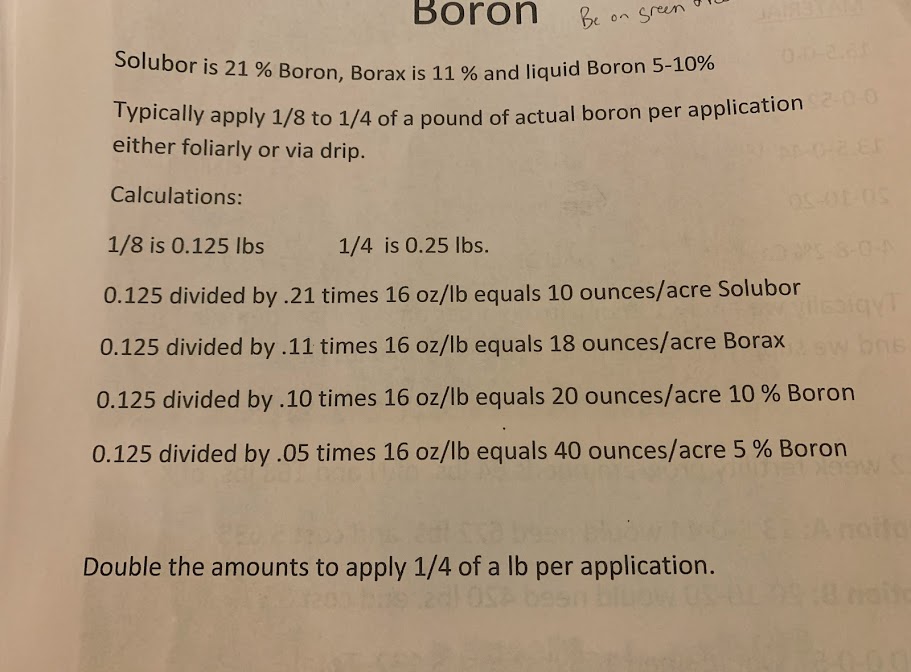
Zack Snipes reports, “I haven’t been out in the fields lately due to all of the rain. Hopefully, it will dry out some this week as we really need some bluebird sky days. If and when you are able to get out in the strawberry fields, it is time to put out boron. Boron helps with flower and fruit development. If you miss this application you will have lots of “bull nose” fruit in a few weeks. We recommend 1/8 lb of actual boron. Please see the picture for calculations of different products. Be extremely careful with mixing, calibrating, and applying boron, as boron is a great herbicide if overapplied. Boron can be sprayed or run through the drip system.”
Be sure to put out the correct amount of boron. Photo from Zack Snipes.
Midlands
Justin Ballew reports, “It’s been raining a lot since Thursday (2/11) here in the midlands. The soil is saturated in some of the less sandy areas and it will be a while before fields are dry enough to work. Sandier areas likely won’t be delayed much. Before the rain came, folks were harvesting some nice looking greens, though I am seeing some diseases pop up in places. Strawberries are still coming along. I know of one fairly large grower that has already started protecting blooms. More will probably start soon.”
Good looking mustard ready for picking. Photo from Justin Ballew.
Sarah Scott reports, “It has been extremely wet throughout Aiken and Edgefield Counties the past week, making field work challenging. In peach orchards, we are continuing to prune and trying to get out dormant oil applications and copper. It appears there is a shortage of Captan this year. There are alternatives for use during bloom as well as at petal fall, just something to look into if you usually use this product. You can read about some alternatives here https://site.extension.uga.edu/peaches/2021/02/captan-shortage/. Again, it looks like we will have plenty of chill hours for the crop this year with Musser Farm sitting at over 1000 and around 950 hours in Johnston.”
Photo by Chris Tyson/UGA: Shows an onion field that’s saturated from the excessive rains.
The wet winter weather has Georgia Vidalia onion producers concerned about not getting into their fields to apply fungicide sprays or make fertilizer applications. Certain diseases could soon become problematic considering how much rain the Vidalia onion region has received this year.
“They’re just not able to get caught up with their applications or get out there and do what they need to do,” said Chris Tyson, University of Georgia Extension Area Onion Agent at the Vidalia Onion & Vegetable Research Center in Lyons. “We are always concerned about disease. This is the time of the year when we’re spraying for fungal diseases like Botrytis and Stemphylium. They’re actually not as bad right now as they normally are. But because of the weather, we’ve had below-average temperatures, and they just haven’t gotten fired up and going like they normally would at this time of the year.
“They’re definitely creeping up on us out there. We just hope it will dry out and we can and try to play catch-up with everything. That’s the biggest concern right now.”
Rainy Conditions
Vidalia, Georgia received 9.73 inches of rain from Jan. 1 to Feb. 14 with 25 rainy days, according to the UGA Weather Network. That’s almost triple what it received in 2019 when it amassed 3.83 inches. That doesn’t even account for cloudy, overcast days when it is not raining. Sunny days have been few and far between lately.
“Looking at some of the weather data, we got almost two inches over the weekend and we were already wet. We had a half-inch to an inch last weekend and some during last week. We haven’t been able to dry out,” Tyson said.
The onions continue to progress, though, through the adverse conditions.
“The onions that are out there look good. They’re a little smaller than they usually are. But overall, I think we have a good-looking stand of onions out there across the industry. They’re a little on the smaller side right now,” Tyson said. “We know that can change real fast. We’re just looking for a little bit of warmer weather and sunny days to help them do that.”
An inside view of an over-the-row mechanical blueberry harvester.
Two issues facing University of Florida (UF)/IFAS scientists regarding the future of blueberry production are machine harvesters and blueberry flavor. Patricio Munoz, UF blueberry breeder, spoke about both issues during the recent American Seed Trade Association webinar last week.
“The major issue that I see for us is the machines that we are using nowadays, they are not to the standards that we need them to be. That’s the issue. We’re still able to harvest. We can harvest our very best cultivars for firmness characteristics,” Munoz said. “However, we need the technology, the machine robotic technology to improve. That’s something we can now work on. We can work on improving the plants. Then we have other people that work on improving the machines. That’s what is needed nowadays.
“The second one is flavor and aroma; our capacity to select new flavors and aroma and I believe they’re going to be well accepted by your consumers.”
According to Jeff Williamson, UF Professor, hand harvesting is the greatest expense for Florida blueberry producers. The lack of labor availability can also limit harvest operations. Mechanical harvesters can also lead to reduced yields by fruit dropping on the ground during harvest or immature fruit being harvested. Fruit can also be bruised from the harvester.
Munoz said there are between 50 and 60 blueberry farms in the state. Florida is the earliest producer of blueberries in the country every year.
Photo/Map by University of Florida/IFAS: Shows dragonfruit production in Florida.
HOMESTEAD, Fla. – Scientists at the University of Florida’s Institute of Food and Agricultural Sciences are providing valuable insect management information to farmers interested in producing dragon fruit. The fact sheet Pitaya (Dragon Fruit) (Hylocereus undatus) Pests and Beneficial Insects provides insight on insects and pests that can limit production by this vine-like cactus.
As is the case for any other crop in Florida, dragon fruit is vulnerable to insect attacks.
“The goal is to provide growers with a description of all pests and beneficial insects associated with dragon fruit in south Florida, together with some general control recommendations,” said Daniel Carrillo, an assistant professor of entomology and nematology at UF/IFAS Tropical Research and Education Center in Homestead.
Carrillo, who co-authored the fact sheet with biologist Rita Duncan, works with a team of scientists at the research center monitoring pests impacting the crop.
“Pitaya, or dragon fruit, is an emerging crop in South Florida,” he added. “Acreage of this fruit crop in Florida has increased rapidly and shows a good potential for commercialization. But as with most fruit plants, pests can be a problem.
Potential pests for the dragon fruit in South Florida are leaf-footed bugs, aphids, beetles, mealybugs and scales. The most dangerous are thrips.
“Thrips can be very detrimental,” said Carrillo. The unsightly damage has rendered 20% to 80% of the fruit unmarketable during years with high populations – a devastating result for the grower.”
What is Dragon Fruit?
Dragon fruit, which bears other common names such as strawberry pear and night-blooming cereusis, is a group of vine-like, climbing cacti perennial originating from Mexico and Central and South America. It was introduced and cultivated in Vietnam more than 120 years ago. Between the 1990s and 2000s, dragon fruit was introduced into other Asian countries, the Middle East, Australia, and the United States as an exotic fruit crop. In Florida, production of dragon fruit has steadily increased since the 2000s. This crop that growers can harvest in less than two years produces fruit with high-nutrient values and low calories and is enjoying increasing demand in the market.
According to Jonathan Crane, a tropical fruit crop specialist at the Homestead research center, dragon fruit is grown on about 721 acres in five Florida counties. These include Palm Beach, Charlotte, Brevard, Lee and Miami-Dade.
Chill hours are no longer a concern for peach growers in Alabama and Georgia. So, what is their biggest worry heading into the spring?
“March 28, the full moon in March. We always tend to have some cold in that full moon in March. But with it being later, maybe we’ll be out of the woods and in the clear. You just never know. March can be so up and down. Even the last few years, February has gotten pretty warm,” said Jeff Cook, University of Georgia Cooperative Extension Agriculture and Natural Resources agent for Peach and Taylor counties.
Cook said there are early varieties that begin to bloom towards the end of the third week in February.
Growers in both states are cautiously optimistic about the state of the peach crop. The cold winter temperatures provided enough chilling hours for the trees to make a crop this year. But what will happen if temperatures warm up? Trees will be vulnerable to a late-season freeze.
“We’ve got some peach producers around. They’re not all in one area, they’re kind of spread out. When I talked to them, they’ve done some pruning,” said Eric Schavey, Alabama Regional Extension agent in Northeast Alabama. “They’re just hoping we don’t get one of those late freezes. Their early varieties, they’re not blooming but they’re swelling. Those buds are swelling. That’s because we had those 68 and 70-degree days.
“I guess that early crop is always kind of a gamble here in our area.”
That makes what happened on Feb. 2 so important for farmers eyeing the upcoming weather forecast. Punxsutawney Phil saw his shadow and predicted six more weeks of winter.
“When the groundhog saw his shadow, it was like, ‘Okay, that’s good. Stay cool,’” Cook said.