Blog

  • Winter Weather: What to do When Storms Bring Ice, Potential for Damaged Trees Across North Carolina

    RALEIGH – Ice and freezing rain can be common weather events during the winter months. These types of weather events can severely impact trees and forested areas across the state. The N.C. Forest Service urges property owners and anyone preparing for or cleaning up after a storm to be cautious and think safety first.

    Troxler

    “If you’re out preparing trees for a winter storm or cleaning up after one, be extra cautious,” said Agriculture Commissioner Steve Troxler. “If you’re a landowner with concerns about your woodlands, you have resources available to help you with a plan for managing damaged trees and timber. Contact your county ranger or a consulting forester.”

    If you are a property owner preparing for a winter storm or cleaning up after one, here are some helpful tips and guidelines:

    Before the Storm

    • Prevention is key. Properly pruned trees with strong branch attachments will hold up better in an ice storm.
    • Prune branches with weak attachments, co-dominant trunks and other defects. Hire a qualified arborist to ensure trees are pruned properly. Look for tree service companies with a certified arborist on staff and/or Tree Care Industry Association (TCIA) accreditation.
    • Do not top your tree. Topped trees will quickly regrow new branches which are weakly attached and more likely to break during storms.

    During the Storm

    • Safety first! Stay indoors in a safe place. Your safety is most important.
    • Do not attempt to knock ice or snow from branches. This will likely cause the branch to break, possibly injuring you. Branches are designed to bend and stretch. Quick shocks or instant bends will cause them to break more easily rather than bending slowly.
    • Do not spray water on a tree, attempting to melt ice or snow, as it will likely add more weight to the tree.
    • Do not try to prop up bending or sagging limbs.
    • Do not touch limbs that may be in contact with power lines.

    After the Storm

    • Wait until ice or snow has melted before cleaning up.
    • Cleaning up downed debris presents many safety risks. First, assess safety conditions of your family, home and neighborhood. There may be a debris field, making for poor footing. There may be potentially downed power lines. If electrical wires are an issue, do not attempt tree work. Contact your utility company and let them remove the electrical wires.
    • Only attempt to clean up minor tree debris.
    • Operating a chainsaw on storm-damaged trees is dangerous. Historically, more people are injured by chainsaws than the storm that caused the tree damage. Never operate a chainsaw alone and always use it in accordance with the manufacturer’s instructions. Work only on the ground, and always wear personal protective equipment such as a hard hat, a full-face shield or safety goggles, and hearing protection. Be aware of cutting any branches under tension or pressure.
    • Avoid leaving broken limbs on your tree. All broken or torn parts of the tree should be properly pruned. A proper pruning cut will promote sealing off the wound and reduce further threat of decay or excessive sprouting.
    • Hire an arborist with experience in storm restoration pruning.
    • Consider hiring an arborist with Tree Risk Assessment Qualification (TRAQ) to fully evaluate the condition of your tree(s) after a damaging storm.

    Choose a qualified and insured tree service or consulting arborist. To find qualified arborists in your area, visit www.treesaregood.com, www.asca-consultants.org, or the www.treecareindustry.org.

    For more information and advice on proper tree care and tree assessment following a storm, visit www.ncforestservice.gov/Managing_your_forest/damage_recovery.htm. Additional advice on proper tree care can be found at www.ncforestservice.gov/Urban/Urban_Forestry.htm  or by calling 919-857-4842. To find contact information for your local NCFS county ranger, visit www.ncforestservice.gov/contacts.

  • Sweet Grown Alabama Receives Grant to Increase Locally Grown Grocery Purchases

    MONTGOMERY, Ala. — Sweet Grown Alabama has been awarded a grant to track locally grown products purchased by five grocery store and distribution partners.

    This specialty crop block grant, awarded by the United States Department of Agriculture in partnership with the Alabama Department of Agriculture and Industries, provides financial incentives to the stores in exchange for local procurement data. Sweet Grown Alabama’s goal is to motivate stores and distributors to boost the amount of locally grown products purchased, which in turn will make Alabama grown products more readily available for consumers. 

    “We are so grateful to local grocery stores and distributors who value Alabama grown products and already support so many of our local farmers,” said Sweet Grown Alabama Director Ellie Watson. “Through this grant program, we hope to make buying local products even easier for our grocery members. We know buying local takes a bit more money and e ffort, but the economic benefit it brings to our state outweighs the challenges.”

    Grant partners include Greer’s Markets in South Alabama with 17 Alabama stores; Piggly Wiggly Birmingham Group with 13 stores; Renfroe’s Markets in Central Alabama with six stores; WM Grocery in East Alabama with four stores; and Mitchell Grocery Corporation in North Alabama with 30 corporate stores and nearly 200 distribution partners.

    “Mitchell Grocery strives to supply the freshest top-quality produce available. We also want to support the families in our communities across the state,” said Robin Hayes of Mitchell Grocery. “We are grateful for the grant program and hope by forming this partnership with Sweet Grown Alabama we can connect with more local farmers. Really what can be fresher than local grown?”

    In addition to data tracking, these stores also joined the Sweet Grown Alabama branding program. Stores are listed in Sweet Grown Alabama’s online searchable database where consumers can find locally grown products. Members also receive the rights to use the Sweet Grown Alabama logo on point-of-sale materials and advertisements.

    To learn more about Sweet Grown Alabama and find locally grown products near you, visit SweetGrownAlabama.org.

  • Agricultural Trade: USDA Updates Outlook

    According to the USDA Economic Research Service, horticultural product exports for fiscal year (FY) 2021 remain the same from November’s forecast at $34.5 billion. Whole and processed tree nuts are unchanged at $9.0 billion. Most exports are bound for Europe and Asia.

    Fresh fruit and vegetables also remain the same at $6.9 billion on stable shipments to top markets like Canada and Mexico. Processed fruits and vegetables are unchanged at $6.5 billion on steady shipments to Canada.

    Imports

    The FY 2021 forecast for horticultural product imports also did not change. It’s still projected at $70.2 billion, which is $3.3 billion more than FY 2020. Fresh and processed fruit import values are unchanged from the November forecast.

    The forecast for fresh vegetable imports remains the same. The $200-million increase to the processed vegetable forecast offsets the $200-million decrease in for the forecast for whole and processed nuts based on a downward trend in nut imports since FY 2019.

    This forecast of increasing horticultural imports through FY 2021 continues a trend of yearly increases since 2009.

    It was also reported that U.S. imports of sugar and tropical products are forecast to reach $23.3 billion in FY 2021, a $100 million upward adjustment from the previous forecast and $300 million above FY 2020.

    Information taken from the USDA Economic Research Service.

  • Water-Logged: Well-Drained Soils Key to Pecan Trees’ Health

    Torrential rains this year have impacted farmers across the Southeast. Vegetable farmers are unable to get in the fields to apply plastic in preparation for the upcoming season.

    File photo shows a pecan orchard flooded.

    One commodity group that could also feel the sting of excessive rainfall this winter are pecan producers. While trees are currently dormant, their production could be affected this year and years to come.

    “Pecans actually adapted in areas that got seasonal floods. They kind of evolved their natural range in areas that have seasonal floods this time of year. The big caveat on that is they grew on well-drained soils,” University of Georgia Cooperative Extension pecan specialist Lenny Wells said. “They can stand water-logging for a little while, especially when they’re dormant. But that soil needs to be well-drained so that it can drain off quickly. Ideally, they wouldn’t be in standing water for more than a few weeks. This time of year, there’s a little bit of leeway. They’re a little more tolerant of it this time of year. The worst time for something like this to happen would be anytime during the growing season, really; bud break especially, as the new foliage and the crop load is developing, that’s the worst time for it.”

    Young Trees At Risk

    Standing water is especially harmful to young orchards in poorly drained soils. Those trees that are newly planted, a couple of years old or younger. If they’re in soil that doesn’t drain well, in standing water for weeks up to bud break, they’re going to be stressed and more attractive to ambrosia beetles.

    According to the UGA Weather Network, Tifton, Georgia received 13.66 inches of rain from Jan. 1 to Feb. 17, compared to 6.72 in 2020 and 5.8 in 2019. In Albany, Georgia, there were 11.1 inches recorded, compared to 8.15 in 2020 and 8.34 in 2019.

  • Arbor Day: Celebrate with Fruit Trees

    UGA CAESNewswire photo/Apple trees can add a nice backdrop and bounty to your garden. Although the northern half of the state is best suited for the more “conventional” apple varieties, you can have success in the southern half of Georgia with adapted varieties.

    By Becky Griffin for CAES News

    Americans recognize Arbor Day in April. However, Georgia celebrates Arbor Day on the third Friday of February each year because this is a better time to plant trees, giving roots time to grow before the heat and drought of our summer months.

    Georgia’s Arbor Day falls on Feb. 19 this year and University of Georgia Cooperative Extension has many resources available to help you select, plant and maintain trees in your landscape.

    Fruit trees in particular can add a nice backdrop to your garden, provide a bit of shade during the very hot summer days and, of course, produce delicious and nutritious fruit.

    Be warned, however, that fruit trees can be a lot of work. There are a few points to think about before you decide to plant fruit trees in your home or community garden.

    Find the Right Location

    When planning fruit trees in limited space, location is the key. Fruit trees require at least six hours of sunlight to be healthy and to produce fruit. Eight to 10 hours of sun is optimal.

    Also, although the shade a fruit tree provides during August may be welcome, you do not want to create unwanted shade on vegetable plots. Dwarf trees may be the best answer here. They are also easier to care for than full-sized trees. Remember that what you plant will get bigger and taller.

    Maintenance Matters

    Realize that fruit trees involve more care than vegetables. They may need to be properly pruned, thinned and fertilized regularly. Apples, peaches and plums will get diseases and insects in Georgia, and this must be addressed with the use of pesticides, fungicides and traps.

    If you are avoiding using pesticides, growing traditional fruit trees such as apples, pears and peaches may not be for you. Instead, you may want to try other fruit crops such as blueberries and figs. UGA Extension Circular 1027-10, “Growing Fruits,” by UGArden Director David Berle and consumer horticulturist Robert Westerfield, is a great resource on these issues.

    You May Need More Than One

    Many trees need cross-pollination to produce fruit. You will need at least two different apple trees and, depending on the variety, you might need two different pear or plum trees.

    Most peach trees self-pollinate, so one will still produce fruit.

    Other Considerations

    Many fruit trees are purchased as bare-root trees that have no soil or planting medium around the roots. For information on planting these, see UGA Extension Circular 1061, “Planting Your Bare-Root Fruit Tree.”

    If these points haven’t scared you off, check out other Extension publications, including Circular 742, “Home Garden Pears,” and Circular 740, “Home Garden Apples.”

    Another way to think about trees is their value to pollinators. There are many “trees for bees” and other pollinators that do well in our Georgia ecosystems. Did you know that several native trees are larval host plants for butterflies? Extension Bulletin 1483, “Selecting Trees and Shrubs as Resources for Pollinators,” is a wonderful resource for Georgia gardeners.

    Contact your UGA Extension agent for more information on planting trees by calling 1-800-ASK-UGA1 or visiting extension.uga.edu/publications.

    Story taken from UGA CAES Newswire.

  • Competitive Disadvantage: Why are Mexican Imports Increasing?

    Statistics show that fruit and vegetable imports have increased dramatically from Mexico in recent years. But why? University of Florida Associate Professor Zhengfei Guan explains why imports have gone up significantly over the last decade.

    Guan

    Mexico and Florida are in the same market window. They are direct competitors for such commodities as tomatoes, peppers, berries, cucumbers and squash.

    Reasons Why Imports are Surging

    It is due mainly to three main reasons: the depreciation of the peso, gaps in labor costs and Mexican subsidies.

    “When NAFTA took effect in 1994, one peso was 30 cents in U.S. dollars. But now in 2021, it’s less than five cents. Just look at the last 10 years, since 2011, the peso has lost 40% of its value. That makes Mexican products cheaper and more competitive,” Guan said.

    It is also well documented of the large gaps in labor costs between Mexico and the U.S.

    “Mexican minimum wage is less than one dollar per hour. But Florida minimum wage was over $8 per hour. Now, it’s getting to $15 per hour because of the new mandate,” he added.

    Government Subsidies

    The Mexican government also subsidizes its fruit and vegetable industry. From 2006 to 2016, the average annual budget for subsidies was 59.2 billion pesos or $4.5 billion dollars. Protected agriculture is one of the subsidy programs. The government subsidizes 50% of the costs of protected structures like macro-tunnels, shade houses, anti-hail mesh and greenhouses. In 2019, growers could get 4 million pesos or $200,000 per project.

    “With generous support from the government, protected agriculture has been the fastest growing sector in Mexican agriculture and now has about 130,000 acres,” he added.

    Approximately 95% of the protected acreage is for fruits and vegetables, with tomato being the largest crop in protected agriculture. It encompasses almost 40,000 acres in protected acres, compared to Florida’s total tomato production area of nearly 30,000 (almost all open fields).

    Protected agriculture allows Mexican farmers to produce crops with higher yields, better quality, improved market access, higher prices, better pest control and reduced risk.

    For example, Mexican-protected tomatoes yield about 130,000 pounds per acre, compared to Florida’s 30,000 pounds in an open field setting.

    Not many remedies exist for producers who hope to compete long term. One potential fix is with mechanization and automation.

    “The long-term solution for the industry is mechanization or automation. I would like to see a farm bill special funded program for mechanization or labor-saving technology. That is the future of the specialty crop industry,” Guan added.

  • Liking Lakota: Pecan Variety Generates Interest in UGA Trial

    One pecan variety could be a valuable option for producers seeking a low-cost input variety to plant.

    Photo by Lenny Wells/UGA: Shows Lakota pecans.

    Lakota is a low-input variety where producers don’t have to spray much to manage it throughout the season. It has thrived in research trials on the University of Georgia (UGA) Tifton campus, according to UGA Cooperative Extension pecan specialist Lenny Wells.

    “The yields on Lakota have been very impressive. You can see this year, we’re looking at about 4,300 pounds per acre. I think 159 pounds per tree was the average. Yields have been phenomenal. The count has been good; 63 nuts per pound. It’s a smaller nut than what you see with Desirable and Pawnee, but it’s in the range that shellers would like,” Wells said.

    UGA Tifton Research

    In 2020 low-input test trials at UGA Tifton, Lakota yielded 4,296 pounds per acre at just $1,124.08 per acre. Selling at $1.35 per pound, the gross total was $5,799.60 with a net income of $4,675.52. By comparison, Desirable yielded 1,434 pounds at $1,448.90 per acre and generated just $2,249.10 gross income and $800.20 net income.

    “Our gross income off Lakota was $5,800 roughly per acre. The net was around $4,700 per acre. I don’t know of many crops you can grow, much less pecan varieties, that are going to generate that kind of income,” Wells said.

    Potential Problems

    Wells cautions pecan producers about a few issues that pertain to growing the Lakota variety. Overbearing is an issue so fruit thinning is required for consistent yields. Also, the kernel’s color is darker, especially when compared to a comparable variety like Excel.

    “It seems like every variety has some problems. One thing that is an issue is the color. The kernel color of Lakota is much darker than it is for Excel. That is a red flag to me,” Wells said. “I have run this by a few shellers. Two of them have told me it’s not a problem. One had a concern with it. I’ve seen nuts come out of Mexico and some out of the western U.S. that had this same kernel color; Wichita, Western Schley; shellers buy like crazy and are not too concerned with. Maybe it’s not as big of an issue as I feel like, but I still wonder how much of this the market can take.”

  • Long Wait: Solution for Citrus Greening Will Take Years

    It may not be the news Florida citrus growers want to hear but it’s the reality of citrus greening. It is likely to be several years before a remedy is found and put in place to combat this destructive disease.

    Fred Gmitter

    Fred Gmitter, a University of Florida Professor in Horticultural Sciences, shared his assessment during a recent American Seed Trade Association webinar.

    “We learn a lot more every day that goes by. There are labs all around the world looking at different kinds of solutions for citrus greening,” Gmitter said. “Very recently there’s been talk about a peptide that’s produced by a kind of citrus called Microcitrus that seems to be able to kill the bacteria. It’s being tested right now and if it turns out to be reality, we may have a solution within the next two years.”

    Work with Peptides

    He warns, though, that researchers have worked with peptides over the last 15 years. Some that looked good in the beginning eventually failed. Gmitter doesn’t know if that will be the case with this latest potential solution, however.

    According to the UF/IFAS, citrus greening, or Huanglongbing (HLB) is a disease affecting citrus production throughout the world. The Asian citrus psyllid, which is found throughout Florida, transmits the bacterium Candidatus Liberibacter asiaticus. It causes HLB.

    Gene Editing

    Gene editing could also lead to a remedy.

    “It’s very likely that we’re going to find a gene editing solution within the next two to three years. That sounds like a long time. But citrus trees are difficult to work with. It’s a long process,” Gmitter said. “The bottlenecks are, once we find something and we test it in the lab and we test it in the greenhouse, again we have to go to the field and do some long-term field testing to confirm that it’s going to be durable; to confirm that we haven’t created any other changes in the performance of the plant that might be deleterious.

    “Assuming all of that goes as quickly as possible, we then need to look at ramping up the supply of plant material because we’re not collecting citrus seeds and planting them in the field and seeing a tree six weeks later like we would with a vegetable crop.”

    Between finding a solution in the lab, testing in groves, producing it in nurseries and getting the finished product to producers, a remedy for producers won’t be coming anytime soon.

    “Citrus trees unlike watermelon and pepper are in the ground for decades and not for a couple of weeks. We really need something that’s robust and long term,” Gmitter said. “This is a long, long haul for us in the world of citrus.”

  • Additional Despair: USITC Blueberry Verdict a Sign for Vegetable Producers?

    The U.S. International Trade Commission’s (USITC) decision regarding blueberry imports dealt a disheartening and devastating blow to Southeast producers claiming serious injury to the domestic industry.

    But does the verdict foreshadow additional despair for vegetable farmers who are also claiming imports have hurt their respective commodities; namely, squash, peppers and cucumbers?

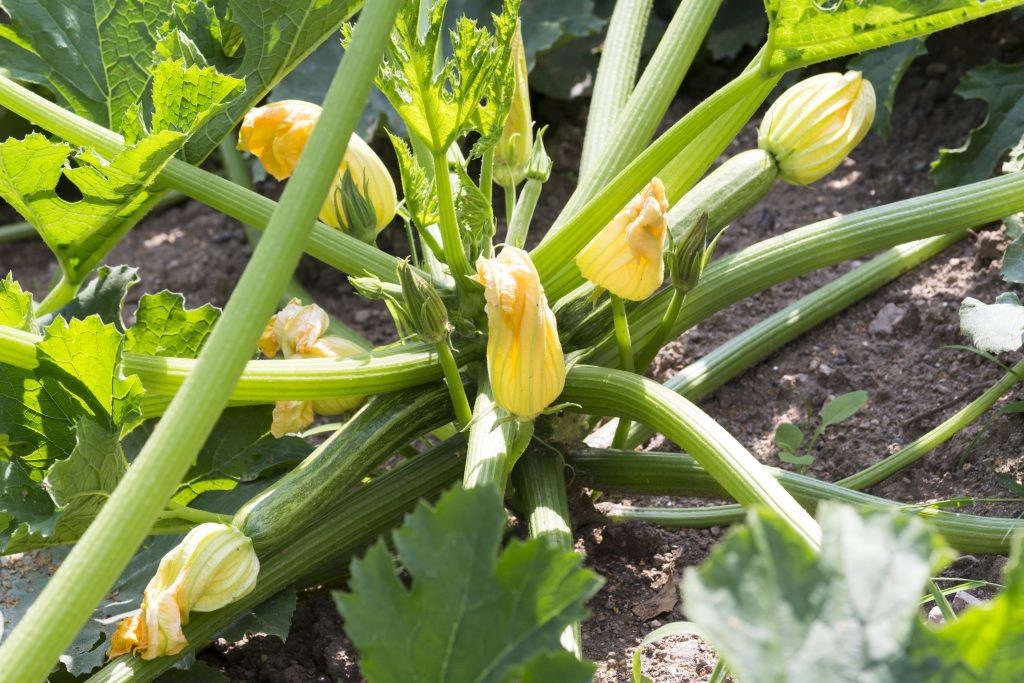
    File photo shows a squash plant.

    “There is concern. Each case is kind of held on its own. As I understand it, they look at the evidence presented and judgements are made at that point,” said Charles Hall, executive director of the Georgia Fruit and Vegetable Growers Association.

    “We felt like blueberries did have a very strong case and very strong data. We’re trying to evaluate how the others will be handled. It’s concerning but not discouraging.”

    Last Week’s Verdict

    The USITC voted unanimously last Thursday that imports of fresh, chilled or frozen blueberries are not a serious injury to the domestic industry. The decision was made despite staggering statistical evidence of how the rise of imports in previous years has driven down prices for such growers in Florida and Georgia.

    Additional Investigations

    The USITC is currently seeking input for two additional investigations regarding the impact of imported cucumbers and squashes on the U.S. seasonal markets. The U.S. Trade Representative (USTR) requested the investigations in a letter. The USITC will hold a public virtual hearing regarding the investigations on April 8 at 9:30 a.m.

    The USITC has also agreed to monitor the imports of fresh or chilled strawberries and bell peppers. The USTR requested those investigations in a letter.

    While the commodities are not the same, the premise behind the investigations are similar: Imports are devastating the futures of Southeastern farmers. For cucumber, squash and bell pepper farmers, the main culprit is Mexico.

    “When you start looking at the nature of the imports, where blueberries had heavy imports from multiple countries like Canada, Mexico, Chile, Peru; our (vegetable) imports are primarily from Mexico. The ITC will have to look at all the various imports,” Hall added. “I’m assuming if you look at the percent of imports in peppers and squash and cucumbers, Mexico is going to be your largest importer whereas they were not as large of an importer with blueberries as some of the other countries.”

  • Short Supply: Lack of Captan Concerning for Fruit Farmers

    A shortage of a major fungicide could have a significant impact on fruit producers in the Southeast. University of Georgia Cooperative Extension Fruit Disease Specialist Phil Brannen confirmed that Captan is in short supply right now.

    Spraying being done in a peach orchard.

    This is a major development for growers of strawberries, peaches, apples and grapes.

    It is one of the products that strawberry producers use for Anthracnose and Botrytis. Peach producers use it to protect against Brown Rot during cover sprays in mid-season.

    More pressing though, is its importance for grape and apple farmers. Brannen said it is the backbone of the spray programs for both of those commodities.

    “I’m hopeful that in those commodities we’ll get some Captan in eventually. If we don’t, in those commodities, I really don’t know what to do,” said Brannen. “We’ll just spray a lot of other stuff. It will really pressure us to get resistance development because we spray so often and so long on apples and grapes.”

    When Will Supplies Pick Up?

    Brannen is hearing that Captan supplies will pick back up in either April or May. Apples will start blooming in late March to early April.

    According to the UGA Extension Strawberry News blog, Brannen said that Thiram products can be used for disease control in strawberries. Other products are available, but Captan and Thiram mainly control Botrytis and Anthracnose.

    The concern of an extended short supply of Captan cannot be understated, however.

    “It’s an old fungicide. It’s been around a long time. It’s broad spectrum, so it works on a lot of different diseases. It does not develop resistance. That’s its main thing. It’s good against multiple diseases and it does not develop resistance, whereas most of the things that are really active, we try to target those when we need them and spray them as little as we can because they do develop resistance,” Brannen said. “It’s a backbone of the spray program. It’s part of what we would call our backbone for strawberries, for sure, and in large part for peach in the cover sprays it is. Then when you go to apples and grapes, it certainly is.

    “If we don’t have Captan, for whatever reason … we just don’t have really good options for resistance.”