Blog

  • UF/IFAS Extension Veteran: Farmers Give to Food Banks in Time of COVID-19

    University of Florida: A woman shopping for food at a food pantry.

    By: Brad Buck, bradbuck@ufl.edu

    With the COVID-19 shutdowns increasing people’s need for food, some consumers rely on nonprofits for a bite to eat. To help, farmers in Florida and elsewhere are donating excess produce to food banks, said a UF/IFAS expert.

    In fact, some food banks are helping farmers by offsetting some of their costs, thus incentivizing growers to harvest food they can’t sell, said Gene McAvoy, a UF/IFAS Extension agent emeritus.

    “There is no shortage of food, but the majority of vegetables grown in Florida are targeted at the food service industry — hotels, restaurants, schools, cruise ships, etc.,” said McAvoy.

    Food service represents 60% to 80% of normal demand for Florida-grown vegetables. 

    “When this source of customers dried up, growers were faced with a huge oversupply for the remaining retail demand,” said McAvoy. “With no market, it makes little business sense to harvest because that adds expenses like picking, packing and storing, on top of what farmers have already invested in the crop.

    “Growers feel bad when the crops they have worked so hard to grow go to waste, and they’re interested in helping feed hungry Americans,” McAvoy added. “But they also need help to be able to do so.”

    McAvoy, UF/IFAS Extension agent emeritus for Hendry County and a regional vegetable Extension specialist for Southwest Florida, said he has received multiple calls and emails from farmers wishing to donate and from food banks and facilities, who are looking for food.

    He gives several examples of farms that are giving to food banks. Here are four:

    • Over the past few weeks, Wish Farms in Hillsborough County has donated 220,000 pounds of fresh strawberries — equivalent to 241 pallets/nine semi-trailer loads — to Feeding Tampa Bay and the United Food Bank in Plant City.
    • Nearly two weeks ago, growers in Immokalee donated more than 3 million pounds of vegetables to the Harry Chapin Food Bank of Southwest Florida, “overwhelming their ability to store, transport and distribute the produce. They had to call a halt,” said McAvoy.
    • Farm Share, a food-distribution nonprofit, works with more than 2,000 food pantries, churches, schools and other nonprofits throughout Florida. The agency is running at maximum capacity, despite having 25 refrigerated trucks, six warehouses between 10,000 and 35,000 square feet and nearly 50 drop sites from Jacksonville to Florida City.
    • U.S. Sugar provided more than 120,000 servings of fresh, locally grown green beans to South Florida churches, healthcare providers and food banks. 

    “Farmers work hard to grow this food, putting in a lot of time, money and sweat equity, and nothing breaks their hearts more than to see their efforts go to waste,” McAvoy said. “Unfortunately, it costs money to pick, pack and transport produce for which there is currently no market. People can help in the recovery effort by donating to food banks so that they can finance efforts to recover this food before is spoils.”

  • U.S. Congressman: A Fourth Relief Bill Will not Happen Fast

    By Clint Thompson

    Austin Scott

    United States Congressman Austin Scott (GA-08) believes if there is a fourth coronavirus relief bill to help people like farmers and aid agribusinesses, it will not happen fast.

    Scott, along with fellow Congressman Sanford Bishop (GA-02), spoke about the recently passed Coronavirus Aid Relief and Economic Security (CARES) Act and its different provisions. Due to circumstances regarding the health and well-being of members of Congress, passing another piece of legislation may have to wait.

    “There are 535 members of Congress. There are at least five that have tested positive for the coronavirus. There are several others that have been on quarantine because they’ve been exposed to it,” said Scott on April 3. “One of the questions is, at what point are you able to bring 535 people back in to work in close proximity and actually get something done? I think this last bill was unique in the way that it was passed. I don’t think it is possible to pass another bill with simply the Senate effectively drafting the bill and the House, including myself, voting yes by voice on the bill.”

    The Paycheck Protection Program (PPP) was an integral part of the $2 trillion CARES Act. It was designed to aid small businesses recover amid the ongoing coronavirus pandemic. However, it may not have enough funds to support the $350 billion allocated for the program. Congressman Buddy Carter (GA-01) believes additional funding will be ready if needed through a Phase 4 relief package. Scott reiterates his position that another stimulus package will still take some time to pass.

    “I would tell you, if there is a fourth relief bill, I think a couple of the areas that are going to have to be looked at. (No.) 1, from a timing standpoint, I think it would be more than 30 days from now before another bill passed. (No.) 2, at that stage, we will have a better indication of what the revenue impact is on state and local governments and on our healthcare providers,” Scott said.

  • Whiteflies Already a Problem for Florida Farmers

    This file picture shows whiteflies on a squash leaf.

    By Clint Thompson

    Between the coronavirus pandemic and decreased demand for their product, Florida’s vegetable farmers have had their share of challenges this past month. Add whiteflies to the list.

    According to the South Florida Vegetable Pest and Disease Hotline, the Immokalee, Florida area in South Florida has seen hundreds of acres abandoned. This is due to irregular ripening and high incidences of tomato yellow leaf curl virus disease (TLCVD).

    There’s been some reports of 50% to 80% of the disease being seen in several vegetable fields. According to Gene McAvoy, University of Florida/IFAS Regional Vegetable Extension Agent IV Emeritus and President of the National Association of County Agricultural Agents, whiteflies have been problematic in tomatoes, watermelons and other cucurbits.

    “We’ve had a number of growers destroy substantial amount of acreage, even before this whole COVID-19 thing blew up. We’ve had a lot of irregular ripening because of high levels of whiteflies. Most of our growers are using a resistant (tomato) variety so that’s not an issue in the round tomatoes. But especially with the Romas that have no resistance, they’re getting tore up,” McAvoy said.

    According to the South Florida Vegetable Pest and Disease Hotline, farmers have pulled up entire first plantings due to very high incidence of TYLCV.

    The whiteflies’ impact on tomatoes is felt across Central Florida and on the East Coast where pressure is higher in older tomatoes. Whiteflies are also problematic in cucumber and pepper and are increasing in melons.

    High incidences of whiteflies may be attributed to the mild winter. While colder temperatures don’t eliminate whiteflies, they do kill many of their wild hosts and slow population development in cultivated hosts. Warmer temperatures allow for larger whitefly populations to overwinter and become mobile earlier.

    “Down here our strategy is to try to have clean fallow in the summer and not have anything for them. We usually start off pretty low but if we have a warm, mild winter like we’ve had the past couple of years where they start building in the fall, they just continue going this time of year. They basically become unmanageable,” McAvoy said.

  • Pecan Farmers Need to Watch out for Budmoths

    By Clint Thompson

    Budbreak in pecan trees is under way in orchards across the Southeast, and farmers need to be wary of one particular pest – budmoths.

    Budmoths were a nuisance last year on pecan trees and have already showed signs of infesting young trees during the first week in April.

    A bag of shelled pecans in this file photo.

    University of Georgia Cooperative Extension pecan entomologist Angelita Acebes offered tips on her blog on how to identify a budmoth and what management options are available at this point in the growing season.

    Pecan growers can recognize budmoth damage by the webbing around newly-developed leaves and small dark spots on the tips of those leaves.

    During the spring, adult moths start laying eggs and can lay eggs in about six days. Unfortunately, the young larvae will feed on the leaves. Then they spin a web to roll the leaves where they’ll bore into the shoot. Once in the shoot, an insecticide will be ineffective because it can’t reach them.

    Whether to spray your trees at budbreak is a question that can go either way. Spraying at budbreak is an option since there’s a small window to effectively apply an insecticide. If farmers have time to scout, treating when the infestation is first noticed is also an option.

    When considering what insecticide to apply, worm materials are more ideal if you can catch budmoth outbreaks early. If budmoth damage is severe and the initial outbreak was missed, Lorsban is the only option for quick control.

    For more information, see Acebes’ blog.

  • Florida Farmer: It’s Demand and it’s Competition With Foreign Products That’s Beating us up

    By Clint Thompson

    Count Daren Hanshaw in as one of the numerous Florida fruit and vegetable growers impacted by the coronavirus pandemic and the continued imports of produce from other countries.

    Hanshaw Farms: Pictured are cucumbers left in the field.

    Hanshaw who owns Hanshaw Farms in Immokalee, Florida, grows cucumbers, tomatoes, watermelons and cantaloupes on about 500 acres. He’s experienced the negative impact of the past month with all his crops.

    “We’ve had a variety of ways that this thing has hit us. Obviously, we’re still waiting on about a $1.5 million of receivables of tomato money from the fall that these food service companies are not paying their bills,” Hanshaw said. “That hiccup started at the beginning of this before we really knew what it was going to do to our current crop. Our first problem was cash flow. The first problem was noticing that people were slowing down on paying their bills. That money is trickling in but obviously that money is what keeps this watermelon crop and this cantaloupe crop going and pays the labor every week for that.”

    Hanshaw had about a 10-day period where he was harvesting cucumbers at $35 or $40 per box. That price dropped to $10 in the span of three days.

    “It went from, everybody needing whatever you can harvest to well we better not harvest because we’re not even getting our labor and box back. The decision we had to make was to pull the plug rather than delivering them to the packing house basically just to trade money or to lose,” Hanshaw said.

    “You had off-shore stuff still coming in to Pompano. You had Mexican stuff that was surging. It just seemed like the volume picked up just exactly at the least perfect time for us. On top of the fact, our customers were telling us they couldn’t take the product,” Hanshaw said.

    Hanshaw said he has a fresh cut contract with two major companies, but just Monday did he receive the first three POs (purchase orders), where normally he should have had 15 loads per week. The demand for watermelons has dropped significantly and it shows in the market price. Hanshaw said the prices are 45% off of what they have been the past three years.

     “I can’t disagree that there are more important things to get on somebody’s shopping list than watermelons. Obviously for us, in our world, they’re the most important thing going right now,” Hanshaw said. “I don’t believe that there is a surplus of fruit. It’s not like everybody down there has got a stellar crop. It’s demand and it’s competition with foreign product that’s beating us up.”

  • Potential Frost Damage Could Impact North Carolina Grape Production

    By Clint Thompson

    Pictured are grapes and wine.

    Last weekend’s cold temperatures may have impacted North Carolina’s grape production this season. According to Mark Hoffmann, North Carolina State small fruits Extension specialist, he should know more in the upcoming days about the severity of any frost damage that may have occurred throughout the state.

    “The WineGrowers Association, they have a survey out to assess how much damage people are seeing. It’s going to take a couple of days before we know that,” Hoffmann said. “I know in the mountains they didn’t get a lot of frost. They didn’t get a lot of damage because they didn’t have a lot of shoot growth. In the lower areas, like the Yadkin Valley, they had shoot growth already two weeks ago. Pretty sure they got a lot of damage.”

    He said on Friday, April 10, temperatures dropped into the 30s in the Yadkin Valley, outside of the mountains in the Piedmont area. To know how to manage frost damage in grapes, see Hoffmann tips on frost management in grapes.

    “There’s so many other things in North Carolina that could impact yield production. If you get a lot of damage and you have to remove the shoot, then yes it will (impact yields). If you only have mild damage, then you might be okay,” Hoffmann said.

    Grape production in North Carolina

    Hoffmann said producers started harvesting two weeks ago in the eastern part of North Carolina. But the whole state should be picking at this point. Depending on how weather cooperates over the next month will impact how big the harvest window will be this year for grape producers.

     “If we have a good year, we can go ’til the end of June. In a bad year, it can be over in like mid-May already,” Hoffmann said. “If it gets humid pretty soon and if we get a large, heavy rain event, which happened two years ago in May; it was in 2018 I believe, in the second week in May, we had a large rain event and then the third week we had another large rain event that basically shut it down.

    “I would say April and the first two weeks of May, for sure, and then after that, I hope we have two to three more weeks.”

    Hoffmann estimates that more than 1 million bottles of wine are produced every year in the state and there are 1,500 acres of grape production in state.

    “Ten years ago, it was much smaller than that. We’re growing a lot. We have about 180 wineries which produces wine. The last 10 years it grew about 50%. It’s a pretty large industry,” Hoffmann said.

  • Wildflowers Impact Watermelon Pollinators

    1) A bumblebee and sweat bee forage on the same flower, Cosmos sulphureus.
    2)Sweat bees (Lasioglossum spp.) are so small they often go unnoticed. Sixteen species of these bees were collected visiting watermelon.
    3) The Southern plains bumblebee (Bombus fraternus) is a frequent watermelon and wildflower pollinator on farms in South Carolina.

    By Mimi Jenkins

    A resilient and stable pollinator community includes a diverse suite of pollinators with a range of nesting habits, foraging behaviors and activity periods. These different behaviors and traits complement each other and can buffer against any year-to-year fluctuations or environmental changes that affect species differently.

    BEYOND HONEY BEES

    In many pollinator-dependent crop systems, honey bee colonies are brought onto the farm to provide the pollination services necessary to produce the crop. In the case of watermelon, a monoecious plant with separate male and female flowers that make it entirely dependent on pollinators to set fruit, using honey bee hives to pollinate the crop is widely recommended for growers to achieve high yields. While honey bees are an important agricultural pollinator, especially for industrial scale farms, considering alternative pollination sources that already exist in the natural environment helps buffer against ongoing honey bee losses and the rising cost of renting honey bee hives.

    Wild native bee communities rely much more on the natural habitat of an area than honey bees because of their different nesting habits and because they are not actively managed by humans. Wild bees require habitat that provides food (flowers) and shelter (nesting materials and proper soil/environmental conditions). Other pollinating insects, such as flies and butterflies, share the need for floral resources with bees but many do not have a nest, and others require certain plant hosts or prey in their larval stage.

    The flowering period of the wildflowers in this South Carolina strip began in May before watermelon bloom and lasted long after watermelon was done flowering, into August.

    Implementing on-farm enhancements such as wildflower strips is one way to increase the availability and diversity of food resources for pollinators beyond the crop bloom period. Traits that should be considered for wildflowers in farm fields include: drought-tolerance, native to eco-region, fast germination rates, hardiness, difference in flowering period, length of flowering period and attractiveness to a variety of pollinating insects.

    RESEARCH RESULTS

    In a study I conducted from 2016 to 2018, the number of visits to watermelon was significantly higher for one group of pollinators (sweat bees in the genus Lasioglossum) when wildflowers were in a watermelon field compared to fields without wildflowers. These small, metallic grey-green bees nest underground and do not forage more than a few hundred meters from their nest.

    In addition, the overall biodiversity of the pollinator community was higher in watermelon fields with wildflowers strips, with nearly twice the number of pollinator species collected on watermelon fields with wildflowers compared to control fields. The mean number of watermelon pollinating species per field was 15 species, and the mean number of total pollinators (including wildflower pollinators) per field was 24 species.

    More than half (64 percent) of the watermelon pollinator species collected were also collected visiting one or more of five wildflower species in the study. This demonstrates that social colonies of bees, solitary bees and other insects like syrphid flies and butterflies utilize the multiple floral species as resources on the watermelon field in addition to the crop flowers when they are available. In fields with wildflowers, we also observed and collected a wide range of pollinators and insects that do not visit watermelon flowers but visited the wildflower species, such as several swallowtail butterfly species, cleptoparasitic bees and sunflower bees.

    In conclusion, when wildflowers and weedy flowers are available on the farm landscape, a more diverse community of beneficial insects is supported. This community included declining species like Monarch butterflies, the American bumblebee and the Southern plains bumblebee as well as parasitic and predatory flies and wasps that can control crop pests.

  • Weather Impacting Alabama Vegetable Production

    By Clint Thompson

    U.S. Drought Monitor: The latest map of Alabama abnormally dry and modertately dry areas in yellow and light brown.

    Farmers in South Alabama are in desperate need of rain. Producers in North Alabama need field conditions to dry so they can plant their crop. It’s been an unpredictable winter and early part of spring for the state’s vegetable growers.

    “It’s been wet in the central and northern part of the state and it has been impressively dry on the Gulf Coast. (Even) with this last storm we had (Sunday), things are very dry,” said Joe Kemble, Auburn University Extension vegetable specialist. “Most of the plantings, I think things have been going okay. We’re still pretty early right now. There’s still a lot of brassicas, collards, cabbage, broccoli and other cole crops out there in the field and look good.”

    Alabama farmers produce a substantial amount of tomatoes, melons, cantaloupes, sweet corn, southern peas, greens, squash, zucchini and sweet potatoes every year. The state’s vegetable production is located as far south as Mobile on the Gulf Coast, all the way to Huntsville, which is located near the Tennessee border. But as vegetable crops try to grow, they continue to experience vastly different weather conditions throughout the state.

    “Last night, I think in the Huntsville area, they got over 5 inches of rain. Where down on the coast, they got less than an inch and a half to two inches. Unfortunately, that wasn’t even enough to do a lot in the Gulf Coast area,” Kemble said. “It’s something with how dry it is in the southern part of the state. Most of our vegetable crops are irrigated. In the long term, it is a concern. Wells can only get you so far. It’s also a bigger expense associated with having to provide well water.”

    Kemble said growers are still trying to plant crops in the central and northern parts of the state amid the wettest winter on record.

    “I think things are pretty well on schedule. There was a lot of concern in March just with the incredible amount of rain we received. That was more of a problem for crops that were already in the field. The weather’s been sort of decent the past couple of weeks,” Kemble said. “I think a lot of people have been able to get out there and prep their fields and get plastic laid and things like that. I think they’re sort of right on schedule, maybe a little bit behind in planting. From the folks I’ve spoken to, I don’t think they’re weeks behind, I think they’re a week behind, in some cases.”

  • High Rainfall Probabilities Look Promising for Florida Agriculture

    By Ashley Robinson

    There may be light at the end of a dark and dry tunnel for Florida farmers with increased chances of rainfall over the upcoming week.

    According to the U.S. Drought Monitor, the majority of Florida is classified as moderately dry.

    According to Gary England, RSA/Director for the Hastings Ag Extension Center in Hastings, Florida, the same weather system currently ushering severe weather into the Southeast will elevate rainfall chances in the Hastings area beginning today.

    “The one system moving through right now is supposed to go stationary, meaning it will hang around, keeping things mixed up. So, we’ll have a pretty good chance of rain from that through Wednesday.”

    The front is expected to move south down the peninsula Thursday and stall once again, somewhere near the Big Lake, thus keeping a chance of some showers in northeast Florida through Friday. In addition, a second front is expected to pass through the region on Saturday, stalling in central Florida. This will keep rainfall chances moderate to high through the weekend. 

    According to the National Weather Service’s Weather Prediction Center, the Hastings area can expect to see 1.0 to 2.0 inches of rainfall through next Monday.

    “It seems like the regions who are experiencing the worst of the drought are in the areas we’re expecting some rainfall,” England says. “However, that still has to materialize. These stationary fronts may be predicted to be in one place but could remain 50 miles south or north. Rain chances can dramatically change so we’ll have to see how it plays out over the next week.”

    Lack of rainfall for the months of March and April have caused concerns for Florida farmers.

    According to the U.S. Drought Monitor, the state of Florida is experiencing abnormally dry or moderate drought conditions. Most of Wakulla County, Florida and parts of Liberty and Franklin County, Florida are deemed ‘D2’ status which is a severe drought.

    GROWERS CONCERNS

    Florida’s growers are no strangers to dry spells and having to utilize irrigation systems during periods of less than average rainfall. However, applying more irrigation than normal can create additional issues for growers on top of the high costs to operate the irrigation systems. 

    “Generally, we’re pumping water out of the Florida Aquifer. The chemistry of the water in the Hastings area tends to be a little more saline. So, with extended periods of irrigation you could see some harmful effects from that,” England says.

    In addition, increasing temperatures could be troublesome for growers.

    “It’s not always uncommon for March or April to be fairly dry. However, what we’re seeing in this situation is very warm temperatures,” England says. “We’ve had dry March’s and April’s, but the high temperatures were in the 70’s and low 80’s. These warm temperatures that we’re seeing during this dry period can move the crop ahead, possibly maturing a week or so ahead of time.”

  • Vidalia Onion Crop Looks ‘Favorable’ Despite Presence of Downy Mildew Disease in Localized Areas

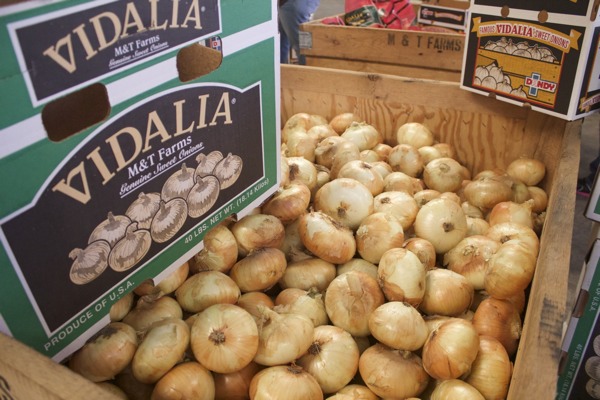
    File photo of Vidalia onions for sale.

    By Clint Thompson

    Vidalia onion producers have begun harvesting the early maturing varieties this year, and Chris Tyson is excited about the potential of this year’s crop.

    “The Vidalia onion crop definitely looks favorable this year. We are anticipating a quality harvest,” said Tyson, University of Georgia Cooperative Extension area onion agent at the Vidalia Onion and Vegetable Research Center in Lyons, Georgia. “Frequent and heavy rains created some adverse conditions earlier in the season, but growers have managed their crop well. They’ve done a great job managing their fertility and fungicide programs despite the weather.”

    Growers started harvesting their earliest varieties in the beginning of April. The peak of harvest will occur near the end of the month.

    There is optimism despite some localized outbreaks of downy mildew disease in the Vidalia Onion zone in Southeast Georgia, according to Bhabesh Dutta, UGA Extension vegetable plant pathologist. Severe and widespread cases have not been reported. He warns, however, things can change quickly with respect to infections in newer areas, as harvests continue to ramp up over the next few weeks.

    “This all depends on how diligently our growers monitor their crops for initial infection and how aggressive they are on their protective fungicide spray schedules,” Dutta said. “Our onion growers have been on top of their game for the most part with respect to timely protective fungicide sprays. This in combination with some warm, clear weather may help reduce the onset or severity of downy mildew.”

    Dutta said the first symptoms of downy mildew occur on older leaves as light green to pale yellow, which turn to tan and brown as the lesion ages. In Georgia, early symptoms can be diamond-shaped lesions that are mottled with pale and green areas interspersed. As colonization progresses, lesions may girdle the entire leaf. This could cause the total collapse of leaf tissues. Infected bulbs are reduced in size and typically don’t store well.  In severe cases, 100% yield losses have been reported. 

    “Although bulb symptoms are rare to none, foliar infection and secondary pathogen colonization result in bulbs that are reduced in size and more often with internal rot,” Dutta said. “Healthy appearing bulbs from a downy mildew-infected crop do not store well and can get often discarded due to the internal rot.”