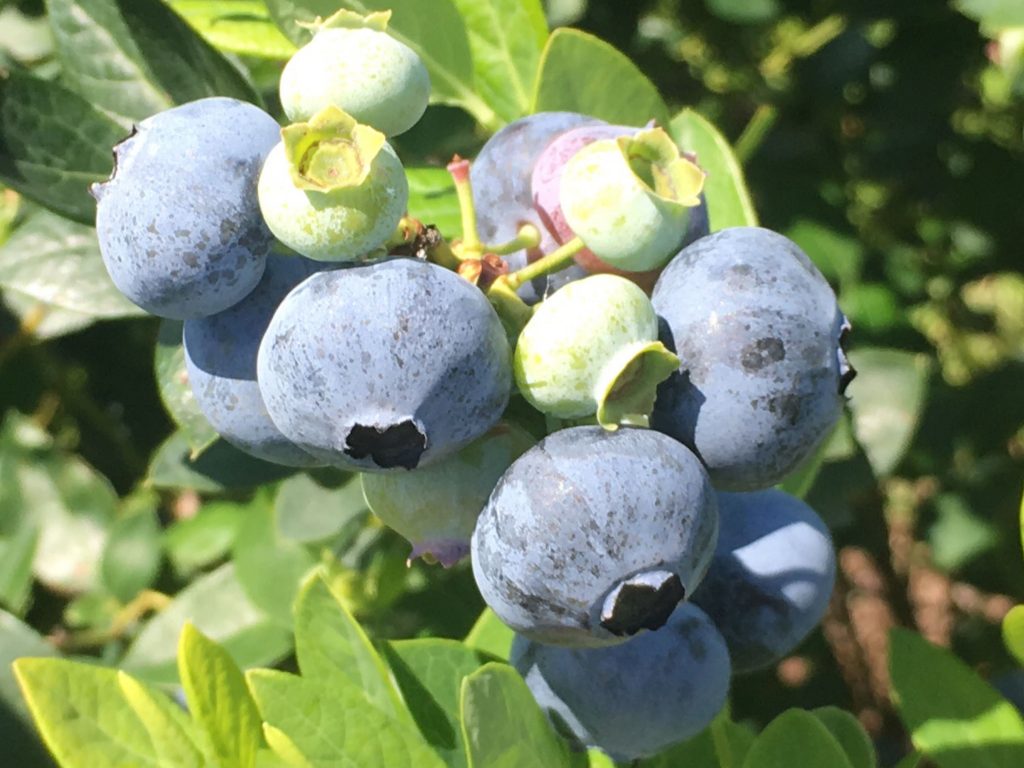
N.C. State Extension recommends strawberry producers to secure their row covers to protect against high wind speeds and to implement cooling measures against warmer temperatures now and into the weekend.
Increasing temperatures are expected to be 10 to 20 degrees above normal, especially in the mid-Atlantic area. This will undoubtedly speed up the development of buds and blooms this weekend.
High winds with 20 mph to 30 mph wind gusts are in the region today and will stay that way until Saturday.
What would it look and feel like for the United States to be totally dependent on foreign countries for food? While it’s a scenario that might seem unfathomable for some, it’s a proposition that keeps inching closer to reality.
“If things don’t change and they keep going the course they’re going, people are going to look up one day and say, ‘Why can’t I find anything from the U.S.?’ Because of the costs that we’re paying and what we’re battling, we’re going to start dropping like flies eventually,” said Georgia farmer Jason Tyrone.
More and more farmers are calling it quits because it is unsustainable to compete against imports from other countries. Cheap labor costs and the subsidization of Mexican farmers allow produce like blueberries, strawberries, squash, tomatoes and cucumbers to be imported into the U.S. at staggeringly low prices. Markets react, and the American farmers suffer.
How can they compete? They can’t.
“You just think we got into trouble when were waiting on medications and stuff from China for a pandemic. You just wait and see what happens when we have to ask Mexico for food to eat,” Georgia farmer Ricky Powe said. “To break even on a box of pepper is probably $10 or $11. That’s just to break even, no profit, just to get your money back. When they’re allowing this pepper in at $6, we’re losing $5 or $6 a box on pepper, there’s nobody that’s going to stay in business.
Future Generations
Vegetable farmers like Powe and Tyrone cringe at the thought of future generations being totally dependent on other countries for food.
“The American consumer says we want to buy our food as cheap as we can get it. If Mexico sends it over here at $4, we can buy it cheaper. I say, you’re exactly right. But you don’t know what you’re buying. If you put everybody out of business in the United States, then you’re going to be totally dependent upon a foreign country for your food,” Powe said.
The problem is not slowing down, either. Imports are increasing at a rate that producers from Georgia and Florida can’t keep pace.
“The scary part of this, say we do get to where the U.S. farmer can’t afford to do produce because of the labor costs differences, input costs differences, that’s kind of scary from a national security standpoint. Do you want to depend on stuff from other countries to totally feed our country? It’s scary if you think about it,” Tyrone said.
HOMESTEAD, Fla. – One of the most important mango varieties across the world has been sequenced by scientists at the University of Florida.
Photo courtesy of Alan Chambers, tropical plant geneticist at UF/IFAS Tropical Research and Education Center.
It’s an important breakthrough for the ‘Tommy Atkins’ mango – a variety that originated from Florida and is valued for its long shelf life, pest resilience and other key beneficial traits.
The scientists at UF’s Institute of Food and Agricultural Sciences (UF/IFAS) are trying to grow the domestic mango industry in the Sunshine State, because there is potential for greater profits, export volumes and wider consumer demand.
“We now have the complete genetic instructions of the ‘Tommy Atkins’ which is a primary export mango,” said Alan Chambers, tropical plant geneticist at UF/IFAS Tropical Research and Education Center. “We can now use this as a tool to answer questions like, ‘Why does Tommy Atkins have such a great peel color?’ ‘Why is Tommy Atkins so disease resistant?’ ‘What makes Tommy Atkins so great for shipping?’”
The genome is an organism’s complete set of genetic instructions. Each genome contains all the information needed to build that organism and allows it to develop successfully. The instructions in a genome are made up of DNA, which contains a unique chemical code that guides the fruit’s development, growth and health.
Chambers and his team believe their work is an essential tool that will be used to help grow mango varieties that are desired by consumers and farmers.
“With these instructions we can start to compare different plants,” he said. “For example, those instructions can help us understand why one plant has a red peel versus a yellow peel, or why one mango tastes like pineapple. The same instructions help us to find the DNA responsible for those differences.”
A late crop, a topsy-turvy market and a consistent influx of produce coming in from Mexico – just another challenging year for Florida’s blueberry growers.
Chuck Allison, blueberry farmer and owner of Wild Goose Farms in Umatilla, Florida, said the cooler winter has delayed harvests this year.
“We’re getting started. We picked last week a couple of times. We’re getting back this week, probably, and then next week we’ll probably be picking every day,” Allison said. “With the cool weather this past weekend, it kind of slowed things down again. A lot of early varieties are probably 7 to 14 days later than last year. It’s all about heat units. We just didn’t get the same heat units this year.”
As harvests begin to increase for Allison and other Florida farmers, the question is how will the market play out over the next month or two? That’s really unpredictable.
“It’s so hard to tell with the marketing and stuff. There’s so many dynamics going on with Mexico now, when Georgia would come in behind Florida; Chile’s going to end and be out of the market, which will help significantly. We’re hoping that Mexico will get some of their volume through the marketplace instead of storing fruit and leading it into the market later on,” Allison said. “We think Georgia may be late like we are, so there will be a normal transition there, and North Carolina even later. We may get a more normalized market with the transitions between states. I don’t know, it’s so hard to tell.”
Acquisition of Imperial Sugar provides U.S. Sugar’s and Imperial Sugar’s customers with increased production and distribution, a full suite of sugar products, and a more secure sugar supply
CLEWISTON, FLORIDA — An acquisition on Wednesday by U.S. Sugar returns Imperial Sugar to All-American owernship.
U.S. Sugar announced on Wednesday it has reached an agreement with Louis Dreyfus Company to acquire the business and assets of Imperial Sugar Company, which is a port refiner with operations in Georgia and Kentucky.
“We are excited to combine our operations with Imperial Sugar’s port refinery, consumer brands, and sugar processing capabilities,” said Robert H. Buker, Jr., President and CEO of U.S. Sugar. “Together, U.S. Sugar and Imperial Sugar will provide our customers with a more dependable, secure supply of sugar.”
“Imperial Sugar has a strong heritage as a family-owned business and could not be more proud to become part of the U.S. Sugar family,” said Mike Gorrell, CEO of Imperial Sugar. “This move will increase production and reduce costs at Imperial Sugar’s refinery, generating significant efficiencies that ultimately will benefit our customers.”
Imperial Sugar currently operates a refinery at Port Wentworth in Savannah, Georgia and a sugar transfer and liquification facility in Ludlow, Kentucky. The company primarily sources its raw sugar from Central and South America, and the Caribbean. Imperial Sugar’s various facilities, consumer brands and raw/refined sugar inventories will be included in the purchase.
“U.S. Sugar has a world-class sugar business focused solely in America, including a historic relationship with the Savannah refinery,” said Adrian Isman, Head of the North American Region at Louis Dreyfus Company. “Imperial Sugar’s port refining capabilities will be an excellent addition for the company, while enabling LDC to concentrate more fully on its global sugar merchandizing business.”
Prior to building its Clewiston refinery in 1998, U.S. Sugar sold and shipped its raw sugar to the Savannah refinery it is now acquiring for decades. The company sustainably farms more than 200,000 acres of sugarcane in South Florida and also owns and operates a short-line railroad, the South Central Florida Express, which facilitates shipping sugar products.
Acquisition to Expand Sugar Production, Increase Sugar Supply Security, Create Logistics and Shipping Synergies, and Improve Competition—All Which Will Ultimately Benefit American Customers and Farmers
Expand Sugar Production and Reduce Costs: U.S. Sugar will invest in Imperial’s refinery to expand production and reduce manufacturing costs. Adding Imperial’s facility will provide U.S. Sugar and its local Florida farmers with enough refining capacity to utilize all the sugarcane they farm.
Increase Domestic Sugar Supply Security: Increased production capacity and access to Imperial’s Savannah port refinery will supplement U.S. Sugar’s marketing cooperative’s sugar supply if supplies of domestic beet and cane crops are limited from freezes or hurricanes.
Create Logistics and Shipping Synergies: Adding Imperial Sugar’s operations to U.S. Sugar’s marketing cooperative will create substantial distribution synergies and cost savings that will benefit customers.
Improve Competition: The new combined company will be a better competitor, offering customers a full suite of sugar products (which U.S. Sugar does not supply today) and expanding distribution capabilities throughout the country. U.S. Sugar will continue to compete across the U.S. with both domestic and imported sugar refiners, along with independent resellers and distributors.
The transaction, expected to close in 2021, is subject to review under the Hart-Scott-Rodino Antitrust Improvements Act and other customary conditions. Wells Fargo Securities, LLC is serving as the exclusive financial advisor to U.S. Sugar. The transaction will be financed through committed debt financing provided by Wells Fargo Bank, N.A. and PGIM Agricultural Finance.
The April issue of VSCNews magazine explores biodiversity, conservation funding, watermelons and a variety of other topics.
First up, an article by University of Florida Institute of Food and Agricultural Sciences (UF/IFAS) professor Oscar Liburd and postdoctoral research associate Lorena Lopez, discusses how to control sweetpotato whiteflies with biological control agents like predatory mites in squash production.
Conservation funding from the U.S. Department of Agriculture can help growers implement good land stewardship practices in an economically sustainable way. Kristin Woods, regional Extension agent in Alabama, shares how growers can capitalize on conservation funding and enhance produce safety.
Manjul Dutt, a research assistant scientist, and Ali Sarkhosh, an assistant professor, both at UF/IFAS, collaborate about muscadine grape production. The authors discuss muscadine’s desirable traits, grapevine improvement efforts and more.
Farmers realize the importance of biodiversity — the variety of plants, animals and microorganisms within an ecosystem, both above and below the soil to maximize the performance of their operation and to protect the environment. Researchers at the University of Georgia look at the steps growers can take to help restore and maintain biodiversity on their operation.
The new Making Sense of Biologicals sponsored series of articles aims to educate growers on the diverse class of inputs known as agricultural biologicals. The April issue discusses how to enhance your crops with seaweed.
The watermelon spotlight also returns to the April issue as growers are gearing up for harvest.
Two growers, Carr Hussey and Bill Brim, shared their views on last year’s watermelon season and their expectations for this year.
Also featured in the spotlight, AgNet Media’s Clint Thompson provides readers with the latest watermelon news, including whitefly management, improving flavor and National Watermelon Promotion Board appointments.
Find all these articles and more, coming soon in the next issue of VSCNews magazine.
UGA Extension photo/Shows anthracnose disease in pepper.
It is never too early to start thinking about cucurbit disease management in Alabama. In the case of anthracnose, producers who are planting their crops are best served by utilizing resistant varieties, according to Ed Sikora, professor and Extension plant pathologist in the Department of Entomology and Plant Pathology at Auburn University.
“I was just looking through the Southeast Handbook for 2021 and we do have a lot of anthracnose-resistant varieties for a number of different crops; for watermelon, cantaloupe and cucumber. That’s the best control practice we have if you have a history of this disease in your field,” Sikora said.
It’s important to avoid overhead irrigation if you are not using disease-resistant varieties. It just promotes the disease and provides conditions for its development.
Follow a fungicide spray program when there are warm and wet conditions. These conditions will favor the disease’s development.
Sikora said anthracnose is probably the most common cucurbit disease every year.
“Cantaloupe, cucumber and watermelon are all sensitive to it, more susceptible. You’ll see these tan to brown spots on the leaves, fairly small and conspicuous. Often times, you’ll see shallow elongated tan spots on the stems as well,” Sikora said. “On the fruit, you might see sunken areas on the fruit with pink discoloration to them, which is the disease-producing fungal spores.”
The vegetable and specialty crop sector was highlighted this week in a letter sent by several organizations, including American Farm Bureau Federation, to Agriculture Secretary Tom Vilsack and U.S. Trade Representative Katherine Tai.
The organizations spoke of a “trade relationship with Mexico that has declined markedly, a trend USMCA’s implementation has not reversed.”
Among the concerns brought forth include organic export certification requirement. The letter states that the Organic Trade Association was informed by a U.S. accredited organic certifying agency that Mexico’s Health, Food Safety and Quality Agency (SENASICA) would require all U.S. organic exports to Mexico be certified to Mexico’s organic standards.
The U.S. was granted an extension until June 26. But if the policy enforced, there is concern that trade disruptions will occur. It can take more than a year for organic companies to become certified to these new standards. This will increase export costs to Mexico and bring losses for organic exporters.
The potato import ban is another issue. Despite an agreement almost two decades ago that the U.S. would expand market access to Mexican avocados and Mexico would open its market to U.S. fresh potatoes, the potato market remains almost closed. This despite the U.S. importing $2 billion worth of avocados.
Then of course there’s the situation regarding Mexico imports and their impact on the domestic market, pertaining to strawberries, bell peppers, squash and cucumbers and blueberries.
“Renewal of a healthy bilateral trade relationship requires prudent actions by both parties. Until the U.S. International Trade Commission (USITC) voted on Feb. 11 to find there is not serious injury to U.S. blueberry producers from imports, 44% of Mexico’s fresh produce exports to the U.S. were investigation,” the letter read. “Monitoring investigations continue regarding imports of strawberries, bell peppers, squash and cucumbers, respectively, and blueberry producers are seeking protection through political intervention. As you address the struggles of U.S. seasonal produce farmers, we respectfully urge you to explore a variety of other means of enhancing their competitiveness.”
Tallahassee, FL — Florida Agriculture Commissioner Nikki Fried applauded the U.S. Department of Agriculture’s (USDA) $6 billion in expanded pandemic assistance on Wednesday. This will aid specialty crop and seasonal produce growers who did not benefit sufficiently from last year’s USDA assistance.
“Florida’s proud farmers, ranchers, and growers have had a tough year, working to overcome half a billion dollars in pandemic-related losses while keeping their workers safe and producing the domestic food supply on which 150 million American families rely. With USDA support last year slow in coming and inconsistent across agricultural sectors, Florida agriculture deeply appreciates this expanded, inclusive approach to federal support,” Fried said. “Our seasonal produce growers have been particularly hard-hit by COVID-19 and will benefit from additional specialty crop grant funding. PPE will help keep our farmworkers safe in fields and packing houses. Financial support for new, veteran and socially disadvantaged farmers will make our entire $147 billion agriculture industry stronger.”
This funding includes an additional:
$100 million for the Specialty Crop Block Grant Program
$100 million for local and regional agricultural marketing and expansion of direct-to-consumer agriculture
$75 million to support new/beginning, socially disadvantaged, and military veteran farmers and ranchers
$75 million for efforts to increase fresh fruit and vegetables purchases by low-income consumers
$28 million to state departments of agriculture for farm stress/mental health assistance
$20 million for improving animal disease prevention and response
The Florida Department of Agriculture and Consumer Services works to support Florida’s $147 billion agriculture industry, including seasonal produce growers who faced $522 million in pandemic-related losses, and oversees plant and animal disease detection and prevention in Florida.
Source: Florida Department of Agriculture and Consumer Services
What was once a booming industry in Florida is now running on fumes. Mexican imports and the U.S. International Trade Commission (USITC) have made it almost impossible for Florida blueberry producers to compete like they used to.
“Florida went through an increase from 2000 to 2015 or so. Now, I don’t know of anybody that’s putting blueberry acreage in because they see the writing on the wall,” said David Hill, owner of Southern Hill Farms in Clermont, Florida and vice chairman of the Florida Fruit and Vegetable Association. “What’s happening now is the smaller guys, they can’t hang. The margins aren’t there. They’re selling out. They’re either selling to developers trying to find somebody to buy their farm for cheap. Now you can get a blueberry farm cheaper than you can put one in. But I don’t see a lot of people wanting to get in the blueberry business.”
Why would any farmer want to try their hand in blueberries? Especially when the USITC decided in early February that blueberry imports were not a serious injury to the domestic market. The USITC voted 5-0. It was a devastating blow to Florida blueberry producers longing for relief.
Statistically Speaking
According to University of Florida Associate Professor Zhengfei Guan, Mexican imports of blueberries were non-existent before 2009. But in 2019 they totaled a little more than 90 million pounds, compared to Florida’s approximate 24 million pounds of production.
Hill compares the state of the blueberry industry to Florida’s tomato industry which was also decimated in recent years.
“It’s the same kind of thing. You’ve got to be big, and there’s only so many people that can be big, but the smaller guys, you just can’t afford to keep losing money. Things are looking worse,” Hill said. “Mexico is ramping up. The government is subsidizing the industry. The obvious is look at the labor costs. It makes it very difficult to compete.
“You’ve got all of this infrastructure you put in and you can’t get the returns. If you sell it as a blueberry farm, you’re selling it at a huge discount. That’s the only way you’re going to entice somebody to buy it as a blueberry farm.”