South Carolina is the country’s No. 2 producer of peaches.
The current coronavirus pandemic has impacted fruit and vegetable farmers across the Southeast. South Carolina producers may be better equipped to deal with the current crisis based off who their normal clientele is.
“I think everyone here is looking at Florida and is not liking what we see down there but hoping that our situation is a little bit different,” said Eva Moore, communications director at the South Carolina Department of Agriculture. “A lot of our market for our produce is in-state or neighboring states. Whereas I think Florida took a big hit with the tourism industry going away and that sort of thing. We’re in constant communication with our growers, just keeping an eye on things.”
South Carolina thrives heavily on agriculture as a source of revenue for the state. Moore said there are 4.7 million acres farmed and 25,000 farms. Peaches are the state’s No. 1 fruit. Moore said there were approximately 17,500 acres of peaches in 2017, amounting to $18 million in production.
Andy Rollins, Clemson Extension agent says the state’s peach crop appears ripe for a productive season this year, pending how the market spirals over the next few months.
Also, in 2017, there were about 2,800 acres of tomatoes, earning $34 million in production. Watermelon acreage totaled 4,900 with a value of $26 million.
With U.S. watermelon production ramping up, now more than ever promotional positioning and marketing efforts matter
Winter Springs, FL — April 21, 2020 — The National Watermelon Promotion Board (NWPB) is realigning resources to adapt to the new climate, continuing to adjust marketing and promotional efforts to positively position watermelon as the go-to for health and happiness while making the most out of precious shoppers’ dollars.
“Watermelon holds a special place with consumers, and it’s so much more than a sweet treat for summertime,” says Jesse Wiggins of Wiggins Farms, Texas, and current president of the NWPB. “Watermelon provides important basic health benefits like hydration at 92% water. It’s an excellent source of Vitamin C.”
Customers are looking for health, value and versatility all in one package.
“It’s the best value among fruit to stretch families’ budgets at only $0.17 per serving. Furthering the value position for watermelon is that it is 100% edible, so there is zero food waste, and so versatile to use in many recipes or in delicious slices,” Wiggins added.
The NWPB has pivoted from planned marketing activities to those more conducive to the current landscape.
“While every audience is impacted, NWPB is working hard to continue to educate about those important health benefits, the terrific value for families of buying a whole watermelon, and how to use that one watermelon in various ways,” says Wiggins. “The opportunities for watermelon in the shopping basket, whether whole, mini, fresh cut or juice, are endless.”
The following are adjusted activity highlights listed by division:
Communications
· Special flight of YouTube television commercial – April through June flight of National YouTube television commercial highlighting watermelon’s health benefits and showing watermelon value and versatility
· Amplify hydration and vitamin C health benefits and at-home usage in social media post calendar
· Partner promos on Instagram Live with #WatermelonWednesday Home Workout and Watermelon Beverage Recipes
· “Kid-Friendly Creativity in the Kitchen” national paid feature syndication
· Jump with Jill “digital” live tour reaching virtual students and teachers with lessons, video content, P.E. classes and more
· Master class media event for press and editors goes virtual in July
Foodservice
· Digital outreach and in-office deliveries to inspire Foodservice media with watermelon
· Foodservice refocus to support takeout and delivery opportunities
· Reaching culinarians and culinary educators with digital Watermelon Culinary Curriculum
Retail & International Marketing
· Actively distributing Retail Kit and advertorial released April 8
· Ibotta redemption offer planned for early summer
· Shoppable recipe activation with Fexy Media in development
· Independent grocer outreach via Live. Balanced activation kit
· Retail and international account management teams at the ready In these unprecedented times, watermelon provides a solution to consumers’ needs to feed their families nutritious meals and snacks. It is a smart value with zero food waste and is tremendously versatile in recipes and even provides hands-on activities and crafts for the at-home world. For more information and to explore the resources available to retailers, foodservice and consumer audiences, visit Watermelon.org.
UF/Peach rootstock research at the University of Florida could be key in crop’s future in the state.
By Clint Thompson
Rootstock research could hold the key to the advancement of the peach industry in Florida. According to Lorenzo Rossi, University of Florida (UF) horticultural science root biologist, the research he’s teamed with UF colleague Jose Chaparro and Ph.D Student, Ricardo Lesmes, could be a game changer in the state’s peach production
“In Florida, we have different type of soils, in particularly in peach-growing regions. We have the central part of Florida in which there is a deep soil profile and a lot of drainage. And we have an area here at the Indian River Research and Education Center, coastal Florida, where the soils are not deep. They have a shallow water table which means there’s a lot of problem with drainage,” Rossi said. “The idea is to create a rootstock for peaches that can do well in soils here. The rootstocks we have, at the moment, are only good for well-drained soils or those in central Florida.”
How does the research work?
Rossi and Chaparro are studying root traits and want to select a particular trait that allows the roots to grow laterally, instead of going deeper. If roots grew sideways, drainage issues would not be a concern because the roots aren’t going as deep in the ground.
“The rootstocks we have right now, they don’t grow in soil that doesn’t have a lot of drainage. They don’t like water to stay there. They will die,” Rossi said. “Our idea was that if we started looking at root traits, you can select and breed rootstocks that can vegetate and be productive on soils that are not well drained. Unfortunately, we don’t have at the moment.”
Rossi said growers are looking for alternative crops to grow since citrus greening disease wiped out a bulk of the state’s citrus crop. Peaches are a potential option.
“Having a better rootstock will help them for sure and that’s what we’re doing,” Rossi said.
Rossi said they have two or three more years left on this research.
Tallahassee, Fla. – Today, Agriculture Commissioner Nicole “Nikki” Fried and the Florida Department of Agriculture and Consumer Services (FDACS) released the Florida Seasonal Crop COVID-19 Impact Assessment, a new report providing data on crop losses facing Florida farmers. Based on figures reported by growers, total crop losses across the state through mid-April 2020 may exceed $522.5 million. Florida is the nation’s second-largest producer of seasonal specialty crops such as blueberries, strawberries, tomatoes, peppers, cucumbers, and more.
“As COVID-19 continues to upend our economy, access to a safe, healthy, secure domestic food supply is critical. That depends on our farmers, who are facing significant crop losses and unprecedented market challenges,” said Commissioner Nikki Fried. “With high-volume buyers like theme parks and cruise lines closed, as well as continued unfair foreign trade practices, Florida’s growers are facing over half a billion dollars in losses. These crop loss figures reported by growers are the tip of the iceberg – without quick access to meaningful federal assistance, many of Florida’s multi-generation agriculture businesses could be sunk.”
Causes: The Florida foodservice industry’s demand for fresh produce has plummeted as large-scale buyers including restaurants, school districts, food processing facilities, and others have closed due to COVID-19. Farmers who depend significantly on these high-volume purchases are experiencing losses. In addition to these COVID-19 market issues, high volumes of unfairly-priced Mexican imported produce continue to over-saturate the U.S. market and driving prices below the economical point to harvest, pack, cool and ship the domestic product. As Florida and Mexico share nearly-identical growing seasons, COVID-19 has intensified the problem for Florida farmers.
Solutions: Commissioner Fried and FDACS have been working tirelessly to help mitigate these losses. Commissioner Fried has worked closely with agricultural producers, the U.S. Department of Agriculture (USDA) and other partners to support Florida growers through these challenging circumstances. Commissioner Fried has been in communication with Congress, USDA Secretary Perdue, and other federal agencies to advocate for fast economic relief, and with major retailers and state agencies to seek additional purchases of Florida-grown products, including produce and dairy. She has also advocated for increased focus on Florida’s food supply, and communicated and directly with farmers and ranchers to provide resources, support, and connections directly to buyers, consumers, and food banks. On Friday, the USDA announced $19 billion in aid for agriculture, but concerns remain about the aid’s timeliness and effectiveness due to payment limitations. Commissioner Fried will continue working with USDA, Florida’s Congressional delegation, and industry partners to push for the solutions and support Florida’s farmers need and deserve.
Florida Seasonal Crop COVID-19 Impact Assessment:
The Florida Seasonal Crop COVID-19 Impact Assessment was assembled utilizing phone interviews with growers on April 15, 2020. It should be noted that markets, as well as selling and purchase strategies, change rapidly for most crop sectors with the current conditions of the market. Fluctuations for these projected figures should be expected. Below is information on six of the eleven seasonal crops surveyed to collect value loss data for the Florida Seasonal Crop COVID-19 Impact Assessment. For the full list, find the full report here.
Selected Crop Loss Data:
Lettuce: Circumstances have driven sales down by at least 60% for the season, with estimates of 75% or more of the crop being plowed under. A conservative value loss estimate for the Florida lettuce industry is $5-7million. Some growers in this industry still have one month of harvest left to complete, and report that a more precise estimate will be available once the season ends in mid-May.
Green Beans: Estimated crop losses of green beans in Florida ranges from 50-75% and prices have fallen from $16-18 per box to $6-8 per box in one week. This crop loss cumulatively could range from 75-100% in Central and North Florida, where harvest season has just begun. Industry estimates may approach $40-50 million in overall losses. This crop is approaching heavy scheduled volumes and peak production in coming weeks.
Cabbage: Overall demand for Florida cabbage has decreased by almost 100% following the closure of processed product markets for food service. Estimates of crop losses approach $24 million for the Florida cabbage industry.
Zucchini/Squash: Growers of zucchini and squash are harvesting the crop only where pre-existing contracts are in place or for the purpose of preserving plants. With 25% of the product still remaining in fields, prices have dropped from $28 per box to as low as $3 per box. Estimated losses on Florida zucchini and squash are $17 million for each crop. These crops are approaching heavy scheduled volumes and peak production in coming weeks.
Peppers: It is estimated that up to at least 25% of the overall Florida pepper crop has yet to be picked, as growers are harvesting only to cover pre-existing contracts, and then are shutting down production quickly to minimize further losses. Each crop is typically only seeing one to two picks, resulting in approximately 20% of the total pepper business being plowed under this season. Estimated losses are at least $10 million on Florida peppers.
Cucumbers: Many South Florida companies grow cucumbers for the spring market, and 100% of that spring market crop may now be plowed under. Industry estimates approach up to $38 million in overall losses. This crop is approaching heavy scheduled volumes and peak production in coming weeks.
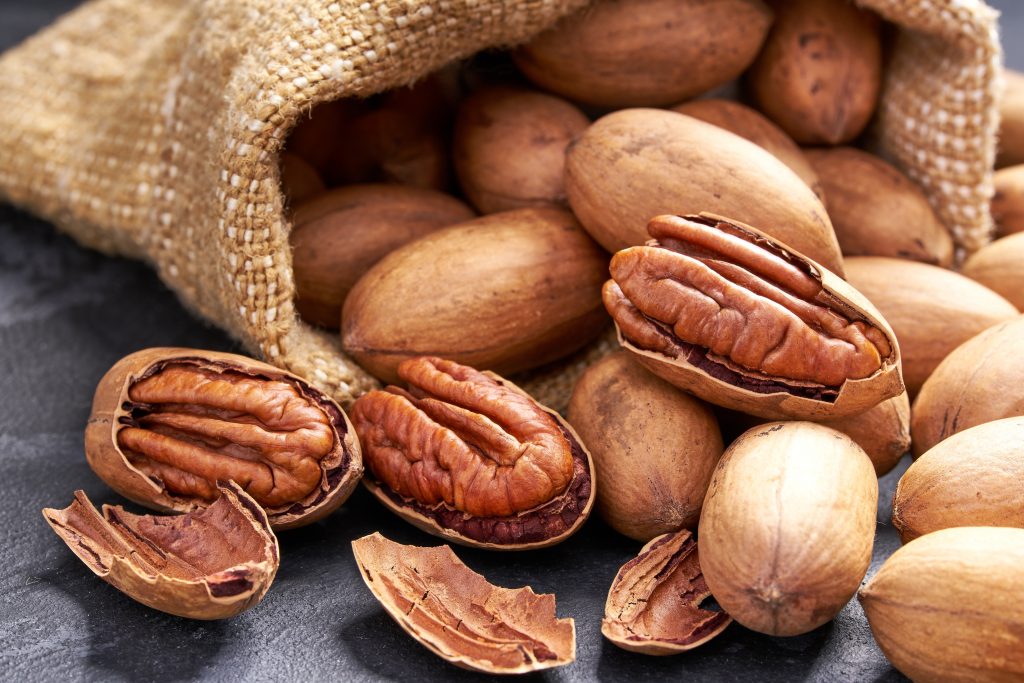
ATLANTA, GA – Georgia pecan growers of 30 acres or more will vote in May on the renewal of a one-cent per pound assessment on pecans for the Georgia Agriculture Commodity Commission for Pecans.
Pursuant Georgia law, producers are required to vote every three years to renew the assessment. Voting takes place May 1 through May 30, and all ballots must be postmarked by May 30. Additionally, the back of the return envelope must be completed for the ballot to be valid.
The commodity commission utilizes assessment funds for research, education, and promotion of Georgia pecans. Among the research funded is support for a University of Georgia (UGA) pecan specialist and breeder whose research includes disease and insect management as well as health benefits of pecans. Additionally, funding helps promote Georgia pecans in domestic and international markets.
Growers of 30 or more acres who have not received a ballot should contact Andy Harrison, at andy.harrison@agr.georgia.gov.
Produce industry experts believe consumers are, and will continue to be more health conscious, which is good news for blueberry producers.
“It’s very apparent to me that consumers are getting the message because when you look at things like the blueberry category, the strawberry category, the citrus category, we’re seeing great movement in those types of items,” said Melissa Byland, senior buyer in produce at Walmart. “I think consumers are definitely connecting fresh produce and specific items within fresh produce in the aspect that they contribute to better health. We’re definitely seeing the impacts of that in our business.”
Health Benefits
According to UGA Extension’s blueberry site, blueberries are a good source of vitamin C, iron and fiber. They’re cholesterol-free, sodium-free and possess an important source of potassium.
Research concludes that the antioxidants in blueberries help protect the body against chronic diseases associated with aging.
“We talked to one scientist who said there are seven things you should be eating to boost your immune system to protect you from any virus. Blueberries were on the list. We need to take advantage of that in this current situation to educate consumers,” said Cathy Burns, CEO of the Produce Marketing Association. “I don’t think it’s going away anytime soon. People are going to continue to be concerned about health. Obviously, what Melissa is seeing in her sales is very consistent with what we’re hearing with retailers across the board. It’s our time to shine and really focus on eating fresh fruits and vegetables, and blueberries fits squarely in that.”
According to the U.S. Highbush Blueberry Council, Georgia and Florida, along with eight other states, help produce more than 98% of the country’s blueberry crop.
Blueberry producers should really profit in the upcoming months. Byland said the latter part of spring and into summer, berries are under the spotlight at Wal-Mart. And it’s not changing.
“For us, we look at May, June and July as the Super Bowl of berries. We’re really planning to execute business the same way we have in the past. I know that quality and availability is at its best during this time. We’re able to offer customers larger pack sizes,” Byland said. “We’re really gearing down and looking toward running our summer business the same way we always have. It’s a great opportunity also for us to feature locally grown products, which we try to do as often as we possibly can. We know that it definitely resonates with customers. It gives them a great feeling about being able to support their local farmers.”
The Alabama Department of Agriculture and Industries (ADAI) is accepting grant applications for projects that enhance the competitiveness of U.S. specialty crops in foreign and domestic markets. The application deadline for these specialty crop block grants through the U.S. Department of Agriculture (USDA) is Monday, April 27, 5 p.m. CST. Specialty crops are defined by the USDA as fruits and vegetables, dried fruit, tree nuts, horticulture (including maple syrup and honey) and nursery crops (including floriculture).
Commodity groups, agricultural organizations, colleges and universities, municipalities, state agencies and agricultural nonprofits are all eligible for this grant program. However, their proposals must meet all of the program specifications. ADAI and a review committee of industry representatives will make application evaluation reviews and award recommendations to the USDA. USDA has final approval for projects submitted.
The specialty crop block grant is a competitive grant process, with the minimum amount awarded being $5,000. The maximum award to commodity groups, agriculture organizations, municipalities and agriculture nonprofits applicants is $25,000. The maximum amount for colleges and universities is $40,000.
Projects cannot begin until official agreements are signed, which is expected in October, 2020. For more information, visit http://www.agi.alabama.gov/scbgp or contact Johnny Blackmon at 334/240-7257.
Excessive nutrients in waterbodies, such as nitrate-nitrogen (N), have been one of the major issues in unconfined regions underneath the Upper Florida aquifer. This can be attributed to farmers applying excessive N fertilizer with the hope of obtaining higher yields. Therefore, the implementation of Best Management Practices (BMPs) such as proper irrigation and N management is required to avoid N leaching from soil profiles.
RESEARCH RECOMMENDATIONS
A field experiment was conducted in Live Oak, Florida to evaluate different irrigation strategies and N fertilizers in corn production. The goal was to improve strategies that could reduce N leaching from fields.
Scheduling can increase irrigation efficiency by decreasing runoff, deep percolation and soil evaporation losses. It also manages soil water content to reduce evapotranspiration during crop stages that require less water. According to Maria I. Zamora-Re, a Post-Doctoral Associate at the University of Florida, soil moisture sensors and soil water balance sheets are recommended methods of irrigation scheduling.
“The soil water balance sheet is a very easy spreadsheet that growers can put their inputs into, and the spreadsheet will allow them to know when irrigation is required in their fields,” says Zamora-Re.
In addition to reducing the amount of nutrients leaving the fields, irrigation scheduling tools can save growers input costs by applying less irrigation and fertilizer while potentially increasing crop yields.
“The data may be seen as overwhelming by some growers, and just one added to-do thing to their list. So we’re hoping to provide the tools and teach them that these technologies can be a very simple and cost-effective adaption. Another concern some growers share is the cost of soil moisture sensors. However, cost-share programs are now available through the grower’s water management district, which would provide them with a great opportunity to try this technology,” Zamora-Re says.
The University of Florida/IFAS Hemp Program is seeking qualified partners across the state to permit 20 farms for on-farm trials. The application link has been extended with late submissions due tonight by 11:59 p.m.
Partner farms will conduct a coordinated field planting on two acres with variations in land preparation. Partners will also have the opportunity to submit a plan industry development research on an additional three acres.
Application Details
Applications will only be accepted through the online form up to the late submission deadline. Only submissions through this online application form will be considered by the review panel. Past submission attempts via email using draft application or permit forms will not be considered. Applications for nurseries or indoor production facilities will not be accepted for this application period.
You must complete the application in one session. You can advance through the form without answering the questions (after answering question 1) to review the application questions before completing submission.
Recommended preparation for application
You will need a Google account to upload images required for the application.
Draft and/or log your answers in a separate file on your computer as a backup in case of technical difficulties.
Select a contiguous 2-to-5 acre field. Obtain GPS coordinates for the center of the field and annotated satellite image (.JPG, .PDF).
You may also permit an on-site propagation facility (e.g., greenhouse, shadehouse, high tunnel). Obtain separate GPS coordinates and annotated satellite image (.JPG, .PDF).
Identify farm supervisor and contact information.
Identify additional personnel by name and positions.
Consider limited access control points, storage capacity, and environmental containment procedures. You will have 500 characters to describe each of these points.
Determine your farm soil and source of water.
Consider the availability of irrigation and cultivation equipment.
Reflect on your farming experience, research experience, and industry engagement. You will have 1000 characters to describe each of these points.
Design an industry development plan for up to three acres. This is optional. You have 5000 characters to detail the goals and methods of the plan.
Frequently Asked Questions
When will selected farms hear back about selection? What will the permitting process be like? When is the expected planting date? About two weeks for initial response. The first round of applications are currently with the review panel. Late submissions will follow shortly. It is my goal to make selection recommendations late next week to UF/IFAS Research for approval the following week. Selection announcements and permitting procedures will be handled through UF/IFAS Research. My goal is to have permits in place and farms ready to plant mid to late May.
Why are you asking partners to pay? The main objective of this on-farm trial is to establish a network of knowledgeable farmers and industry professionals associated with rigorous research trials. The UF/IFAS Industrial Hemp Pilot Project needs the support of the industry and generous donors to complete that work. We will be asking partner farms and others in the community to contribute to the program through a volunteer donation.
Will partners be able to sell hemp produced during the trial? I do not know yet but am getting closer to a situation that would make that possible. If the crop was to be sold it will likely be done so through a commercial cultivation permit from the Florida Department of Agriculture and Consumer Services linked to the research permit. So, given that situation, we expect partner farms to also obtain a commercial permit for the trial field.
Where will we get seed or hemp material to plant? This is another area of uncertainty. I am working many angles for exactly where seed or plants come from and how or if it will be paid for. I ask a question of applicants to describe relationships with hemp genetics companies and possible acquisition scenarios through those relationships. Regardless, seed and plant material acquisition will have to be routed through UF/IFAS Research.
The ongoing coronavirus pandemic has dealt a devastating blow to the U.S. economy and especially the American farmer. North Carolina State Extension Economist Mike Walden believes the country needs to do what it can to help those farmers rebound from the current recession.
“We do need to worry about keeping our farmers afloat. Fortunately, in the stimulus plan, there was about $50 billion that was allocated for various programs that would help farmers,” Walden said. “We certainly need to watch our farmers.”
Fruit and vegetable producers are struggling because of the lack of the food service market. Restaurants have either closed or reduced their business traffic to try to limit the spread of COVID-19. However, that has caused a problem for producers, especially in Florida.
“If you look at where people get their food, we’re almost split 50-50 between people eating their food in their homes in home-prepared meals versus eating them in restaurants,” Walden said. “The restaurant industry is essentially shut down. There is some pick-up and take-home but that’s a small fraction of what they do. The problem for the farmer is that their supply chain is geared towards that 50-50 split. People don’t understand that farmers just can’t take the produce that they were sending to restaurants and just ship them over the grocery stores. There are different regulations and different packaging.
“That’s creating a real headache for farmers.”
On Friday night, the United States Department of Agriculture announced the Coronavirus Food Assistance Program (CFAP). According to the USDA press release, President Trump directed USDA to craft this $19 billion immediate relief program to provide critical support to farmers and ranchers, maintain the integrity of our food supply chain and ensure every American continues to receive and have access to the food they need.
Walden still warns that the economy will likely get worse before it gets better.
“The second quarter, which is how most economic data are calibrated, is going to be horrible. It’s going to probably be a record in terms of drop of GDP (Gross Domestic Product). But we should start to see growth come back in the third quarter and fourth quarter,” Walden said. “But it’s likely not going to be until, I would say, at the earliest, mid-2021 before we’re back to where we were before this started.”
Walden said he’s been an economist for more than 40 years. This is his sixth recession but admits this one is much different than the others.
“Most recessions are caused by imbalances in the economy, particularly over-indulgence in debt. Businesses and consumers taking too much risk,” Walden said. “This is a recession that has actually been mandated by the government. The government has said we have a problem with the coronavirus. It is easily spread. In order to contain it, in order to limit deaths, in order to not overwhelm our hospital system, we have to essentially shut down a large part of the economy.
“All of the bad numbers we’re getting now should not be surprising because we have to do this in order to control the virus. Apparently we are getting good numbers on that. We will likely see the economy contract by somewhere between 25% and 30% in the second quarter, that is April, May and June. The unemployment rate may very well get over 15%. But the good news is this should be short-lived. We should probably see some return to growth in the third quarter and then forward.”