Blog

  • Florida Produce Farmer Concerned Over Lack of Fair Trade

    Canada, U.S. and Mexico are part of the USMCA.

    By Clint Thompson

    A Florida produce farmer is the latest to voice his concern over the impact Mexican imports are having on American farmers.

    Will Hyatt, who farms bell peppers and cantaloupes in Lake Wales, Florida, said there are multiple reasons consumers should buy domestic. He also believes the idea of fair trade is a fantasy and not reality.

    “I farmed in Mexico, and I know what it’s like. I know what the labor is like, and I know what the regulations are like; know Mexican government regulators are open to bribes to overlook or even assist violators,” Hyatt said. “To tell me, we have to compete against that, it’s not really fair. I think we can out-compete Mexico and Central America in a fair market if we have a fair regulatory market.

    “If we could trade labor and trade resources, this wouldn’t be a problem.”

    Florida blueberry farmer Ryan Atwood confirmed that just last week, Mexico exported 5 million pounds of blueberries into the U.S. last week. This happened despite it being the peak harvest season for Georgia, one of the country’s leading producers of blueberries.

    According to the USDA, U.S. agricultural imports from Mexico equaled $25.9 billion in 2018.

    What can change?

    Hyatt believes nothing will change until voters make their voices known.

    “Farmers are conservative as a rule, politically. The vast majority of us are conservative. But we are the first one to scream, please help us government when Mexico ships out a bunch of products. When the answer to me is to educate our fellow countrymen,” Hyatt said. “At the end of the day, our fellow countrymen vote with their dollars to purchase products that are produced internationally above purchasing domestically produced products. The farmers are a very small percentage of the community that will pay a price for that. At some point the greater population will pay a much steeper price, in my opinion.”

  • Still Time to Get Boxed Produce

    Workers get boxed produce available to deliver to customers last Wednesday, April 29.

    By Clint Thompson

    There’s still time for fruit and vegetable lovers in South Georgia to order their boxed produce from Lewis Taylor Farms.

    There are still boxes available for purchase, according to the Lewis Taylor Farms Facebook page,

    The boxes are $20 each and include sweet potatoes, cucumbers, bell pepper, onion, cantaloupe, green beans and collards. Boxes can be picked up on Wednesday, May 6 from 8:30 a.m. to noon or from 1:30 p.m. to 6 p.m. at the Quality Produce Packing shed on 217 TyTy Omega Road.

    Order forms for next week’s boxed produce can be found here.

    Bill Brim, a Tifton, Georgia fruit and vegetable farmer, was overwhelmed with the positive response his produce boxes generated last week. The co-owner of Lewis Taylor Farms said between 1,300 and 1,400 produce boxes were sold.

    Like his brethren in Florida, Bill Brim’s farming operation has been impacted by the orders of self-quarantine amid the current coronavirus pandemic. The lack of a foodservice market led to a decrease in demand for fresh produce. This includes those grown at Lewis Taylor Farms in Tifton, Georgia.

    Brim decided to offer boxed fruit to consumers in the South Georgia area.

    Lewis Taylor Farms grows more than 6,500 acres of produce each year.

  • Whiteflies Already a Concern for Georgia Farmers

    By Clint Thompson

    University of Georgia Cooperative Extension vegetable entomologist Stormy Sparks said whiteflies are present in Georgia vegetables. This is not good since cotton farmers have begun planting their crop, and whiteflies like to feed on cotton plants as well.

    “There’s some. I don’t know if it’s worse or better or whatever compared to other years. Apurba’s been running those traps and checking some fields and he’s finding whiteflies,” said Sparks, referring to Apurba Barman, a postdoctoral researcher under UGA entomologist Michael Toews.

    “Apparently, they’ve always been here. But yeah, noticeable numbers in April is early, particularly in any fields. Where he’s finding most of them is kale which is not a good sign. That’s one of the crops they overwinter in. This time of year, having numbers is not good in any crop.”

    Why So Early?

    While colder temperatures don’t eliminate whiteflies, they do kill many of their wild hosts. They also slow population development in cultivated hosts. Warmer temperatures this winter allowed for larger whitefly populations to overwinter and become mobile earlier.

    “They’re able to carry through on crops a little easier. It never really gets cold enough here to really kill them, it just slows them down. Hopefully, the crops we have out there in the winter are not as good of hosts as some of our spring, summer or fall crops. You’re always hoping they’ll crash during the winter. But yeah, the mild winter undoubtedly plays a role in them overwintering a little better.”

    Whiteflies cause feeding injury issues in vegetables and transmit two viruses: cucurbit leaf crumple virus and cucurbit yellow stunting disorder virus. Vegetables like squash, zucchini, cucumber, cantaloupe and snap beans are highly susceptible to these viruses. Commercial cultivars that have resistance or tolerance to these pathogens are not available.

    Will They Get Worse?

    The weather patterns over the next couple of months will determine if the whiteflies continue to worsen. How much rain will there be? How heavy are the rains and when will they occur? This is especially important as farmers move from winter crops to spring crops and then to cotton. Freezes in the winter and a tropical storm-type of weather system really impact populations.

    “You never want a tropical storm but a good tropical storm at the right time really knocks them back,” Sparks said.

    Sparks and other specialists continue to preach sanitation with whitefly management. He said farmers have done better in recent years in getting rid of winter vegetables once they’re done harvesting. That needs to continue with the spring crops once they’re done.

    “If you’ve got crops where you know you’ve got them, if you’re done with the crop, get rid of that crop,” Sparks said. “I think overall we’ve been doing a better job with sanitation. That’s something we always need to hammer on and remind them that sanitation is critical.”

  • Blueberry Farmer Reflects on Lost Crop Following Hailstorm

    By Clint Thompson

    A devastating hailstorm on Thursday, April 23 wiped out production for one of the largest blueberry farming operations in the Southeast, says blueberry farmer Phillip Mixon. The former owner of Mixon Farms, who now serves as manager, reflects on what might have been with this year’s crop.

    Pictured are highbush blueberries.

    “We had the best crop we had since about 2016,” Mixon said. ““We deal with rain. Some of them will split and you have to wait a few days and let them heal up and go back to picking. With hail, it devastates them.”

    Mixon’s farm has about 850 acres. Approximately 600 would have been harvested. The storm knocked a bunch of blueberries off. What was left on the bush was bruised really bad. They aren’t marketable.

    “It wiped ours out. It’s a total loss. It’s not good,” Mixon said. “We had golf ball size hail. It didn’t last but about 30 seconds, but it just totally wiped them out.”

    Mixon estimated he lost about 5 million pounds.

    Challenging Spring

    It’s been a challenging spring for Mixon. First, the blueberry farmer said having enough labor was a problem when the coronavirus pandemic hit. Now, he must find work for his workers. He’s reached out to his farming brethren.

    “You’ve got to guarantee them three-quarters of the contract. You’ve got to pay them whether you’ve got something or not,” Mixon said. “That sucks because I couldn’t help the hailstorm. If not been for that, I’d have plenty of work. It’s a bad deal all the way around.

    “We just start over and hope for the best next year. We started (Wednesday) hedging our blueberries down. We’re just going to have to tend to them and hope for next year and collect what little bit of insurance there is.”

    The only saving grace for Mixon was that this didn’t happen a year or two sooner. He sold the farm to an investment group, who kept him working as manager. Still, it’s a hard pill to swallow to see a year’s production lost.

    “It’s disheartening,” Mixon said. “I still treat it just like it’s mine even if somebody else has got it.”

    For more information about how the blueberry market is faring, see VSCNews story.

  • Boxed Produce Leads to Sweet Results

    Picture by Clint Thompson/Workers bring boxes of produce to customers on Wednesday.

    By Clint Thompson

    Thinking inside the box helped Brill Brim sell fruit and vegetables while providing an outlet for consumers to buy local produce.

    Brim, a Tifton, Georgia farmer, was overwhelmed with the positive response his produce boxes generated in the South Georgia area this week. The co-owner of Lewis Taylor Farms said they sold between 1,300 and 1,400 produce boxes. Each were stocked with turnips, broccoli, onion, cabbage, blueberries, kale and zucchini. Cars lined the road leading into Lewis Taylor Farms on Wednesday.

    “The response was great. We were overwhelmed and very surprised,” Brim said. “We were very surprised but very thankful for all of the gracious people.”

    Those interested in making a purchase next week, order forms can be found here.

    Next week’s box will have sweet potatoes, cucumbers, bell pepper, onion, cantaloupe, green beans and collards. All boxes are $20 each. Boxes can be picked up next Wednesday, May 6 from 8:30 a.m. to noon or from 1:30 p.m. to 6 p.m. at the Quality Produce Packing shed on 217 TyTy Omega Road.

    Brim’s farming operation has been impacted by the orders of self-quarantine amid the current coronavirus pandemic. It’s much like what happened to his brethren in Florida. The lack of a foodservice market led to a sharp decline in demand for fresh produce including those grown at Lewis Taylor Farms in Tifton, Georgia.

    With excess fruit and vegetables, Brim decided to offer boxed fruit to consumers in the South Georgia area. It’s been a sweet success.

    Lewis Taylor Farms grows more than 6,500 acres of produce each year.

  • Cabbage, Broccoli and Other Cole Crop Diseases

    Clemson Cooperative Extension released some diseases that cole crop growers need to be on the look out for this spring.

    Black rot is one of the most serious diseases for cabbage growers.

    Cole crops, such as broccoli, Brussels sprouts, cabbage and cauliflower, are easily grown in South Carolina. Tips for growing healthy cole crops in the garden are available in HGIC 1301, Broccoli, HGIC 1326, Cauliflower and HGIC 1303, Cabbage & Chinese Cabbage. Several disease problems commonly affect these plants, especially when resistant varieties are not planted. Some of the more common problems are covered here, including root and stem rots of young plants, black rot, downy mildew and viruses.

    Pythium Damping-Off

    This disease commonly affects seeds and young transplants and is caused by the soil-borne fungus Pythium species. Infected seeds decay in the soil. Seedlings and young transplants will “damp-off” or rot at the soil line, before they eventually collapse and die.

    Prevention & Treatment: Cultural controls include planting on raised beds and providing good drainage. Start seeds in commercial potting soil, not in garden soil. Use new potting soil and new or thoroughly cleaned and dis-infested containers and trays. Wash used containers with soapy water to remove all traces of old soil mix, and then briefly submerse containers in a 10% bleach solution. Allow to dry before planting in containers.

    If disease has been severe enough in the past to warrant control, the biocontrol fungicide, Bacillus subtilis QST 713, can be used before or at the time of seeding. It can be used for treatment of seedlings in trays or young transplants in the garden.

    Downy Mildew

    This disease is caused by the fungus Peronospora parasitica and can attack both seedlings and mature vegetable plants. Infected plants develop a gray mold on the lower leaf surface. The upper leaf surface of infected plants first turns yellow and then may turn brown or necrotic. Leaves wither and die. Symptoms differ from powdery mildew in that the downy mildew fungus grows only on the lower surface of the leaf. Development of the disease is favored by moist conditions.

    Prevention & Treatment: Use varieties with resistance or tolerance to this disease. Rotate with crops other than cole crops or greens. Remove plant debris immediately after harvest. Use wide plant spacing to promote drying of leaves. Avoid wetting the leaves when watering.

    If disease becomes severe enough to warrant chemical control, chlorothalonil will give good control and copper fungicides will give fair control. Spray every 7 to 10 days after transplants are set. Make sure that the lower leaf surface is covered with fungicide. Do not apply copper when temperatures are above 90 °F. Wait 7 days after spraying before harvesting if using chlorothalonil or mancozeb.

    Alternaria Leaf Spot

    This disease is caused by the fungus, Alternaria species, and occurs during warm, moist conditions. On seedlings, the symptoms are small dark spots on the stem that can cause damping-off or stunting of the plant. On older plants, the bottom leaves are infected first with brown circular spots on the leaves. Spots have characteristic concentric rings (target spots). Infected leaves soon turn yellow and drop. Bright sunshine, frequent dews or showers, and temperatures between 60 and 90 °F favor disease development.

    Prevention & Treatment: Remove and destroy all crop debris immediately after harvest, since this disease overwinters on plant residue. It is easily spread by tools, wind, splashing water or insects. Seed treatment and rotation with crops other than cole crops or greens will also reduce disease. If disease is severe enough to warrant chemical control, chlorothalonil will give good control and copper fungicides will give fair to poor control. Spray every seven to 10 days after transplants are set. Wait 7 days after spraying before harvest if using chlorothalonil.

    For full story, see Clemson fact sheet.

    Clemson Cooperative Extension

  • Timing is Everything for Florida Farmer

    By Clint Thompson

    Timing is everything, and for Florida produce farmer Will Hyatt, it might be the key to a successful season.

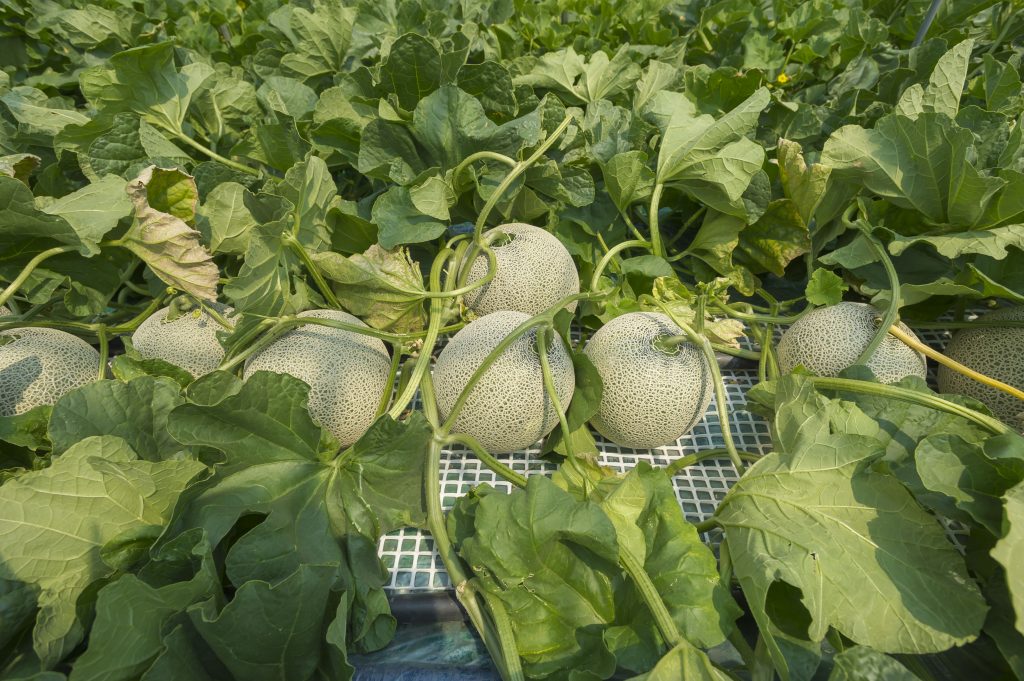
    File photo shows picture of cantaloupes in a field. Will Hyatt has been harvesting his cantaloupes for more than a week.

    Hyatt, who farms bell peppers and cantaloupes in Lake Wales, Florida, has been picking melons for more than a week. He was fortunate not to have to deal with the challenge of marketing produce during the onset of the coronavirus pandemic.

    “I think it was our good fortune to be far north to not have to deal with the front side of it. Our crops are typically planned for mid-to-late April, early May. We weren’t faced with tackling the upfront panic,” Hyatt said. “Really, because of the products that we’re growing and the sales outlets that we have, so far our season has been fairly good to us. I know a lot of people aren’t in the same boat. We’ve been very fortunate to align ourselves with the right labor providers and the right clients. It’s not been too bad for us.”

    Not All Are As Fortunate

    Unfortunately, not all Florida farmers were as lucky. Paul Allen, president of R.C. Hatton Farms in Belle Glade, Florida and chairman of the Florida Fruit and Vegetable Association, said he had to leave 2 million pounds of green beans and about 5 million pounds of cabbage in the field in this April 7 VSCNews story. All because of the lack of a foodservice market due to restaurants closing in mid-March amid COVID-19.  

    Hyatt’s harvest window for cantaloupes will last until the first week of June. High temperatures in Florida helped ripen his cantaloupes but also impacted the pepper’s production.

    “The temperatures have helped bring the cantaloupes on a little quicker but it’s also made the pepper a little more challenging from a fruit set standpoint,” Hyatt said.

    “We can be glad or mad at any kind of weather,” Hyatt joked.

  • UGA Research Aimed at Helping Hemp Varieties Adapt Better to Southeast

    Pictured is a hemp field that UGA’s Jason Wallace and Matthew Johnson studied hemp at.

    By Clint Thompson

    Georgia farmers can begin growing industrial hemp this year. Many Georgia growers are enthusiastic about the new opportunity. But most varieties have not been selected for Georgia’s climate. There is little information about which ones will do well.

    University of Georgia scientists are hoping their research will help hemp producers profit for many years to come. UGA scientist Jason Wallace and student Matthew Johnson are studying the genetics of different varieties. They hope to improve them to better adapt to the Southeast region.

    “The first step is finding something that actually works [in Georgia] and survives,” says Wallace, a member of UGA’s Department of Crop and Soil Sciences. “Once we have that, the next goal is to ask, ‘How do we make this better? What do we want to change to make it more profitable, less likely to go over the legal limits [of THC], and require fewer inputs?’”

    Breeding Trials

    UGA grew a collection of 60 hemp varieties in several locations around the state last year. They scored how well each did to identify the best varieties and began breeding trials to produce even better ones.

    Johnson, a graduate student in UGA’s Institute of Plant Breeding, Genetics, and Genomics, believes many of hemp’s traits need to be improved if it is to be adapted to growing conditions in the Southeast.

    “During these past 100 years when this crop’s been pushed off for legal reasons, the most advanced work that has ever happened in plant genetics and in fruit cultivar development happened,” Johnson said. “Corn has gone from maybe 20 to 30 bushels an acre to yields of 200 to 300 bushels per acre.  Hemp has had no improvement [for large-scale production]…. You need to make it a plant that can be harvested with a machine and stay within legal limits…. Those are more long-term goals and do need to be approached from the genetics research.”

    Wallace is confident that hemp research can be accelerated with the technology he and Johnson have access to.

    “With the technology we have now, you can develop tools in just 2 or 3 years that took corn or wheat 30 or 40 just because the technology has come so far, so fast,” he said.

    Challenging Research

    Hemp research is still a challenge since the crop has been illegal for decades. With limited prior studies in genetics, Johnson has had to develop and validate a lot of the foundational data on his own.

    “There aren’t a lot of well-known protocols,” he says. “If I want to know how to do something in corn, I can call up 100 different researchers and they can tell me how to do [it]. If I want to know how to cross two hemp plants together, I have to figure that out. Not much is set up. I’ve had to figure out how to make my plants produce pollen, how to cross them, how to control them. I’ve (also) had to figure out what nutrients to use.”

    Despite those challenges, Johnson is excited about the crop’s potential.

    “To be honest, this [industrial hemp] is what got me interested in agriculture genetics in the first place. I’ve been studying this crop for 10 years, since I was in high school. To be in this position and to be able to do this research is a dream come true.”

    Although industrial hemp is the same species as marijuana, it lacks the high concentrations of a chemical–tetrahydrocannabinol, or THC–required to give people a high.

  • Florida Farm to You Commodities Page Adds Interactive Map, Transportation Options

    Tallahassee, Fla. – The Florida Department of Agriculture and Consumer Services (FDACS) has added several exciting new features to the Florida Farm To You commodities exchange that the Department launched on April 9.

    commissioner
    Nikki Fried
    Florida Agriculture Commissioner

    Designed to connect farmers with buyers, consumers, and food banks during COVID-19, the page has been visited more than 334,000 times, with more than 310 listings of farm-fresh items for purchase, and is part of the #KeepFloridaGrowing effort launched by FDACS. The new features include an interactive map and a new commodities transportation option.  

    Interactive Map: The Florida Farm to You page now features an interactive map in which users can enter their address, city, or ZIP code to find growers near them. The map includes icons indicating what commodities are nearby, such as fresh produce, dairy, meat, seafood, honey, and more.

    Transportation Option: Similar to farmers listing their products, transportation companies can now list their refrigerated and non-refrigerated truck services on the Florida Farm to You page. By filling out the simple online form, transportation companies can be contacted by farmers and ranchers looking for options to have their commodities transported from their farms.

    “Our new Florida Farm to You page has successfully connected Florida’s farmers with buyers, food banks, and consumers in their communities,” said Agriculture Commissioner Nikki Fried. “Now, we’ve made the page even more user-friendly by adding an interactive, searchable map, and we’re adding functionality to help agriculture producers find transportation for their crops from their fields. As COVID-19 creates unprecedented challenges, we remain committed to doing everything we can to support both our farmers and consumers in need.”

    The additions were the result of feedback from Florida Farm to You page users, as well as from transportation companies eager to help agriculture producers. Transportation companies with vehicles suitable for the transportation of agricultural commodities are encouraged to sign up on the page and share information including location, truck sizes, travel radius, and availability.

    For more information, see the Florida Farm to You website.


  • North Carolina Growers Await Decision on Hemp Licensing

    Pictured is a field of industrial hemp.

    By Ashley Robinson

    North Carolina is still operating under the state’s pilot program, just as it has since 2017 when the program started. If you want to grow hemp, you will need to apply for a license from the North Carolina Department of Agriculture and Consumer Services (NCDA&CS). However, that will all change soon.

    “Something is going to have to happen by Nov. 1,” says Jeanine Davis, Extension specialist and researcher in the Department of Horticultural Science at North Carolina State University.

    The state’s pilot program expires October 31, 2020, which leaves two options moving forward: North Carolina can submit a state plan to the United States Department of Agriculture (USDA) for approval, in which case the (NCDA&CS) would continue to regulate hemp licensing; or the state can go under the USDA’s plan, which would mean that growers would apply for a license directly from the USDA.

    Davis said a final decision hasn’t been made yet, but growers are waiting in anticipation.

    N.C. Hemp Pilot Program Sees Success

    Since the state’s pilot program began in 2017, hemp has proven to be a successful and exciting crop for North Carolina.

    “We can grow beautiful hemp all across North Carolina,” says Davis. “It takes some time and experience to learn how to grow it. But we see good crops being produced all across the state.”

    According to Davis, the issues growers have seen haven’t been in crop production but rather in areas such as financing and markets.

    “Hemp is unique because we’re all learning it together. We didn’t have established markets or a lot of information to draw on. So our markets are developing right along with the growers,” Davis said.

    She advises new growers to focus on efficiency.

    “In our first couple of years, if you were able to grow good hemp, you could probably sell it. But this year, you’re really going to have to concentrate on being a very efficient grower and doing things well.”

    In the first couple of years, growers had to rely on hand labor because of the lack of appropriate equipment to grow and harvest hemp. Now, growers need a specialty, niche market lined up that will pay high enough prices to cover those labor costs. If not, growers are going to have to mechanize and increase efficiency to stay competitive.

    Overall, Davis is excited about what hemp means for agriculture in the state.

    “It’s a very exciting time to be in agriculture. I love seeing a new crop such as hemp that has been embraced by so many. It’s been interesting to see this crop develop and to see it engage people of all ages and all walks of life,” Davis said.