Blog

  • South Carolina Crops: Clemson Extension Agents Provide Updates Across State

    Clemson Extension agents provide updates in the The South Carolina Grower this week about the status of various crops being produced throughout the state.

    Weekly Field Update

    Coastal

    Rob Last reports, “Strawberry crops continue to develop well with sustained flowering and fruit set. Early crops are ripening well with crops coming to market. Just a note of caution, the weather last week can be conducive to gray mold development, so fungicide programs are going to be key. Thrips are active in some crops too, so keep scouting. Melon transplants are going in the ground over the last week with development looking very promising. Peaches in the area are all but finished flowering with great fruit set. Finally, as we are looking at a cooler week for flowering fruit crops, keep an eye on the forecast temperatures to determine if protection is going to be required. Fruit and closed buds can tolerate cooler temperatures than flowers, but damaged flowers can increase gray mold development.”
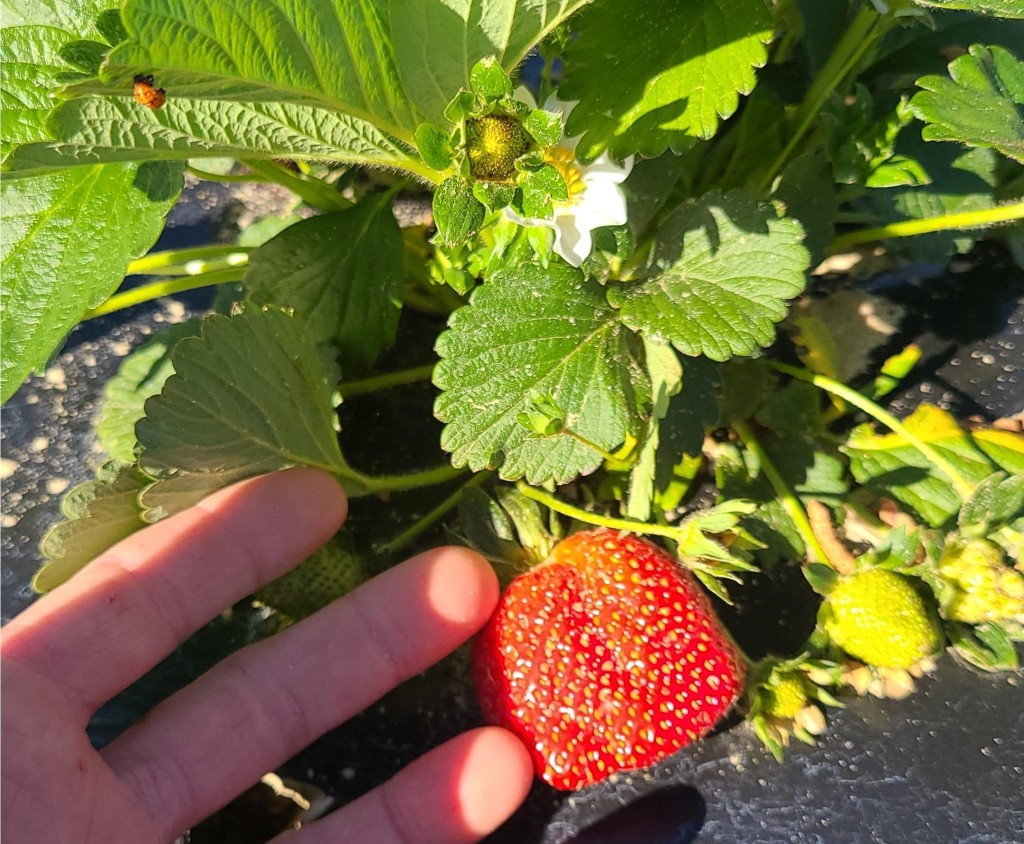
    Strawberries continue to develop well in the Coastal region. Photo from Rob Last.

    Zack Snipes reports, “We have had pretty good weather as of late and it has really made things jump here. Spring greens, onions, radishes, carrots and strawberries are really pushing out hard. I counted 57 green berries+flowers on one strawberry plant. If someone can beat that number, I will give you a Free Crop Handbook. The blueberry crop is looking great with a good fruit set on highbush varieties and tons of flowers right now on the rabbiteye types. We planted around 30 citrus trees on Friday as part of a Specialty Crop Block Grant. We have around 75 more to plant next year. All in all we will plant somewhere around 40 varieties with varying scion and rootstock combinations. We are looking at cold tolerance in both the lab and a field setting and monitoring for citrus greening. We will plant everything from kumquat to grapefruit to finger limes.

    Newly planted citrus trees at the Coastal REC this past week. Photo from Zack Snipes.

    Midlands

    Justin Ballew reports, “Last week was pretty cloudy, but we had a couple of beautiful days that reached the 80s. Though we’ve had a little bit of rain, the air has been thick with pine pollen. We’re seeing a few strawberries ripen, but we’re still not at the point where we can open the U-Picks. We’re running a little behind where we’ve been in the past few years, and I suspect all the cloudy weather we’ve had over the last month is partially to blame. I’m seeing a good bit of misshapen fruit, which is normal for the very first fruit that develop. This is usually related to pollination, but make sure you tissue sample to make sure boron levels are where they need to be. Watch out for the cool nights in the forecast later this week. We may need to cover. Spring planted brassica crops are looking good. Diamondback moths are showing up in places, especially near fields where a fall crop was grown through the winter, so be sure to destroy those fields once harvest is finished.”

    Misshapen fruit are pretty common early in the season. Its usually related to pollination, but can be a sign of low boron. Tissue sample to make sure boron levels are adequate. Photo from Justin Ballew.
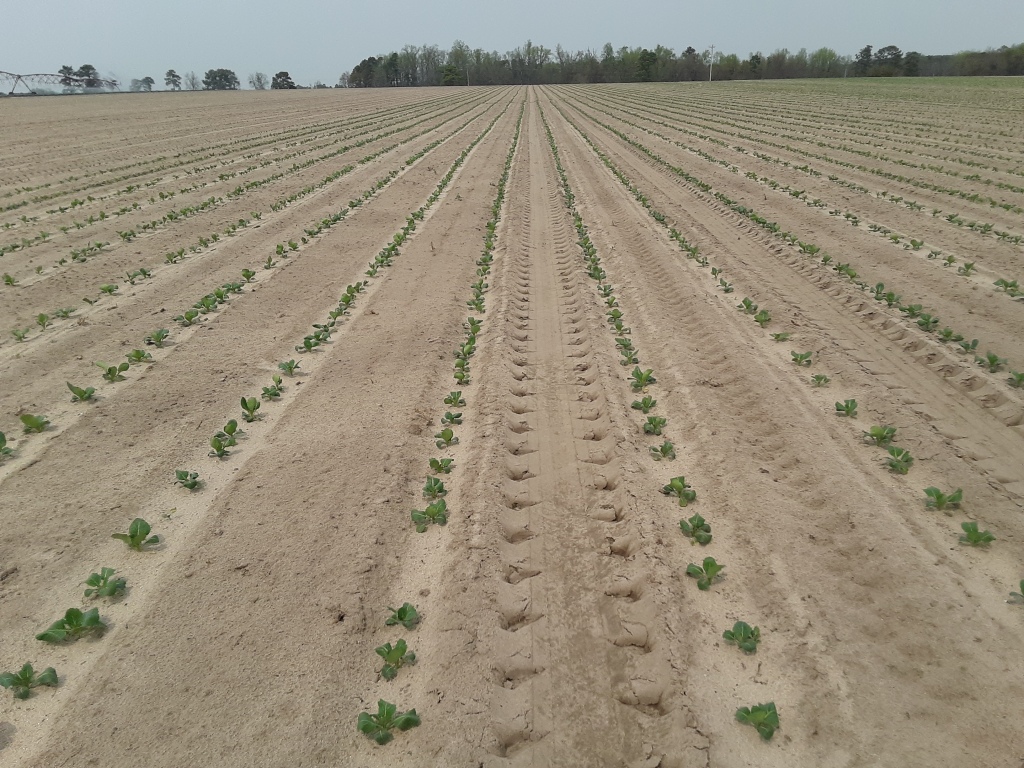
    Spring planted brassicas are growing well and looking good. Photo from Justin Ballew.

    Sarah Scott reports, “Peaches are progressing quickly with small fruit forming on early varieties. Georgia has reported plum curculio activity in the middle part of the state, so orchards in the Ridge of SC can expect to see activity in about 2 weeks. Check the 2021 management guide for control options which include Imidan, Actara, Belay, and Avaunt. Strawberries farms are on track to begin picking regularly April 1. Spring greens are being transplanted as well.”

    Pee Dee

    Tony Melton reports, “Strawberries are ready to burst forth, and there are already some fruit on Ruby June. Working to protect strawberries and peaches later on this week. A lot of summer crops will be going into the ground after Easter. Pickle growers are biting at the bit.  Most greens are just emerging. Cabbage is enjoying the weather and getting to what I call the whirl stage so hope we have no damaging winds to wring them off. Sweet potatoes slips are just emerging on the beds.”

  • Overwhelming: Challenges Mounting for Producers to Stay Afloat

    Challenges continue to mount for Southeast produce farmers. There is a fear among producers in Florida and Georgia that one day obstacles like Mexican imports and rising costs will be too much for growers to overcome. It will lead to producers going out of business and this country becoming reliant on foreign countries for food.

    “An older guy told me this, whether you’re the biggest produce outfit on the block or the smallest, because of the way this industry goes, the big guys aren’t but about two seasons behind the little guys as far as going out,” said Georgia vegetable farmer Jason Tyrone. “The amount of money you could lose at one time, one season or one year is very serious.”

    While last year was profitable for Tyrone and Tycor Farms in Lake Park, Georgia – even then he is still not sure how that happened amid the coronavirus pandemic – domestic producers are always going to be vulnerable to going out of business when compared to rising imports from Mexico.

    “If something doesn’t change, it could happen sooner rather than later,” Tyrone said. “I know it can happen and I try to prepare for it, financially and mentally, of what would I do?”

    Lack of Support

    What is really frustrating for farmers like Tyrone is the lack of support being shown their way. Back in February, the U.S. International Trade Commission voted 5-0 against farmers claiming that imports were having serious injury to the domestic market.

    And, according to Tyrone, local grocery store chains are not backing their local producers, either.

    “I’ve seen in my own grocery store in Lake Park in Winn-Dixie, a big old bin full of, I don’t even remember what commodity it was; they have to put the country of origin up there on the bin; it says, grown in the U.S. Then you look at the actual stickers on the fruit, like on the pepper, and it’s from Mexico,” Tyrone said. “They’re just dumping boxes of Mexican pepper in there in the bin that says, grown in the U.S. The grocery stores are definitely not doing their part.”

    The lack of support is reflective in the financial margins of today’s vegetable and specialty crop producer.

    “My in-laws started the operation we’re in now in the late 80s. They’ve got books with numbers all the way back. Most of our input costs, labor, seed are up anywhere from 200% to 500% over that timeframe. If you look across the board at the average box price, it’s the same,” Tyrone said. “They had great margins back then. That’s how they built what they built. There was only two packing houses in Lake Park, now there’s six. And they weren’t battling Mexico.”

  • Mite Management on Southern Highbush Blueberries

    Figure 1. Southern red mite adult female and male mating (top) and one egg (bottom). Photo by L. Buss, UF/IFAS

    By Oscar E. Liburd, Lorena Lopez and Doug Phillips

    Mites can cause significant damage on blueberry plants if not properly managed. Mite species that feed on southern highbush blueberries (SHB) include the southern red mite (Oligonychus ilicis) and the false spider mite or flat mite (Brevipalpus yothersi). The southern red mite is the primary mite pest feeding on blueberry plants in the southeastern United States and is common in fall and early spring. The false spider mite, first reported on SHB in 2016, is more common during summer months.

    SOUTHERN RED MITES

    In Florida, southern red mite populations increase under dry weather conditions with warm temperatures (60 to 86° F) and reach their peak during the fall. Their life cycle can be completed within two weeks under these conditions, and populations can double within five days with overlapping generations, increasing their potential for significant yield impact.

    Adults are similar in appearance to the red form of twospotted spider mites (Tetranychus urticae) and other red Tetranychus species, about 0.4 millimeter in length, red or brown to deep purple in color, with lighter colored legs (Figure 1). Females are slightly larger than males and have a more rounded body shape. Red to brown spherical eggs hatch into pale six-legged larvae. In the nymph stages, mites develop eight legs and are darker and larger.

    Figure 2. Female adult flat mite Photo by: R. Akyazi, University of Ordu
    FALSE SPIDER MITES

    False spider mites can complete their life cycle in about 19 to 20 days at around 77° F and 60 percent relative humidity. Adult flat mite females are flat and oval, approximately 0.3 millimeter in length, with red-orange coloring (Figure 2). Males and immature stages (larvae and nymphs) are similar in appearance and color pattern to the females but smaller. Eggs are bright red to orange and elliptical in shape.

    DAMAGE

    Southern red mites primarily live and feed on the lower side of SHB leaves. An accumulation of shed white skins can be observed when populations reach high numbers (Figure 3). Bronze coloring of leaves is the primary symptom accompanying southern red mite injury, with the intensity of bronzing increasing with the level of internal leaf damage (Figure 4). The southern red mite feeds on plant tissues by inserting its mouthparts into the leaf and removing cell contents, resulting in a decrease in the rate of photosynthesis.

    In SHB, leaves heavily infested with flat mites typically develop necrotic brown spots (Figure 5).

    Figure 3. Southern red mites shed their white skins on leaves. Photo by D. Phillips, UF/IFAS
    MONITORING

    In addition to differences in body shape and color, there are other distinctions between southern red mites and flat mites to consider when monitoring for these pests. Flat mites are smaller, move more slowly and are best observed with a hand lens or under a microscope. Southern red mites move more rapidly and can be observed with the naked eye on blueberry leaves. Southern red mites tend to feed over the entire surface of the underside of leaves and produce a web over the infested surface to protect them from predators. Flat mites typically feed near the midrib or secondary veins on the underside of leaves and do not produce a web.

    Mite populations tend to increase during hot, dry conditions. Frequent scouting for the presence of mites is recommended for early identification of infestations. Although southern red mites can be seen with the naked eye or a 10x hand lens, flat mites will need a higher magnification lens (20x) for identification.

    Typical symptoms of mite feeding (bronzed leaves for southern red mites and necrotic spots for flat mites) are also a good indication of mite infestations. However, monitoring for adults in addition to symptoms is important since by the time symptoms appear, infestation has already occurred and defoliation risk is increased.

    Closely examine the underside of leaves with the appropriate magnifying glass to look for adults, shed skins and webbing. Another way to scout for the presence of mites is to sharply tap the foliage onto a sheet of white paper to observe any adult mites.

    Figure 4. Bronze-colored blueberry leaves are associated with southern red mite damage. Photo by D. Phillips, UF/IFAS

    The pests favor dusty conditions, and drought-stressed plants can be more susceptible to infestations. In addition to supplying plants with sufficient irrigation, applications of water should be made regularly to roadways or other dusty areas during hot, dry periods.

    MANAGEMENT

    The flat mite is an important pest of citrus and its biology and ecological interactions have been studied in that cropping system, as well as most of the management techniques used for its control. Because it was only recently reported in blueberries, there are no established guidelines for the control of this mite in blueberry plantings. There is also no available information on miticide performance against flat mites infesting blueberries.

    The southern red mite is now an important pest in both protected and open-field SHB plantings. Three miticides — Magister (fenazaquin), Portal (fenpyroximate) and Kanemite (acequinocyl) — have recently been registered for use in highbush blueberries. These miticides target tetranychids and not specifically southern red mites, although Kanemite specifically mentions southern red mites on its label. The miticides control all developmental stages including larvae, nymphs and adults of southern red mites. In addition, Magister provides control of eggs by contact while controlling other stages by both contact and ingestion.

    Data from University of Florida Institute of Food and Agricultural Sciences (UF/IFAS) 2020 field trials (where eight miticides were evaluated) indicate that Magister and Portal continue to be the best-performing miticides as shown in 2019 trials. Both products suppressed southern red mite populations and allowed bushes to recover from mite injury. Growers can only make one application per year using Magister and two applications per year with Portal. Kanemite was also effective at reducing southern red mites in 2020.

    Additionally, two sulfur-based products were evaluated in the 2020 field trials. Sulfur-CARB, a suspended sulfur soil amendment (elemental sulfur and molasses), is sometimes used for foliar applications to repel mites and insects. It provided good performance for control of mites only after a second application (14 days apart), as well as lower levels of bronzing at the end of the experiment. However, this product is not labeled specifically for southern red mites in SHB. Cosavet DF (sulfur) was not effective at reducing southern red mites.

    Figure 5. These necrotic brown spots on blueberry leaves are caused by flat mites. Photo by: R. Akyazi, University of Ordu

    Early identification of mite infestations and implementing management techniques before populations reach high numbers are recommended to avoid yield impacts. Although predatory mites have been an important tool that is used for controlling spider mites, to date they have not been successfully evaluated in blueberry systems.

    For more information, see UF/IFAS Electronic Data Information Source Publication ENY-1006, Mite Pests of Southern Highbush Blueberry in Florida (edis.ifas.ufl.edu/in1284).

    Oscar E. Liburdis a professor, Lorena Lopez is a post-doctoral research associate, and Doug Phillips is a blueberry Extension coordinator — all with UF/IFAS.

  • FFVA President: Good Year, Not a Great Year for Producers

    Joyner

    It’s been a “good year, not a great year,” for Florida’s vegetable and specialty crop producers.

    Florida Fruit and Vegetable Association (FFVA) President Mike Joyner uttered those words last week. He believes the main reason for the season not being a total success has been market prices.

    “I spoke to a blueberry grower (last week). They’re coming in about a week later than they’d hoped. You know those (market) windows matter. He’s a little bit concerned because he’s a week behind, and Mexico’s bringing in about a million pounds a day right now. He’s a little concerned, but that remains to be seen,” Joiner said. “Unfortunately, for strawberry growers, Mexico came in a big way. The feedback that I’ve gotten from that industry is, it was an okay year, not a great year.

    “I’m not seeing any product being left in the field. Yields are good. I think the issue is just the prices. (Producers are) just not getting a premium price right now for it.”

    Florida’s vegetable and specialty crop sector could have used a profitable year following last season that was upended by the coronavirus pandemic. Growers couldn’t sell a lot of produce because of the closures to restaurants and schools.

    But the hard times felt last year didn’t impact the amount of acreage devoted to both vegetables and specialty crops this year, however.

    “I think when they were ordering seed and inputs in August, they ordered the same that they had ordered the year before. Obviously, restaurants are opening back up. So much of what we do in Florida goes to the food service industry. I think (farmers) will tell you, they’re not back where they were pre-pandemic, but they’ll tell you that products are moving,” Joiner said.

  • Alabama Extension to Host Weed Management Webinar for Fruit Growers

    Li

    Alabama Extension will hold a virtual webinar on weed management in strawberry, peach and blueberry production systems on Tuesday, May 4 at 11 a.m. (EST). Alabama Extension specialist Steve Li will discuss weed management on blueberry, peach and strawberry farms.

    This meeting will be held via zoom. It is free but those interested must pre-register. Click here to pre-register: https://www.aces.edu/go/regionalfruitmeetings.

  • Still a Shock: Alabama Pecan Producers Moving Forward Following ’20 Storms

    Alabama Farmers Federation photo/Hurricane Sally damaged crops and structures along Alabama’s Gulf Coast when it hit Sept. 16. Cassebaum Farms in Lillian in Baldwin County sustained damage to its pecan crop.

    Not a day goes by that Alabama Extension Research Associate Bryan Wilkins doesn’t think about the impact two hurricanes had on his area’s pecan crop in 2020.

    “I think about it every day. Personally, cleaning up around my house, I’m still cleaning up dang mess around my house. I only had a few oak trees down around me. But then I go out to these farms where I’ve been doing research, the plots that I had research on, there ain’t nothing there now,” said Wilkins. “It’s a big wide-open spot in some of them. That’s going to alter how I’m doing things this year.”

    Huge Loss for Pecan Industry

    What was projected to be 3.5 million pounds in Baldwin and Mobile Counties was reduced to nothing following Hurricane Sally in September and Hurricane Zeta in October.

    Still, five months later, Alabama pecan producers continue to sift through the storms’ aftermath.

    “When you’re sitting there and you’ve got a block of 300 or 400 90-year-old trees gone down, and everybody and their brother’s trying to rent equipment, it just takes time to get to it,” Wilkins added. “It’s still a shock. You look here where I work on Auburn’s Gulf Coast Research and Extension Center, I’ve got one whole block of tree that’s just a big empty space right in the middle of it.

    “We’re learning new ways to do things. We’re adapting, these guys here, they’re resilient. They’ve been dealing with this, most of them their whole lives; Camille, Frederick, Danny, George, Ivan, Katrina, Opal and now this. These guys are resilient. It’s disheartening when it happens. Some of them are still a little bit disheartened.”

    Replanting Underway

    While some producers were adamant they were not going to replant, it appears that is not the case for all growers.

    “I’ve talked with some of them. At one time, a lot of them were like, ‘No, I’m done. I’m not doing this anymore.’ But now that, I’m not going to say the shock’s worn off, but they’ve kind of had time to sit back and regroup, I know there’s a lot of them that are replanting, at least going back and filling in the skips where they had blocks taken out or whatever,” Wilkins said.

    “I don’t know that they’re planting any new orchards or leased orchards. I know a lot of them are replanting land that they own or at least filling in the skips, planting trees that got downed. Some of them are still trying to decide what they’re going to do. Part of the problem is it took on into the winter to get cleaned up. Some of them aren’t even finished. Some of them are just now finishing.”

  • Fingers Crossed: Farmers Hoping No Frost with Week’s Cold Temperatures

    UGA CAES photo shows a frost on a bloom.

    Easter is Sunday, which means it’s time for at least one more cold snap for vegetable and specialty crop producers to contend with. On cue, temperatures are expected to drop as low as 39 degrees on Thursday and 36 degrees on Friday in Lake Park, Georgia, according to weather.com.

    Echols County is where Justin Corbett and his brother, Jared, farm bell pepper, chili pepper, eggplant, yellow squash, zucchini, cucumbers, cabbage and satsumas. Justin is holding out hope that they can avoid a frost, which could be devastating.

    “We’re hoping that we don’t wind up with a frost out of it. It’s looking like it’s going to be very close this weekend,” Corbett said. “It could be yield-altering at least. If we get a severe frost out of it, it could be catastrophic.

    “You’re going to have different vegetables that are a lot more susceptible. A cucumber’s probably the most susceptible that we grow.”

    Corbett Brothers Farms are back on schedule after winter rains delayed most South Georgia producers from applying plastic and fumigation on a timely basis. However, warmer temperatures in recent weeks allowed fields to dry out and farmers to get plants in the ground.

    “We’re on schedule right now. It put us behind early on. We’ve done some catching up in the past couple of weeks,” Justin added.

  • Winter Showers Bring Spring Heartache?

    Lack of Fumigation a Concern for Growers This Production Season?

    Photo by Josh Freeman/Shows plastic being laid.

    Excessive winter rains threw a monkey wrench into the plans of some Southeast vegetable producers. Farmers were sidelined at a time when they needed to be in the fields applying fumigation and laying plastic.

    Now, in a race against time to get their plants in the ground and meet their market window, some growers are bypassing the fumigation option altogether. Will they regret it later in the fight against such pests as nematodes and sedge weeds?

    Knowing Their Fields

    Josh Freeman, an associate professor in Horticultural Sciences at the University of Florida/IFAS, believes those farmers’ success may come down to how well they know their fields and make the necessary adjustments throughout the season.

    “If you eliminate fumigation, that’s just one less tool in the toolbox to work with. It’s like, well I’m growing tomatoes and I’ve got these herbicides at my disposal so maybe I can manage my sedge. I’m not going to double crop this plastic. That’s where growers have got to start,” Freeman said. “They may, if they’re in a pinch, and especially in South Georgia where it’s a double or triple crop situation and they’ve got some marginal nutsedge density, it could be a problem, depending on what their first crop is, especially if their first crop’s pepper.”

    Freeman said there is not a good post-emergence herbicide to control sedges in pepper.

    “That population is going to build over 110, 120 days. Then their second crop of whatever they put in, cucurbit wise, it’s going to be subjected to that pressure,” Freeman said. “If they know what their primary yield-limiting factor is in that field, there may not be an issue. If it’s a single crop of tomato and they’ve got some nematodes in the field… we’ve got some post-plant drip applied nematicides.

    “It’s just what they know they’re facing. The beauty of fumigants is they cover all those bases and give those plants a really good head start on a lot of pests.”

    What is Fumigation?

    Fumigation is a necessary component of vegetable production in how it controls nematodes, diseases and weeds.

    It is usually applied under plastic about 21 days before planting starts. However, with excessive rainfall, growers were late in applying plastic this year.

    “It is impressive. That’s their value. They’re broad spectrum. They cover a lot of their bases with a single application prior to the season starting,” Freeman said.

    In order for growers to not be delayed by applying fumigation – the gas needs to exit the soil before a plant is produced – many producers are foregoing the option and taking their chances with alternative management strategies.

  • Breaking Ground: Pecan Trees More Effective in Planted Early

    Photo by Chris Tyson/UGA CAES: Shows pecan trees being planted.

    Pecan planting season has come and gone for most producers. University of Georgia Cooperative Extension pecan specialist Lenny Wells believes farmers who planted their trees in early February are more likely to succeed compared to producers who planted their trees later, or in mid-March.

    Data from 2020 research supports his belief.

    “It confirmed what I had been seeing. Those that were planted in February and even early March compared with middle of March, tended to be a little more vigorous and grow better than those planted later,” Wells said.

    According to Wells’ research, trees planted in early February yielded leaf area (size of the leaf) about 17mm, and even in mid-February, it was 20mm. But in early March, leaf area dropped to about 12mm and then to about 11mm in mid-March. Much higher leaf area on early planted trees is a sign of vigor in the tree.

    Supporting Evidence

    Other indicators like the trunk diameter growth, leaf length and average leaf width support the importance of planting early.

    “Anytime you pull a tree out of the nursery and plant it into the field, it’s going to undergo some transplant shock. We do recommend pruning the root system now as they plant. Even if they don’t, they’ve lost some of that root system that they had in the nursery in the digging process. When you put that tree planted out into an orchard, it’s got to develop some new roots and get going again before the top of that tree can start growing like it should,” Wells said. “Sometimes, just from the energy that’s stored in the buds and in the trunk of that tree, it’ll start pushing out new growth before it has the root system ready to support that new growth. That’s where you can get in trouble.”

    Unfortunately, most producers were unable to get in the orchard to plant trees this winter because of excessive rainfall.

    “This year, even if they wanted to plant in February, it was really tough to get those trees planted with all the rain we had during that time. A lot of them were forced this year to plant later. If they take care of them and manage them right and just don’t let those root systems get stressed for any reason, keep good water on them, they should be okay,” Wells said. “But it’s always better to get them in earlier so those roots get established before budbreak begins, which we’re at budbreak now.”

    Wells doesn’t recommend producers plant after budbreak which is the stage the trees are in now.

  • GFVGA Advises Growers to Schedule Vaccines for Farmworkers

    The Georgia Fruit and Vegetable Growers Association (GFVGA) encourages its members to begin communications with local health providers so their farmworkers can get vaccinated.

    This followed the announcement from Governor Brian Kemp that beginning Thursday, March 25, all Georgians aged 16 and older were eligible for the vaccines.

    GFVGA continues to communicate with the Georgia Department of Public Health (DPH) regarding the urgency for farmworker vaccinations. Local DPH districts are beginning to plan for on-site and pop-up clinics. Your local DPH and health providers are the best source of information on when these will become available.

    To find a vaccination location or to schedule an appointment, log on to dph.georgia.gov/covid-vaccine or visit myvaccinegeorgia.com to schedule an appointment at a GEMA mass vaccination site.