Broccoli is one of the specialty crops covered under CFAP.
Details of the Coronavirus Food Assistance Program (CFAP) were announced this week. It’s a program that will provide up to $16 billion in direct payments to deliver relief to America’s farmers and ranchers impacted by the coronavirus pandemic. In addition to this direct support, USDA’s Farmers to Families Food Box program is partnering with regional and local distributors to purchase $3 billion in fresh produce, dairy, and meat and deliver boxes to Americans in need.
According to Under Secretary of Agriculture for Marketing and Regulatory Programs Greg Ibach, CFAP does include specialty crops.
For eligible specialty crops, the total payment will be based on the volume of production sold between January 15 and April 15, 2020; the volume of production shipped, but unpaid; and the number of acres for which harvested production did not leave the farm or mature product destroyed or not harvested during that same time period, and which have not and will not be sold. Specialty crops include, but are not limited to, almonds, beans, broccoli, sweet corn, lemons, iceberg lettuce, spinach, squash, strawberries and tomatoes. A full list of eligible crops can be found on farmers.gov/cfap.
Beginning Tuesday, May 26, USDA’s Farm Service Agency (FSA), will be accepting applications from agricultural producers who have suffered losses.
Rain was widespread in April in North Carolina. According to the N.C. State Climate Blog, the National Centers for Environmental Information (NCEI) reports a statewide average precipitation of 5.15 inches, which ranks as the 17th-wettest April since 1895.
The highest totals came in the Mountains from a series of moisture-rich cold fronts that moved in from the west and southwest. The wettest site in the state, Highlands, recorded 12.73 inches for the month, while in the northern Mountains, Boone had its wettest April since 1982 with 11.70 inches.
The western Piedmont also picked up heavy rainfall. In Mount Airy, it was the wettest April out of 120 years of observations with 8.84 inches of precipitation. Charlotte had 7.10 inches and its 6th-wettest April on record, and Gastonia had 6.33 inches for its 5th-wettest April since 1931.
Latest U.S. Drought Monitor shows North Carolina is drought free.
Dry Areas
The driest spots were across parts of the Coastal Plain that didn’t see the same coverage of heavy rainfall, but even these sites finished the month close to normal. In New Bern, the monthly precipitation total of 2.84 inches was just 0.3 inches below normal.
The southern coast did see the bulk of the severe weather activity on April 13 during that morning’s tornado outbreak. A total of 16 tornadoes were confirmed across the state that day, including nine EFOs, six EF1s, and one EF2.
While those were the only tornadoes in North Carolina last month, it was still an active month for thunderstorms. The National Weather Service issued a total of 473 severe thunderstorm warnings across the state — the most in a single month since last August. It’s also an impressive total considering there were just five severe thunderstorm warnings in the state in March.
Drop in Temperatures
March may have ended with temperatures approaching 90 degrees F in parts of the state, but that extreme heat was non-existent in April. NCEI notes the statewide average temperature last month was 57.5°F, which was the 53rd-coolest April out of the past 126 years.
Most sites finished the month with average mean temperatures within a degree or two of normal. The coolest sites were in the rain-soaked parts of the Mountains, including Jefferson, which tied for its 4th-coolest April out of 88 years with data.
Along with cloudy, wet weather keeping temperatures down, pronounced troughing in the jet stream over the eastern US persisted throughout the month, which contributed to the overall unsettled April pattern.
UF/IFAS picture of Industrial hemp. Photo taken 06-12-19.
By: Tory Moore, 352-273-3566, torymoore@ufl.edu
As the UF/IFAS Industrial Hemp Pilot Project moves into its second year, on-farm research trials begin with commercial growers across the state. Twenty farms across 12 Florida counties were selected for the UF/IFAS on-farm trials. These farms are in different agricultural regions to provide a variety of conditions to study the growth and success of hemp across the state.
The UF/IFAS Industrial Hemp Extension team and the UF/IFAS Industrial Hemp Pilot Project Advisory Group made up the 20-member panel that reviewed grower applications. Reviewers looked for farmers that could plant a hemp field, execute a coordinated field experiment, and share their farming knowledge to support the establishment of a hemp industry in Florida.
“When choosing growers, we looked carefully at each application to evaluate what each grower could bring to the project and if they could satisfy the objectives of the coordinated trial while meeting the required security measures,” said Zachary Brym, UF/IFAS agronomy assistant professor and hemp pilot project coordinator.
“The selected farms will work on a coordinated research trial on two acres per farm to understand the impacts of the environment, or their soil and access to water, on how hemp grows,” Brym said “Growers have the option to include another three acres for an independent research trial focused on industry development.”
If growers choose to add the additional three acres, they were asked to submit a plan that states a clear research topic, achievable goals and detailed methods for those three acres in the application, according to Brym. Examples of acceptable topics include variety trials, fertilizer trials, irrigation system design, equipment tests and others. Farmers will submit an annual report to the UF/IFAS Industrial Hemp Pilot Project of all activities pertaining to the UF/IFAS on-farm trial.
Hemp varieties will be planted at each farm to see how they perform under the differing conditions across the state.
“This is an excellent opportunity to grow our community with farmers that share the UF/IFAS mission to make information available broadly on growing hemp,” Brym said. “UF/IFAS Extension agents play a major part in this effort to work with the farmers in their area and help share the information we gain from this research.”
On-farm trials with growers are just one of the new additions to the research. Experiments alongside industry supporters develop and expand as the project moves into its next phase.
“Our relationship with each industry partner is founded on the common goal of increasing hemp knowledge for growers across Florida,” said Jerry Fankhauser, lead oversight manager of the UF/IFAS Industrial Hemp Pilot Project.
With the on-farm trials focused on the performance of different hemp varieties at farms around the state, the research with industry partners focuses on propagation, accumulation of cannabinoids during plant growth and commercialization of hemp genetics.
“The goal alongside our industry partners is to better understand propagation and commercialization of the crop in the state of Florida,” Fankhauser said. “With commercial licenses to cultivate hemp being issued by FDACS, we are in an exciting next phase of the program because we have the opportunity to learn by working together.”
(Washington, D.C., May 19, 2020) – U.S. Secretary of Agriculture Sonny Perdue today announced details of the Coronavirus Food Assistance Program (CFAP), which will provide up to $16 billion in direct payments to deliver relief to America’s farmers and ranchers impacted by the coronavirus pandemic. In addition to this direct support to farmers and ranchers, USDA’s Farmers to Families Food Box program is partnering with regional and local distributors, whose workforces have been significantly impacted by the closure of many restaurants, hotels, and other food service entities, to purchase $3 billion in fresh produce, dairy, and meat and deliver boxes to Americans in need.
“America’s farming community is facing an unprecedented situation as our nation tackles the coronavirus. President Trump has authorized USDA to ensure our patriotic farmers, ranchers, and producers are supported and we are moving quickly to open applications to get payments out the door and into the pockets of farmers,” said Secretary Perdue. “These payments will help keep farmers afloat while market demand returns as our nation reopens and recovers. America’s farmers are resilient and will get through this challenge just like they always do with faith, hard work, and determination.”
Beginning May 26, the U.S. Department of Agriculture (USDA), through the Farm Service Agency (FSA), will be accepting applications from agricultural producers who have suffered losses.
Background:
CFAP provides vital financial assistance to producers of agricultural commodities who have suffered a five-percent-or-greater price decline due to COVID-19 and face additional significant marketing costs as a result of lower demand, surplus production, and disruptions to shipping patterns and the orderly marketing of commodities.
Farmers and ranchers will receive direct support, drawn from two possible funding sources. The first source of funding is $9.5 billion in appropriated funding provided in the Coronavirus Aid, Relief, and Economic Stability (CARES) Act to compensate farmers for losses due to price declines that occurred between mid-January 2020, and mid-April 2020 and provides support for specialty crops for product that had been shipped from the farm between the same time period but subsequently spoiled due to loss of marketing channels. The second funding source uses the Commodity Credit Corporation Charter Act to compensate producers for $6.5 billion in losses due to on-going market disruptions.
Non-Specialty Crops and Wool
Non-specialty crops eligible for CFAP payments include malting barley, canola, corn, upland cotton, millet, oats, soybeans, sorghum, sunflowers, durum wheat, and hard red spring wheat. Wool is also eligible. Producers will be paid based on inventory subject to price risk held as of January 15, 2020. A payment will be made based 50 percent of a producer’s 2019 total production or the 2019 inventory as of January 15, 2020, whichever is smaller, multiplied by the commodity’s applicable payment rates.
Livestock
Livestock eligible for CFAP include cattle, lambs, yearlings and hogs. The total payment will be calculated using the sum of the producer’s number of livestock sold between January 15 and April 15, 2020, multiplied by the payment rates per head, and the highest inventory number of livestock between April 16 and May 14, 2020, multiplied by the payment rate per head.
Dairy
For dairy, the total payment will be calculated based on a producer’s certification of milk production for the first quarter of calendar year 2020 multiplied by a national price decline during the same quarter. The second part of the payment is based a national adjustment to each producer’s production in the first quarter.
Specialty Crops
For eligible specialty crops, the total payment will be based on the volume of production sold between January 15 and April 15, 2020; the volume of production shipped, but unpaid; and the number of acres for which harvested production did not leave the farm or mature product destroyed or not harvested during that same time period, and which have not and will not be sold. Specialty crops include, but are not limited to, almonds, beans, broccoli, sweet corn, lemons, iceberg lettuce, spinach, squash, strawberries and tomatoes. A full list of eligible crops can be found on farmers.gov/cfap. Additional crops may be deemed eligible at a later date.
Eligibility
There is a payment limitation of $250,000 per person or entity for all commodities combined. Applicants who are corporations, limited liability companies or limited partnerships may qualify for additional payment limits where members actively provide personal labor or personal management for the farming operation. Producers will also have to certify they meet the Adjusted Gross Income limitation of $900,000 unless at least 75 percent or more of their income is derived from farming, ranching or forestry-related activities. Producers must also be in compliance with Highly Erodible Land and Wetland Conservation provisions.
Applying for Assistance
Producers can apply for assistance beginning on May 26, 2020. Additional information and application forms can be found at farmers.gov/cfap. Producers of all eligible commodities will apply through their local FSA office. Documentation to support the producer’s application and certification may be requested. FSA has streamlined the signup process to not require an acreage report at the time of application and a USDA farm number may not be immediately needed. Applications will be accepted through August 28, 2020.
Payment Structure
To ensure the availability of funding throughout the application period, producers will receive 80 percent of their maximum total payment upon approval of the application. The remaining portion of the payment, not to exceed the payment limit, will be paid at a later date as funds remain available.
USDA Service Centers are open for business by phone appointment only, and field work will continue with appropriate social distancing. While program delivery staff will continue to come into the office, they will be working with producers by phone and using online tools whenever possible. All Service Center visitors wishing to conduct business with the FSA, Natural Resources Conservation Service, or any other Service Center agency are required to call their Service Center to schedule a phone appointment. More information can be found at farmers.gov/coronavirus.
Pictured is downy mildew disease’s impact on vegetables.
By Clint Thompson
One Clemson Extension vegetable pathologist has observed downy mildew disease and fusarium oxysporum f. sp. niveneum disease on his research plots and cautions vegetable growers in South Carolina to be on the lookout for both.
“This is strictly based on observations from my research plots here in Charleston. I have not been out to any commercial fields,” Tony Keinath said.
Keinath reported downy mildew, a cool-season pathogen, on brassicas and can especially impact kale and collard.
“For downy mildew on collard, the pathogen prefers to grow in cool temperatures. Once the temperature reaches 85 degrees F, the pathogen basically goes dormant until late fall. And it probably survives in crop debris. It’s dormant, it’s not active at all,” Keinath said.
South Carolina has experienced cooler temperatures this spring, especially the timeframe between the end of April and first two weeks in May. Downy mildew mainly affects the lower leaves but will sometimes move to the larger leaves in the middle of the plant.
“Because it causes leaf spots on the leaves and the leaves are what the growers are harvesting … even a small amount of downy mildew means the leaves can not be harvested,” Keinath said.
Fusarium’s Impact
Fusarium is also active in cool soil temperatures. It infects roots when the soil temperatures are below 82 degrees F. Unfortunately, if growers observe fusarium damage, there isn’t anything they can do to treat the disease. Fungicides need to be applied during transplanting.
“If you spray them at this stage it’s too late because all the fungicides do is prevent infection. Once the fungus has gotten into the plant, then the fungicide does not work anymore,” Keinath said. “If they want to use grafted plants because the rootstocks are resistant to fusarium, that’s obviously something that has to be done at transplanting.
“They should make note of how widespread it is in a given field this year. Then if it’s (bad) enough to cause yield loss, they need to plan to use a control measure the next time they plant watermelons in that same field.”
There are different control measures available. One could be the watermelon variety and if it’s tolerant to the disease. Growers can also utilize varieties that produce medium to large size fruit. If you plant a variety that was bred to produce small fruit and you plant that in a fusarium-infested field, then a lot of those fruit will not reach marketable size.
Growers can also utilize hairy vetch as a winter cover. It will provide some suppressive effect on fusarium. Producers can also apply fungicides to the row bed before they lay plastic. Or they can do it through drip irrigation the same day as transplant.
Since its first detection in 2008, spotted-wing drosophila (SWD) has emerged as a devastating pest of berry and cherry crops throughout the United States.
IDENTIFICATION AND DEVELOPMENT
Male SWD have dark spots on the outer margins of their wings. Female SWD have saw-like ovipositors used to cut the skin of ripe or ripening fruit and deposit eggs inside the fruit (Figure 1).
Figure 2. Spotted-wing drosophila damage progression in blueberry
Larvae feed inside the berries and develop through three stages within the fruit, causing it to degrade (Figure 2). Larger larvae are visible to the naked eye, and if they are detected in the fruit, distributors may reject contaminated loads of fruit. SWD injury also increases the risk of damage by other pests and fungal infections.
In regions with mild winter climates (e.g., Georgia, Florida and California), SWD adults can be captured in traps year-round and can infest ripe fruit. Females lay over 300 eggs that develop to adult flies in eight to 10 days during the growing season, completing several generations per year (Figure 3). High populations build up over a short period of time. A wide host range, fast generation time, ability to lay eggs directly into the fruit, and larvae being sheltered from insecticide applications while feeding inside the fruit make this pest a challenge to manage.
Figure 3. Spotted-wing drosophila life cycle
CONTROL COMPONENTS
A multi-regional team of researchers I lead has investigated behavioral, cultural, biological and chemical strategies to effectively control SWD. This team was funded by the U.S. Department of Agriculture National Institute of Food and Agriculture through the Organic Agriculture Research and Extension Initiative (Project # 2015-51300-24154 and 2018-51300-28434). Based on the team’s findings, SWD control programs should consist of three major components: 1) monitoring and identification, 2) preventative tactics such as exclusion, sanitation, frequent harvest intervals, pruning, mulching and resistant varieties and 3) curative tactics such as the judicious use of insecticides.
While a number of insecticides provide good SWD control in conventional production systems, organic management of SWD is really challenging. However, the research team developed a list of National Organic Program-approved insecticides that can be used to control SWD. Although insecticides are typically needed to maintain fruit quality on commercial farms, organic growers should integrate cultural, physical, behavioral and biological tactics into their SWD management programs as much as possible to help ensure effective control and prevent insecticide resistance development.
10 TIPS
Based on research findings, implementation of the following strategies is recommended to effectively control SWD and protect fruit.
Planting regionally appropriate early-ripening varieties and varieties with thicker-skinned fruit can help decrease the chances of SWD infestation.
SWD adults are very sensitive to desiccation (drying out) and do not perform well at high temperatures and low humidity. Heavy pruning of blueberries will allow more light to penetrate through the canopy, which may lower humidity and increase temperature leading to less SWD infestation.
SWD larvae often emerge from fruit to pupate in a suitable protected place, usually under the soil surface. Using black plastic weed mat as mulch on the ground provides an effective barrier that prevents larvae from pupating underneath the soil surface, reducing SWD survival in the field.
Physically excluding SWD from the crop is very effective in preventing SWD infestation. Timely installation of insect netting to high tunnel infrastructure (side walls and ends of tunnels) provides a physical barrier to SWD.
Over-ripe and damaged fruit act as a reservoir for SWD and other pests in the field. Do not leave waste piles of fruit in the open. They should be bagged, burned or frozen. If bagging the fruit, use a clear trash bag and leave it in the sun for at least 48 hours to kill the larvae.
SWD has a broad host range and will infest other non-crop plants, especially those that produce small fruits. A list of plants that can serve as SWD hosts is available at https://bit.ly/2JeVDwd. If these alternate plant hosts are present on the edge of the field, removing them could decrease the onset and severity of the SWD infestation.
Ripe berries serve as a strong attractant for SWD. Frequent harvesting of the ripe fruit will decrease risk of SWD infestation in the fruit.
Once SWD is detected in traps, insecticide applications need to be made to protect fruit from SWD infestation. Conventional management programs rely on the frequent use of pyrethroid, spinosyn, organophosphate, carbamate or diamide insecticides. Of these chemical classes, only the spinosyn insecticide spinosad is approved for use in organic systems. This means that other non-chemical control measures must be implemented to control SWD in organic berries. Among the organic insecticides, Entrust (spinosad) is the most effective but must be rotated with other insecticides to decrease resistance development and meet current label requirements. Products that can be used in a rotation program with Entrust include Pyganic, Grandevo, Venerate and Azera. Agricultural sanitizers such as Jet-Ag and OxiDate 2.0 used in tank-mix or rotation with insecticides also show some promise for use in organic integrated pest management programs.
Spray coverage and timing of applications are critical to achieving good control. Sprayers should be calibrated at least annually, and appropriate spray volumes used to achieve excellent coverage. Initial research suggests that SWD are more active in the field during cooler parts of the day, in the morning and at dusk. Targeting sprays during these times may increase efficacy. When bees are present in the crop, avoid insecticide applications. If control is needed, use insecticides less toxic to bees and do not spray when they are active.
After harvest, cool fruit as soon as possible to maintain quality. Cooling the fruit to 35°F for three days has been shown to kill SWD larvae. If fruit is sold directly to consumers, advise them to keep it in the refrigerator. Freezing the fruit will kill eggs and larvae of SWD.
SUMMARY POINTS
In a nutshell, controlling SWD requires a rigorous, persistent and diverse management plan. Using as many control techniques as possible will help to reduce SWD infestation. Continue to evaluate your management program by monitoring SWD populations. Sample ripe and ripening fruit regularly to determine whether your management program is working and respond in a timely manner if needed. Always stay informed of your regional SWD pressure and new management techniques by contacting your local research and Extension personnel and utilizing the resources recommended by them.
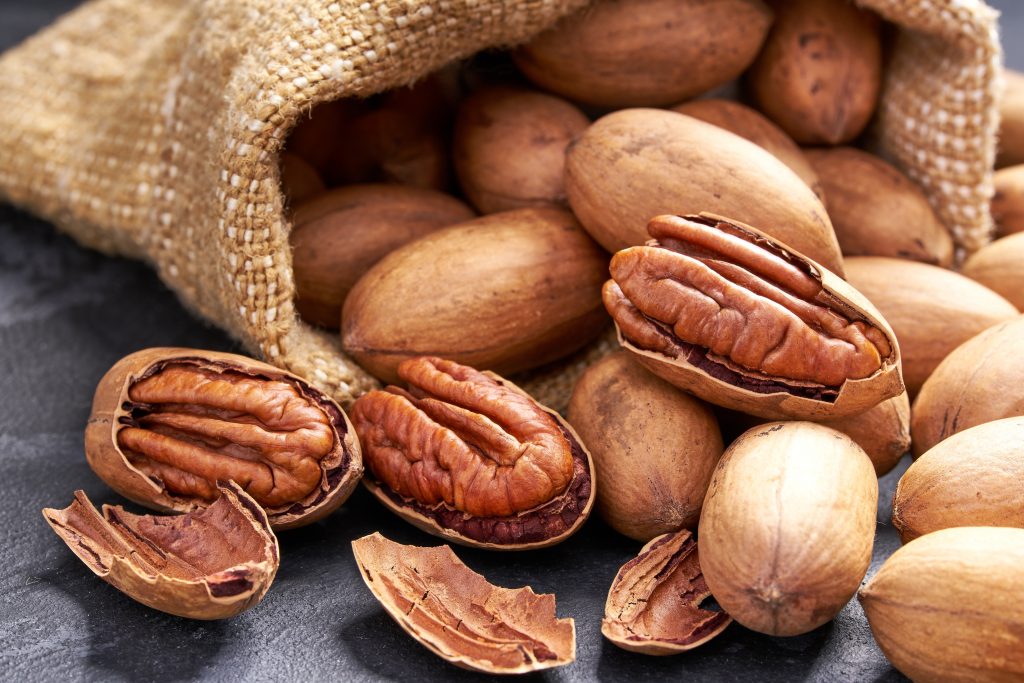
Pecans appear to be in good shape right now, thanks to light scab disease pressure.
By Clint Thompson
It is only May, but University of Georgia Extension pecan specialist Lenny Wells is optimistic about this year’s crop.
“It looks great right now as far as crop load and the light disease pressure. Everything’s pretty clean. Everything looks great so far,” Wells said. “I just hope we can get them to harvest. We’ve got a long way to go. Hope we have a decent market when we get there.”
The relatively dry weather throughout for most of the Southeast has also led to low scab disease pressure in pecan trees.
“It’s been pretty light, been really light here since we got started spraying back in April,” Wells said. “So far, pressure has been very light, and I haven’t seen much problem at all with scab.
“Early in the spring, it stayed cool a good while and that probably helped some too. But yeah dry weather more than anything. And when we have had rains, they were quick rains. It may have rained one day and then it cleared out and we’d have sunshine and wind several days to a week and then get another rain.”
What is Scab?
Scab is a fungal disease that infects the leaves or nuts of pecan trees. If it hits the nut early enough, scab can cause the pecan to blacken and fall from the tree. Some growers spray between 10 and 12 times during an average year to fight scab, Wells said. Scab thrives on trees that have received moisture. That is why a quick rain event is important and not prolonged rainy weather of several days in a row.
“If we have rain events that kind of move in and out, those don’t cause us much problems. But it’s where we have these long sustained several days in a row of rain, that’s really when scab will get going,” Wells said.
As part of the Georgia Department of Agriculture’s (GDA) “Buy Georgia Grown, Now More Than Ever” campaign, Georgia Grown is partnering with local governments to connect produce farmers directly to consumers in highly populated areas. Georgia Grown To-Go is a series of pop-up markets, primarily in metro Atlanta, that will give customers an opportunity to purchase fresh produce directly from farmers with limited contact, drive-through service.
Black
“We are excited to offer this great opportunity to help bridge the gap between consumers in metro areas and our farmers in South Georgia,” says Georgia Agriculture Commissioner Gary W. Black. “With foodservice channels limited, Georgia Grown To-Go pop-up markets are a great and innovative way to make sure our consumers have access to the Georgia Grown products they crave. We have enjoyed joining forces with our local government and non-profit partners in an effort to best serve our communities during this unprecedented time.”
After testing the markets in Northwest Georgia and Dekalb County, Georgia Grown To-Go is continuing in different communities statewide. The next pop-up style market is in partnership with the City of Marietta, Cobb County Government, Cobb Chamber of Commerce and Cobb Community Foundation. The event is Saturday, May 23 from 10 a.m. to 2 p.m. at Al Bishop Park, 1082 Al Bishop Dr. SW Marietta, Georgia 30008.
“Cobb County is pleased to welcome the opportunity to buy Georgia Grown and giving our residents easy, direct access to the best of fresh farm vegetables, Georgia grown,” says Marietta Mayor Steve Tumlin. “We are bringing the best in farm harvest direct from the farm to our front porch with Marietta’s own Tip Top Poultry as a participant in this pop-up market. Additionally, our charities will be well supported thanks to Cobb neighbors who have the opportunity to make Georgia Grown available to our local food banks during these challenging times.”
While supplies last, customers can drive through and have produces boxes placed directly in their trunks. For payment, cash, credit and debit cards will be accepted. Customers can also pre-order boxes for a reduced rate until Thursday, May 21 at noon.
In addition to purchasing personal boxes, customers can support their local community by donating boxes to a neighbor or local charity. Several nonprofits will receive produce boxes through the Cobb Community Foundation, including MUST Ministries, Sweetwater Mission, Family Life Restoration Center, Reflections of Trinity, Storehouse Ministries, and Noonday.
Following the Cobb County event, more Georgia Grown To-Go events will be announced.
For more information on produce offerings, pricing and upcoming events, please visit www.GeorgiaGrownTo-Go.com.
South Carolina’s produce season is producing sweet results with its farmers. Clemson Extension Commercial Horticulture agent Justin Ballew said fruit and vegetable farmers in the Palmetto State are enjoying a strong spring season so far.
Strawberry season has been really strong in South Carolina this year.
“For the most part, we’re having a good spring. We’re in the last month of strawberry season and we’ve had a decent strawberry season for the most part. Demand has been really good this year. Folks are selling everything they pick with no problems at all,” Ballew said. “Other crops, we’ve got stuff growing pretty quickly, growing pretty well. Disease pressure has been low for the most part this year. Insect pressure hasn’t been terrible. We’re doing pretty well as far as growth.”
And with one exception, growers have experienced little problem with Mother Nature.
“The only weather-related issues we’ve had recently was from hail damage in … Chesterfield County, that area. They had some pretty tremendous damage to their peach crop up there, some strawberries and other stuff. There was one large grower up there that was affected pretty badly,” Ballew said. “There were some thunderstorms that came through and dumped a bunch of hail up there.”
A tour of the research vineyard at the Clanton Research and Extension Center in Chilton County at the Alabama WIneries and Grape Growers Association meeting in September 2019. Grapes are grown by Elina Coneva and the staff at the CREC. Grape varieties are developed by Dr. Andy Walker, a grape breeder at UC Davis.
By Clint Thompson
The time is now for grape producers to tissue sample their crop, says Phil Brannen, University of Georgia Cooperative Extension fruit disease specialist. In doing so, growers can make any modifications to impact this year’s crop.
“If you go ahead and get the sample now, you can do something about it. You can actually impact this year’s crop,” Brannen said. “If you wait until the (veraison) which is when the grapes start turning color, which is the other time you can sample, that is much less meaningful for this year. It may indicate more with what you need to think about with fertilization for the following year. For right now, you can get information on what you put out in the way of micronutrients or macronutrients to impact this year’s crop.
“(Tissue sampling) gives you a really good idea about what’s going on, specifically in the tissues of the plant. It’s a better indicator than even a soil sample would be, of what you actually need. You still need to get soil samples. I’m not saying don’t get them. But the tissue samples are much more valuable to you.”
How To Sample
Brannen said the tissue samples can be taken from the petioles or the leaf itself. For wine grapes, vinefera grapes and hybrid grapes, take petiole samples. For muscadine producers, you need to sample from the leaves.
“Generally, you don’t want to take more than two per plant. You want to do it randomly throughout a vineyard. You’re really talking about a single block, so it would be one variety that you would sample,” Brannen said. “You can’t really go across different varieties and get a good understanding. Each sample has to be a variety within a specific area. That could be up to about 10 acres for a sample.”
Brannen estimates that a total of 50 to 75 petiole samples is needed.
Grapes will be harvested in early August through September.