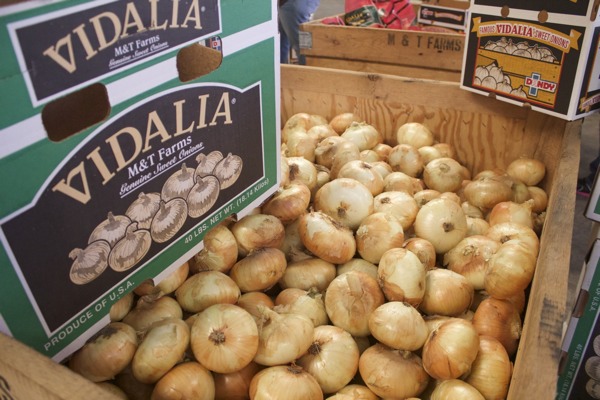
Photo courtesy of M & T Farms, Lyons, GA, and Vidalia Onions.com
University of Georgia Cooperative Extension will host the Vidalia Onion Field Day this year on Thursday, April 8, beginning at 10:30 a.m. It will be held outside and conclude at noon.
There will be a walking tour of the research plots at the Vidalia Onion and Vegetable Research Center in Lyons, Georgia.
A survey aimed to gauge impact of the coronavirus pandemic on the food supply chain will close on April 11.
A research team from various institutions, including the University of Florida aims to assess the impact of the pandemic on food and agricultural systems and to develop strategies for coping with future crises. The project is funded by the U.S. Department of Agriculture’s Agriculture and Food Research Initiative (USDA-AFRI).
The UF/IFAS Economic Impact Analysis program, which Court directs, conducted similar, short-term surveys of Florida businesses last year as impacts evolved along with the pandemic. Information from these efforts can be found on the program’s Disaster Impact Analysis webpage and will continue to be updated.
Feb. 11, 2021 could be a date that lives in infamy for Florida’s vegetable and specialty crop growers. At least that’s the way Mike Joyner views the U.S. International Trade Commission’s (USITC) unanimous verdict regarding blueberry imports.
“As a result of that 5-0 ruling, I would completely agree with you, it was a gut punch for our growers,” said Joyner, president of the Florida Fruit and Vegetable Association (FFVA). The five USITC members voted on the Section 201 investigation into serious injury regarding blueberry imports. It deemed that imports of fresh, chilled or frozen blueberries are not a serious injury to the domestic industry.
Joyner
Joyner worries what the ramifications like that ruling can have on other commodities that Mexico exports.
“One of the biggest concerns we had before the blueberry 201 vote was that if we lose, it’s a green light to unfair imports. We’re seeing that,” Joyner said.
Imports from countries are overflowing markets with various commodities, including strawberries, blueberries, squash and cucumbers.
“I worry that as a country, a decision is going to be made, whether it’s intentional or unintentional, that we’re okay to rely on foreign produce during certain times of the year. I personally think that’s a bad public policy. But if it keeps going like it’s going, that’s what’s going to happen,” Joyner said. “These winter months where Florida feeds the U.S., if it keeps going like it’s going, we’re going to be relying on foreign imports to feed the U.S. I just don’t think that’s good public policy.”
New U.S. Trade Representative
The fight continues for Florida farmers who are hoping Katherine Tai, the new U.S. Trade Representative, will become a much-needed ally.
“We’re going to continue to work with Ambassador Tai. I can tell you that the Florida delegation which has just been so solid on this issue. Senators (Marco) Rubio and (Rick) Scott both interviewed her individually as she was being confirmed. She understands this issue, she knows it,” Joyner said. “She made no commitments but we’re hoping Ambassador Katherine Tai will take this issue on and make it a priority.”
Joyner and Florida farmers will have another chance to voice their concerns during a virtual hearing with the USITC on Thursday, April 8. It will focus on imports of cucumbers and squash on seasonal markets.
“Our growers like Paul Allen have said so many times, it’s a national security issue. They’ll argue every day it’s a national security issue,” Joyner said. “It is a national security issue; food security, national security.”
A fully mature cluster of black-skinned muscadine grapes
The newly formed Georgia Agriculture Commodity Commission for Wine and Grapes will hold its first meeting on Friday, April 16 at 10:30 a.m. at the Atlanta Farmers Market in Forest Park, Georgia. The meeting will be in the Administration Building of the Georgia State Farmers Market (enter from the market side). The address for the meeting is 16 Forest Parkway, Forest Park, 30297.
The meeting’s purpose is to elect a chair and vice-chair from the commission members appointed earlier this year by the Commodity Commission Ex Officio Committee. The meeting’s agenda will also be to discuss operations and guidelines of a Georgia Agriculture Commodity Commission, as well as the marketing orders and assessments and how to implement them.
The Georgia Wine and Grape Commission was created by the Georgia General Assembly in 2020 at the request of Georgia wine and grape producers.
Social distancing guidelines and masks are encouraged.
For more information, please contact:
Andy Harrison Manager, Commodity Commissions Georgia Department of Agriculture Andy.harrison@agr.georgia.gov (404) 710-1196
What began as a sour start to Florida’s strawberry season is ending with a sweet finish, says Matt Parke, farm manager of Parkesdale Farms in Plant City, Florida.
Parke said he wasn’t getting the desired volume before Valentine’s Day. Then it started and hasn’t stopped since.
“I think it’s going to end up being a bumper deal for us. We started off real slow, and I thought our averages were going to be low,” Parke said. “It could be spotty for a grower, just depends on what varieties you planted and what kind of volume you got. It’d be hard for me to say anybody had a bad deal unless they had a big problem with disease,” Parke said.
The main disease was Neopestalotiopsis Fruit Rot, which still took its toll on Florida’s strawberry crop. Even Parke had throw away about 400 flats to the acre during one harvest.
“Regardless of that, I almost matched last year on volume,” Parke said. “I would say this year was a good season as well. For us and the growers I know, everybody’s had a pretty good deal.”
Even more remarkable than the turnaround in volume was the consistent market prices that growers like Parke capitalized on.
“Between Mexico, Florida and California, we were picking 1.5 million (flats) a day and still had an $8 to $10 a deal. That’s weird,” Parke said. “Normally when you pick 1.5 in a deal, you’re looking at a $3 to $4 market. I can tell you on the streets, they were $3 to $4. But if you had a good retail business, you were still getting your $8 and $10.
“Normally, when you think about a market, if you want to hold a market, you don’t want to go for a million flats a day. That’s nationwide. You don’t want to be over a million flats; eight million pounds of fruit a day.”
A coffee plant in a pot in a greenhouse. The red berries contain coffee beans. Photo by Juan Giuliani.
University of Florida/IFAS research hopes to yield a new crop for Florida producers.
Though it is not likely to be ready for farmers for years, coffee is a potential commodity that the state’s growers could utilize one day.
“It’s really outside the box. Often times we’ll start researching a crop, but growers have already started trying to produce it. This one is likely to be farther off into the future because coffee requires those low temperatures for good quality. It’s going to take a bigger lift to identify varietals that would produce good quality in Florida,” said Diane Rowland, chair of the agronomy department and UF/IFAS’ research lead on the project. “It may even become a controlled condition production where maybe we’re in greenhouses or we’re in hoop houses. There’s so many questions on the table. That’s what makes this one particular challenging.”
One pleasant surprise in this project that is still in its infancy is how quickly the plant flowers.
“We brought it into the greenhouse and started to see that it flower, and it produced very, very quickly. That was a surprise. Normally it would take a couple of years in the field for it to become established and to start to produce,” Rowland said. “Almost immediately we saw flowering and some production of berries. That led to the option of exploring, would it be economically feasible under controlled agricultural conditions? That’s one of the questions we’re going to start to explore.”
Unique Plant
Coffee is a unique plant in that it needs temperatures that are low enough but not too low. If it is hit with a frost, it will die. The research team is growing Arabica coffee. It is the most commonly grown variety around the world and the most valuable one on the market.
UF/IFAS is also utilizing artificial intelligence (AI) in its research. Researchers are using minirhizotrons, or clear plastic tubes with tiny cameras inside. These devices are placed underground to record images of the plants’ roots.
“The roots are essential for water and nutrient uptake. The more we understand about where the roots are in the soil, that helps us determine part of the health of the plant itself. The way this camera is set up, we can go back and look at the same place on the roots over time. Normally you would have to dig up, collect soil cores or whatever, to get the roots out,” Rowland said. “This is non-destructive, so we can go back to the same root and see if it’s still alive.”
Another Potential Crop?
One of the main reasons for pursuing a research project like this is it could provide Florida producers another tool in the cropping toolbox. With a climate conducive to various crops, growers like to have options to choose from when deciding what to plant every year.
“I think it’s part of the benefit and part of the detriment of living in Florida. We’ve got these great growing conditions which makes a lot of crops possible. But we also have a lot of issues we have to deal with, from invasive species to diseases to insects. We’ve got climate change. We’ve got changing rainfall patterns, storms, all of those things,” Rowland said. “It makes it important for us to have a diversified agricultural system, too. It’s more sustainable, certainly more economically sustainable for a producer. I think our goal in IFAS is to make sure we provide as many as those opportunities that we can.”
Photo by Clint Thompson/Shows farmer Dick Minor talking with U.S. Congressman Sanford Bishop and Senator Raphael Warnock.
The two issues Southeast vegetable and specialty crop producers want and need assistance with the most are labor and imports. Georgia farmers and industry leaders made sure Senator Raphael Warnock heard their concerns on Wednesday.
The U.S. Senator visited South Georgia as part of a farm tour that stopped at Minor Brothers Farm in Leslie, Georgia. Along with Congressman Sanford Bishop, Warnock heard from producers about the impact that imports from Mexico are having on various commodities, including cucumbers and squash. Both crops are the focus of separate U.S. International Trade Commission Section 332 investigations that will be heard on April 8.
“The message is we still have issues we’ve got to deal with,” Georgia farmer Dick Minor said. “As they say, if you’re not at the table, you might be on the menu. We are constantly trying to get in front of our leaders and express what our issues. Today we’re going to talk mostly about labor and trade. Those are the two biggest issues in specialty crops.”
Labor Reform
The House has already passed the Farm Workforce Modernization Act, which offers reform to the current H-2A program. The bill has been sent to the Senate.
“Obviously, the H2A bill they have in front of Congress. We need to tweak those a little bit to help us,” Minor said. “The trade issues we’ve got with cucumbers and squash in front of the ITC that we’re going to try to get some help with Mexican imports that are coming in much cheaper than our products and affecting our markets. Those are the two main things we want to talk to him about today.”
Georgia farmer Bill Brim and Charles Hall, executive director of the Georgia Fruit and Vegetable Growers Association also spoke.
Warnock expressed a desire to learn more about the No. 1 industry in Georgia.
“I chose to be here to focus on agriculture. I hope that signals to you how important this issue is to me,” Warnock said. “I’m here to hear from you. You can’t represent folks without talking to them.”
South Florida bean producers continue to contend with Asian bean thrips (ABT) populations. According to the University of Florida/IFAS, populations vary from farm to farm and planting to planting.
In southeastern Hendry County, populations averaged 0.1 ABT per bud and 0.2 to 0.5 ABT per bloom. Even the older plantings had reached counts totaling 2.2 ABT per bloom. Because of record numbers in one field, the crop was disced due to low pod set and damage to pods.
In northeastern Hendry County, ABT populations totaled as high as 2.0 ABT per bloom and early pod development stages, while in the central part of the county, populations have declined and are now at 0.1 to 0.3 ABT per bud or bloom.
In eastern Palm Beach County, populations were 0.7 ABT per bloom or 0.5 ABT per plant, while in western Palm Beach County, hot spots remain with 1.0 to 2.0 ABT per plant bloom.
Sneap bean plantings are still young in southern Martin County. ABT has not been reported.
Beans were harvested and young peas were not scouted in northern Collier County.
Damage from high populations can happen at budding. Therefore, populations must be monitored earlier in the growth cycle. There is currently no research to support thresholds for management. Some scouts are using 1.0 to 3.0 ABT per bloom for reference.
Preventative Measures
Prevention is one of the main components of any Integrated Pest Management program. These measures include cultural control, like sanitation, utilizing resistant varieties, and establishing crop free periods. It is also important to eliminate alternate hosts.
In Homestead, this is a huge problem for snap bean growers, as there are many specialty legumes that are grown for ethnic markets scattered around the area providing year-round hosts for the Asian bean thrips.
In other snap bean producing areas such as Palm Beach and Hendry Counties, there are few cultivated hosts. Weeds become the source of inoculum from one season to the next. The fecundity (ability to produce an abundance of offspring) of the thrips on these weed hosts, combined with the amount of these weed hosts in a given region, determines the base population level of the pest. Reducing weed hosts is critical in reducing the base population of Asian bean thrips.
UGA CAES file photo/ Shows peach trees blooming in middle Georgia.
Georgia peach producers are eyeing the weather, as temperatures are expected to dip into the 30s later this week. It could impact this year’s crop.
Jeff Cook, University of Georgia Cooperative Extension Agriculture and Natural Resources agent for Peach and Taylor counties, said Georgia’s peach crop is post bloom on most everything with fruit forming on most of the varieties. They are susceptible to cold damage if temperatures drop considerably.
“When you get post bloom and the shucks gone, your flower’s gone and you’ve got exposed fruit, if frost forms on that fruit, then you’ll get damage,” Cook said. “It’s not always on every fruit, not every fruit’s exposed. I’ve never seen frost destroy a crop. We are more worried about getting down below 30 (degrees) for a few hours. That would be more of a killing type cold. Right now, I think forecasts are 32 to 34 depending on which one you look at. And then it’s going to vary, depending on the orchards.
“I tell everybody, most of the planning goes in way before the cold comes. You put the orchard in a place where that cold air’s going to (go) away and you’ve got warm air left behind. That’s what we always hope.”
Copper Applications
Cook also said there has been research done with copper applications and their impact in keeping frost from forming.
“There’s bacteria that will help take cold water and form ice. If you can spray copper, it’s been proven that it can help reduce ice formation,” Cook said.
Temperatures are expected to drop to 33 degrees Thursday night and Friday night, according to weather.com.
With the cold winter temperatures, peach trees across the Southeast received sufficient chilling hours. But now producers are hoping to avoid cold temperatures that could impact this year’s harvest.
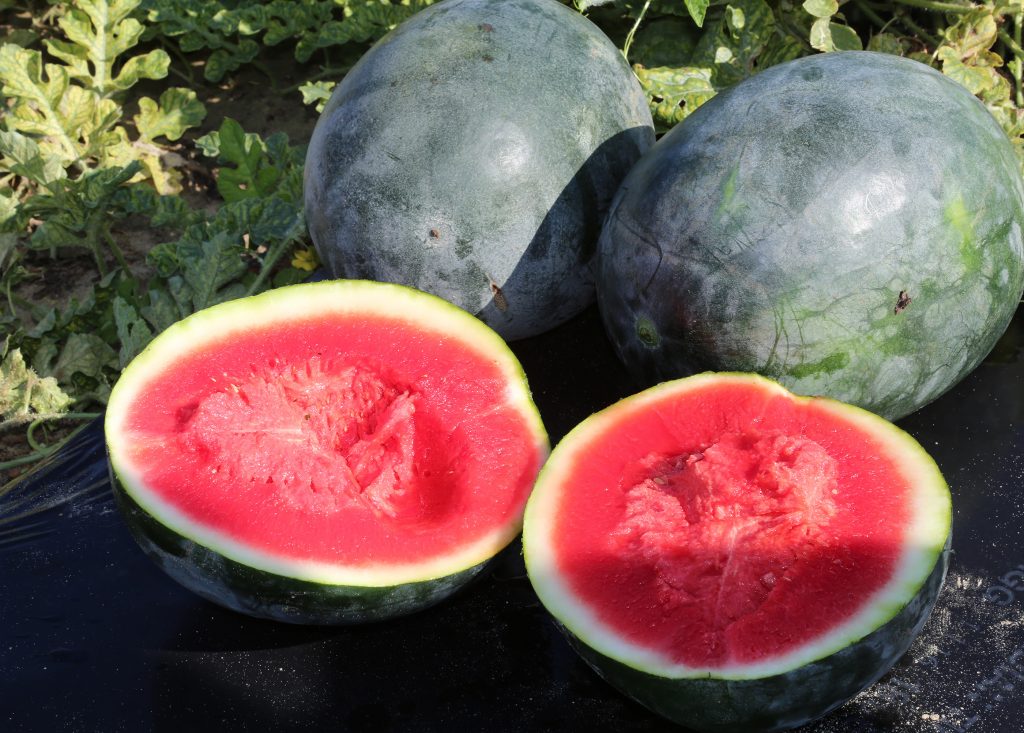
Watermelons on display at a farm on the UGA Tifton campus. Clint Thompson 6-14-19
Watermelon plantings are under way across the Southeast, but it’s never too early to start thinking about harvest. While maturity levels in seeded melons can be determined by thumping the melon or observing its appearance, seedless melons are not as simple.
Joe Kemble, Alabama Extension vegetable specialist, recommends producers to utilize a refractometer to determine the brix or sweetness levels of watermelons. The sweeter the watermelons, the closer they are to reaching full maturity or being fully ripe.
“If I’m a commercial watermelon grower, I want to have a brix meter in my back pocket. These brix meters are used to measure sweetness. If you happen to raise honeybees, there’s brix meters associated for measuring the sweetness of honey, the sugar content. They also sell them for wines and other beverages. You want one that can be used for agricultural purposes for fruit,” Kemble said.
Sweeter the Better
The sweeter the watermelons when they’re harvested, the better off the producer will be. Kemble said large grocery store chains desire watermelons at 10% brix or higher. A refractometer will help growers accurately determine if a watermelon is fully ripe instead of them just guessing.
“What this requires is to sacrifice a melon or two. You go out there and do your best guessing in terms of figuring out, how close are we to harvest? You harvest one or two that look likely candidates, cut them open, take some of the tissue from the center of the fruit and squeeze it on that plate on the refractometer. You’ll close the plate and hold it out towards the sun and look through it. There’s a gauge in it, and it will show the percent brix,” Kemble said.